
You are using an out of date browser. It may not display this or other websites correctly.
You should upgrade or use an alternative browser.
You should upgrade or use an alternative browser.
Threadmarks
View all 198 threadmarks
Reader mode
Reader mode
Recent threadmarks
Fowler road locomotive - chimney folded part 2 ( Diversion : herding sheep at Spetchbury Halt ) NER class H2 . . named as 'Quintus' . . at NEEGOG (9 May) ( Diversion : wheel flanges ) New . . battery endurance New NER class H2 . . charging New Manning, Wardle "Lady Marion" . . "Poover" battery and terminals New

RichardG
Western Thunderer
The last month has seen me build a lighting rig for Heybridge Basin but little modelling. This trend continued today by taking Lady Marion to the club track. A beautiful day here in Essex.
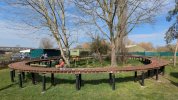
The garden railway was set out by a retired bridge engineer using a traditional theodolite and with assistants placing sticks in the ground.

The "baseboard" is so level, Lady Marion hauls eight wagons without difficulty. This is two more than she can manage at NEEGOG, which is a bit up and downy.

Lower level shot to lessen the impact of the track.
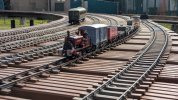
The MW manages a scale 15mph maximum (timed at home) and a lap here takes five minutes or so. Enough time to forget the train has passed before it reappears.
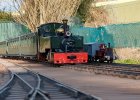
A frame from a video to illustrate "scale and gauge"

I wondered if my stock would pick up some real-world smuts to start the weathering but I've found only a blade of grass so far.
The Peco SM32 points are very good with Slater's FS 7mm wheels, yes there is a wheel drop at the crossings but the trains stay on the track. This is the first time I have brought my Heybridge Railway wagons here so I will call this successful test running as well as playing trains
The garden railway was set out by a retired bridge engineer using a traditional theodolite and with assistants placing sticks in the ground.
The "baseboard" is so level, Lady Marion hauls eight wagons without difficulty. This is two more than she can manage at NEEGOG, which is a bit up and downy.
Lower level shot to lessen the impact of the track.
The MW manages a scale 15mph maximum (timed at home) and a lap here takes five minutes or so. Enough time to forget the train has passed before it reappears.
A frame from a video to illustrate "scale and gauge"
I wondered if my stock would pick up some real-world smuts to start the weathering but I've found only a blade of grass so far.
The Peco SM32 points are very good with Slater's FS 7mm wheels, yes there is a wheel drop at the crossings but the trains stay on the track. This is the first time I have brought my Heybridge Railway wagons here so I will call this successful test running as well as playing trains
RichardG
Western Thunderer
I wish to unleash my inner pedant and, given this is my own workbench thread, I will. The RSU causes the generation of heat, it does not apply heat. So there!
View attachment 231660
I put this piece on with the RSU.
I tinned the strapping with 145 solder wire. The obvious overheating came about during the tinning not the application of the part. The main thing for me is, there is no solder running into the etched lines between the planks. Also I found this really easy to do, indeed the heat was so localised I held the part down with my fingers.
As an aside, we can see where I managed to burn through another piece of strapping near the corner of the window. This piece went on with the iron . . . I've since turned down the temperature.
I have some solder paste on order and I want to have a go with this after it arrives.
I have taken myself back to the LT&SR horsebox (Gladiator), with some more sessions with the RSU.
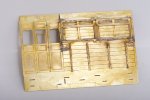
I am evolving a "method" by which I tin the strapping while it is still on the fret, using solder paint and the iron. Then apply solder paste to the bare body side using a cocktail stick. Finally fix the two together using the RSU.

I am finding the half-etched strapping and other detail parts rather intricate, a bit too intricate to be honest. However I do think I would not be able to build this kit without the borrowed RSU. It is difficult to judge a suitable amount of the solder paste, maybe there is a better way.

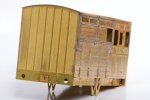
I have manipulated these photos to ephasise the solder, but at least things are fairly straight and neat. The paint will hide an awful lot of mistakes.
The second side is underway

RichardG
Western Thunderer
The rails provide a close but not perfect fit for the roof onto the body. I was thinking of magnets but I suspect Blue-Tak will do the job.
The instructions give me no clues as to how to fix the roof onto the model. If it was a van I would solder it on, but I want to put some detail inside the groom's compartment. I guess this is feasible going in through the floor area, but very awkward. So the roof must be detachable.
The first attempt used large blobs of tacky wax, one near each corner. To be honest this worked really well, and after five hours it had set firmly. But somehow I wanted a more "engineered" approach.
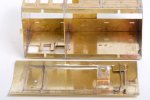
So I cut four slots into the cant rails, and fixed two lengths of piano wire across the roof. The ends of the piano wire drop into the slots, and the roof slides along to lock everything into place. I put an end stop at one end of the roof, this meets up with the end of the horse space.
The wire at the horse end is stiff and un-springy and holds the roof down. The wire at the groom's end is thinner and springy and provides some friction. This is all of my own invention but I usually find such arrangements are either standard practice or more likely a bastardisation of a standard practice. Anyway, it seems to work. I expect I will still end up with a dab of the wax at the end stop.
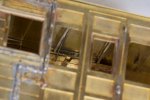
I have an idea, the ribs made out of rail will look a bit like the ribs under a real roof, though really this is by luck not design. The locations of the ribs look about right, though they are not based on a prototype.

Here is the roof located into place with its bits of piano wire. I am a bit suprised how well this has worked. It the fit is a little sloppy I will call this leaving room for the paint. I think it will be just right after painting.
Last edited:

Osgood
Western Thunderer
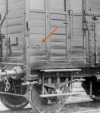
I looked at the prototype expecting to see something like a dog kennel hatch, but can only see this detail?...
The prototype has a rectangular panel on the outside of the groom’s compartment, roughly level with the seat cushion. I don’t know what this panel is for, or even whether there was one on both sides. Pretty much all of the details of this vehicle appear on both sides, so I put a panel onto both sides.
RichardG
Western Thunderer
I have mentioned the lack of a floor a few times. This is why . . .
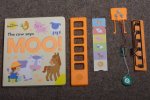
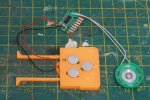

The resistor across the input terminals fulfils the role of the conductive material (carbon?) printed on the switch flexi.
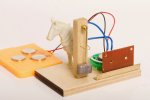
Pendulum switch.
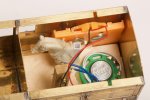
Easy drop-in installation. There is a large hole in the plywood base underneath the loudspeaker.
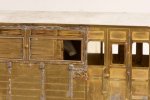
What I see when the roof is on.
At the moment, the pendulum switch trips when I pick up the model, but not during a rough shunt. Maybe this will turn out to be wise in the overall scheme of things
The resistor across the input terminals fulfils the role of the conductive material (carbon?) printed on the switch flexi.
Pendulum switch.
Easy drop-in installation. There is a large hole in the plywood base underneath the loudspeaker.
What I see when the roof is on.
At the moment, the pendulum switch trips when I pick up the model, but not during a rough shunt. Maybe this will turn out to be wise in the overall scheme of things
RichardG
Western Thunderer
We got talking about RSUs at last month's NEEGOG, and a member of the group has given me a piece of armour plate to make a work surface. It is strange what people have tucked away, I didn't ask how/why they had come by it.

I have cleaned up both sides (power sander), painted the underneath and added four feet. This is mild steel sheet c. 6 mm thick with four neatly-rounded corners.

The stud is M4 to match my lug connectors, the hole is M5 in case I need something more robust.
I have given this a trial run and I know it is going to work
I have cleaned up both sides (power sander), painted the underneath and added four feet. This is mild steel sheet c. 6 mm thick with four neatly-rounded corners.
The stud is M4 to match my lug connectors, the hole is M5 in case I need something more robust.
I have given this a trial run and I know it is going to work
RichardG
Western Thunderer
I have started the painting of the LT&SR horse box with the primer, the roof and the interior.
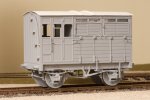
It is good to see what the model really looks like without being distracted by the patches of tinning and discoloured brass. I am actually very happy with this.
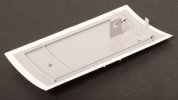
I painted the underneath of the roof because bare brass looks so tired after it tarnishes. The tissue is now off-white.
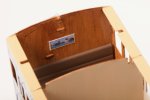
I have no idea what the inside of the groom’s compartment looked like. I suppose the walls would be painted or varnished wood; I went for the varnished look as a practice piece for the outside.
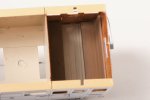
The seats are from Slater's and the floor is embossed styrene. The picture is from Connoisseur Models.
The varnished wood effect is Ronseal teak-coloured varnish brushed over Tamiya XF-15 "Flat Flesh". I did some test patches of the varnish over different underlying paint colours and this is the only one I liked. The Tamiya version of flesh is like a peach colour, the others e.g. Vallejo are paler and more yellowy. There are five really thin coats of the varnish, I painted them on as slowly and carefully as I could manage and the streaks appeared naturally as it dried.
It is good to see what the model really looks like without being distracted by the patches of tinning and discoloured brass. I am actually very happy with this.
I painted the underneath of the roof because bare brass looks so tired after it tarnishes. The tissue is now off-white.
I have no idea what the inside of the groom’s compartment looked like. I suppose the walls would be painted or varnished wood; I went for the varnished look as a practice piece for the outside.
The seats are from Slater's and the floor is embossed styrene. The picture is from Connoisseur Models.
The varnished wood effect is Ronseal teak-coloured varnish brushed over Tamiya XF-15 "Flat Flesh". I did some test patches of the varnish over different underlying paint colours and this is the only one I liked. The Tamiya version of flesh is like a peach colour, the others e.g. Vallejo are paler and more yellowy. There are five really thin coats of the varnish, I painted them on as slowly and carefully as I could manage and the streaks appeared naturally as it dried.
RichardG
Western Thunderer
Today is my third anniversary on WT. The Heybridge Railway has been underway a bit longer, since the autumn of 2021. I have promised myself a break until next weekend (Kempton) in which to decide what to do next.

The wagons belonging to the railway are pretty much all there. Three for customer’s freight and four for service use. This is about the minimum I can get away with.
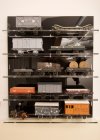
The collection of foreign wagons is looking balanced too. The unpainted van is GER, so there are five GER and seven from further afield. These are a mixture of builds by me and others, plus the Minerva mink. The NER Lomac is only useful for the dismantling of the railway in 1913.
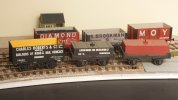
Conversely the PO wagons are still struggling. Most of these are a fiction in one way or another. I am much happier with my own inventions than those devised by the large manufacturers. Certainly the compact tar wagon will stay, but it would be good to replace some of the others with models of real wagons. Eventually, as I find suitable kits and models.
The main omission is something belonging to E H Bentall, and of course these will be fictional too. I bought the Chas Roberts demonstrator (Tower Models) as a quick fix but it doesn’t quite work. I have some plastic kits to do the Bentall wagons, but I am having a bit of a Brass Phase at the moment and I want to try out my RSU again. Kempton may of course change things again!
Thank you of course to everyone for your continued support. This and the facility to share my efforts on WT does help to drive me along
The wagons belonging to the railway are pretty much all there. Three for customer’s freight and four for service use. This is about the minimum I can get away with.
The collection of foreign wagons is looking balanced too. The unpainted van is GER, so there are five GER and seven from further afield. These are a mixture of builds by me and others, plus the Minerva mink. The NER Lomac is only useful for the dismantling of the railway in 1913.
Conversely the PO wagons are still struggling. Most of these are a fiction in one way or another. I am much happier with my own inventions than those devised by the large manufacturers. Certainly the compact tar wagon will stay, but it would be good to replace some of the others with models of real wagons. Eventually, as I find suitable kits and models.
The main omission is something belonging to E H Bentall, and of course these will be fictional too. I bought the Chas Roberts demonstrator (Tower Models) as a quick fix but it doesn’t quite work. I have some plastic kits to do the Bentall wagons, but I am having a bit of a Brass Phase at the moment and I want to try out my RSU again. Kempton may of course change things again!
Thank you of course to everyone for your continued support. This and the facility to share my efforts on WT does help to drive me along
RichardG
Western Thunderer
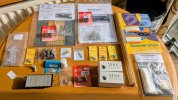
The spoils of Kempton.
I sold two RTR wagons on the bring and buy, and since the last show here I have completed three kits. So by buying four kits and a built model, I am still arithmetically in balance

The highlights are the built LSWR wagon, bought for less than the cost of its wheels and buffers; the unidentified wagon; and a really bored-looking figure to represent the groom for the horse box.
I saw a few WT'ers. There was an alcove with two or three pro model makers, I guess this is the real naughty step? I have never enjoyed a show quite as much as this one.
RichardG
Western Thunderer
I don't know, RTR barrels - I mean, whatever next?
Perhaps, “ready to restore”?
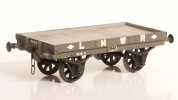
I found this rather lovely but neglected wagon at Kempton on Saturday, within the Epson and Ewell MRC estate sale. The model was built by Douglas Thomas.
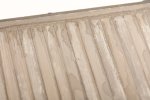
The model seems to have been stored in a wet place.
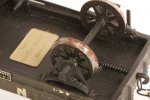
Possibly in standing water.
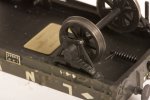
Wheel cleaning was in stages:
- Chemical cleaning using Birchwood Casey's ‘Blue and Rust Remover’
- Abrasive work with wet and dry paper used wet
- Polish with a small flap wheel
- Chemical bluing using Birchwood Casey’s ‘Perma Blue’ and then buffing
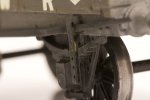
The blob of glue(?) inside the brake guide is a clever touch. It makes the brake guide really sturdy.
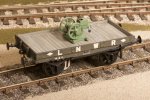
A little repainting on the floor and to hide minor chips.
The wagon sits flat on the track and runs well.
This was the heaviest rusting I have tried to remove from Slater’s wheels. There are a few dark spot marks I couldn’t shift but these have vanished under the bluing.
RichardG
Western Thunderer
I think the railway will find a simple trolley useful for tools or perhaps a stationary engine.
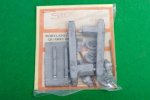
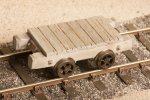
This kit is for a Portland stone quarry block wagon. It is my first kit by ABS Models.
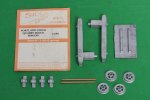
Simplicity means no instructions.

Initial assembly with epoxy glue.
The kit axles are a soft wire coated with copper and I found them difficult to work with, so I am using brass instead.

The bearing clamps fell off too easily so I soldered them on, though the solder hardly shows now. I added the brass plate to neaten things up and make a space for a label.
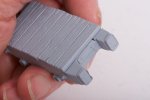
Adrian Swain was certainly a master caster . . . I haven’t done any cleaning-up here except to dress some of the sharpest edges.
The idea was to make a simple static model for display. I turned the wheels to a better profile but a piece of flange fell off. Then it dawned on me, I could never leave the model on the track unless I was running a battery loco. So I am now waiting for some 00 wheels, see if I can make a working model.
This kit is for a Portland stone quarry block wagon. It is my first kit by ABS Models.
Simplicity means no instructions.
Initial assembly with epoxy glue.
The kit axles are a soft wire coated with copper and I found them difficult to work with, so I am using brass instead.
The bearing clamps fell off too easily so I soldered them on, though the solder hardly shows now. I added the brass plate to neaten things up and make a space for a label.
Adrian Swain was certainly a master caster . . . I haven’t done any cleaning-up here except to dress some of the sharpest edges.
The idea was to make a simple static model for display. I turned the wheels to a better profile but a piece of flange fell off. Then it dawned on me, I could never leave the model on the track unless I was running a battery loco. So I am now waiting for some 00 wheels, see if I can make a working model.
RichardG
Western Thunderer
I took some of my 'foreign' wagons and the new trolley along to NEEGOG this morning.
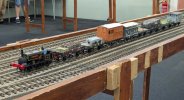
Everything ran perfectly although the horsebox batteries had run out so no sound effects. Probably a good thing, this really does need an on/off switch. This was the first visit here for the horsebox, the LNWR open and the trolley.
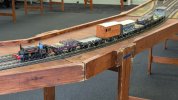
A train of eight or so wagons looks the part for how I want to portray the Heybridge and Langford Light Railway.
I have five more foreign wagons for the period. So choosing seven from thirteen gives about 1,700 possible trains, rather more if they have only five or six wagons.

I couldn't propel the trolley but it tagged along without problems. It ran through Peco pointwork at a modest speed so I think it will work out fine on the layout at home.
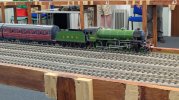
Finally a gratuitous B1 which seemed worth photgraphing.
This was my first visit to NEEGOG since we lost Martin Long and I think it was a good session for everyone.
Everything ran perfectly although the horsebox batteries had run out so no sound effects. Probably a good thing, this really does need an on/off switch. This was the first visit here for the horsebox, the LNWR open and the trolley.
A train of eight or so wagons looks the part for how I want to portray the Heybridge and Langford Light Railway.
I have five more foreign wagons for the period. So choosing seven from thirteen gives about 1,700 possible trains, rather more if they have only five or six wagons.
I couldn't propel the trolley but it tagged along without problems. It ran through Peco pointwork at a modest speed so I think it will work out fine on the layout at home.
Finally a gratuitous B1 which seemed worth photgraphing.
This was my first visit to NEEGOG since we lost Martin Long and I think it was a good session for everyone.
RichardG
Western Thunderer
I think staying away from the maths might be my next step on a lovely Sunday morning too!
I want to stay away from maths altogether!
I have wanted to build the early GER ballast wagon (diagram 39) from Ragstone Models for a while but I couldn’t see a decent excuse to include the model in the project. The LT&SR horsebox has rather changed my outlook, because this was built to a GER design. It therefore seems fair to suppose that someone (even the GER themselves) could have supplied ballast wagons of the GER design to the Heybridge Railway.

The kit seems very reasonably priced, but then again it provides just eight castings, some styrene to make the floor, and two couplings. The castings for the axle guards are really crisp and need hardly any cleaning up; conversely the long sides are distorted and need work.
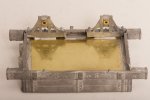
I have built the model around a new floor of 0.25 mm brass. There are so many different angles involved here I cannot comprehend how anyone could build the model with just the cosmetic styrene floor.
To begin I soldered the sides along just the edges of the floor and not up into the corners. I have minor errors along the solebars (they are spayed outwards about one or two degrees) and a fairly tight arrangement of the four corners of the sides.
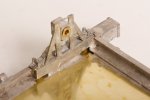
Then I twisted the ends of the sole bars (the dumb buffers) into their final alignment and soldered up the corners.

With the soldering confined to the areas near the floor, the sides look as though they can drop. The lack of a physical connection at the corners also means I could curve the long sides outwards so they look a bit more natural. Three of the four latches for the doors broke off during assembly and I cut the fourth one off for completeness.
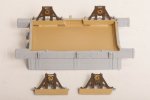
I am going to try to paint this model before I add the wheelsets, see how I get on. I have started with the easy bits.
As someone who craves right angles and straight lines in their models I have found this build to be a bit of a challenge. I spent a lot of time fettling and trying to straighten the sides but however hard I tried I could not get things to align completely to build a wagon in ex-works condition. This is probably a good thing and the wagon with its curving sides now looks a bit "used". I have learnt rather a lot here, more than the photos show.
RichardG
Western Thunderer
Staying with the permanent way theme I have a kit from ABS to build a platelayer's trolley, a simple hand-propelled one.
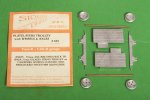
Building the kit should be straightforward (as long as I don't ruin a wheel trying to dress it) but the instructions are not making much sense:
"Stand trolley on two sleepers, wheels chained and padlocked together alongside".
I guess the sleepers are to reduce damage to the wheel flanges and could be any suitable timbers; but what is alongside what?
Building the kit should be straightforward (as long as I don't ruin a wheel trying to dress it) but the instructions are not making much sense:
"Stand trolley on two sleepers, wheels chained and padlocked together alongside".
I guess the sleepers are to reduce damage to the wheel flanges and could be any suitable timbers; but what is alongside what?
RichardG
Western Thunderer
I have had a go at painting the quarry block wagon. I am sure I have chosen a period with more than its fair share of unpainted wood.
The small black line on the buffer is a trick of the light, it isn't there on the model.
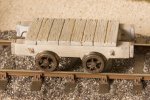
I didn't see the wood grain detail in the solebars until I looked at these photos.
I am actually quite pleased with this effort but I still want to get better at doing old and weathered wood. However much I look at examples I usually see a little brown in there, if not very much. Hopefuly I can look back on this in a few year's time and see I have got better.
RichardG
Western Thunderer
View attachment 243002
I have not fitted a sail but I have added some wheels. These are Alan Gibson Lomac wheels with bushes cut from styrene tube to hold them onto the kit axles. Obviously the spoke count is wrong but if I cut out alternate spokes I will have four which is still wrong.
It is good to have something I can roll along the track to amuse myself, but the 3DP wheels by @simond (here) do withstand a longer look.
Early this month I received a message from @simond telling me a wee envelope was on its way to me, and to enjoy it.

I was rather hoping it would be a set of wheels for my ABS Sidelines PW trolley, so you can imagine my delight when it arrived and I saw it contained not only these wheels but the prints to make up two more trolleys as well.
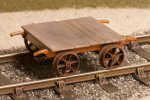
This is my ABS trolley (white metal) with its new wheels.
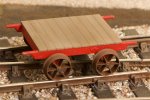
One of the printed trolleys has straight handles. I have painted this one in the style of the one at Bideford. Somehow I imagine this one bedecked with a spotless table cloth and all laid out with tea and cakes for dignitaries. For some special event still gestating inside me.

The second printed trolley has curved handles like my first one. I am keeping this one in primer for the time being. I have set it aside to go with a future project.
The rusted iron colours are a mix of Vallejo 'Smoke' and ‘Red Leather’.
RichardG
Western Thunderer
View attachment 167785
One final photo of Nellie to show the subassemblies I mentioned in post 235.
The pivot pin ended up being soldered solid onto the base for the crane, apart from this little changed from how I saw things then. This is as far as the model can be dismantled, apart from changing the wheels or motor or similar.
I have used BA screws to attach the chassis to the body and a metric screw for the trailing axle. They look quite similar at a glance. I would rather not do this again, I need to buy a few BA taps.
I have soldered the two rear sand pipes onto the body. I won't do this again either, they leave the body needing blocks of wood or similar to stand it on the workbench. Some brackets on the chassis would be better.
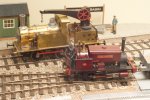
I have returned to my crane tank ‘Nellie’ to make some minor changes to the chassis and to tackle the painting. It is over three years since I built the loco and even I am fed up with the sight of the unpainted brass.
The idea is to tackle three weaknesses in the build:
- The plunger pickups work but they always look as though they are the brink of failure.
- The loco runs well enough but rather noisily. I attribute the noise to having the gearbox frame soldered firmly into the chassis as if it were a frame spacer.
- I never soldered the brake gear into the chassis, it has always been free to slide from side to side.
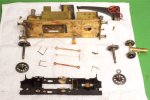 I bought the face flannel to use as padding around a fragile model in a sandwich box, but it holds small parts well so they can go back into their original locations.
I removed the original gear box by slicing through it with a cutting disc, you can see where it was held at the axle bushes and along the tops of the frames.
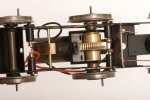
The new plunger pickups are from Premier Components. They are gently sprung but the springs are strong enough to overcome any tensions in the 7/0.1 wires connecting them to the motor.

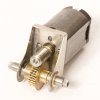
The replacement motor/gearbox is this single-stage unit from MSC Models.
The only structural addition to the chassis is this length of brass rod going across between the frames. After some experimentation I have decided to leave the motor/gearbox floating, i.e. it is pivotting around the driven axle. When the loco is going forwards, the torque reaction lifts the assembly as it appears here. When the loco is going backwards, the motor drops to rest on the wooden wedge.
I took the MSC gearbox from a future project so I have assembled the original motor and gears onto a fold-up gearbox to compensate.
Jim Mcgeown (Connoisseur Models) offers two styles of fold-up gearbox: a wide version, designed to be soldered into the frames (like the one I cut out), and a narrow version, designed to make a floating motor/gearbox. For the narrow version, the modeller is left to make arrangements to hold the assembly in alignment on the axle. I used a 0.25 mm shim washer (left) and a slightly shortened Slater's axle bush (right).
The "Jim" gearbox has a big advantage over the MSC one in that you can reach the screws holding the motor without taking out the worm gear. This makes setting up the meshing a lot easier.
This axle is also borrowed from the future loco. I wonder if I will remember where it is when the time comes.
RichardG
Western Thunderer
I took the MSC gearbox [for Nellie] from a future project so I have assembled the original motor and gears onto a fold-up gearbox [from Nellie] to compensate.
Jim Mcgeown (Connoisseur Models) offers two styles of fold-up gearbox: a wide version, designed to be soldered into the frames (like the one I cut out), and a narrow version, designed to make a floating motor/gearbox. For the narrow version, the modeller is left to make arrangements to hold the assembly in alignment on the axle. I used a 0.25 mm shim washer (left) and a slightly shortened Slater's axle bush (right).
The "Jim" gearbox has a big advantage over the MSC one in that you can reach the screws holding the motor without taking out the worm gear. This makes setting up the meshing a lot easier.
Sometimes it is nice to do a simple upgrade during a few hours. Especially when the upgrade makes a tangible improvement. Such was the new motor/gearbox in my GER Y14.
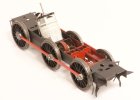
To recap, this is a rigid chassis with the drive to the centre axle. It is like this because I built the chassis according to the manufacturer's instructions. The centre wheels rarely touch the track because they sit about 0.2 mm above the other two. So really, traction is from four not six wheels. Wheel cleaning involves these four wheels not all six.

The gearbox is from the kit, and this fits snugly between the frames. I have a little sideplay on this axle to let the loco go through my Peco Setrack point. This sideplay means that every time the loco changes direction, the middle wheels kick sideways in response to the new torque reaction. In addition, the contact patch on the worm gear is a broad area rather than a single spot.
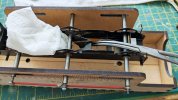
The chassis is back in the Poppy's box where I built it to unsolder the gearbox. The idea was to avoid moving the bushes for the centre axle, and I seem to have got away with this. Soggy paper towel protects inside motion parts from flame of gas torch.
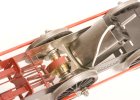
This is the fold-up gearbox I wrote about on 20th July.

The gearbox frame, gearset and motor are all from Jim McGeown. The shim washers and 3/16 inch bush are from usual sources. I had to file down the insides of the axle bushes in the chassis to accomodate the sideplay on the axle.
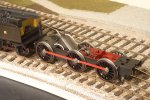
The result ran really well straight away. I suppose the gears are already bedded in (I took them from Nellie) but this is excellent.
The floating gearbox is one subject I would never try to record on video. If you don't know how they position themselves during running, just try to imagine what happens. The comparisons are all too obvious . . .
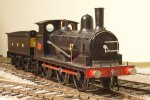
Reassembled for token portrait. Still pleased with the colour of the rails!
Last edited:
RichardG
Western Thunderer
I have used the gearset I removed from the Y14 to build a new gearbox. The other parts here are a fold-up gearbox from Connoisseur Models (Jim McGeown) and a secondhand Mashima 1830 motor I found on eBay.
The Mashima motors are still useful because, unlike the Canon CN22, their mounting holes line up with the holes in these gearbox etches.
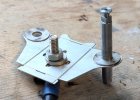
My method of assembly here is completely different to that suggested in the instructions but I think it makes for a potentially more accurate job. I began by opening out the axle holes in the frame and the washers to let an axle pass through with a tight freehand push fit. The five-sided broach keeps things symmetrical.
Then I soldered the washers to the inside of the frame - I want to make the assembly as slender as I can. Temporary electrical connection for RSU.
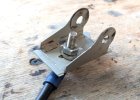
The two sides of the gearbox are each folded up to a true right angle, one at a time, and secured using the angle strips supplied on the fret.
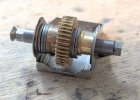
The ends of the gearbox are folded up and soldered along all edges, and the outside corners dressed.
With the gearbox as solid as it can be, the two axle holes are teased out (5-sided broach again) to give a decent running clearance for the axle. The axle is inserted and the worm gear located using some packing washers, a Slater's axle bush and the inevitable shim washer.
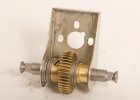
After a test fit of the motor, the two mounting slots are filed slightly longer to allow a closer mesh between the gears.
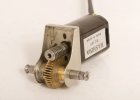
The motor is installed, the gears are meshed correctly (slacken one fixing screw and twist the motor) and the gearbox is test run. Everything is smooth and quiet, and I lubricated the gears and the holes where the axle passes through the gearbox.
The important thing is to make the angle beween the motor spindle and the axle as close to a right angle as you possibly can. If there is a skew here then the worm gear (being the softer of the two) will wear very quickly.
I am happy with this one, so I can put it aside for a future loco and I cannot lose the gears or the motor in the meantime
The Mashima motors are still useful because, unlike the Canon CN22, their mounting holes line up with the holes in these gearbox etches.
My method of assembly here is completely different to that suggested in the instructions but I think it makes for a potentially more accurate job. I began by opening out the axle holes in the frame and the washers to let an axle pass through with a tight freehand push fit. The five-sided broach keeps things symmetrical.
Then I soldered the washers to the inside of the frame - I want to make the assembly as slender as I can. Temporary electrical connection for RSU.
The two sides of the gearbox are each folded up to a true right angle, one at a time, and secured using the angle strips supplied on the fret.
The ends of the gearbox are folded up and soldered along all edges, and the outside corners dressed.
With the gearbox as solid as it can be, the two axle holes are teased out (5-sided broach again) to give a decent running clearance for the axle. The axle is inserted and the worm gear located using some packing washers, a Slater's axle bush and the inevitable shim washer.
After a test fit of the motor, the two mounting slots are filed slightly longer to allow a closer mesh between the gears.
The motor is installed, the gears are meshed correctly (slacken one fixing screw and twist the motor) and the gearbox is test run. Everything is smooth and quiet, and I lubricated the gears and the holes where the axle passes through the gearbox.
The important thing is to make the angle beween the motor spindle and the axle as close to a right angle as you possibly can. If there is a skew here then the worm gear (being the softer of the two) will wear very quickly.
I am happy with this one, so I can put it aside for a future loco and I cannot lose the gears or the motor in the meantime
Threadmarks
View all 198 threadmarks
Reader mode
Reader mode