The Heybridge Railway, 1889 to 1913

RichardG

Western Thunderer
For completeness, this is what happens if you use wheels close to scale width and expect to run them on both 0-F and 0-MF track . . .

DSC_9916.jpeg
These wheel sets are sufficiently close together to let them run along 31.5 mm without the flanges climbing up the rails. If I push the model across to one side on 32 mm track, the treads are doing a balancing act on one of the rails. Though during normal operation, the coning might help the wheels to centre themselves.

I suppose, this shows quite graphically how far we can expect to take gauge widening on curves for 0-MF. This wagon is a bit too close to the limit for me.
 

AJC

Western Thunderer
I seem to remember that the origin of this kit was - ultimately - Bob Alderman, who did these for his quarry layout. The running issue (which led to consistent derailments), you describe on curves sticks in the memory...

Adam
 

Dog Star

Western Thunderer
Adam,

I think that you are correct in respect of the late Bob Alderman being the stimulus for the kits... for Bob's Albion Quarry layout. Peter and I started helping Bob as operators at a Watford show circa 2011... and whilst running was not of the best derailments were not frequent. My memory tells me that we did about 12 shows in the period 2012-18 and running was always clunk clonk.

Rgds, Graham
 

AJC

Western Thunderer
Adam,

I think that you are correct in respect of the late Bob Alderman being the stimulus for the kits... for Bob's Albion Quarry layout. Peter and I started helping Bob as operators at a Watford show circa 2011... and whilst running was not of the best derailments were not frequent. My memory tells me that we did about 12 shows in the period 2012-18 and running was always clunk clonk.

Rgds, Graham

To be fair, Graham, my experience of operating that layout was on its debut at RailWells which is a tough gig for layouts. It was not ready for this appearance and the whole thing was a bit of a trial, these wagons being part of that - washers helped, I think (but this is going back the better part of 20 years, the track was more of a problem in various ways).

Adam
 
( Diversion : horsebox and other wagons at NEEGOG )

RichardG

Western Thunderer
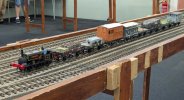
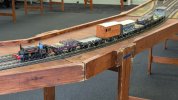
I took some of my 'foreign' wagons and the new trolley along to NEEGOG this morning.

2025-06-14 10.34.07.jpeg
Everything ran perfectly although the horsebox batteries had run out so no sound effects. Probably a good thing, this really does need an on/off switch. This was the first visit here for the horsebox, the LNWR open and the trolley.

2025-06-14 10.05.59.jpeg
A train of eight or so wagons looks the part for how I want to portray the Heybridge and Langford Light Railway.

I have five more foreign wagons for the period. So choosing seven from thirteen gives about 1,700 possible trains, rather more if they have only five or six wagons.

2025-06-14 10.12.15.jpeg
I couldn't propel the trolley but it tagged along without problems. It ran through Peco pointwork at a modest speed so I think it will work out fine on the layout at home.

2025-06-14 10.10.32.jpeg
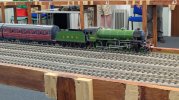
Finally a gratuitous B1 which seemed worth photgraphing.

This was my first visit to NEEGOG since we lost Martin Long and I think it was a good session for everyone.
 

simond

Western Thunderer
Richard,

I’m certain there are regulations about cattle wagons being marshalled next to the locomotive to reduce the shocks on the wagon and risks of injury to the cargo - I presume the same is true for horse boxes (even more so as they’re terminally stupid AND fragile).

That limits the combinations a bit…

Cheers
Simon
 

RichardG

Western Thunderer
That limits the combinations a bit…

Indeed.

To everyone:

I have 13 different model railway wagons and I want to assemble a train of any 8 of them.

I wonder how many unique trains I can make.

To make the calculation more difficult, the 13 include a horse box and a cattle wagon. Neither of these can go next to the engine at the front of the train.

How can I calculate the quantity of valid possible trains?

I'm afraid this has me stumped.
 

simond

Western Thunderer
Indeed.

To everyone:

I have 13 different model railway wagons and I want to assemble a train of any 8 of them.

I wonder how many unique trains I can make.

To make the calculation more difficult, the 13 include a horse box and a cattle wagon. Neither of these can go next to the engine at the front of the train.

How can I calculate the quantity of valid possible trains?

I'm afraid this has me stumped.

surely one or the other of them must go next to the engine, or next to the other livestock car, itself next to the engine, should one or the other be in the roster.

I recall learning about all sorts of equations for combinations and permutations, but I do not recall the equations and derivations and rules of application, so I’d have to look…

We might simplify the exercise by assuming the horsebox has priority over the cattle wagon, and thus, if both are to be marshalled, the horse gets the view of the footplate.
 

simond

Western Thunderer
we are talking about permutations because the order matters

nPr = (n!) / (n-r)!

ignoring the livestock for the time being, n=13, r=8 nPr = (13 factorial) / ((13-8)=5 factorial)

nPr = 6227020800 / 120 = 51891840.

that’ll keep you busy. We want photos :)
 

RichardG

Western Thunderer
I’m certain there are regulations about cattle wagons being marshalled next to the locomotive to reduce the shocks on the wagon and risks of injury to the cargo
Sorry Simon I completely misunderstood this - I read it as saying, the livestock must not be marshalled next to the engine.

Anyway, having the livestock wagons empty will allow more permutations. I'll try to keep some variety in future photos.
 

simond

Western Thunderer
Sorry Simon I completely misunderstood this - I read it as saying, the livestock must not be marshalled next to the engine.

Anyway, having the livestock wagons empty will allow more permutations. I'll try to keep some variety in future photos.

ah yes, unless it’s one way traffic, it’s a case of rolling the die to say ”loaded” or “empty”.

one could perm 6 wagons from 11, and then multiply by 2/13, but it won’t give the right answer. I’m struggling a bit to work that one out. I suspect I’ll not bang my head on the wall any further!

best
Simon
 

RichardG

Western Thunderer
one could perm 6 wagons from 11, and then multiply by 2/13, but it won’t give the right answer. I’m struggling a bit to work that one out. I suspect I’ll not bang my head on the wall any further!

Ignore the horse box because it ought to be marshalled into passenger trains.

(a) calculate the number of possible trains where the cattle wagon is present
The cattle wagon is always next to the loco so we have to choose 7 more wagons from the remaining 12
12P7 = 3,991,680 : TOTAL (A)

(b) calculate the number of possible trains where the cattle wagon doesn't appear
We need to choose 8 wagons from the remaining total of 12
12P8 = 19,958,400 : TOTAL (B)

(c) add together (A) + (B) to find the number of possible trains
3,991,680 +
19,958,400
-------------
23,950,080
-------------
 

alastairq

Western Thunderer
Please...I'm old, and my head hurts...I've just lost count of my fingers and toes for the fourth time...I need to put my socks back on...or go & have a lie down...
 

simond

Western Thunderer
there‘s something wrong here…

It depends upon there being cattle to transport, if the cattle wagon is loaded with beer barrels, it can be treated as a normal wagon, in which case you would just perm 8 from 12, which is your total B. This number B must be bigger than the total number of possible trains if there are cattle as there are obviously many trains that are not allowed (eg with the cattle wagon not at the front) within that number.

I think you have not included the probability of the cattle wagon being present or not, which is obviously 1/12. I would multiply your first Perm by 1/12, and your second by 11/12 and then add them. This gives

A 3991680/12 = 332640
B 19958400 x 11 / 12 =18,295,200

total 332640 + 18,295,200 =18,627,840

This is smaller than 12P8 by about 1.3 million, which feels plausible.

I suggest you include a prohibition on the inclusion of horse boxes in goods trains as part of the Heybridge branch operating appendix…
 

RichardG

Western Thunderer
if the cattle wagon is loaded with beer barrels, it can be treated as a normal wagon, in which case you would just perm 8 from 12

If the cattle wagon contains no livestock (regardless of what it might be carrying), I think I would perm 8 from 13 to get the grand total.

Livestock, for agricultural shows
The railway intended to carry livestock and build a cattle dock beside its goods shed. This side of the business was never a great success, because the GER catered for livestock at Maldon.
I think you have not included the probability of the cattle wagon being present or not

I've taken two totals of what is possible (with and without the cattle wagon) and added them together. I'm not sure if we need probabilities here, as long as the likelihood of including the cattle wagon (with livestock on board) is equal to likelihood of each other wagon?

Unfortunately if I start thinking about probabilities, the cattle wagon doesn't really run very often at all. I would be better off compiling a sectional appendix for the branch as you suggest, and staying away from maths.

I have a list of all of my locos and rolling stock, with purposes and loads assigned to each item. I am happiest to keep things this way for now, so for example the cattle wagon only carries livestock (or nothing), the NSR open wagon only carries barrels and their packing crates (or nothing) and so on. Because every wagon on the branch has to be here with a purpose.

Unlike NEEGOG where I assemble a train to look nice and test out new stock. The only real constraint here is a couple of wagons which have their buffers protruding a tiny bit too far, and have to be coupled up to specific other stock where the coupling chains are long enough to reach!
 

simond

Western Thunderer
I think I would perm 8 from 13 to get the grand total.
I thought the 13 included the horse box?

my recalculation was triggered by the total number of conditional permutations being greater than the total of unconditional permutations, which can’t be the case.

I think staying away from the maths might be my next step on a lovely Sunday morning too!

cheers
S
 
Top