The Heybridge Railway, 1889 to 1913

( Diversion : GER Y14 on SM32 garden railway )
  • RichardG

    Western Thunderer
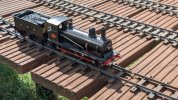
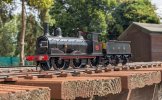
    The Y14 had some test running at the model engineering club today to help the chassis to bed in:)

    2025-08-05 10.55.49.jpeg
    The track here is laid with nominal 2mm gaps between the rails but the repeated heating and cooling provokes them to move in different directions, closing up some gaps and opening up others. This does not affect the loco's performance!
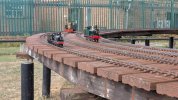
    2025-08-05 10.50.00.jpeg
    Running with Gauge 1 and SM45? (LGB-ish size) locos.
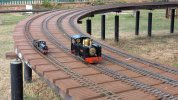
    2025-08-05 10.48.55.jpeg
    Live steam nearby brings a wonderful smell, more evocative than sound to me.
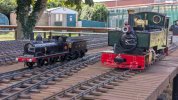
    2025-08-05 11.12.14.jpeg
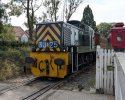
    Another strange juxtaposition.

    2025-08-05 10.59.07.jpeg
    All went really well - the loco is running better than ever.
     
    Gearboxes especially 'dished' vs straight-cut worm wheels
  • Bob Essex

    Western Thunderer
    WRT to the MSC gearbox the big issue with these types is the way the gears are cut. This also applies to a lot of the gear sets produced under the Romford/Markits brands for 4mm. That is they use ‘dished’ worm wheels. This is good for transmission of heavy loads but the worm and wormwheel must be be extremely accurately meshed, there is no room for mesh adjustment, only that built-in by the machining standards they are made to, because the meshing is radial. If this doesn’t match then the two faces don’t match up anywhere. Added to this if the wormwheel is not precisely located at the axis of the worm the same applies. Both shaft axes must be dead right. This is why, historically, getting Romford gear sets to run well has been the bane of many 4mm modellers.

    By contrast, the gears from Jim use ‘straight cut’ worm wheels. These only mesh at the axis of the worm, a vertical chord, so the transmission pressure is all located here, but the meshing distance can be varied to a degree while the wormwheel is free to move sideways without altering this basic meshing. These type are thus much more suited to model use where a degree of flexibility is allowed.

    Both types of wormwheel can be hob cut. The dished by sinking the cutter into the wheel, as is the done to mesh the actual worm, the straight cut by running the cutter sideways across the wheel.

    Hope this is of interest.

    Bob
     
    NER class H2 (1907)
  • RichardG

    Western Thunderer
    DSC_0380.jpeg
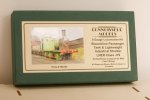
    It’s been a while since I built a loco and even longer since I bought this kit for a LNER J79 (NER H2) from Connoisseur Models. This kit has been the longest resident in my stash, bought from Jim in September 2022. This is an attractive prototype of the right size and proportions for my Heybridge Railway, with a bonus of having the Westinghouse brake as used by my nearby GER and LT&SR.

    The loco I build might be on loan to the Heybridge Railway from the NER; or it might be a fictional extra member of the class, found to be surplus by the NER and quickly sold to the Heybridge operation. If the loco belongs to the railway then I can paint it black to match ‘Blackwater’ and ‘Heybridge’; if it is a NER loco it needs a pro paint job. Either way I can still make a start.

    DSC_0377.jpeg
    The parts were all beautifully packed into the box, as is the way with Jim’s kits. The boiler arrived pre-rolled.

    The kit comes with a 32-page instruction book and additional pages of photographs, an illustrated parts list and advice on fitting some newer castings.

    DSC_0385.jpeg
    This a selection of the castings, they are all as clean and sharp as these ones.

    DSC_0382.jpeg
    There is a lot of attention to detail here - even a hole template to help the builder scribe a circle onto glazing material. This has all been put together by someone who expects you to build the kit successfully and to enjoy doing it.

    DSC_0391.jpeg
    The etches are over three years old so I have cleaned them with Barkeepers Friend, rinsed with tap water. They are too big to go into my ultrasonic bath.

    DSC_0393.jpeg
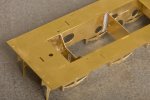
    The chassis is designed for motor drive to the middle axle. This axle is raised about 0.2 mm, so the loco effectively runs as an 0-4-0 like my Y14.

    If I arrange drive to the rear axle I will make myself enough space for batteries and radio control equipment. Unfortunately this needs a two-stage gearbox to leave the cab clear, and this one (Slater’s) cost me nearly as much as the kit. There is no room for a flywheel but this is unnecessary with battery power.

    The J79 is quite a simple kit by today's standards, so there is plenty of scope for customisation. I am reliably assured that the kit goes together (like all of Jim's kits really) so most of the problems I encounter will be of my own making . . .
     
    . . preparations: running board and cab footsteps
  • RichardG

    Western Thunderer
    Received wisdom tells me, the running board hides the space between the frames where the inside motion would be (if it was modelled); and the clearances between the rear crankpins and the cab steps are extremely tight. Thank you @Rob Pulham.

    DSC_0398.jpeg
    After I lopped out the surplus running board I saw that one side of the running board was about 0.5 mm broader than the other. This photo isn’t very clear, but I marked out the discrepancy before I opened up the hole to make things symmetrical.

    DSC_0403.jpeg
    This means, the hole is now c.26.5 mm wide. So far so good, but the fold-up frames, by design, will be 25 mm apart. The tops of the frames will show through the hole.

    I suspect this kit was drawn up to accept coarse scale wheels, hence the 25 mm across the frames. I can either live with this or fabricate new frame spacers. It's funny how one thing leads to another as soon as you make a start :rolleyes:

    DSC_0410.jpeg
    For the cab footsteps, I removed about a millimetre from the top flanges. This will let the assemblies sit further out, and hopefully clear the crankpins. The idea of the n/s wire is to strengthen the steps against unwanted bending, and allow a stronger fixing onto the underneath of the footplate. The two assemblies are handed, with the wire located away from the crankpins.

    This deals with the “known problems” so to speak. I can now proceed and doubtless create some new ones of my own :cool:
     
    Last edited:
    . . boiler backhead
  • RichardG

    Western Thunderer
    DSC_0385.jpeg

    This a selection of the castings, they are all as clean and sharp as these ones.

    I want to start this build with as many subassemblies as I can. Next is the boiler backhead, to make sure I do it. My Y14 still hasn’t got one.

    DSC_0409.jpeg
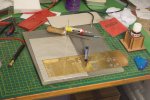
    There are some tiny handwheels on the frets and I thought these would look better than the ones on the casting. This is one of my first arrangements for using the RSU in anger. The working area is a sheet of card wrapped in aluminium foil, and the welding magnet is making sure the electrical connection is really good and stopping things sliding around. The RSU is on a low-ish power setting to avoid vapourising the part.

    2025-08-11 21.58.00.jpeg
    I filed off the cast hand wheels, and then managed to snap the drill bit. Unbelievable while drilling something as soft as white metal. I drilled small holes nearby so I could find the scrap of hardened steel from behind and then push it back out.

    DSC_0416.jpeg
    The backhead is thinner than the one on Nellie, and has a separate backing plate. The notch in the backing plate is guesswork, for the gearbox. The soldering on the handwheels is neater than I could manage with the iron.

    DSC_0414.jpeg
    The spindles are still loose. I have counterbored the backing plate so I can fix them in with glue after painting.

    I spent much of my life writing technical specifications for readers who have English as a second language. This led me to use words in only one part of speech, and so "glue" is always a noun never a verb and so on. It's not a bad habit in terms of clarity but it certainly kills off creative writing.
     
    . . smokebox door
  • RichardG

    Western Thunderer
    For the smokebox door I have used a mixture of the pillar drill and drilling by hand, and nothing broke.

    DSC_0427.jpeg
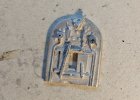
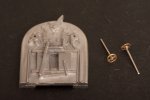
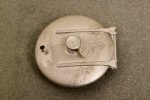
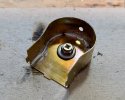
    There is a spare smokebox dart so I had a go at replacing the handle. I drilled a hole 0.55 mm using the pillar drill (1,800 rpm) because this helps alignment. Then opened the hole out to 0.75 mm by hand to reduce the risk of breaking the casting.

    DSC_0429.jpeg
    The pin for the small handle is supplied in the kit.

    I have put this assembly together using CA glue. I would find soldering this very difficult.

    I know I have broken a disproportionate number of small drill bits over the years while drilling white metal. Now I know why :)
     
    . . brake hangers
  • RichardG

    Western Thunderer
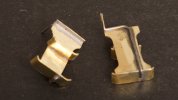
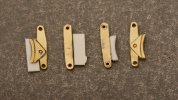
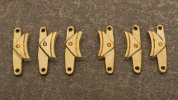
    The brake hangers in the kit looked a bit undernourished so I have fattened them up with scrap brass and styrene.

    DSC_0421.jpeg
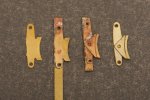
    (L-R) An original hanger, laminated onto scrap etch, brake shoe added, and tidied up.

    DSC_0423.jpeg
    (L-R) Pieces of styrene glued onto the backs of the original hangers, and then profiled to match.

    DSC_0436.jpeg
    My new background is the piece of steel plate I use with the RSU. If I put the flash head in the right place the light brings out the texture in the metal.
     
    . . cab roof, floor and brake standard
  • RichardG

    Western Thunderer
    The kit lets you build the cab roof as a lift-out subassembly, and this seems really useful.

    DSC_0438.jpeg
    When built, these locos had a wooden cab roof with a distinctive rebate around the edges. I filed down the four edges of the roof panel and added strips of brass to create the rebate. The strips are from Nairnshire Modelling Supplies (eBay), I find them useful for all kinds of detailing.

    DSC_0440.jpeg
    I tried to use some rolling bars to form the roof but I ended up using fingers to make the final shape.

    DSC_0441.jpeg
    The ventilation hatch is scrap brass, and the rain strips are tinned copper wire filed flat to suggest wooden battens. Maybe they should be straight but I doubt I will ever find a photo looking down onto a roof.

    I have guessed the size of the notches in the supporting frame. These are to let the frame clear the window frames inside the spectacle plates. I must set these parts aside now and see how well the frame fits into the cab before I fix them together.

    Having an RSU is like cooking with gas. It is quicker and easier than the iron, and the results are neater and need less cleaning up.
     
    . . train brake and drawgear
  • RichardG

    Western Thunderer
    And now, the honeymoon is over. I have worked up most of the subassemblies where I have wanted to customise things. I have got to decide which loco I am trying to make.
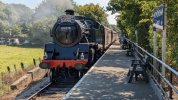
    The NER built just three of these locos. They are all different in one way or another; and the kit caters for only some variations . . .
    • Number 407 was rebuilt in 1907 with taller side tanks, and had different cab steps
    • Number 1787 had smaller sandboxes
    • Numbers 407 and 1787 received the Westinghouse brake in 1907
    • Number 1662 had parallel-sided buffer stocks (similar to GER ones) but never received the Westinghouse brake
    Numbers 407 and 1787 were built in 1897; number 1662 arrived in 1907. If I want a loco to serve the Heybridge Railway from 1897 through to beyond 1907, I need to do some creative modelling i.e. fudge things. The best compromise for me is a fictional fourth member of the class, supposedly built alongside the first two in 1897. To do this I am going to build a model of 1662 in its original condition, but giving it a Westinghouse brake and screw couplings.

    This way, a future owner can readily convert the model to represent 1662, in its NER or LNER condition or even being used in industry. I am making something which can be useful in the future as well as now.

    DSC_0484.jpeg
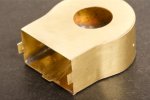
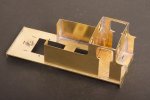
    I have given the cab front two offcuts of tube to hold the Westinghouse pump. The idea is to glue the pump into place after painting. Also a rebate for the gearbox driving onto the rear axle.

    DSC_0448.jpeg
    The couplings will be screw couplings from Premier Components.

    I have never worked out a decent way to open up this sort of narrow slot. My approach is to find a drill bit with a diameter to match the desired slot width. Run the bit through the slot in a few places, and then work the part backwards and forwards, using the flutes of the bit as if it were a milling cutter. This works using a soft brass part and a pillar drill, but the brass does hurt if you lose your grip on it. There must be a better way.
     
    . . frames
  • RichardG

    Western Thunderer
    DSC_0498.jpeg
    To recap slightly, the frames are intended to be a fold-up item. I want the frames to be farther apart so their top edges don’t show between the running boards in the space behind the smokebox.

    DSC_0505.jpeg
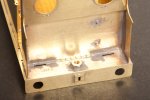
    Putting the drive to the rear axle leaves no space for plunger pickups. The unwanted holes are blanked off inside and filled with low melt solder. This seemed a good idea at the time but the solder melted when I soldered up the frames so it had to be re-done.

    DSC_0526.jpeg
    I am happy with the new frame spacers but they are not quite symmetrical so each has a centre punch mark and a red dot. The rebate in the top of the third spacer is my invention to make it less intrusive on the finished model.

    DSC_0536.jpeg
    I found the frames rather difficult to put together. A fold-up arrangement is easier. However, the result is pretty square.

    DSC_0535.jpeg
    I suppose, this is a dress rehearsal for building a first ScaleSeven loco from a finescale kit.

    DSC_0512.jpeg
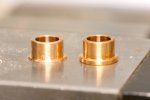
    The standard Slater's axle bush (right) has a flange 1mm thick.

    DSC_0506.jpeg
    I have reduced the flanges to around 0.33 mm, so the wheels will be able to turn.

    DSC_0533.jpeg
    For now, the important thing is the frames are under the running boards.

    I am still on my first piercing saw blade but the teeth are losing their edge.
     
    ( Diversion : two days in Norfolk )
  • RichardG

    Western Thunderer
    We have just had two days in Norfolk . . .

    2025-08-25 09.41.46.jpeg
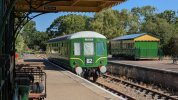
    We found ourselves having a picnic breakfast yesterday because the so-called B&B didn't serve breakfast. Happily the Morrisons in Dereham was open for "meal deals" and so we headed up to County School station to eat them, this really is a lovely spot.

    2025-08-25 09.42.43.jpeg
    The field beside the access road is full of sunflowers.

    2025-08-25 12.27.34.jpeg
    Punctuality on the Mid Norfolk Railway took a hit because of a movement from Network Rail, but the sun was still shining for the first steam working of the day. I have stopped carrying a pocket camera on holidays because the phone camera (Pixel 6a) is so good.

    2025-08-24 13.08.02.jpeg
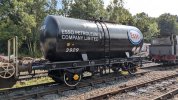
    We went to the Whitwell and Reepham Railway the day before. This was so relaxing and calming I fell asleep in their conservatory, so not many pictures to share. I noticed the raised Esso emblem - the plastic backing panel on the Airfix kit is more appropriate than I thought :)

    If we had had a third day then Holt was around twenty minute's drive from County School and we could have visited the North Norfolk Railway too. The three railways are very different and all have something to enjoy.
     
    ( Diversion : K&ESR and the Colonel Stephens Railway Museum )
  • RichardG

    Western Thunderer
    We went to the Colonel Stephens Museum at the K&ESR yesterday. This might be the best railway museum in the world, it is so well laid-out and the displays are just right for the subjects portrayed.

    2025-09-07 10.59.50.jpeg
    The smell of steam spread across the car park to welcome visitors.

    2025-09-07 11.45.40.jpeg
    I thought this looked like a model.

    2025-09-07 12.16.18.jpeg
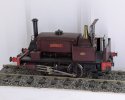
    One of many real models complementing the historic bits and pieces in the museum. All of the models are behind glass, some photograph better than others.

    2025-09-07 13.08.57.jpeg
    'Sankey' built by @Allen M doesn't seem to have moved since my last visit, this model was really useful when I built my 'Lady Marion'.

    2025-09-07 12.16.54.jpeg
    'Gazelle' was blue the last time I saw her.

    2025-09-07 13.30.29.jpeg
    The railway's "vintage train" as it was running yesterday.

    The gift shop is selling a new book by Brian Janes, "Colonel Holman F Stephens, The Man and His Railways". Published in June this year by The Colonel Stephens Railway Museum. This looks like a good read, it describes the man himself as well as his railways.

    A great day out.
     
    . . smokebox
  • RichardG

    Western Thunderer
    Things have gone wrong but I have a chance of putting them right thanks to Jim McGeown.

    To be brief, I tacked my completed smokebox onto the front of the boiler, soldered everything solid, and then realised the smokebox was offset about 0.2 mm to one side. Just enough to notice. I stuffed the smokebox full of soggy paper towel, applied the cook's torch to remove it and the whole assembly sprang apart. Difficult to reassemble because the outer corners are filed down to give a radius.

    View attachment 177695
    Well, I put the smokebox back together but the outer wrapper revealed I had put a slight twist onto the assembly.

    At this point I tried cutting through the wrapper and fixing the two parts flush onto the inner wrapper. This did not work, not in any form, so the wrapper was spoilt.

    View attachment 177696
    A second rebuild of the smokebox followed, minus the outer wrapper. The result (see below) stands up to casual inspection but it is still skewed; the wrapper is not orthogonal to the front and back. So it looks awful on the loco.

    View attachment 177697
    And now the good bit.

    I phoned Jim McGeown, the proprietor of Connoisseur Models. He has two gash frets from this kit. One was already robbed for its smokebox parts, and now the second one is robbed too. Jim has posted the parts to me and they arrived today. No pressure then :confused:

    The smokebox for my Y14 was a bit of a disaster, and Jim had to send me some fresh parts to let me build a second one. I had to do better for the H2.

    This time, I put the main radius onto the wrapper in the rolling bars. Then I annealed the lower sections of the wrapper to help me put the reverse curves onto them when the time came.

    2025-09-10 15.06.23.jpeg
    The smokebox front is screwed down onto a piece of board, with some sacrificial cardboard to reduce the scorch marks on the board. I reflowed the solder after I took this photo.

    I fixed both the front and the back ever so slightly behind the edges of the wrapper. Then I filed down the wrapper to make it flush.

    DSC_0642.jpeg
    There is a tiny error in the alignment of the wrapper. I’m not sure if this is the kit or my build, but it will disappear below the top cover of the cylinders.

    I have removed the tab on the back of the smokebox (uppermost here) so I can extend this surface downwards towards the cylinders.

    DSC_0654.jpeg
    A dummy run to show how well the smokebox, cylinder cover and running board all fit together. I had to file about 0.05 mm off each side of the wrapper (0.1 mm in all) to make it a snug fit into the cylinder cover. Everyone says these kits go together, and indeed they do.

    DSC_0657.jpeg
    The two holes for the front handrail were rather large (I think they were intended for split pins) so I have sleeved them with brass tube.
     
    . . boiler
  • RichardG

    Western Thunderer
    The boiler arrives pre-rolled so there is little work to do.

    DSC_0659.jpeg
    The boiler is rolled too tight and sprung onto place around this semi-circular former. The edge of the boiler sank into the sacrificial bit of cardboard and this put things at a wonky angle, so I have a fresh scorch mark on my sheet of board. Sometimes I think scorch marks are unavoidable. I start a new piece of board every year or so.

    DSC_0662.jpeg
    I struggled with the boiler bands supplied in the kit, so I used some 1 x 0.2 mm brass strip instead. This is overlength, so it is easy to pull taught and clamp at both ends. Then sweat into place and trim the ends flush.

    I have rubbed down the boiler bands to reduce their thickness. The primer is self-levelling so I think they will look okay in the end. There is a trick of the light here, I really have drilled out both holes for the handrail knobs.

    DSC_0660.jpeg
    Finally some short tubes to hold the clack valves. I can glue the clack valves into the tubes after painting the model.

    The former at this end of the boiler is a bit skewed, this is not a trick of the light. I will leave this alone, so I can show it to people who tell me I am a perfectionist :D
     
    . . locations for cab handrails
  • RichardG

    Western Thunderer
    DSC_0680.jpeg
    I have spent the last 3+ hours tackling the cab beading on the H2. This must be one of the most awkward things I have ever tried to do with brass. The photo is my third attempt . . . I gave up trying to arrange a single strip and I now have two pieces with a join near the middle.

    The black background shows up the asymmetry between the handrails (quite exasperating really!) but I can put this right with a file on the mounting holes.

    This is my first loco with an enclosed cab, and right now I hope it will be my last. I am saving the second cab side for another day.
     
    Last edited:
    . . springs and sandboxes
  • RichardG

    Western Thunderer
    I will put off attaching the sandboxes because I want to try for some better springs first. So this post wraps up the assembly of the frames for a short while.

    DSC_0735.jpeg
    The new springs are from Jim McGeown, he includes them with his re-released J69 and sells them separately as an accessory pack.

    DSC_0731.jpeg
    I have shortened the castings so they fit the H2.

    DSC_0733.jpeg
    I think these are a worthwhile upgrade over the originals, which are etched as part of the frames.

    DSC_0739.jpeg
    I did the first spring as a test piece but of course having done one I had to do the rest. Then I added the sandboxes.

    DSC_0745.jpeg
    Finally a bracket (two layers of scrap fret) to constrain the motor.

    The frames assembly might be finished now. The brakes will have to be added after painting and installing the wheels. I haven't done anything about electrical pickups because I am still undecided whether to go for radio control.
     
    . . rolling chassis
  • RichardG

    Western Thunderer
    I also have Jim's J71 kit in the stash which upon examination of the etches had the same infill plate between the tank fronts and smokebox so another that will need modifications from the outset.

    DSC_0773.jpeg
    I am not convinced that the chassis widening is worth the effort. I hope to be pleased with the finished model, but these frames have taken a huge amount of work with very little to show for it. The open space inside looks large but much of it will be between the side tanks.

    A couple of strategically-placed toolboxes beside the original infill plate would look pretty good from most angles.

    Still, I am pleased with the colours here - Halfords no. 228 'Volvo Dark Grey' on the frames, with black on the sandboxes and springs to bring a bit of variety. Satin varnish over everything except the axle bushes.
     
    . . power and control planning
  • RichardG

    Western Thunderer
    I want to see the model hurtling through some points and staying on the track before I add the brake gear.

    Hurtling is good, but slower speeds are better especially at home. Also I can see how well the model runs through my own track first.

    DSC_0807.jpeg
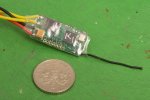
    This is a Micron MR601a controller. It arrived today (sooner than expected), and it combines a radio receiver and an electronic speed controller. There are also auxiliary outputs for lights, but the H2 doesn't need these.

    DSC_0804.jpeg
    Temporary wiring . . .

    DSC_0813.jpeg
    . . . wrapped up to go into a wagon.

    DSC_0816.jpeg
    DSC_0810.jpeg
    This ensemble reaches a maximum speed of 0.6 feet per second, which scales up to around 17 mph. This is with a 7.5 volt supply. The MR601a accepts up to 13 volts; more batteries = faster.

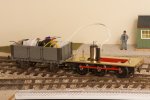
    This unloaded chassis can also move six additional wagons before wheelslip begins i.e. seven wagons in all. Adding 200 grams of ballast increases this considerably. I have tried 15 wagons without problems; this is all I can manage on my layout.

    I haven't ruled out conventional analogue control from the track, but I do like the convenience of radio control. And the way the models never stall. I used the same MR601a controller in 'Lady Marion' and it has worked well.

    Micron Radio Control : Micron MR601a DSM2/DSMX 13V Receiver with 1.2A Bi-Directional ESC
     
    . . superstructure
  • RichardG

    Western Thunderer
    DSC_0851.jpeg
    I have added the cab and side tanks to the model. I tacked the four main parts into place first, shuffled things around as needed, and then soldered everything solid.

    DSC_0844.jpeg
    I took about 0.5 mm off the bottom of the cab back so it could stand on top of the footplate and not behind it. This is the first significant correction I have made to any of the etched parts.

    DSC_0843.jpeg
    The model has a supporting frame for the cab roof, to allow the roof to be lifted off the finished model.

    DSC_0840.jpeg
    The fit of this frame into the cab is testament to the design of this kit. I haven’t adjusted anything here to make it fit.

    DSC_0852.jpeg
    Outer corners dressed. The Z-fold is the last part of the cab to be soldered up, to allow small adjustments to the location of the rear spectacle plate.

    DSC_0856.jpeg
    The fit of the etched parts (except the bottom of the cab back) has been spot-on. This is a hand-drawn kit from 1989.

    DSC_0865.jpeg
    I have made a false floor for the coal bunker so the loco can have a partial load of fuel. The bunker back is waiting until I have sorted out the rear lamp irons.

    DSC_0864.jpeg
    So far so good! This gentleman watches every new arrival at Heybridge Basin. Perhaps he should be rotated by some kind of mechanism so his gaze is always following the trains.

    I am hoping to take the loco to the get-together at British Sugar in Bury St Edmunds tomorrow, so do say hello if you go along and see it. I hardly know what anyone here looks like.
     
    . . detailing
  • RichardG

    Western Thunderer
    The detail parts for the superstructure begin with the buffer stocks and some pieces of brass sheet and wire.

    DSC_0974.jpeg
    When I modified the buffer stocks, I removed the bosses which would locate them in the buffer beams. The brass dowel in the foreground has a small diameter to go into the back of a buffer stock and large diameter to go into a buffer beam. The dowel makes aligning the buffer stocks a whole lot easier.

    The panel below the smokebox is here to hint at the backs of the cylinders being present.

    DSC_0964.jpeg
    A while ago, I drilled some holes in the running board to accept the cab handrails. Three holes were in the right place, one was adrift. So I opened up the wonky hole from underneath and packed out the space with more wire.

    DSC_0979.jpeg
    All of the prototype photos I have show the coal rails to be plated over. But I think they look better in their original state so I have left them unmodified. This is the last etched part bar the lamp irons.

    DSC_1000.jpeg
    The cab footsteps ended up tight against the tube I used for the hanging bars . . .

    DSC_0996.jpeg
    . . . and I have just enough room to spare in front of the crankpins. Thank you to @Rob Pulham for warning me about this before I started.

    The RSU provides a very localised heat but I still wrapped the footstep assemblies in soggy wet paper towel when I soldered them onto the model ;)

    DSC_1003.jpeg
    The handle on the valve cover is a veneer pin with a 16BA washer. I quite enjoy adding this sort of thing but there is isn't much scope for any more.

    DSC_1004.jpeg
    The long handrail extends into the cab so I can add a control wheel for the blower valve.

    The RSU makes adding the handrail knobs so much easier, but do put a bit of wire through the hole before pressing down with the probe. I didn't do this on one knob, crushed the part and now I am waiting for a replacement.
     
    Top