
You are using an out of date browser. It may not display this or other websites correctly.
You should upgrade or use an alternative browser.
You should upgrade or use an alternative browser.
Hartley Hills, LNWR c1900 - buffer stops, how do you build yours?
- Thread starter Dog Star
- Start date


Buckjumper
Flying Squad
Actually, five pages in, I think there's quite a bit of interest in the processes of track building and prototype practice, it's just that it's such a big, complex subject (particularly switch and crossing work) that some of us feel a little like rabbits caught in the headlights...especially when you bring trigonometry into it!
Please continue to broaden my knowledge with these posts.
Edit: The Guv beat me to it!
Please continue to broaden my knowledge with these posts.
Edit: The Guv beat me to it!

Old Buffer
Western Thunderer
I am following this thread and learning, but, the maths and trigonometry, not forgetting the A, B, C, D, E, F, and 5, 6, 7, 8, 9, etc. Sometimes it goes right over my neanderthal head to the extent that I have to read it quite a few times before it finally sinks in.
As Adrian says "please continue".
Alan
As Adrian says "please continue".
Alan

Dog Star
Western Thunderer
I suspect that some of us have access to good sources of information about trackwork - or know someone who does have the information - and the recent posts to this thread indicate that some sort of "PW Corner" might be useful to WT in general. What I have in mind is a question-driven thread where WTers can ask about PW matters without anyone feeling that the question is too simple, too complex or just plain daft. For those who have read through my offerings here and on the threads dealing with tools there is not much which is scale/gauge specific although I acknowledge that some scales and/or gauges might have preferences (eg. American short lines and flat-bottom section rail).
Questions about Templot are better served by the existing Templot forum - which is concerned mostly with the use of the software tool.
If a PW Corner might fill a void in your comfort zone, maybe as a first step to making your own track, then put your question forward in a new topic, possibly in the "Resources" or "Techniques" sub-forum.
regards, Graham
Questions about Templot are better served by the existing Templot forum - which is concerned mostly with the use of the software tool.
If a PW Corner might fill a void in your comfort zone, maybe as a first step to making your own track, then put your question forward in a new topic, possibly in the "Resources" or "Techniques" sub-forum.
regards, Graham

28ten
Guv'nor
Here you go http://www.westernthunder.co.uk/index.php?forums/permanent-way.32/ and a selection of prefixes are available
Dog Star
Western Thunderer
Thank you, what did you want to ask?Here you go http://www.westernthunder.co.uk/index.php?forums/permanent-way.32/ and a selection of prefixes are available

Rob Pulham
Western Thunderer
Hi Graham , as others have said I am greatly enjoying, both the story line and the actual show us how it's done aspect of your posts on this thread so please don't stop!
Dog Star
Western Thunderer
Albert is taking a few days off, he says that he is owed a break. More likely that he drank a bit too much, he was a bit wobbly when I left the Public Bar at around ten last night.
Anyway, with the help of some domino tiles and a few matchboxes, representing 12" and 14" timbers respectively, Albert was able to show me just how he was going to sort out the blocked work between no. 1A and no. 1B. Rather ingenious really, the strategy is one of minimum work for maximum gain... or rather, make the fewest number of cuts to timbers and leave as much in place as fits the new turnout arrangement. This Sunday morning I strolled down the High Street to check on progress, not much to report as the gang seems to understand the old saying "when the cat is away the mice will play" and has gone fishing.
With Albert's vivid description in mind I could see how the work would be done and I hope to do the same on the model before the week is out. In the meantime the Station Master is heading up The High with a face that says it all. The gang is in trouble for the single line working through the station is playing havoc with the movement of parcels and freight especially as there is a backlog of traffic in brassicas and the porter is on rest day. Moving trolleys across the main is no fun at the best of times, a consequence of the single line working is that goods and smalls from down arrivals / for down departures has to be man-handled over the barrow crossing to the up platforms.
regards, Graham
Anyway, with the help of some domino tiles and a few matchboxes, representing 12" and 14" timbers respectively, Albert was able to show me just how he was going to sort out the blocked work between no. 1A and no. 1B. Rather ingenious really, the strategy is one of minimum work for maximum gain... or rather, make the fewest number of cuts to timbers and leave as much in place as fits the new turnout arrangement. This Sunday morning I strolled down the High Street to check on progress, not much to report as the gang seems to understand the old saying "when the cat is away the mice will play" and has gone fishing.
With Albert's vivid description in mind I could see how the work would be done and I hope to do the same on the model before the week is out. In the meantime the Station Master is heading up The High with a face that says it all. The gang is in trouble for the single line working through the station is playing havoc with the movement of parcels and freight especially as there is a backlog of traffic in brassicas and the porter is on rest day. Moving trolleys across the main is no fun at the best of times, a consequence of the single line working is that goods and smalls from down arrivals / for down departures has to be man-handled over the barrow crossing to the up platforms.
regards, Graham
Dog Star
Western Thunderer
If you are one of those who is thinking "so what is the problem?", have a look at this photograph....
If I can read the arrangements anywhere near correctly, this "bit of track" shows extensive block work plus some interleaving of the ends of timbers and evidence of timebrs being cut-short (probably during an occupation for relaying of the main lines). Come what may, I am glad that I do not have to replicate this maze of steel and timber.
As a challenge, anyone fancy trying to set this out, with the same visual appearance of timbers, in Templot?
And here is one for Richard... my immediate thought was a nook / cranny of Heyside. That S&C stuff is a taxing piece of work.
regards, Graham
If I can read the arrangements anywhere near correctly, this "bit of track" shows extensive block work plus some interleaving of the ends of timbers and evidence of timebrs being cut-short (probably during an occupation for relaying of the main lines). Come what may, I am glad that I do not have to replicate this maze of steel and timber.
As a challenge, anyone fancy trying to set this out, with the same visual appearance of timbers, in Templot?
And here is one for Richard... my immediate thought was a nook / cranny of Heyside. That S&C stuff is a taxing piece of work.
regards, Graham
Dog Star
Western Thunderer
I have received a picture postcard of Blackpool from Albert - and in the space where day-trippers would write "wish you were here" Albert has put "go to Stechford and see what that bl**dy bowler wants done now". The weather was fine this morning and so I took a local service via the direct line to Coventry. On the cushion beside me was my trusty Practika, with film, and some refreshments in a bag... Lyons fruit pie, a Mars bar and some Tizer. I was not sure why Albert suggested, in such a terse manner, that I went to Stechford until I walked down the goods yard at the west end of the station. After showing my all-line pass to the bobby and signing the register in Stechford No.2 I got out the camera and photographed the S&C work on the bridge over Albert Road. What had seemed to be a good day went downhill when, on the return journey, the camera back opened and my pictures of that day became fogged.
Not all is lost for I have found some suitable alternatives and I suggest that you take a look at this picture.
If the reason for Albert taking some impromtu leave is not yet clear then let me explain. About a month back the local District PW Inspector came to brief Albert about a new siding to be added on the up side of the station and with a connection into the Up Goods Line. It seems that the town council is going to build some terraced houcing on The Rise and the Directors think that the new houses will generate some additional traffic - probably bricks and timber for building and then coal and goods for the influx of inhabitants. Nothing more was heard from the Bowler until last week when Station Master Lewin received an instruction from the PW department relating to the authorised work in relation to the new siding.
The PW Gang say that there was a develish grin on the SM's face when he spoke to Albert about the work to be done and showed Albert some drawings. I am told, by the sub-ganger, that Albert went as white as a sheet and without a word he departed for the comfort of the local public bar. If you are still in the dark, then may I suggest that you take a magnifying glass to the above picture and look at those turnouts in the lower left hand corner.... and then remind yourself that you are looking at a section of the West Coast main line circa 1910!
No light at the end of the tunnel? That bu**er of an inspector has instructed Albert to make the connection between the siding and the up goods without disrupting services - clearly someone has had his collar felt after the fiasco of the recent relaying of the down main to down platform loop. Albert's only option is to insert the common crossing at night and between goods services with the switches done in a similar fashion. To deal with the closures Albert is going to have to use interleaved timbering and that is no joke.
As to when this is going to happen I have no idea because Albert will need to get the help of George's gang and arrange for a hand-operated crane to do the lifting. The down side for us is that none of my film stock is fast enough to give a good image when the only light comes from flare lamps.
regards, Graham
[and in case this goes pear shaped, I can rely on a recent comment from a member of the LNWRS...
<quote>
A quick look at the pre 1900 period photos shows what appears to be some turnouts with plain timbering, some with interleaved and some with what looks like "double" timbers (usually in the centre section of the turnout). You may end up with a view ... that if, after all your research you don't have a final definitive solution, then nobody else has!
<unquote>
I like that sentiment, what do you think Richard?
Not all is lost for I have found some suitable alternatives and I suggest that you take a look at this picture.
If the reason for Albert taking some impromtu leave is not yet clear then let me explain. About a month back the local District PW Inspector came to brief Albert about a new siding to be added on the up side of the station and with a connection into the Up Goods Line. It seems that the town council is going to build some terraced houcing on The Rise and the Directors think that the new houses will generate some additional traffic - probably bricks and timber for building and then coal and goods for the influx of inhabitants. Nothing more was heard from the Bowler until last week when Station Master Lewin received an instruction from the PW department relating to the authorised work in relation to the new siding.
The PW Gang say that there was a develish grin on the SM's face when he spoke to Albert about the work to be done and showed Albert some drawings. I am told, by the sub-ganger, that Albert went as white as a sheet and without a word he departed for the comfort of the local public bar. If you are still in the dark, then may I suggest that you take a magnifying glass to the above picture and look at those turnouts in the lower left hand corner.... and then remind yourself that you are looking at a section of the West Coast main line circa 1910!
No light at the end of the tunnel? That bu**er of an inspector has instructed Albert to make the connection between the siding and the up goods without disrupting services - clearly someone has had his collar felt after the fiasco of the recent relaying of the down main to down platform loop. Albert's only option is to insert the common crossing at night and between goods services with the switches done in a similar fashion. To deal with the closures Albert is going to have to use interleaved timbering and that is no joke.
As to when this is going to happen I have no idea because Albert will need to get the help of George's gang and arrange for a hand-operated crane to do the lifting. The down side for us is that none of my film stock is fast enough to give a good image when the only light comes from flare lamps.
regards, Graham
[and in case this goes pear shaped, I can rely on a recent comment from a member of the LNWRS...
<quote>
A quick look at the pre 1900 period photos shows what appears to be some turnouts with plain timbering, some with interleaved and some with what looks like "double" timbers (usually in the centre section of the turnout). You may end up with a view ... that if, after all your research you don't have a final definitive solution, then nobody else has!
<unquote>
I like that sentiment, what do you think Richard?

JimG
Western Thunderer
If you are still in the dark, then may I suggest that you take a magnifying glass to the above picture and look at those turnouts in the lower left hand corner.... and then remind yourself that you are looking at a section of the West Coast main line circa 1910!
No light at the end of the tunnel? That bu**er of an inspector has instructed Albert to make the connection between the siding and the up goods without disrupting services - clearly someone has had his collar felt after the fiasco of the recent relaying of the down main to down platform loop. Albert's only option is to insert the common crossing at night and between goods services with the switches done in a similar fashion. To deal with the closures Albert is going to have to use interleaved timbering and that is no joke.
Graham,
Are these turnouts fully interlaced? It looks as though interlaced sleepers are used up to the crossings then full length timbering is used under the crossings - notable by the lack of chairs at the crossing. A fully interlaced turnout would have chairs on each sleeper through the crossing.
Fully interlaced pointwork lasted in Scotland to well in BR days - and in a lot of cases the original timbering and fittings had been replaced, meaning that post-Grouping Scottish PWay gangs were still effectively laying interlaced turnouts.

Jim.
Dog Star
Western Thunderer
It looks as though interlaced sleepers are used up to the crossings then full length timbering is used under the crossings - notable by the lack of chairs at the crossing. A fully interlaced turnout would have chairs on each sleeper through the crossing.
I am not sure that I understand... what do you mean by "lack of chairs at the crossing"? Unfortunately the website which has the Stechford picture does not have a photograph which contains the rail joint between switch and closure so I am not able to say how much of the the S&C work is interleaved. What may be relevant to the question is that the LNWR submitted a drawing of a 1:8 crossing and a separate drawing of a 20'0" switch to the 1900 IRC.... and no details of the closure rail. A shame because a 7mm version of a C8, to pre-1900 practice, is the equivalent of around 75'0" prototype so there is at least one pair of stock rails and one pair of closure rails which are less than 30'0" and I have no idea of the placing of those rail joints.
[Although LNWR had the ability to roll 60'0" rails from circa 1894 I feel that there is likely to have been much S&C work based on the previous standard of 30'0" rails in the Edwardian era. What I am trying to create is the impression of a station layout where some of the Victorian trackwork (30'0" rail) has been relaid to the later Edwardian standard (60'0" rails.]
JimG
Western Thunderer
I am not sure that I understand... what do you mean by "lack of chairs at the crossing"?
Graham,
On a fully interlaced crossing, there are chairs on each sleeper, therefore about double the number of chairs you would expcet to see on a non-interlaced crossing. I'll try and dig up a good picture of a Caledonian crossing to show what I mean. It's the first thing I look for when identifying interlaced P&C work.
Just dug up this picture which I posted on the Templot forum a while ago - a three way interlaced turnout at Crow Road station in Glasgow on the ex-Caledonian line (in the mid 50s!!). You can see the greater number of chairs evident at teh crossing in the foregrpound of the picture.

Jim.
Dog Star
Western Thunderer
Well the plot thickens... or rather the rumour mill in the village was not getting the gossip from the (appropriate) horse's mouth.
There is a possibility that Albert got the order of the honorary boot over the recent relaying fiasco rather than him taking a holiday. Time will see on that one. Irrespective of what and why, the consequences continue to filter upwards and the latest to feel the wrath of the Directors are the District Inspector and the Divisional Inspector. I understand that the new men may well have been in the employ of another railway company - the post of Divisional Inspector has gone to an unknown, Henry Harvie, whilst G E Hobbs is the new District Inspector.... there is a possibility that Hobbs might have trained under Harvie. I seem to recollect something about those gentlemen appearing in the proceedings of one of the engineering societies.... maybe a paper I read whilst acting as a PW Engineer for some recent work on the Extended Widened Lines of the Metropolitan Railway.
regards, Graham
There is a possibility that Albert got the order of the honorary boot over the recent relaying fiasco rather than him taking a holiday. Time will see on that one. Irrespective of what and why, the consequences continue to filter upwards and the latest to feel the wrath of the Directors are the District Inspector and the Divisional Inspector. I understand that the new men may well have been in the employ of another railway company - the post of Divisional Inspector has gone to an unknown, Henry Harvie, whilst G E Hobbs is the new District Inspector.... there is a possibility that Hobbs might have trained under Harvie. I seem to recollect something about those gentlemen appearing in the proceedings of one of the engineering societies.... maybe a paper I read whilst acting as a PW Engineer for some recent work on the Extended Widened Lines of the Metropolitan Railway.
regards, Graham
Dog Star
Western Thunderer
The owner of the estate around Hartley Hill came to inspect today... so far so good. Now that Mr. Lewsey has had the chance to see what I have been doing since the beginning of the year I feel that I can share recent photos with WTers.
The first photo shows the extent of timbering to date.... yes, not much to show for the work in January. Suffice to say that at least one of the turnouts has been re-laid twice as a result of new information dropping into the e-mail inbox. Up (to London) is to the left of the scene. The diamond and three of the turnouts are to the LNWR 1909 drawings whilst the fourth turnout is to the LNWR pre-1900 drawings.
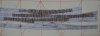
This photo shows the timbering of the 1:8 diamond to the 1909 pattern drawings. Nothing special to this piece of work.... 12" timbers throughout.

This photo shows the timbering of the 1:8 down lead into the platform loop and the 1:8.25 connection from the up loop to the up main. Both turnouts are to the 1909 pattern drawings with 16' swtiches. These turnouts feature an interesting LNWR foible - the timbers progress in 12" increments rather than the expected (normal?) 6" increments.... this little featurette lead to the first re-laying of the timbers.

This photo shows the blocking through of the down main into the diamond crossing. Yet another cause of re-laying of timbers.... there are two timbers which extend under just three rails.... rather than the expected four rails. Again 12" timbers.
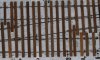
And finally... the start of the carriage siding with the trap protecting the down platform loop. The siding is set out according to the pre-1890s arrangement of ten 10" sleepers per 30' rail - the trap is set out to the pre-1900 S&C drawings with 14" timbers.
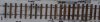
The first photo shows the extent of timbering to date.... yes, not much to show for the work in January. Suffice to say that at least one of the turnouts has been re-laid twice as a result of new information dropping into the e-mail inbox. Up (to London) is to the left of the scene. The diamond and three of the turnouts are to the LNWR 1909 drawings whilst the fourth turnout is to the LNWR pre-1900 drawings.
This photo shows the timbering of the 1:8 diamond to the 1909 pattern drawings. Nothing special to this piece of work.... 12" timbers throughout.
This photo shows the timbering of the 1:8 down lead into the platform loop and the 1:8.25 connection from the up loop to the up main. Both turnouts are to the 1909 pattern drawings with 16' swtiches. These turnouts feature an interesting LNWR foible - the timbers progress in 12" increments rather than the expected (normal?) 6" increments.... this little featurette lead to the first re-laying of the timbers.
This photo shows the blocking through of the down main into the diamond crossing. Yet another cause of re-laying of timbers.... there are two timbers which extend under just three rails.... rather than the expected four rails. Again 12" timbers.
And finally... the start of the carriage siding with the trap protecting the down platform loop. The siding is set out according to the pre-1890s arrangement of ten 10" sleepers per 30' rail - the trap is set out to the pre-1900 S&C drawings with 14" timbers.
Rob Pulham
Western Thunderer
Looking good Graham, I look forward to the next episode in the adventures of the permanent way gang.
And stunningley, the terms 12" timbers etc are starting to make sense, in that I can see the differing timbers and relate to them
And stunningley, the terms 12" timbers etc are starting to make sense, in that I can see the differing timbers and relate to them
Dog Star
Western Thunderer
... the terms 12" timbers etc are starting to make sense, in that I can see the differing timbers and relate to them
In general terms, pre-group railways used 10" wide "wood strips" for sleepers in plain line track and 12" wide "wood strips" for timbers in turnouts / diamonds / compounds / tandems and other S&C work. There were exceptions and Hartley Hill is showing two examples at this time although not necesarily in the photos to date.
From circa 1900 (exact date not known to me) the LNWR began to use 12" sleepers adjacent to a rail joint in plain line track where the rail was 60'0" in length. The reason for the wider sleeper is to accomodate a "joint" chair with a wider base. What I have not been able to determine is LNWR practice where a 30' rail length is used post circa 1905.... I would expect that the 12" wide sleeper would be used adjacent to the joints between 30' rails, just have not found any evidence as yet. Similarly, one might surmise that the early 60' track panels might have been laid with 10" wide sleepers throughout prior to the introduction of the 12" wide joint sleeper.
Pre-1900 the LNWR used 14" wide timbers in switch and crossing work, moving to a 12" wide timber at some later date and before 1909 (PW drawings of that date appear to show 12" rather than 14" timbers). Where things get interesting - and this has yet to be incorporated into the Hartley Hill plan - is that the LNWR used interleaving of timbers in turnouts. In such examples the switch and crossing timbers were 14" wide... and the timbers under the closure rails were 10" wide (timbers not sleepers!!!!!).
And just to add some variety to the spice.... GWR S&C practice was 12" timbering throughout turnouts except for 14" timbers under the nose of the Vee and under the toe of the switch.
BTW - free paracetemol with every PW S&C lesson
 .
.regards, Graham
Dog Star
Western Thunderer
For those who are following the story of local folk, I think that there is not likely to be any more news from Hartley Hill for some time. I have packed my portmanteau ready for a long journey. I shall be travelling on a night sleeper from London on Monday... I have an important engagement just north of the border and at this time I am not able to divulge any more on the matter. Suffice to say, I am expecting good news.

adrian
Flying Squad
The game is afoot. Not a word! Into your clothes and come!I shall be travelling on the night sleeper from Euston on Monday... I have an important engagement just north of the border and at this time I am not able to divulge any more on the matter. Suffice to say, I am expecting good news.