Hartley Hills, LNWR c1900 - buffer stops, how do you build yours?

Dog Star

Western Thunderer
I like the gentle curve...

That was not the way I saw things last week. When the track templates were drawn the Goods Line was a headshunt and diverged from the direction of the main lines. After drooling over studying the flow of the main line curves agreement was reached that the headshunt would become a Goods Line which would "exit stage left" at 10' spacing from the Up Main (Board of Trade requirement). This change meant that I had to draw the new formation on (roughly) 61' radius between the left hand end of the layout and the facing turnout on the up platform loop. I have mentioned previously that my ability to set out a curve using versines is negligble even though I understand the mathematic priniciple - I have no idea of the maths required to determine the (tangential) point where the transition curve has to start / end let alone how to determine the rate at which the separation of Up Goods from Up Main had to reduce by around 4" over 8'. No Hornby setrack curves here!

Suffice to say, I had several attempts at plotting the curve with frequent use of the pencil rubber. In total, this piece of the plan (about 100" in length) took five or six hours to achieve a "look" which flowed from end to end. Maybe this experience is why most S7 layouts are straight.

regards, Graham
 

Dog Star

Western Thunderer
I like the gentle curve.
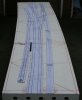
To keep the "Curve-spotters" happy here are two pictures of the current state of play, taken this morning in a temperature of around 4 degrees C (there is dedication for you). The first photo is of the station from the London end (LHS of plan).
templates1.jpg

"Real" templates in the majority with my effort to the right hand side. Once I was happy with the lay of the land for the Up Goods Line I went over the centreline of that track with a permanent marker....

.... cut some strips from the offcuts of the template printout.
.... taped the paper over the marked centreline.
.... traced the line from the baseboard onto the paper strip.
.... added the outline of the ballast shoulder.
.... cut strip along edge of ballast.
.... stick paper to the foam.
.... stick paper / foam to the baseboard.

That there is no indication of rail / sleeper positions is not a problem given my methods of constructing track - the jig includes the centreline of the assembled track and that datum is transferred to the sleepers so I can lay the rail/sleepers "to the centreline" on the board.

And from the country end of the station:-

templates2.jpg

The kink in the ballast to centre right is not a mistake.... that is the curved catch point to protect the entry to the down loop. As there is no commercial template for this sort of thing I have made my own. Take an A5 LH template and cut out the rail and timbers from the toe of the turnout to the heel end of the switches (the first joint in the stock rails). The templates have the centrelines of the through and diverging routes plotted and that helps with the next step. Cut the "switch" template between each pair of timbers and retain the centreline for each timber. Stick the strips onto a piece of paper upon which is marked the required centreline of the through road, aligning the centreline of each "timber" strip with the underlying paper.

What might not be obvious from either the photos or the description so far is that the track templates were supplied as 19 sheets of paper, each sheet being roughly 50cms x 100 cms in size. Thankfully each sheet had been printed with register marks in the corners to assist with the task of aligning the templates on the baseboard. As an interim step in the evolution of the layout plan and track templates I had been given a Templot print file for the initial station plan, I printed the Templot drawing on A3 paper and stuck the 40 or so sheetsa together to create a full-size, draft, plan and that plan was used to determine the orientation of the final templates on the baseboard. No way was I going to commit to sticking the final track templates to the baseboard without having had a trial run - and that trial run was beneficial as the result showed that the platform roads crept towards the baseboard edge. So the draft plan was "slewed" at one end, by about 2cms, to increase the space between the platform and baseboard edge. Wonderful what can be achieved with a tape measure, a permanent marker and helpers to hold the plan.

regards, Graham

 

28ten

Guv'nor
Cracking work :thumbs: that is going to look pretty darn good in S7. You weren't tempted to get it all printed in a roll?
I do think that however much Templot or 3d cad work is done in preparation, nothing beats the final dry run for sorting out and tweaking.
 

Dog Star

Western Thunderer
You weren't tempted to get it all printed in a roll?
I do think that however much Templot or 3d cad work is done in preparation, nothing beats the final dry run for sorting out and tweaking.

In hindsight - producing the track plan from a roll plotter might have been a good idea as getting alignment across so many joins has been really time consuming. With three sheets to span the baseboard width and seven sheets to cover most of the baseboard length then that means about 44 sheet-sheet joins to align. On the other hand, without cutting the track plan, how would one get the foam in the correct place let alone position and stick the paper to the foam? Sounds like a good subject for a "compare and contrast" topic!

BTW - in passing, I have yet to find any part of the track plan where the track is straight for more than a couple of inches.

regards, Graham
 

Dog Star

Western Thunderer
Ah yes, the knitting needles. Has your good lady forgiven you yet!:cool::p
Well done Rob, clearly paying attention there. Well, whilst you have been sailing the world I have been searching the charity shops here, there and everywhere... at least I now know which of those shops sell knitting needles although one has to ask as they are kept under the counter in a plain brown wrapper. Quite who has decided that the simple, honest, knitting needle is a threatening weapon in the wrong hands - who would have thought it of little old ladies.

regards, Graham
 

Dog Star

Western Thunderer
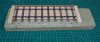
Here is the first track for the LNWR station... trial runs of the assembly jig for track with 30'0" rails and 10 sleepers (of 10" width and 9'0" length). The sleeper arrangement is from the HMRS "LNWR Livery Register" which seems to be appropriate for plain, straight, track that was laid circa 1890. The model track is steel rail and ABS chairs from Exactoscale and walnut sleepers (now available from the S7 Group Stores).

The first photograph shows a piece of track after the chairs have been fixed to the sleepers and before the rail-alignment pegs have been added to the base. Construction of this jig, including the magic ingredient, will be covered soon.

The lower pine strip holds the sleepers against the MDF fence, the pine strip is removable to assist in getting the track out of the jig without damage to the track.


track-jig-with-track.jpg

The second photo shows the jig after removal of the pine strip and reveals that the ends of the sleepers project beyond the MDF support strip. A strip of ply is inserted into the gap and used as a lever to raise all of the sleepers at the same time thereby making track removal an easy task - the "fit" of the sleepers and ply spacers is such that sliding the track sideways can lead to some sleepers "sticking" with the result that a shearing/twisting moment is set up and chairs come unstuck. The holes in the base are for the dowels in the pine strip... I have yet to add the third dowel which acts as a "fooling pin".

track-jig-with-track-2.jpg

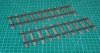
And so to the product... two panels of LNWR track circa 1890, 30' rails and 10 sleepers per panel. The steel rail has been blackened and the chairs have been painted - all before assembly. There is a difference in the colouring of the chairs:- one panel has a medium orange rust colour to represent track which has been laid in the recent past, say 5 years, one panel has a darker rust colour to represent track which has been laid for some time, say 15-20 years.

lnwr-30-track.jpg


And now on to the next jig for LNWR track with 60'0" rails and 24 sleepers per rail.

regards, Graham
 

Rob Pulham

Western Thunderer
Graham,

This may end up being a stupid question but given that the bulk of the lines are curved and you are making straight sections in your jig. How do you curve them? My thought and this will determine whether the questions is stupid or not, is that you would perhaps ultimately bend the straight sections much like flexi track?
But that then begs the question of how you retain your accurate sleeper spacing given that you have gone to all the trouble to make jigs to ensure they are correct in the first place.

Or I am completely off track (pardon the pun) and I live up to being stupid.:eek:
 

Dog Star

Western Thunderer
This may end up being a stupid question....

....and I live up to being stupid.

Surely the only question which is a stupid question is a question which is not relevant.... any other question creates communication and elicits information.

....given that the bulk of the lines are curved and you are making straight sections. How do you curve them?

My thought .... is that you would perhaps ultimately bend the straight sections much like flexi track?

But that then begs the question of how you retain your accurate sleeper spacing given that you have gone to all the trouble to make jigs to ensure they are correct in the first place.

The root question here is "how do you lay track on a curve when the jig produces straight track?". Tricky this one, for you are perceptive in seeing the quandry. The answer is that I use the jig to produce straight track which can be laid directly and to produce curved track (in a straight form) which needs sorting. The key to this puzzle lies in some statements made much earlier in this topic and in the final step of jig manufacture - the infamous knitting needles.

All of the Exactoscale templates are marked with the centre line of the track (both main and diverging routes for turnouts) and I lay the track to the centre lines - notice the odd "template" which I created for the Goods line... just a curved strip of paper with the centre line of the required formation. Each piece of assembled track is marked, whilst in the jig, with the centre line on the sleepers - just a slight "nick" with a HB grade pencil from a "centre line" on the sleeper spacers (and yet to be done when the jig was photographed earlier). So the track for use in straight parts of the templates goes from the jig direct to the formation and uses the pencil "nicks" on the sleepers for alignment.

When track is being made for a curved part of the layout then the second rail is not affixed to the sleepers in the jig. The first rail is located by the pegs, knitting needles and that ensures that the rail is at the correct position relative to the centre line of the sleepers. After the chairs have become fixed firmly to the sleepers then the retaining pine strip is removed from the jig and the sleeper ends are raised to release the sleepers with one rail attached (the friction between sleepers and jig is sufficient to shear the joint between chair and sleeper if the sleepers are slid sideways). This "half-track" can then be curved, gently, to the required radius and laid to the centre line of the formation.... with the rail to the outer side of the curve. The second rail is then curved, gently, to approximately the radius of the inner rail of the curve and secured by use of several track gauges.

Dependent upon the radius of the curve, the inner rail may need adjusting to length before laying. Or, as per the prototype, allow the inner rail to creep forward relative to the outer rail until the inner rail leads by 1.5" (prototype) whereupon the next inner rail is cut shorter by 3" so that the inner rail is then trailing by 1.5". As is often the case, the prototype often had practices which, based on years of experience, saved time and effort. In this case the use of an occasional "special" rail reduced the amount of cutting (when laying) and sorting (when re-using) of rails.

regards, Graham
 

Dog Star

Western Thunderer
The walnut sleepers are excellent, much better looking out of the box than ply or plastic

Humm, time for some investigative journalism then.

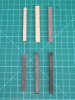
As I build track for different layouts / people then I end up with different sleeper material and with different finishes to the sleepers. In the next photograph are examples of some raw and prepared sleepers which have crossed the workbench this past year. The top row shows material as received: Exactoscale ply to the LHS, Perfect Miniatures Lime in the centre and Walnut to the RHS. The bottom row shows:- Exactoscale ply which has been treated with Precision Paints enamel paint to LHS, Lime treated with shoe dye (Steve Cook's recipe) in the centre and Lime treated with wood spirit stain to the RHS.
sleeper-compare.jpg


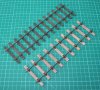
The next photograph shows GWR 32' length made with sleepers of Exactoscale ply treated with spirit stain and LNWR 30' length made with untreated walnut. Unfortunately, all of the samples of track made with Lime sleepers went to Adrian and so I could not include treated Lime in the same photo as the ply and walnut track.
gw---lnwr-track-compare.jpg


However, I did take a photo of some track with treated Lime sleepers before the samples departed. In the third photo the sleepers are Perfect Miniature Lime... just not sure if the treatment was shoe dye or spirit stain. Rail by Exactoscale, chairs by C&L and Oak keys by.... Humbrol. Madness, pure madness.
BF-track-panel.jpg


My preference is Exactoscale ply treated with dark Oak wood spirit stain. Len's sleepers are cut by laser and are consistent in all dimensions, hence no problems with individual sleepers fitting the assembly jigs. Spirit stain colours the wood quickly and with depth, diluting the stain offers results with varying shades/tones/intensity.

Poll anyone?

regards, Graham
 

28ten

Guv'nor
Imho the least convincing is the lime. my gripe against ply is that the end grain can look like ply, the walnut is might be better suited to more distressed sleepers whereas the ply looks better maintained.
 

Dog Star

Western Thunderer
... my gripe against ply is that the end grain can look like ply, the walnut might be better suited to more distressed sleepers whereas the ply looks better maintained.

What you say about the ply laminations being visible on the side/ end is true.... and if the sleeper ends are exposed as with some prototypes in Victorian / Edwardian days then the appearance may suffer. My modellng interest is GW&GC Jt circa 1910 so the prototype had ballast level with the top of the sleepers and ends banked with ballast.

The walnut sleepers have a visual "hardness" to their edges and the surface is very smooth so getting a worn and distressed appearance is going to be difficult.

Of the three (ply / lime / walnut), I think that the Lime is going to give the best result for worn and weathered sleepers.

regards, Graham
 

adrian

Flying Squad
Imho the least convincing is the lime. my gripe against ply is that the end grain can look like ply, the walnut is might be better suited to more distressed sleepers whereas the ply looks better maintained.
Why do you say the lime is the least convincing? The only reason I ask is that I'm just making up a short S7 demo board and I've used the Perfect Miniatures lime sleepers! Too late to change now though as the glue is drying! The only difference is that I've used Rustins Ebony wood stain rather than the dark oak which I didn't think was dark enough. I'll have to dig my camera out and post a few pictures for comparison.
 

28ten

Guv'nor
Why do you say the lime is the least convincing? The only reason I ask is that I'm just making up a short S7 demo board and I've used the Perfect Miniatures lime sleepers! Too late to change now though as the glue is drying! The only difference is that I've used Rustins Ebony wood stain rather than the dark oak which I didn't think was dark enough. I'll have to dig my camera out and post a few pictures for comparison.
From the photos the grain looks a little more coarse, this may not be as apparent in real life ? I have heard somewhere that balsa looks good for sleepers, basswood could be a possibility as well.
Graham, you should have the option to start a poll when you post a reply, if not I can start one in a new thread once Adrian has taken a couple of shots for comparison
 

Dog Star

Western Thunderer
From the photos the grain looks a little more coarse, this may not be as apparent in real life ? I have heard somewhere that balsa looks good for sleepers, basswood could be a possibility as well.
Guv'nor, you are correct regarding the grain of the Lime sleepers, more pronounced and rougher than the Walnut ones. Herein lies the quandry.... I feel that the Lime is too grained for "just laid" track whilst the Walnut is too smooth to be anything other than "brand new". Surprisingly, both respond to some sanding with, say F1 grade Oakey - neither Lime nor Walmut have been so treated in the photographs.

regards, Graham
 

adrian

Flying Squad
Graham, you should have the option to start a poll when you post a reply, if not I can start one in a new thread once Adrian has taken a couple of shots for comparison
Well these are my rudimentary efforts. My method is
1. print out the templot template.
2. lay a thin strip of double sided sticky tape along the rail lines.
3. lay Perfect Miniatures lime sleepers onto the sticky tape.
4. paint sleepers with Rustins Ebony woodstain.
5. Steel rail from Exactoscale, paint Casey's gun blue along the sides.
6. Thread Exactoscale chairs onto the rail.
7. Lay one rail down and use Butanone to glue chairs to sleepers - leave to dry.
8. Lay own second rail using necessary track gauges, from S7 stores.
9. Use 50/50 copydex and water to glue Exactoscale foam underlay on board.
10. Remove track from template, use template to put location pins on foam underlay.
11. Use copydex mix to glue down track panel on underlay, use weights whilst it dries.
12. Lay ballast dry ( first layer can go down with the track panel) copydex to fix.
13. Railmatch weathered black used to dry brush on chairs to tone down chairs.

So the first photo is sleepers stained and glued down. The second with ballast and chairs painted. The effect I'm looking for is 1950's well used suburban track - separate post to follow will explain a bit more.
stage1.JPGstage2.JPG
 

Jordan or Plymouth Mad

Mid-Western Thunderer
I have heard somewhere that balsa looks good for sleepers, ...
I apologise for lowering the tone of this thread, as I realise that track laid like mine is the model railway version of the AntiChrist for you S7 guys, but just out of interest (hopefully), balsa wood is what I used for ties (sorry, sleepers) on Schiller Point...
Cue gratuitous picture posting...
f8ebbc29.jpg

IMG_0006-1.gif
 
Top