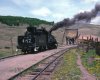
Hartley Hills, LNWR c1900 - buffer stops, how do you build yours?

Jordan or Plymouth Mad

Mid-Western Thunderer
The 'spikes' are Peco N scale track pins... :confused: ... the rail is Code 100 (yes, with O scale!!) and the turnouts are 2 foot (24") radius :eek: ...am I lowering the tone now?!?!... :D
 

Jordan or Plymouth Mad

Mid-Western Thunderer
Just inconsistently thinned black enamel, with a bit of gloss added for oily areas. I did them after laying in position; the thinned paint soaks in under the rails okay.
 

adrian

Flying Squad
I apologise for lowering the tone of this thread, as I realise that track laid like mine is the model railway version of the AntiChrist for you S7 guys, but just out of interest (hopefully), balsa wood is what I used for ties (sorry, sleepers) on Schiller Point...
Cue gratuitous picture posting...
No apologies needed, it looks good and right for the situation. It looks better than this standard of track laying, cue more gratuitous picture posting.
Cumbres.jpg
 

Dog Star

Western Thunderer
John, the owner of the LNWR layout for which I am building track, has decided to join WT - so that he can see the photos and keep up-to-date on the progress. I have asked Cynric to rename the topic in line with John Lewsey's choice of "Hartley Hills". However, due to some serious humour from another member of WT I shall not be removing comments about either the previous name or parentage of the road to nowhere (oopps, sorry Telford).

regards, Graham
 

Dog Star

Western Thunderer
In preparation for the next episode in "Hartley Hills - a sleepy-down-town on a road-to-nowhere" I have replaced the station plan with a drawing that has annotations for the up and down lines plus an initial attempt at numbering of the turnouts. As I am not that knowledgeable in how the LNWR would have given names / numbers to such aspects of a plan, let alone getting the layout signalled correctly, I invite WT readers to offer comments and / or suggestions on the following:-

* the arrangement of signals (given that there is an expectation of a No.2 signal box);
* the arrangement of the signal box levers with respect to the track layout;
* the locking between levers.

Thank you for your help in these matters, Graham
 

Dog Star

Western Thunderer
Previously in Hartley Hills we have read of the first lengths of track being produced to prove the LNWR 30' assembly jigs (see post no. 29) and as that task was succesful the next step in creating plain track is to make a similar jig for track lengths with 60'0" rail. One jig for plain track looks much like the other track jigs in the drawer so time to consider the turnouts.... and the details thereof.

The design brief for the turnouts was to use 1:8 crossings and "C" switches as a minimum wherever possible and that brief was achieved albeit with some modifications. As the station is on a continuous curve the intention of retaining consistency in crossing angle and switch length was in conflict with the need to introduce divergence on tightening radius (for example up slow to up fast) whilst maintaining flowing curves and BoT statutory clearances between running lines. The result of the design is turnouts using crossing angles and switch lengths as follows, with reference to the station plan in the first post:-

[1a] - C8
[1b] - C7.5
[2] - A switch, no crossing
[3a] - D8
[3b] - C8.5
[4a] - C8.25
[4b] - C8
with a diamond of 1:8.

Whilst I have used REA terminology for the switches the modelling will follow contemporary LNWR practice where known. Contemporary? ah, yes.... whilst the period for the station is circa 1905-10 that does not mean that all of the track was laid in one day and so there is an opportunity need to consider how the prototype station layout evolved over time. Placing Hartley Hills on the LNWR main line between Birmingham and Stafford means that the through roads of the station were installed at an early date and have been subject to heavy traffic ever since. The LNWR introduced 60'0" steel rails circa 1894 and there is a good probabilty that the Stafford road had been relaid with 60'0" rails / 24 sleepers per rail by 1905. Hence the model of Hartley Hills station will echo to LNWR Jubilees thrashing over track laid to 60' (24 per) with the turnouts (1a, 3a, 4a) and the diamond built to LNWR practices of the Edwardian period (need something to support the pounding of the Brush Type 4s).

Passenger growth at Hartley Hills was substantial in the 1880s and 90s so the LNWR provided platform loop lines to allow the slow passenger services to stand out of the way of the express services. The platform lines have not been subject to the same degree of use as the through lines and hence those tracks have retained the 30'0" rails with 10 sleepers per rail of the early 1890s. Similarly the turnouts in the down loop (1b, 3b) and the up loop (4b) are still laid to LNWR practices of the nineteenth century. Indeed, there is a rumour amongst the old gangers that if one was to walk the length of the carriage siding then there is a good chance that one might just find some track which was laid when trains were lighter (and hence the rails were shorter). Actually, "Albert" the Head Ganger for this section is quite proud of that piece of track for, as he is want to say after an evening in the The White Hart, no accidents have ever occured on that section of his patch.

Time moved on and the desire for coal grew and with that desire came more and longer mineral services... plodding along the Up as only Webb's equivalent of the "Iron Lung"s could plod. This growth in coal traffic brought much revenue with a corresponding impact on the passenger services from those hard-worked and weary 0-8-0s pulling dragging recalcitrant grease-box coal wagons. To bring "relief" to the operational side the LNWR Directors determined that something had to be done and hence the headshunt on the Up side was re-laid and extended to form a Goods Line towards the Black Country. Ever watchful of the purse strings the new Goods Line, opened in 1896, was laid with 30'0" rails (for there was a substantial stock of the shorter rails when Crewe commenced rolling 60'0" rail).

So there you have it... the historical background to the permanent way of Hartley Hills. How close the model will be to the practices of that long gone age remains to be seen, just do not expect that the track is going to have hex-headed chair screws with the Webb "pip".

Off to the local to join Albert (living out his dotage) albeit the fug of old has long gone and The White Hart is now known as the "Slug and Tractor".

regards, Graham
 

Rob Pulham

Western Thunderer
Surely the only question which is a stupid question is a question which is not relevant.... any other question creates communication and elicits information.


The root question here is "how do you lay track on a curve when the jig produces straight track?". Tricky this one, for you are perceptive in seeing the quandry. The answer is that I use the jig to produce straight track which can be laid directly and to produce curved track (in a straight form) which needs sorting. The key to this puzzle lies in some statements made much earlier in this topic and in the final step of jig manufacture - the infamous knitting needles.

All of the Exactoscale templates are marked with the centre line of the track (both main and diverging routes for turnouts) and I lay the track to the centre lines - notice the odd "template" which I created for the Goods line... just a curved strip of paper with the centre line of the required formation. Each piece of assembled track is marked, whilst in the jig, with the centre line on the sleepers - just a slight "nick" with a HB grade pencil from a "centre line" on the sleeper spacers (and yet to be done when the jig was photographed earlier). So the track for use in straight parts of the templates goes from the jig direct to the formation and uses the pencil "nicks" on the sleepers for alignment.

When track is being made for a curved part of the layout then the second rail is not affixed to the sleepers in the jig. The first rail is located by the pegs, knitting needles and that ensures that the rail is at the correct position relative to the centre line of the sleepers. After the chairs have become fixed firmly to the sleepers then the retaining pine strip is removed from the jig and the sleeper ends are raised to release the sleepers with one rail attached (the friction between sleepers and jig is sufficient to shear the joint between chair and sleeper if the sleepers are slid sideways). This "half-track" can then be curved, gently, to the required radius and laid to the centre line of the formation.... with the rail to the outer side of the curve. The second rail is then curved, gently, to approximately the radius of the inner rail of the curve and secured by use of several track gauges.

Dependent upon the radius of the curve, the inner rail may need adjusting to length before laying. Or, as per the prototype, allow the inner rail to creep forward relative to the outer rail until the inner rail leads by 1.5" (prototype) whereupon the next inner rail is cut shorter by 3" so that the inner rail is then trailing by 1.5". As is often the case, the prototype often had practices which, based on years of experience, saved time and effort. In this case the use of an occasional "special" rail reduced the amount of cutting (when laying) and sorting (when re-using) of rails.

regards, Graham

Thanks Graham, that makes it all clear and, to quote you quoting some one else "Simples" - when you know how!
 

Buckjumper

Flying Squad
Hobbycraft sell knitting needles - you'll find one in Winchester Road in Basingstoke. My tribe went looking for crafty items with paternal grandparents and came back with several balls of wool the size of footballs.

I'm now expecting a scarf of Tom Baker proportions.
 

Dog Star

Western Thunderer
Hobbycraft sell knitting needles - you'll find one in Winchester Road in Basingstoke.

True, on both counts. I try to avoid the place on principle, everything in that shop seems to carry a price tag beyond rhyme or reason (or, in some instances, belief).

My tribe went looking for crafty items.... ...and came back with several balls of wool the size of footballs.

Could be a knitted Indian Headress with feathers from felt...;) Actually a humungus scarf would be of greater benefit to you for the times when you have to walk those dark and dank alleyways of Basilica Fields.

regards, Graham
 

Buckjumper

Flying Squad
True, on both counts. I try to avoid the place on principle, everything in that shop seems to carry a price tag beyond reason.

My parents are quite happy to squander my inheritance on my children...:rolleyes:

Could be a knitted Indian Headress with feathers from felt...;) Actually a humungus scarf would be of greater benefit to you for the times when you have to walk those dark and dank alleyways of Basilica Fields.

There are far greater concerns in the alleyways of BF than the cold and dark. Tap tap tap tap...ooeeeoohh.
 

Ressaldar

Western Thunderer
SWMBO took me into Voirrey Embroidery at Brimstage (just off J4 on the M53) on Saturday and on display were knitting needles - the 8mm dia x approx 175 long - pack of 5, was around £3 from memory - you could fit out a lot of tenders for that.

cheers

Mike
 

Dog Star

Western Thunderer
Ahhhh!!!! That phantom raspberry... an extract from the venerable Wiki....

""The Phantom Raspberry Blower of Old London Town was a serial written by Spike Milligan and Ronnie Barker that ran every week on The Two Ronnies sketch show in 1976 on BBC One. It featured a Jack the Ripper style madman stalking the streets of Victorian London, who killed or stunned his victims by blowing them a raspberry. The title was preceded by the words "Chopper Films Presents". ""

So, the railway link continues with yet another reference to the popular Class 20.

[Thank you Richard, corrected.]
 

Dikitriki

Flying Squad
I thought 'choppers' were class 20s.

However, closer to home perhaps (yours anyway!), are the LNWR Chopper 2-4-0 tanks.

Regards

Richard
 

Buckjumper

Flying Squad
I thought 'choppers' were class 20s.

Remember Dog Star resides in Edwardian times and information gleaned through Project Exordium is limited by the total informational capacity of the superposition state. In effect, it's a bit hit and miss. Besides which he is a follower of Heisenberg, not Everett, and that really doesn't help his case at all.

Meanwhile, back on planet Earth...
 

Dog Star

Western Thunderer
Remember Dog Star resides in Edwardian times and information gleaned through Project Exordium is limited by the total informational capacity of the superposition state. In effect, it's a bit hit and miss.

My brain hurts after trying to get my head around that one.:confused:

Besides which Dog Star is a follower of Heisenberg, not Everett, and that really doesn't help his case at all.

Are you sure? Are you certain?

However, Adrian, even with your ability to manipulate Tardis and determine the probability of choosing the same flavour jellybean twice in succession from an un-openable box of Berty Botts "Every Flavour" beans, as seen in every self-respecting Mark 1 compartment.... your suggestion as to those I "follow" might be a tad "over -the-head" for one or two WTers.

Have you read Wave Mechanics Without Probability by Hugh Everett III ?
 
Top