Hartley Hills, LNWR c1900 - buffer stops, how do you build yours?

Eastsidepilot

Western Thunderer
.........I thought that most members of the S7 Group were au-fait with track building as an Olympic sport a general activity ......................
regards, Graham

Graham,
Even if some of us are "au-fait" mate it's still nice to read what others in the group are doing and how they do it:thumbs: , and of coarse so will the people who have not built track.

ATB, Col.:)
 

Jordan or Plymouth Mad

Mid-Western Thunderer
My initial thoughts revolve around ......

[2] the jigs and gauges which are necessary / desirable for producing reasonable trackwork.
Inject a bit of humour, and contrast the Proper Way to make track with the sort of abominations some other people use to make track.... y'know, track gauges from softwood, rails that may or may not be somewhere near correct gauge, that sort of thing. and remember, you saw it here first....:D
WR3012.gif
f8ebbc29.jpg

Returning to the Back now......:oops:
 

Dog Star

Western Thunderer
Inject a bit of humour,,, ,,, and remember, you saw it here first....

Not sure about that, I am sure that I have seen the Deluxe Jordan Jig in another model railway magazine (the printed variety) - you know, the version which holds four rails at once. So now you get the facility to (mis-)gauge the running rails of two tracks whilst trying to ensure a plausible explanation for carriage collisions on curves below minimum radius.
 

Dog Star

Western Thunderer
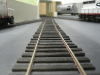
Things have moved... actually a G2 has moved... all of five feet along the Goods Line... and a reporter from the Hartley Hill Examiner was on hand to record the event. There has not been much practice with the new-fangled, hand-held, cinematograph recording device and the resulting 2 minute video is in excess of 256MB... not the stuff to post to an inbox.

What are considered to be acceptable attributes for a video clip to be included in a thread? For example:- maximum file size, file format, video quality.

Thanks for assistance, Graham
 

Buckjumper

Flying Squad
Upload to You Tube and put the link on here. YT can now handle files up to 20GB, and the built-in compression, although not the best*, works well enough.

* © Understatements R Us
 

Dog Star

Western Thunderer
In post #124 noted that the CCE dept had moved on and the formation had been returned to the PW dept., well the truth behind the statement is not that simple. The baseboards for Hartley Hills have been built on "modern" traditional lines with 6mm ply top on 6" deep sides / ends and diagonals. Sides and ends have been built on the "Barry Norman" approach. All of this can be seen in an early photograph where the sides / ends / diagonals were drawn, in red, on the top surface of the baseboard.

All seemed tickety-boo when the boards were delivered in Autumn 2011... by Christmas the top surface had sunk between the cross-members, how much depended upon the distance between the cross-members. Suffice to say that the biggest drops occured close to the toe of switches - not a good recipe for smooth and predictable operation of turnouts. Given the time spent in setting out the formations and in laying the timbers there was a vested interest in not starting again and so the existing baseboard was re-inforced by ply inserts added underneath the top surface. By selective use of the grain and curve of the new panels the extra material was affixed to the original board so as to "level" the game.... and consume a fair number of screw to produce a composite structure.

The formation is reasonably flat and fairly rigid so PW work has re-started without worry that the ups and downs might reappear.

The Up Goods line on board no.2 has been laid and the curve looks very attractive. Next step is to complete the Up Loop to Up Main turnout and then the section towards the Up Main... whilst commencing CCE tasks on board no.1 and preliminary PW work for the goods line extension.

Sorry this is in Black and White.... video practice is continuing. So far a LNWR eight-coupled tender engine has done s bit of road rolling (well that is my excuse - the prototype would often run goods services on new lines, to settle the formation, before starting passenger services), maybe a Jubilee ought to make a trip given that this is a Jubilee year. I keep hearing pleas for a Brush Type 4 to take the road, need more power for that than is possible with a 30 year old Hornby controller.

regards, Graham

 

Dog Star

Western Thunderer
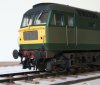
Up t'north, beyond Brum, something has stirred... the Hartley Hill Examiner was on hand again to record the scene.

b47-3 jpg.jpg


Bit of a bruiser and a very, very, nice colour.
 

Dog Star

Western Thunderer
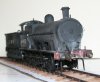
The Hartley Hill Examiner sent a reporter down to the station to see what was what and he stayed around for a few minutes... or, more like it, found a comfy seat in the nearby hostelry. The poor chap had just got settled when there was the unmistakable sound of a sight which was very common at one time. that of a LNWR eight-coupled goods wheezing and groaning at the head of a lengthy mineral train.

g2-front.jpg


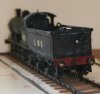
After the passing of the mineral the reporter retired to the Snug once more and looked longingly at the face behind the bar. In too short a time the tired old engine returned and another snap was shot....

g2 tender.jpg

So now we know... take a bike just in case (of failure?).

regards, Graham
 

Rob Pulham

Western Thunderer
The Hartley Hill Examiner sent a reporter down to the station to see what was what and he stayed around for a few minutes... or, more like it, found a comfy seat in the nearby hostelry. The poor chap had just got settled when there was the unmistakable sound of a sight which was very common at one time. that of a LNWR eight-coupled goods wheezing and groaning at the head of a lengthy mineral train.

View attachment 12677


After the passing of the mineral the reporter retired to the Snug once more and looked longingly at the face behind the bar. In too short a time the tired old engine returned and another snap was shot....

View attachment 12678

So now we know... take a bike just in case (of failure?).

regards, Graham
Nice to see in in a proper livery too:thumbs:

Ducking rapidly for cover:p
 

John D

Western Thunderer
Nice to see in in a proper livery too

Nah! the proper livery came with a nice cabside numberplate and none of your fancy red tender bufferbeam......silly place to put a bike B.T.W. ...C.J.B.C. would not have been amused :eek:
 

Dog Star

Western Thunderer
To add to John's post.... the engine moves with a serenity which belies its age and is better than what one would expect from the prototype. My photograph does not do justice to the model for the photo was taken to show:-

(a) the bike at the rear of the tender, and;
(b) the engine sitting at the end of the Up Goods line as that is the current limit of "current".

The camera is a Canon 350D and I have yet to work out how to get increased depth of focus. Further photos of the engines will follow as the track extends back and forth along the baseboards.

regards. Graham
 

Dog Star

Western Thunderer
A problem which comes from exploring the LNWR Switch and Crossing practice of the late 19th century is the paucity of information.... I have one drawing of a 20' switch from a report of the International Railway Congress in Paris 1900 and one photo of Colham yard circa 1890 (Pilcher, LNWRS).... hence a fair bit of interpolation is necessary. The photo shows that the LNWR did not have a bridge chair circa 1890 and so, in the area of the switch heel, there is insufficient space for two adjacent standard chairs on the same timber. The IRC report shows that the LNWR was using 14" wide timbering in the 19th century and other information indicates that the LNWR had a narrow width version of the standard chair.

So, by judicious use of a file, standard chairs can be reduced in width until two such chairs can sit on the same timber. The photo below shows the first couple of attempts at creating the narrow chairs.

narrow chair.jpg

OK - not too clever with the right hand pair of chairs, the left hand pair is acceptable. Whilst the "test" chairs are shown on an actual turnout I shall replace the examples before progressing further. The next step is to work out where the LNWR changed from block chairs to narrow chairs and then from narrow chairs to standard chairs (and of course, the answer is dependent upon the switch length). Most of the Hartley Hill turnouts have 15' 0" switches (which equates to REA "C" switch), there is one turnout which shall have either a 18'0" or 20' 0" switch... at the moment I just do not know if the LNWR used 18' 0" switches given that the IRC drawing shows 20' 0" switch blades... is any WT reader a member of the LNWR Society and who can check on the appropriate PW drawing in the LNWRS archive?

And then? Photos suggest that the LNWR used loose heel switches pre-1900 and with such a short switch as 15'0" from toe to heel then a method of retaining the switch is required.

regards, Graham
 

Buckjumper

Flying Squad
The camera is a Canon 350D and I have yet to work out how to get increased depth of focus. Further photos of the engines will follow as the track extends back and forth along the baseboards.

You're hamstrung by the size of the sensor (about 23mm x 15mm IIRC) for close-up work, so you'll need to do some experimenting. Zoom right out and pull back away from the model - try 3 - 4 ft and shoot at the highest res. Then once on the computer crop then resize.
 

Steve Cook

Flying Squad
Not trying to teach you to suck eggs Graham, but if you manually focus at around 1/3 of the distance along the loco that will also help - I've been told that the depth of field generally extends 1/3 forward and 2/3 back from point at which you are focussed - its certainly helped me to get better shots (when I remember!). You'll still need to follow BJ's suggestions, but worth trying the two ideas together.
HTH
Steve
 

Wagonman

Western Thunderer
Not trying to teach you to suck eggs Graham, but if you manually focus at around 1/3 of the distance along the loco that will also help - I've been told that the depth of field generally extends 1/3 forward and 2/3 back from point at which you are focussed - its certainly helped me to get better shots (when I remember!). You'll still need to follow BJ's suggestions, but worth trying the two ideas together.
HTH
Steve


The other option – given a static subject and a Windoze PC – is to use software like (and here I'm groping in the long grass of memory) 'Helicon' to stitch together a series of shots taken at different points of focus. A quick Google has just brought up http://www.heliconsoft.com/ This can theoretically give you almost infinite depth of field. Yes I know it's cheating but the alternative is get out your old monorail camera and use swing front to get the Scheimpflug effect. You don't have an old monorail camera?:(
 

Dog Star

Western Thunderer
I had taken a photo of the front of the G2 at the same time... and chose the tender view because of the 'bike. So to be fair to the engine, here is the front view:-

g2-front.jpg

I ought to have looked before clicking the shutter.... that hook annoys me.

regards, Graham
 

Eastsidepilot

Western Thunderer
Hi I'm John lewsey I would like to mention that the G2 is over twenty years old .I have seen this loco at exhibitions for years and have recently become friends with its owner who's eye sight has deteriorated and is starting to sell some of his models .so I purchased this one and am also buying a coal tank .this old engine really does look like a lumbering old engine when you see it moving even the baseboards rumble . wounderful
Hi John, welcome to the forum mate, is the G2 a scratch build?

Col.
 
Top