
You are using an out of date browser. It may not display this or other websites correctly.
You should upgrade or use an alternative browser.
You should upgrade or use an alternative browser.
Threadmarks
View all 201 threadmarks
Reader mode
Reader mode
Recent threadmarks
. . at NEEGOG (9 May) Experiments with wheel profiles . . part 1 of 2 New . . battery endurance New NER class H2 . . charging New Manning, Wardle "Lady Marion" . . "Poover" battery and terminals New Experiments with wheel profiles . . part 2 of 2 New Wagon wheel to run on 0-F, 0-MF and (regauged) S7 New GER sand wagon New

RichardG
Western Thunderer
I have had a go at painting the quarry block wagon. I am sure I have chosen a period with more than its fair share of unpainted wood.
View attachment 243161
The small black line on the buffer is a trick of the light, it isn't there on the model.
View attachment 243159
I didn't see the wood grain detail in the solebars until I looked at these photos.
I am actually quite pleased with this effort but I still want to get better at doing old and weathered wood. However much I look at examples I usually see a little brown in there, if not very much. Hopefuly I can look back on this in a few year's time and see I have got better.
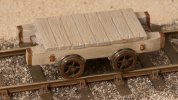 I have tried to highlight the rusted parts of the trolley as suggested by others. The paint is a mix of Vallejo 'smoke' and 'red leather' . . . I am happy with the colour but not with the high contrast against adjacent surfaces. Also I do not have the manual dexterity to paint the edges of the tie bar plates and these are annoying me.
So I have worked on some powder over the offending highlights.
The flash tends to bring out colours, and so the model looks a bit more muted sitting on the layout under its lighting rig. I am sure it was worthwhile doing this last makeover but I think it will be wise to stop here before I go on to spoil things.
RichardG
Western Thunderer
At some point I picked up a good tip to use gunmetal paint, dry brushed, for the darker details, grain, etc., which I find works well.
The dry brushing needs to be really dry - hardly any paint on the brush, and a fairly stiff brush So you can scrub it on. The idea is to pick up the fine texture of the underlying paint, which must be matt.
Given the way the Humbrol gunmetal disolved the Vallejo paint on the model I bought some Vallejo gunmetal and had a go with this. The result looked absolutely dreadful, with dozens of tiny specks of silver making the model look as if it had been brushed with children's glitter paint.
So I guess the brand of paint (perhaps not Humbrol nor Vallejo) is as important as the application technique, which I am still to learn.
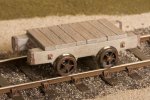
I have repainted the top of the model a third time.
It is probably best for me to welcome advice on painting, but to try it out it on the next model not the current one

Last edited:

RichardG
Western Thunderer
I am treating my model painting as an iterative process, especially for the wagons. I seem to get away with it using acrylic paints and no varnish.
When I painted the ironwork on the trolley and was happy with the result, I re-did the same on the GER ballast wagon. When I worked up the details on the Dapol Terrier and was also happy, I did the same on the Minerva Manning Wardle. So I expect, next time I come to paint something to represent old and weathered wood and I am pleased with it, I'll go back to the trolley.
When I painted the ironwork on the trolley and was happy with the result, I re-did the same on the GER ballast wagon. When I worked up the details on the Dapol Terrier and was also happy, I did the same on the Minerva Manning Wardle. So I expect, next time I come to paint something to represent old and weathered wood and I am pleased with it, I'll go back to the trolley.

magmouse
Western Thunderer
Oh, dear - I feel like the Pied Piper, leading you astray….
I use the Vallejo acrylic gunmetal Paint, and it works for me - as does the Humbrol enamel, if there is no danger of it attacking the underlying paint finish. You might consider it time to stop paying attention to my advice, but if not, then I suggest trying the method on some scrap plasticard. Rub it down with some medium sandpaper to get some roughness and a grain, paint in a ‘new wood’ buff/cream colour, and allow it to set hard (several days). Then apply the gunmetal with an old, stiff brush - something you don’t mind wrecking. Put a tiny amount of paint on the brush, then wipe most of it off on a bit of paper. Apply to the ‘wood’ in the direction of the grain, pressing hard to transfer very small amounts of paint where it catches in the texture. You need to practice having just the right amount of paint on the brush.
Hope that’s of use.
Nick.
I use the Vallejo acrylic gunmetal Paint, and it works for me - as does the Humbrol enamel, if there is no danger of it attacking the underlying paint finish. You might consider it time to stop paying attention to my advice, but if not, then I suggest trying the method on some scrap plasticard. Rub it down with some medium sandpaper to get some roughness and a grain, paint in a ‘new wood’ buff/cream colour, and allow it to set hard (several days). Then apply the gunmetal with an old, stiff brush - something you don’t mind wrecking. Put a tiny amount of paint on the brush, then wipe most of it off on a bit of paper. Apply to the ‘wood’ in the direction of the grain, pressing hard to transfer very small amounts of paint where it catches in the texture. You need to practice having just the right amount of paint on the brush.
Hope that’s of use.
Nick.
Platelayer's trolleys - 3D printed
RichardG
Western Thunderer
View attachment 243002
I have not fitted a sail but I have added some wheels. These are Alan Gibson Lomac wheels with bushes cut from styrene tube to hold them onto the kit axles. Obviously the spoke count is wrong but if I cut out alternate spokes I will have four which is still wrong.
It is good to have something I can roll along the track to amuse myself, but the 3DP wheels by @simond (here) do withstand a longer look.
Early this month I received a message from @simond telling me a wee envelope was on its way to me, and to enjoy it.

I was rather hoping it would be a set of wheels for my ABS Sidelines PW trolley, so you can imagine my delight when it arrived and I saw it contained not only these wheels but the prints to make up two more trolleys as well.
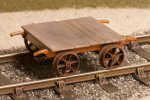
This is my ABS trolley (white metal) with its new wheels.
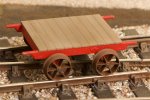
One of the printed trolleys has straight handles. I have painted this one in the style of the one at Bideford. Somehow I imagine this one bedecked with a spotless table cloth and all laid out with tea and cakes for dignitaries. For some special event still gestating inside me.

The second printed trolley has curved handles like my first one. I am keeping this one in primer for the time being. I have set it aside to go with a future project.
The rusted iron colours are a mix of Vallejo 'Smoke' and ‘Red Leather’.
Nellie . . chassis tweaks and painting
RichardG
Western Thunderer
View attachment 167785
One final photo of Nellie to show the subassemblies I mentioned in post 235.
The pivot pin ended up being soldered solid onto the base for the crane, apart from this little changed from how I saw things then. This is as far as the model can be dismantled, apart from changing the wheels or motor or similar.
I have used BA screws to attach the chassis to the body and a metric screw for the trailing axle. They look quite similar at a glance. I would rather not do this again, I need to buy a few BA taps.
I have soldered the two rear sand pipes onto the body. I won't do this again either, they leave the body needing blocks of wood or similar to stand it on the workbench. Some brackets on the chassis would be better.
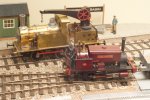
I have returned to my crane tank ‘Nellie’ to make some minor changes to the chassis and to tackle the painting. It is over three years since I built the loco and even I am fed up with the sight of the unpainted brass.
The idea is to tackle three weaknesses in the build:
- The plunger pickups work but they always look as though they are the brink of failure.
- The loco runs well enough but rather noisily. I attribute the noise to having the gearbox frame soldered firmly into the chassis as if it were a frame spacer.
- I never soldered the brake gear into the chassis, it has always been free to slide from side to side.
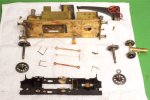 I bought the face flannel to use as padding around a fragile model in a sandwich box, but it holds small parts well so they can go back into their original locations.
I removed the original gear box by slicing through it with a cutting disc, you can see where it was held at the axle bushes and along the tops of the frames.
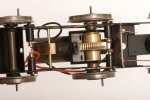
The new plunger pickups are from Premier Components. They are gently sprung but the springs are strong enough to overcome any tensions in the 7/0.1 wires connecting them to the motor.

The replacement motor/gearbox is this single-stage unit from MSC Models.
The only structural addition to the chassis is this length of brass rod going across between the frames. After some experimentation I have decided to leave the motor/gearbox floating, i.e. it is pivotting around the driven axle. When the loco is going forwards, the torque reaction lifts the assembly as it appears here. When the loco is going backwards, the motor drops to rest on the wooden wedge.
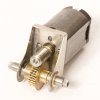
I took the MSC gearbox from a future project so I have assembled the original motor and gears onto a fold-up gearbox to compensate.
Jim Mcgeown (Connoisseur Models) offers two styles of fold-up gearbox: a wide version, designed to be soldered into the frames (like the one I cut out), and a narrow version, designed to make a floating motor/gearbox. For the narrow version, the modeller is left to make arrangements to hold the assembly in alignment on the axle. I used a 0.25 mm shim washer (left) and a slightly shortened Slater's axle bush (right).
The "Jim" gearbox has a big advantage over the MSC one in that you can reach the screws holding the motor without taking out the worm gear. This makes setting up the meshing a lot easier.
This axle is also borrowed from the future loco. I wonder if I will remember where it is when the time comes.
RichardG
Western Thunderer
Painting has been underway for the last ten days or so.


The cleanup was to remove three years of tarnish not the usual flux residues. I used Barkeepers Friend (the cream version), rinsed in running water and then in the ultrasonic bath.

The primer is U-Pol no.8 acid etch primer. After this I painted parts of the cab interior and inside the shell, but I forgot to take any photos.
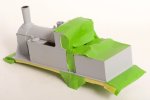
My airbrush is one of the Humbrol fly-spray (external mix) types with a glass jar underneath. This is more controllable than an aerosol, but only a bit. So the masking-up is long-winded.

It is very easy to overthink the livery of a freelance loco. Eventually I remembered, Polly is red, Connie is yellow and Nellie is blue.
The blue is four light passes with the airbrush, these done one after the other in quick succession. The idea is, the paint levels itself off, does not run, and eventually cures. The result was a very wet model, and this one took a full 24 hours to even begin to feel dry.
The gloss is deep enough to make the autofocus struggle so I regard this as success.

The black has a little white mixed into the tin to try to soften the appearance. I would add more white next time. The chimney has now had another coat.

I don’t like seeing tarnish on bare brass so I painted the inside of the body as well. The blue, black and orange so far are all Humbrol enamels.
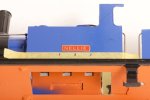
The plates are fixed on with CA glue. I have read, if you fix them with varnish, they usually stay put; but if you fix them with CA they always stay put.
This leaves me the brake gear and the cab interior and putting it all back together. The end is in sight.
The cleanup was to remove three years of tarnish not the usual flux residues. I used Barkeepers Friend (the cream version), rinsed in running water and then in the ultrasonic bath.
The primer is U-Pol no.8 acid etch primer. After this I painted parts of the cab interior and inside the shell, but I forgot to take any photos.
My airbrush is one of the Humbrol fly-spray (external mix) types with a glass jar underneath. This is more controllable than an aerosol, but only a bit. So the masking-up is long-winded.
It is very easy to overthink the livery of a freelance loco. Eventually I remembered, Polly is red, Connie is yellow and Nellie is blue.
The blue is four light passes with the airbrush, these done one after the other in quick succession. The idea is, the paint levels itself off, does not run, and eventually cures. The result was a very wet model, and this one took a full 24 hours to even begin to feel dry.
The gloss is deep enough to make the autofocus struggle so I regard this as success.
The black has a little white mixed into the tin to try to soften the appearance. I would add more white next time. The chimney has now had another coat.
I don’t like seeing tarnish on bare brass so I painted the inside of the body as well. The blue, black and orange so far are all Humbrol enamels.
The plates are fixed on with CA glue. I have read, if you fix them with varnish, they usually stay put; but if you fix them with CA they always stay put.
This leaves me the brake gear and the cab interior and putting it all back together. The end is in sight.

spikey faz
Western Thunderer
That's looking very smart Richard.
I wish I had the patience to set up my airbrush, but I tend to gravitate towards aerosol paints. Less cleaning up afterwards!
Mike
I wish I had the patience to set up my airbrush, but I tend to gravitate towards aerosol paints. Less cleaning up afterwards!
Mike
RichardG
Western Thunderer
I wish I had the patience to set up my airbrush, but I tend to gravitate towards aerosol paints. Less cleaning up afterwards!
I bought myself a length of transparent pvc tube a while ago, I think this is sold for aquariums.
So, when I finish spraying I put a shot of white spirit through to clean the nozzle. Then pull off the dip tube and cut a new one. Wipe around the inside of the airbrush, push on the new tube and it is ready for next time.
RichardG
Western Thunderer
. . .
View attachment 166525
The inner spectacle plate has gone on with offcuts of fret to make a small gap to slip in the glazing. The backhead has a bit more 'presence' now. On the left is the back of the new coal bunker and on the right is space for the reversing lever and a representation of the back of the side tank. I have just noticed the gap above the top of the coal bunker, the driver's bag or a large oil can will have to stand here. The thin ring around the crane spindle holds the gear for rotation clear above the panel to make it look more realistic.
At the moment, the floor and the backhead are loose. After the floor is fixed I won't be soaking the model in hot soapy water, so they will need to be fixed near the end of the build.
I have been looking at my double-skinned spectacle plate for three years, it really is time to finish this loco off.
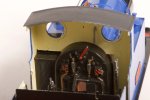
The cab glazing is from one of those spit guards (“face shields”) which we wore during the lockdowns. I think they are polycarbonate, but whatever it is, it hasn’t yellowed so maybe it can last a while longer. The tabs holding the cab roof are slipped into gap above the glazing and fixed with tacky wax to allow subsequent glazing renewal. Sometimes I quite surprise myself with these small bursts of practical thinking.
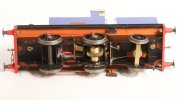
I have tucked some felt inside the body to try to further reduce motor noise. This complements the reductions from having the floating motor/gearbox and the backhead.
I have had fresh problems with the four-coupled part of the chassis . . . these are probably resolved but I want to see the loco running over a distance e.g at NEEGOG. The brake gear makes wheel removal difficult, so I’ll defer adding the brakes until after then.
This means, I can put everything else together . . .

A DCC socket never made it into the space below the crane because the wiring was too restrictive. So the only thing in here is a lead weight on top of the trailing axle. I describe Nellie as a 0-4-2 but mechanically she is nearer to a 0-4+2.

The base for the crane sits on magnets to hold it down. The brass screw engages with the crane to stop it swinging out of gauge during running.
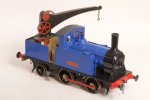
I can still lift the crane to disengage it from the screw, and pose the assembly for photos.

The black line along the bottom of the blue bodywork is a trick of the light, too much gloss I guess.


Nellie will always be my first attempt at a 7mm loco; and also my first loco kit with a chassis. She stands about a millimetre taller than the usual loading gauge, but this doesn't really show - she is much taller than everything else on the line. Thank you everyone for all of the ideas and encouragement on this build.
RichardG
Western Thunderer
The prototype portrayed by ‘Nellie’ is of course unknown, but here are the inspirations for her design . . .
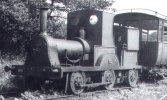
In the late 19th century, the firm of Dodmans in King’s Lynn built a tiny 2-2-2WT locomotive named Gazelle. The locomotive ended up on the Shropshire and Montgomeryshire, where it was rebuild as a 0-4-2WT.
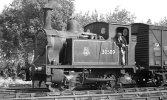
In the early 20th century, the LSWR built a class of 2-2-0 side tank locomotives known as the C14. Some were rebuilt as a 0-4-0 and lasted into BR days.
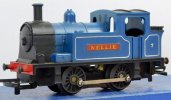 In the 1950s, Tri-ang Railways produced a locomotive similar to a rebuilt C14 but with inside cylinders. Photograph by Elaine Harvey, Elaine’s Trains.
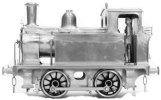
In the late 20th century, Jim Mcgeown (Connoisseur Models) started to produce an etched kit for a Starter Loco inspired by the C14 and the Tri-ang model. The kit is still in production and forms an excellent introduction to locomotive building. Photograph by Jim Mcgeown.
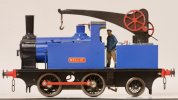
If you then merge a rebuilt C14 and the rebuilt Gazelle together using Jim's kit as the basis, and put a crane from Gladiator Models in the place of Gazelle’s passenger compartment, you get my Nellie crane tank.
A story goes, that Nellie was stored away inside the goods shed at Heybridge after the closure of the railway. On the night of 15/16 April2016 1916, a bomb dropped by Zeppelin L6 (which dropped 34 bombs in the area) destroyed the goods shed and everything inside. I cannot hope to find out anything more about ‘Nellie’, but further embellishments to the model (and the story) are still possible 
In the late 19th century, the firm of Dodmans in King’s Lynn built a tiny 2-2-2WT locomotive named Gazelle. The locomotive ended up on the Shropshire and Montgomeryshire, where it was rebuild as a 0-4-2WT.
In the early 20th century, the LSWR built a class of 2-2-0 side tank locomotives known as the C14. Some were rebuilt as a 0-4-0 and lasted into BR days.
In the 1950s, Tri-ang Railways produced a locomotive similar to a rebuilt C14 but with inside cylinders. Photograph by Elaine Harvey, Elaine’s Trains.In the late 20th century, Jim Mcgeown (Connoisseur Models) started to produce an etched kit for a Starter Loco inspired by the C14 and the Tri-ang model. The kit is still in production and forms an excellent introduction to locomotive building. Photograph by Jim Mcgeown.
If you then merge a rebuilt C14 and the rebuilt Gazelle together using Jim's kit as the basis, and put a crane from Gladiator Models in the place of Gazelle’s passenger compartment, you get my Nellie crane tank.
A story goes, that Nellie was stored away inside the goods shed at Heybridge after the closure of the railway. On the night of 15/16 April
Last edited:

James Spooner
Western Thunderer
And would the embellishments cover how it took a century for the bomb to land…(or possibly just delayed detonation?)…The prototype portrayed by ‘Nellie’ is of course unknown, but here are the inspirations for her design . . .
View attachment 244251
In the late 19th century, the firm of Dodmans in King’s Lynn built a tiny 2-2-2WT locomotive named Gazelle. The locomotive ended up on the Shropshire and Montgomeryshire, where it was rebuild as a 0-4-2WT.
View attachment 244252
In the early 20th century, the LSWR built a class of 2-2-0 side tank locomotives known as the C14. Some were rebuilt as a 0-4-0 and lasted into BR days.
View attachment 244250In the 1950s, Tri-ang Railways produced a locomotive similar to a rebuilt C14 but with inside cylinders. Photograph by Elaine Harvey, Elaine’s Trains.
View attachment 244255
In the late 20th Century, Jim Mcgeown (Connoisseur Models) started to produce an etched kit for a Starter Loco inspired by the C14 and the Tri-ang model. The kit is still in production and forms an excellent introduction to locomotive building. Photograph by Jim Mcgeown.
View attachment 244254
If you then merge a rebuilt C14 and the rebuilt Gazelle together using Jim's kit as the basis, and put a crane from Gladiator Models in the place of Gazelle’s passenger compartment, you get my Nellie crane tank.
A story goes, that Nellie was stored away inside the goods shed at Heybridge after the closure of the railway. On the night of 15/16 April 2016, a bomb dropped by Zeppelin L6 (which dropped 34 bombs in the area) destroyed the goods shed and everything inside. I cannot hope to find out anything more about ‘Nellie’, but further embellishments to the model (and the story) are still possible
Nigel
RichardG
Western Thunderer
And would the embellishments cover how it took a century for the bomb to land…(or possibly just delayed detonation?)…
Duly corrected! I was thinking of chains and ropes as embellishments, but I expect the story could grow too. The flight of L6 was real.

paulc
Western Thunderer
It's really rather cute Richard .The prototype portrayed by ‘Nellie’ is of course unknown, but here are the inspirations for her design . . .
View attachment 244251
In the late 19th century, the firm of Dodmans in King’s Lynn built a tiny 2-2-2WT locomotive named Gazelle. The locomotive ended up on the Shropshire and Montgomeryshire, where it was rebuild as a 0-4-2WT.
View attachment 244252
In the early 20th century, the LSWR built a class of 2-2-0 side tank locomotives known as the C14. Some were rebuilt as a 0-4-0 and lasted into BR days.
View attachment 244250In the 1950s, Tri-ang Railways produced a locomotive similar to a rebuilt C14 but with inside cylinders. Photograph by Elaine Harvey, Elaine’s Trains.
View attachment 244255
In the late 20th century, Jim Mcgeown (Connoisseur Models) started to produce an etched kit for a Starter Loco inspired by the C14 and the Tri-ang model. The kit is still in production and forms an excellent introduction to locomotive building. Photograph by Jim Mcgeown.
View attachment 244254
If you then merge a rebuilt C14 and the rebuilt Gazelle together using Jim's kit as the basis, and put a crane from Gladiator Models in the place of Gazelle’s passenger compartment, you get my Nellie crane tank.
A story goes, that Nellie was stored away inside the goods shed at Heybridge after the closure of the railway. On the night of 15/16 April20161916, a bomb dropped by Zeppelin L6 (which dropped 34 bombs in the area) destroyed the goods shed and everything inside. I cannot hope to find out anything more about ‘Nellie’, but further embellishments to the model (and the story) are still possible

john lewsey
Western Thunderer
Nellie,,, wonderful stuff
RichardG
Western Thunderer
It's really rather cute Richard .
Nellie,,, wonderful stuff
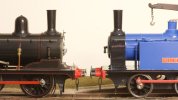
I think I got the proportions about right but, a bit like Uma Thurman, I’m not sure if I can really call her 'cute'. The centre line of the boiler is quite high.
I tried another Starter Loco kit a while ago where I reduced the height of the frames and the cab and side tanks - and overdid it. This was ‘River Pant’ (back here). I could still have a fresh attempt at the Starter Loco, to make a smallish tank loco with a family likeness to “Nellie”. I'm wary of tackling Gazelle as a 2-2-2 and expecting to see it pull a train . . . it is easy to be too ambitious.
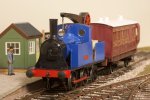
Historically, there was a narrow gauge tramway within the works of E H Bentall. This appears on the OS maps. I am going to suppose ‘Nellie’ and ‘Lady Marion’ belong to the foundry and are also used for service trains on the Heybridge Railway. This helps to justify the foundry owning two steam locomotives. So, if I stretch imagination a little bit further, ’Nellie’ could be found on a workmen’s train or even stand in on a public passenger service.

I think the blue really shines if I put her next to something like the horsebox. Black would be more typical, but the blue gives me a little bit of Edwardian flamboyance.
RichardG
Western Thunderer
I have had fresh problems with the four-coupled part of the chassis . . . these are probably resolved but I want to see the loco running over a distance e.g at NEEGOG. The brake gear makes wheel removal difficult, so I’ll defer adding the brakes until after then.
Today was our first visit to the KLOGGies bash at Runcton Holme near King's Lynn. We had a most pleasant day out, and Nellie had a run on the test track.

This particular track is as challenging vertically as the NEEGOG one is laterally, with pronounced dips at several baseboard joints. The rear guard irons gave a suitably dramatic sparking from time to time. They are a full millimetre above the rail heads.
The good news is, the chassis progressively loosened up, and after six or eight laps she was running pretty much as well as before I did the motor/gearbox swap. Reverse is still a bit lumpy but I can take her to NEEGOG next month knowing she runs.
It seems strange how I dismantled the chassis, laid out all of the parts on the face flannel so they would go back in their original locations, and yet she still needed running in again. I'm not sure why this happens. Perhaps it is a pointer to my working tolerances being a bit too fine, or the new gears bedding in.

simond
Western Thunderer
Axleboxes not perfectly aligned?still needed running in again. I'm not sure why this happens
Threadmarks
View all 201 threadmarks
Reader mode
Reader mode