SimonD’s workbench

simond

Western Thunderer
Thanks Brian,

JJH619 appears in lots of photos. The dapper chap leaning casually on the bonnet does lend a useful sense of scale!

Does anyone know what the two poles (apparently with iron shoes) stowed under the driver’s footwell are for? They only seem to feature in that vehicle, not seen them on others.

Happy New Year!
Simon
 

Osgood

Western Thunderer
Is the bar anything to do with the bar used by the driver in that Scammell film to swivel the coupling round to suit coupling angle of tractor?
 

simond

Western Thunderer
Dinner’s in the slow-cooker, and the guests are due in half an hour. The first beer of the day is a little way down my glass.

I should like to wish a very happy, healthy, prosperous, and enjoyable 2026 to all WT’ers, and thank everyone that has been so kind as to help or offer encouragement, advice and criticism of my efforts.

All the best!
Simon
 

simond

Western Thunderer
They look like they could be ramps to roll barrels or any other circular object up and down from the trailer.

Nick
I wondered about that, and it does seem very plausible, but the thought that they might somehow move apart mid-roll, and risk spilling the beer, worries me.
 

Ressaldar

Western Thunderer
Dinner’s in the slow-cooker, and the guests are due in half an hour. The first beer of the day is a little way down my glass.

I should like to wish a very happy, healthy, prosperous, and enjoyable 2026 to all WT’ers, and thank everyone that has been so kind as to help or offer encouragement, advice and criticism of my efforts.

All the best!
Simon
And to you and yours Simon, although having to keep off of the hops as they put too much gas in the tank so have to imbibe in the malty amber nectar from North of the border!

kind regards,

Mike
 

JimG

Western Thunderer
I wondered about that, and it does seem very plausible, but the thought that they might somehow move apart mid-roll, and risk spilling the beer, worries me.

I also thought about them being used to load or unload barrels, with the chains preventing them being pushed too far apart.

Jim.
 

NickK

Active Member
I also thought about them being used to load or unload barrels, with the chains preventing them being pushed too far apart.

Jim.
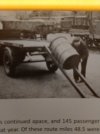
Here is a picture from BR Road Vehicles '48-'68. If you look between the ramps just below the drivers feet you can see an arced rigid bar keeping the ramps from spreading. I presume there would be one near the top as well. The picture was taken when BR instigated a training program because of people getting injured when handling heavy items. Could imagine Health and Safety having something to say about it these days.

Nick
 

Attachments

  • IMG_20260101_102358_MP.jpg
    IMG_20260101_102358_MP.jpg
    130.6 KB · Views: 29

simond

Western Thunderer
Thanks Nick. The stiles do look like the bars under the 3t Cab.

Not sure about the spreaders, perhaps the driver was expected to assemble the “ladder” when he got to the delivery location.

cheers
Simon
 

cctransuk

Western Thunderer
Here is a picture from BR Road Vehicles '48-'68. If you look between the ramps just below the drivers feet you can see an arced rigid bar keeping the ramps from spreading. I presume there would be one near the top as well. The picture was taken when BR instigated a training program because of people getting injured when handling heavy items. Could imagine Health and Safety having something to say about it these days.

Nick

I still see these in use today by brewer's drays in Cornwall.

John Isherwood.
 

simond

Western Thunderer
Good morning from a cold but beautiful day in Kent.

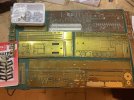
Yesterday‘s progress was assembly of the inner chassis, which went together without a fight.

image.jpg

The solder is not invisible, but it is all on the inside!

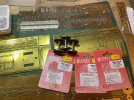
Curiously, the vac tank support cut-outs do not fit the chassis, they’re about 2mm too wide. Jury is still out whether to use the supplied etch with the whitemetal tank casting, or the 3DP I made for the Manor, with minor modifications. The latter appears likely.

image.jpg

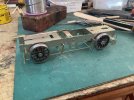
This morning, I have soldered in the bearings for the outer axles. I soldered the bushes in place whilst supporting the extended axles on the ally extrusions, which are in turn sitting on a piece of plate glass. It‘ll roll, but won’t rock…

It’s my normal practice to compensate, but I’m no longer convinced it adds any value, certainly on tenders, etc., and as the kit suggests filing out the half etched half moons to allow the middle axle to rise, I’ve taken that option. I might add light springs to that axle if the pickups cause enough drag to slow the wheels down, or I might simply only fit pick ups to the outer axles. I’ve drilled out the marked pick-up holes in the frames and will print bushes to suit.

Apropos suspension, the loco will have CSB as it’s easy, effective and gives a smooth ride, but that’s a future job.

I shall now add the pivot wires for the brakes, anything else that needs soldering to this bit, and give it a wash.

 

RichardG

Western Thunderer
It’s my normal practice to compensate, but I’m no longer convinced it adds any value, certainly on tenders, etc.

Well I have debated this a lot with myself. If the model has DCC stay alive or a battery pack, the only benefit of suspension is to make for a more realistic appearance while running along. This can be important on group track but really, if you can build a loco with suspension the chances are your home layout already has really smooth trackwork.

I put a rocking axle on the front of my NER H2 (battery power), and I think the model runs really well - but others (outside WT) have told me the rocking axle is pointless. I remain undecided.
 

simond

Western Thunderer
It rolls, and it doesn’t rock…

image.jpg

I have fitted the inner brake hangers, and will use 3DP shoes to get close but no short circuits. Bit irritating as I had to put the wheels on to judge where to put the inner brake hangers to line up with the wheels, and so the wheels will now have flux fumes/spatter, so in addition to giving the chassis a good wash, I’ll now give the wheels a clean and a dose of metal black. If I’d been smart, I’d have done that first.


Richard,

I don’t think a rocking axle is pointless, on a loco where pickup is required, it’ll certainly help in that respect. On a dead rail loco, I guess that’s irrelevant.

It must prevent the loco rocking on one or the other diagonal, and in that respect it must look better, though whether you’d ever see it rocking is perhaps debatable.

It won’t make a difference to haulage, theoretically at least. Practically I feel it might.

On a tender, assuming the track is reasonably smooth, it should not fall off, and I should get at least one wheel picking up (in addition to two or maybe three, on the same side of a sprung loco) so it is, I hope “good enough” from that point of view.

it'll be a PITA if I do decide to fit compensation later.

atb
Simon
 

RichardG

Western Thunderer
It won’t make a difference to haulage, theoretically at least. Practically I feel it might.

I think it ought to make a difference to haulage - but it is nigh impossible to find out.

I mean, if I have a tug of war with my cat on a smooth floor, and then put one of his feet in a plastic bag smothered in silicone and repeat the game, it ought to be easier for me the second time round (*).

Most of the Connoisseur six-coupled chassis run as an 0-4-0 because the middle axle sits about 1/4 mm higher. So, adding even a rudimentary rocking axle at one end ought to increase the contact area with the track from three wheels to four, so 33% more. More contact giving more friction and more haulage.

(*) the cat weighs only 5kg, but can put enough force into his hind legs to jump eight or ten times his height. A lot of force.
 

Osgood

Western Thunderer
So, adding even a rudimentary rocking axle ought to increase the contact area with the track from three wheels to four, so 33% more. More contact giving more friction and more haulage.
More contact but not more weight.
Where is the balance between increasing number of axles and (consequently) reducing weight on each axle?
 

40057

Western Thunderer
I think it ought to make a difference to haulage - but it is nigh impossible to find out.

I mean, if I have a tug of war with my cat on a smooth floor, and then put one of his feet in a plastic bag smothered in silicone and repeat the game, it ought to be easier for me the second time round (*).

Most of the Connoisseur six-coupled chassis run as an 0-4-0 because the middle axle sits about 1/4 mm higher. So, adding even a rudimentary rocking axle at one end ought to increase the contact area with the track from three wheels to four, so 33% more. More contact giving more friction and more haulage.

(*) the cat weighs only 5kg, but can put enough force into his hind legs to jump eight or ten times his height. A lot of force.
Surely, it will make a difference to haulage capacity if haulage capacity is limited by adhesion, not if it is limited by the power of the motor. If full power results in slipping, rather than moving the train, anything that reduces adhesion will further limit haulage capacity. If however the loco doesn’t slip but can’t pull the weight, reducing adhesion will make no difference unless it is so reduced that adhesion does become the limiting factor in haulage capacity. Of course, with variation in rail conditions, track curvature etc., the limiting factor for the amount the loco can pull may switch back and forth between its power and adhesion.

Martin
 
Top