Hi Simon
I have been pondering your questions whilst busy with other things during the day.
I think my answer is all of the above. Yes, I like clockwork. I’m currently working on reinstating the clockwork motor in my rebuilt Royal Scot. The large size Bassett-Lowke motor with speed control and its huge gears is an impressive piece of engineering. I like it as a good piece of engineering. Tom Mallard is just starting to build me a shunter for Rivermead Central using a van Riemsdyk speed control mechanism. This is a very clever and well-thought-out motor using, for example, an unconventional but excellent reversing device. I like it as an ingenious piece of design. Tom’s recent build of CR 828 is reversed by throwing the scale reversing lever in the cab, started by opening the regulator. I think that’s just amazing. We’re almost in automaton territory with features like that. I had my first clockwork 0 gauge locomotive when I was three years old. I still like them just as much as I did then.
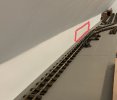
The appearance of the track etc from an earlier age. Yes, that too. Steel rails in chairs on creosoted wood sleepers. It may be over 100 years old, but my railway still smells of creosoted wood on a warm day. The operation of points and signals in a prototypical fashion. Sure, the parts are way over scale — but the operating system is similar to real practice. This is a real railway.
There is something about genuine age. Not a clever representation of 100 year old track. Actual 100 year old track. And actual 100 year old locomotives contemporaneous with their prototypes. Telling the story of real railways in model form.
Returning to the question of, perhaps a battery electric loco with radio control. Very practical, but so out of keeping. With Rivermead Central, I am trying to build a vintage model railway using either vintage models or new builds using vintage technology/approaches. There are inevitably grey areas regarding what would be acceptable modern equipment. I don’t plan on burning the house down by using a 1920s electrical controller. A new build loco is by definition not old, but my test for whether it fits in is essentially ‘could it, or something very like it, have been built, say, seventy years ago?’ It wasn’t built seventy years ago, but it
could have been.
We all have our own likes and dislikes. I don’t want to be rude about anyone else’s choice of model railway. If it gives them pleasure, that’s fine. Each to his own. But I’m not personally keen on most of the retro styled coarse scale models that have been on the market in recent years. I am not referring here to the very distinguished reproductions made by Pieter Penhall (
@Fitzroy) or Ludlow’s of Bolton. But other production with unashamedly modern motors and even sound-fitted. Nothing like real vintage models. Nor very accurate if judged as modern models. When Bing was making models for Bassett-Lowke 100 years ago, these models were as good as they could be — taking into account the track standards in force, the manufacturing technology available and economic constraints. When ‘coarse scale retro styled models’ are produced today, these are
deliberately less accurate than is actually possible. I’m not up for that.
On the issue of getting a vintage look, my aim with Rivermead Central is to follow the example set by great past model railways such as the Sherwood Section of the LMS or Paddington to Seagood. I won’t equal the standard set by these layouts, almost certainly, but that’s the approach. These were serious model railways, realistically operated. Rivermead Central is intended to be, I hope, a serious vintage model railway. An awful lot of modern coarse scale 0 gauge seems to be displayed on layouts that look like the Christmas display from a department store. That’s not my plan at all.
Martin