
You are using an out of date browser. It may not display this or other websites correctly.
You should upgrade or use an alternative browser.
You should upgrade or use an alternative browser.
Rivermead Central
- Thread starter 40057
- Start date


James
Western Thunderer
If this turns out to be true I better start saving for the divorce!If you’re not enamoured of her mother then don’t marry her, for in a few short years, as you become your father so will she become her mother…
John R Smith
Western Thunderer
I would comment that the moguls and J39 and 4F have quite a different character to the earlier Bing models and later Northampton production. They are over-scale with extremely broad wheels and scant detailing, much of it crude. The moguls are absurdly wide with the robust valve gear designed for the live-steam versions.
Martin
Just thinking about it - it looks like one could just remove the offending valve gear, leaving the connecting and coupling rods in place. To my eye, it would improve things no end (but I would probably be thrown out of the Bassett-Lowke Society, in disgrace).
John
Hi JohnMartin
Just thinking about it - it looks like one could just remove the offending valve gear, leaving the connecting and coupling rods in place. To my eye, it would improve things no end (but I would probably be thrown out of the Bassett-Lowke Society, in disgrace).
John
Yes, you probably could remove the valve gear.
But the question is:
Do you want a good model of a Southern mogul?
Or, an historic Bassett-Lowke model of a Southern mogul?
Because once you start altering it, it will be neither.
Not sure about the attitude of The Bassett-Lowke Society. They seem to accept modern electric motors in place of historic clockwork mechanisms quite happily. I don’t approve.
I am not a collector in the sense of trying to get ‘the set’ of Bassett-Lowke models. Impossible anyway. Perhaps a curator or custodian of historic artifacts? Anyway, it’s certainly not my place to damage or modify 100-year-old models. They need to be appreciated for what they are and what they tell us about the time when they were made.
You have shown us pictures of your 1930s B-L 0-4-0T. Now, really, that’s a daft thing — 5’8” diameter wheels on an 0-4-0! You could greatly improve it by substituting smaller wheels. But I’m sure you won’t. As a ninety-year-old Bassett-Lowke tinplate locomotive, it’s a nice thing. As a representation of a real 0-4-0 shunter, it’s terrible.
If something has already been altered — say, repainted — then there is a decision to be made about the most appropriate approach. Returning the item to original condition is impossible. The replacement paintwork, if well done, could be left. Part of the object’s story. Or a further repaint, as far as possible the new paint exactly copying the original. I have one fully repainted Bassett-Lowke loco where the original paint had long gone. What exactly the original paint was like was uncertain. After much consideration, the loco was repainted accurately copying the paint scheme of the prototype. In the circumstances, I thought the most appropriate treatment.
I would never alter something in good original condition to suit my taste*. There were (are) Bassett-Lowke models that were really not good representations, such that I don’t much like them. So I don’t buy them. I won’t, for example, be getting a B-L Schools. The driving wheels are far too small and far too close together. The mismatch between the splashers and the wheels looks terrible. It wouldn’t be difficult to correct by altering the motor. It would then be a better model. But the wrongly spaced and too small driving wheels are a direct result of the Schools being commissioned from Marklin. Then Marklin — who never worried too much about accuracy — using their standard 4-coupled clockwork mech. It’s ‘wrong’ wheels are part of what the model is and how it came to be made. They should not be altered and if they are the loco will then just be a not very good old model of a Schools. Whereas, in original condition, the Schools was the first of the 1930s models B-L commissioned from Marklin and shows the start of a learning process whereby the later Marklin commissions were body only and fitted with Bassett-Lowke motors.
Martin
* I make an exception for track because the Lowko Track points I alter are always broken — and I know they will break again if I simply remake the broken soldered joints. So I alter the points, using original parts sold for home track construction. I think, I hope, the alterations I make to my track are completely within the spirit of how Bassett-Lowke expected the track and track parts to be used by customers.
Last edited:
Hi JohnMartin
To drag this interesting debate just slightly back in the direction of Bassett-Lowke. Your comment caught my eye -
It would seem that this series of engines used a six-coupled mechanism for the clockwork versions that is rather different from the two that I am already familiar with (specifically the six-coupled motor as used in the 0-6-0 tank and Standard Goods and the more sophisticated six-coupled motor as used in the "Scotsman" and "Royal Scot" etc). I recently got interested in one of the SR versions of the 2-6-0, similar to this -
View attachment 257120
This one is electric, but the one I am looking at is clockwork. The motor has a very broad spring, and the winder is on the right-hand side of the engine, which is unusual for B-L. Looking at photos of the mech, I think I can see something odd -
View attachment 257125
It looks as if the ratchet (?) is immediately behind the winder, in between the centre and rear drivers and on the outside of the frames rather than inside. Is this correct, or am I imagining it? And do you have any experience with these clockwork 2-6-0s?
Sorry to pick your brains yet again!
John
I think it is also worth commenting on how brave and ambitious Bassett-Lowke were with their ‘mogul project’.
In 0 gauge, four different models, one for each of the principal railway companies. All produced in clockwork, electric and live-steam versions. So 12 variants in all. Additionally, the LMS and LNER models also made in Gauge 1, each in electric and steam versions. Remember, the ‘mogul project’ was only a few years after the first production of small gauge locomotives started at Northampton. Moreover, the locomotives were not glamorous express engines, but mixed-traffic workhorses.
It must have been an immensely complex and expensive project to deliver. It was surely only possible by the clever use of common parts used on multiple different mogul models. Hence, the valve gear designed for the steam versions being also used on the clockwork and electric models.
Whether the two 0-6-0s — the J39 and 4F — based largely on mogul components, were planned alongside the moguls or a later spin-off idea, I can’t say. But they are in the same ‘family’ of Bassett-Lowke models. A definite and distinctive phase in the small-gauge locomotives made in Northampton.
Of course, later, in 0 gauge only, the LMS model was updated to the Stanier designed 2-6-0. The 0 gauge clockwork and electric LMS and LNER models were revised just before WW2, being much improved by using Royal Scot-type cylinders and valve gear. Post-war, the 0 gauge LNER and LMS live-steam models were back in production. Then, the LMS steam versIon was revived again by Corgi. Has any other model locomotive been made for so long?
In the 1930s, the Gauge 1 LNER live-steam mogul was available in kit form. It was also offered rebuilt with an internally fired Smithies boiler.
The moguls were far from perfect models. But they were successful and long lived. An important chapter in the Bassett-Lowke story.
That’s possibly the best way to think about the SR loco you are considering.
Martin
John R Smith
Western Thunderer
Hello Martin
Your thoughtful replies are greatly appreciated. I do have to admit that I was not being entirely serious in my post about the valve gear on the 2-6-0. Certainly the comment about the Basset-Lowke Society was just in fun - the BLS is very much a broad church, and there is room for many different approaches to our common interest. I have, for example, just contributed a feature to the latest Society journal about a rather extraordinary freelance pacific engine of mine (builder unknown) which does have a B-L clockwork motor, but nothing much else from Northampton.
I do agree with you about the B-L Schools class 4-4-0. It is terrible, and the Hornby "Eton" is just so much nicer. I would have the Hornby one like a shot if the price of nice examples was not so crazy. I have to say that I personally am not too precious about modifications - Jack Ray and John Hart were always at it, with larger bogie wheels, flanged centre drivers, extra handrails, vac pipes etc. And Bassett-Lowke back then would do it for you too, as a special order. In the Club, back in the 1960s, nothing stayed standard for very long if my Father and his mate Graham got hold of it! Our B-L Enterprises were very heavily modified after a few seasons' running.
As far as repaints go - the B-L 2-6-0 that I was interested in is in fact a repaint, anyway. It has been very nicely refinished by Chris Littledale of the Brighton Toy and Model Museum, but as a result it is certainly no longer original (or collectable). I don't have a problem with that or repaints generally, if they are well done - I have two completely refinished engines, my B-L 2-6-4T is partly repainted (and that was a saga in itself) and I have two refinished Exley coaches which have been professionally done and are very nice indeed. Much nicer than a tatty old Exley with chipped sides and corroded roof.
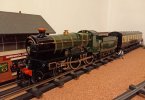
Here is my Hornby County of Bedford, which was refinished by John Metcalf in 1980 (signed underneath). I would much rather have this than a very worn original, it's like being able to buy a new one! (I do like my engines clean and shiny). John has in addition soldered up some of the joints which were a bit wide on the original, she has had new driving wheels, the motor has been fully serviced and she is a great runner. One good feature of repaints is that because they are no longer so collectible, they tend to be cheap(er).
John
Your thoughtful replies are greatly appreciated. I do have to admit that I was not being entirely serious in my post about the valve gear on the 2-6-0. Certainly the comment about the Basset-Lowke Society was just in fun - the BLS is very much a broad church, and there is room for many different approaches to our common interest. I have, for example, just contributed a feature to the latest Society journal about a rather extraordinary freelance pacific engine of mine (builder unknown) which does have a B-L clockwork motor, but nothing much else from Northampton.
I do agree with you about the B-L Schools class 4-4-0. It is terrible, and the Hornby "Eton" is just so much nicer. I would have the Hornby one like a shot if the price of nice examples was not so crazy. I have to say that I personally am not too precious about modifications - Jack Ray and John Hart were always at it, with larger bogie wheels, flanged centre drivers, extra handrails, vac pipes etc. And Bassett-Lowke back then would do it for you too, as a special order. In the Club, back in the 1960s, nothing stayed standard for very long if my Father and his mate Graham got hold of it! Our B-L Enterprises were very heavily modified after a few seasons' running.
As far as repaints go - the B-L 2-6-0 that I was interested in is in fact a repaint, anyway. It has been very nicely refinished by Chris Littledale of the Brighton Toy and Model Museum, but as a result it is certainly no longer original (or collectable). I don't have a problem with that or repaints generally, if they are well done - I have two completely refinished engines, my B-L 2-6-4T is partly repainted (and that was a saga in itself) and I have two refinished Exley coaches which have been professionally done and are very nice indeed. Much nicer than a tatty old Exley with chipped sides and corroded roof.
Here is my Hornby County of Bedford, which was refinished by John Metcalf in 1980 (signed underneath). I would much rather have this than a very worn original, it's like being able to buy a new one! (I do like my engines clean and shiny). John has in addition soldered up some of the joints which were a bit wide on the original, she has had new driving wheels, the motor has been fully serviced and she is a great runner. One good feature of repaints is that because they are no longer so collectible, they tend to be cheap(er).
John
Hi John
There are different views on the issue of repaints (and other restoration). By the sound of it, you are much more tolerant of repainting than I am. So, a few observations or principles.
First, obviously, it’s up to the owner. I may feel someone is damaging or vandalising an historic model, but if it’s their historic model, it’s their decision and none of my business. Second, even the finest antique model trains are not Fabergé eggs or Titians. So keep it in perspective, this isn’t about valuable, unique, works of art of global significance. Third, full disclosure — always. Restorers should sign their work so it can’t be passed off to a naïve purchaser — fraudulently — as the original paint.
My comments relate to commercially made model railways. From a one-off, amateur build, it is generally possible to judge the skill (or lack thereof) of the builder. But only rarely will a home-made model offer the same insights into economic, technological and social changes that can be inferred from the output of a successful company over time. The commercially made models have a different significance and are generally the focus of interest for model collectors and historians.
The use of lithographed tinplate as the basis for quantity production was central to model railway manufacture from c.1900 to the 1950s. The need to print the tinplate whilst flat and then bend and join components afterwards required ‘tab and slot’ type construction and dictated the whole approach to model making. There is a suite of characteristics that go with being a ‘lithographed tinplate train’ which are a direct result of using lithographed tinplate. A lithographed finish is quite different to a paint finish. I would not describe a ‘restored’ originally lithographed model as being ‘repainted’. No, it has been painted. Which it should not be — because it was only made the way it was because it was lithographed. The whole integrity of the model is destroyed by painting it because its construction and other characteristics no longer ‘make sense’.
In my book, no repainting of lithographed models.
Moving on to painted models. It depends, but the original paint may be the crucial feature. Take a Hornby 0 gauge van. Hundreds of thousands — actually I guess many millions — of identical bodies produced. Sold as multiple different models by painting them in the liveries of different railway companies and private owners. Identical but for the paint. So a repainted van could be put in any number of alternative liveries and there would be no way of telling what it was originally. Repaint a common model in a rare livery and it’s pretty much ‘a fake’.
In my book, models where the interest (and monetary value) lies in the ‘rare’ paint should never be repainted.
So when can full or partial repainting be acceptable? A model that was originally hand-painted can be hand-painted again in essentially the same way. So the new paint can be true to the maker’s original approach and reproduce exactly the original appearance and finish. Now, no-one is going to want to repaint a model with original paint in good condition. But if the original paint is very distressed, and the model perhaps deteriorating as a result, repainting may be the appropriate decision. The new work should always be signed to make clear the model has been repainted. If a model has already been repainted, a further repaint may or may not be appropriate. When was the first repaint done, and how well? For example, a loco repainted 100 years ago to professional standard, and in good condition. There is surely a lot more ‘originality’ and interest in the existing 100-year-old paint (albeit it’s not the original original paint) than in any modern repaint, however accurately that reproduces the factory finish. So leave well alone. On the other hand, if the model has been the victim of a badly done amateur ‘restoration’ — another repaint, done right, would clearly be an improvement.
New paint may be necessary for conservation reasons. To anchor and preserve poorly adhering original paint, or to protect against corrosion.
I also take the view that different ‘types’ of models can be approached differently. A standard, mass-produced model, has essentially no individuality. Every example left the factory exactly the same. For these, the ideal is as close to ‘as new’ condition as possible. So the model today shows how it was when first purchased, looking as the manufacturer intended.
At the other end of the scale, as an example, I have one of the express locos from the Sherwood railway (the Patriot). A one-off by a professional builder (Leslie Forrest). A loco used intensively for over 30 years. During that working life, repainted many times. Rebuilt by the builder with a new, different type, mechanism sometime in the 1960s. ‘Original condition’ is pretty much meaningless for such a loco. In any case, the builder’s later alterations — to fit a B-L mech — arguably have greater validity than the loco ‘as built’ with its insufficiently powerful Hornby motor. Unfortunately, the Sherwood Patriot has collision damage at the front (buckled frames and buffer beam). Repairs will require at least partial repainting. In this case, I think getting the loco repaired is the right approach. There will be some loss of old (if not ‘original’) material. But on-going repairs and maintenance have been the norm throughout the loco’s years of service. I will do what the original owner would have done.
For repainting, and other restoration, I would say an overriding principle is to approach each item as an individual case. Sometimes a damaged original is better than a restoration. Sometimes conservation measures (such as treating rust and localised repainting) are necessary to prevent further loss of originality. Sometimes (but as rarely as possible) a full repaint may be the least-worst option.
Martin
There are different views on the issue of repaints (and other restoration). By the sound of it, you are much more tolerant of repainting than I am. So, a few observations or principles.
First, obviously, it’s up to the owner. I may feel someone is damaging or vandalising an historic model, but if it’s their historic model, it’s their decision and none of my business. Second, even the finest antique model trains are not Fabergé eggs or Titians. So keep it in perspective, this isn’t about valuable, unique, works of art of global significance. Third, full disclosure — always. Restorers should sign their work so it can’t be passed off to a naïve purchaser — fraudulently — as the original paint.
My comments relate to commercially made model railways. From a one-off, amateur build, it is generally possible to judge the skill (or lack thereof) of the builder. But only rarely will a home-made model offer the same insights into economic, technological and social changes that can be inferred from the output of a successful company over time. The commercially made models have a different significance and are generally the focus of interest for model collectors and historians.
The use of lithographed tinplate as the basis for quantity production was central to model railway manufacture from c.1900 to the 1950s. The need to print the tinplate whilst flat and then bend and join components afterwards required ‘tab and slot’ type construction and dictated the whole approach to model making. There is a suite of characteristics that go with being a ‘lithographed tinplate train’ which are a direct result of using lithographed tinplate. A lithographed finish is quite different to a paint finish. I would not describe a ‘restored’ originally lithographed model as being ‘repainted’. No, it has been painted. Which it should not be — because it was only made the way it was because it was lithographed. The whole integrity of the model is destroyed by painting it because its construction and other characteristics no longer ‘make sense’.
In my book, no repainting of lithographed models.
Moving on to painted models. It depends, but the original paint may be the crucial feature. Take a Hornby 0 gauge van. Hundreds of thousands — actually I guess many millions — of identical bodies produced. Sold as multiple different models by painting them in the liveries of different railway companies and private owners. Identical but for the paint. So a repainted van could be put in any number of alternative liveries and there would be no way of telling what it was originally. Repaint a common model in a rare livery and it’s pretty much ‘a fake’.
In my book, models where the interest (and monetary value) lies in the ‘rare’ paint should never be repainted.
So when can full or partial repainting be acceptable? A model that was originally hand-painted can be hand-painted again in essentially the same way. So the new paint can be true to the maker’s original approach and reproduce exactly the original appearance and finish. Now, no-one is going to want to repaint a model with original paint in good condition. But if the original paint is very distressed, and the model perhaps deteriorating as a result, repainting may be the appropriate decision. The new work should always be signed to make clear the model has been repainted. If a model has already been repainted, a further repaint may or may not be appropriate. When was the first repaint done, and how well? For example, a loco repainted 100 years ago to professional standard, and in good condition. There is surely a lot more ‘originality’ and interest in the existing 100-year-old paint (albeit it’s not the original original paint) than in any modern repaint, however accurately that reproduces the factory finish. So leave well alone. On the other hand, if the model has been the victim of a badly done amateur ‘restoration’ — another repaint, done right, would clearly be an improvement.
New paint may be necessary for conservation reasons. To anchor and preserve poorly adhering original paint, or to protect against corrosion.
I also take the view that different ‘types’ of models can be approached differently. A standard, mass-produced model, has essentially no individuality. Every example left the factory exactly the same. For these, the ideal is as close to ‘as new’ condition as possible. So the model today shows how it was when first purchased, looking as the manufacturer intended.
At the other end of the scale, as an example, I have one of the express locos from the Sherwood railway (the Patriot). A one-off by a professional builder (Leslie Forrest). A loco used intensively for over 30 years. During that working life, repainted many times. Rebuilt by the builder with a new, different type, mechanism sometime in the 1960s. ‘Original condition’ is pretty much meaningless for such a loco. In any case, the builder’s later alterations — to fit a B-L mech — arguably have greater validity than the loco ‘as built’ with its insufficiently powerful Hornby motor. Unfortunately, the Sherwood Patriot has collision damage at the front (buckled frames and buffer beam). Repairs will require at least partial repainting. In this case, I think getting the loco repaired is the right approach. There will be some loss of old (if not ‘original’) material. But on-going repairs and maintenance have been the norm throughout the loco’s years of service. I will do what the original owner would have done.
For repainting, and other restoration, I would say an overriding principle is to approach each item as an individual case. Sometimes a damaged original is better than a restoration. Sometimes conservation measures (such as treating rust and localised repainting) are necessary to prevent further loss of originality. Sometimes (but as rarely as possible) a full repaint may be the least-worst option.
Martin
John R Smith
Western Thunderer
Hello Martin
A very interesting and well thought through reply. I think that we will have to agree to differ on a few things, but broadly speaking I don't think that we are actually too far apart.
I completely agree with this. None of my repaints have been done on top of litho (tinprinted) finishes. There are a couple of really dreadful ones (of a B-L Midland Compound and a Flying Scotsman) on eBay just at the moment.
I have been involved in conservation and restoration projects in many ways over time. In my younger days with classic cars and motorcycles, where it is completely normal to re-spray paintwork and re-chrome rusty plated components. Often only the basic car body shell or motorcycle frame are "original", even the engine will be replaced or at the very least rebuilt. Also with classic wooden boats, where if you manage to keep one small piece of the hull in the rebuild you can claim it is the original and the boat's name lives on.
For the last 25 years of my professional career I was involved in the recording and conservation of historic buildings, usually Listed or Scheduled, as a local government officer. This posed all the same sort of questions of authenticity, repairs and refurbishment, methods and materials as we are discussing here. With the difference that I did not personally own the buildings, but was trying to persuade an often reluctant owner to comply with the relevant legislation!
Once again, I am happy to agree with your final paragraph. Good conservation practice. I would myself avoid owning a B-L item of real historic importance, because I would not want to be burdened with the responsibility, just the same as I would not want to live in a Grade I Listed house.
My little railway is just for fun, it was certainly never intended as a museum collection with a serious conservation objective. I run some trains at least once a day, working through my timetable, and I find shunting things around for an hour or so very relaxing and therapeutic. And I also enjoy searching for new items which will add to it, and working on them when they turn up. These are the same pleasures and rewards that I had as a schoolboy at home and with my Dad at our club many years ago, and I am grateful to still have them now.
John
A very interesting and well thought through reply. I think that we will have to agree to differ on a few things, but broadly speaking I don't think that we are actually too far apart.
In my book, no repainting of lithographed models.
I completely agree with this. None of my repaints have been done on top of litho (tinprinted) finishes. There are a couple of really dreadful ones (of a B-L Midland Compound and a Flying Scotsman) on eBay just at the moment.
I have been involved in conservation and restoration projects in many ways over time. In my younger days with classic cars and motorcycles, where it is completely normal to re-spray paintwork and re-chrome rusty plated components. Often only the basic car body shell or motorcycle frame are "original", even the engine will be replaced or at the very least rebuilt. Also with classic wooden boats, where if you manage to keep one small piece of the hull in the rebuild you can claim it is the original and the boat's name lives on.
For the last 25 years of my professional career I was involved in the recording and conservation of historic buildings, usually Listed or Scheduled, as a local government officer. This posed all the same sort of questions of authenticity, repairs and refurbishment, methods and materials as we are discussing here. With the difference that I did not personally own the buildings, but was trying to persuade an often reluctant owner to comply with the relevant legislation!
For repainting, and other restoration, I would say an overriding principle is to approach each item as an individual case. Sometimes a damaged original is better than a restoration. Sometimes conservation measures (such as treating rust and localised repainting) are necessary to prevent further loss of originality. Sometimes (but as rarely as possible) a full repaint may be the least-worst option.
Once again, I am happy to agree with your final paragraph. Good conservation practice. I would myself avoid owning a B-L item of real historic importance, because I would not want to be burdened with the responsibility, just the same as I would not want to live in a Grade I Listed house.
My little railway is just for fun, it was certainly never intended as a museum collection with a serious conservation objective. I run some trains at least once a day, working through my timetable, and I find shunting things around for an hour or so very relaxing and therapeutic. And I also enjoy searching for new items which will add to it, and working on them when they turn up. These are the same pleasures and rewards that I had as a schoolboy at home and with my Dad at our club many years ago, and I am grateful to still have them now.
John

Roger Pound
Western Thunderer
The foregoing from #787- #789 have provided a most useful insight into personal aspects of modelling. The various reasonings put forward certainly activate one's 'little grey cells'! Thank you gentlemen once again.
Roger Pound
Roger Pound
A relatively mundane update. Two post-WW2 tinplate signals recently obtained via a well-known internet auction site:

Very minor work required, now completed. Straighten the ladders. Address some areas of loose, flaking paint on the post of the home signal. Overall though, both in astonishingly good condition. Unusually for Bassett-Lowke’s tinplate model signals, no corrosion from flux residue on either of these. Both look ‘new’ and came to me in their original boxes (stacked behind in the photo); never been used I am sure.
As described in my post #436, these are from the cheaper range of signals with tinplate posts. Still complex to make with the posts made of two tinplate U-channels soldered one inside the other, then soldered to the base. The post cap and upper pivot and lamp also soldered in place — so these components necessarily hand painted after assembly. But the signal arm and glass holder are lithographed finish and assembled by ‘tab and slot’.
The home signal I showed in my post #436 has the top of the ladder joined to the post by two bent wires that were soldered to the ladder. The otherwise identical signal shown above has the top of the ladder secured by a bent over tab inserted into a slot in the post. Since the catalogue illustration shows wire joiners for the tops of the ladders, I assume this was the original method. The later tab and slot fastening is an improvement in that no solder means no flux means no corrosion caused by flux residue.
The chevron on the distant signal arm shown above is, rather strangely, embossed and then painted black. I’ve not seen that before. The other distant signal I have from this range has flat arms with a litho-printed chevron.
One benefit of this range of signals is the coil spring between the balance weight and the base. This means the signal will stay in either on or off position so can be operated by Hand of God on a stand-alone basis. The better quality signals show danger as a default and have to be attached by a wire to a separate (remote) lever so they can be cleared. Bassett-Lowke advised anyone wanting to operate the above type of tinplate signals prototypically from a ‘box to remove the spring from the balance weight.
I would like to operate the appropriate points and the semaphore signals on Rivermead Central from Bassett-Lowke signal boxes using Bassett-Lowke lever frames, rodding, bell-cranks etc. But the layout, definitely, would never get finished or probably even get to a useable condition. So my compromise is to operate points using their own adjacent levers and signals individually by hand. EXCEPT, I will do one (possibly two) locations where the points and signals are worked from the nearby signal box. Just to demonstrate the system and show what was possible. At the moment my thinking is the north-east end of the loop for Cairnie Junction station with its diverging Rivermead Central branch would be the best candidate for operation from a signal box. Two turnouts and associated signals should be manageable.
I am minded to use the above home signal and the one shown in my post #436 to control the exits (north and south facing) from the yard at Cairnie Junction. This offers the prospect that I might get the first signals installed on the layout this year …
Martin
Very minor work required, now completed. Straighten the ladders. Address some areas of loose, flaking paint on the post of the home signal. Overall though, both in astonishingly good condition. Unusually for Bassett-Lowke’s tinplate model signals, no corrosion from flux residue on either of these. Both look ‘new’ and came to me in their original boxes (stacked behind in the photo); never been used I am sure.
As described in my post #436, these are from the cheaper range of signals with tinplate posts. Still complex to make with the posts made of two tinplate U-channels soldered one inside the other, then soldered to the base. The post cap and upper pivot and lamp also soldered in place — so these components necessarily hand painted after assembly. But the signal arm and glass holder are lithographed finish and assembled by ‘tab and slot’.
The home signal I showed in my post #436 has the top of the ladder joined to the post by two bent wires that were soldered to the ladder. The otherwise identical signal shown above has the top of the ladder secured by a bent over tab inserted into a slot in the post. Since the catalogue illustration shows wire joiners for the tops of the ladders, I assume this was the original method. The later tab and slot fastening is an improvement in that no solder means no flux means no corrosion caused by flux residue.
The chevron on the distant signal arm shown above is, rather strangely, embossed and then painted black. I’ve not seen that before. The other distant signal I have from this range has flat arms with a litho-printed chevron.
One benefit of this range of signals is the coil spring between the balance weight and the base. This means the signal will stay in either on or off position so can be operated by Hand of God on a stand-alone basis. The better quality signals show danger as a default and have to be attached by a wire to a separate (remote) lever so they can be cleared. Bassett-Lowke advised anyone wanting to operate the above type of tinplate signals prototypically from a ‘box to remove the spring from the balance weight.
I would like to operate the appropriate points and the semaphore signals on Rivermead Central from Bassett-Lowke signal boxes using Bassett-Lowke lever frames, rodding, bell-cranks etc. But the layout, definitely, would never get finished or probably even get to a useable condition. So my compromise is to operate points using their own adjacent levers and signals individually by hand. EXCEPT, I will do one (possibly two) locations where the points and signals are worked from the nearby signal box. Just to demonstrate the system and show what was possible. At the moment my thinking is the north-east end of the loop for Cairnie Junction station with its diverging Rivermead Central branch would be the best candidate for operation from a signal box. Two turnouts and associated signals should be manageable.
I am minded to use the above home signal and the one shown in my post #436 to control the exits (north and south facing) from the yard at Cairnie Junction. This offers the prospect that I might get the first signals installed on the layout this year …
Martin
Last edited:
John R Smith
Western Thunderer
Hello Martin
I am really quite envious of your signals. I have not managed to find any of the B-L all-metal ones in anything like as nice condition as yours are. Most of the ones that I have seen (and purchased) have been in a really poor state, largely due to flux corrosion as you say. I do have two of the "Best Quality" wooden post signals, one distant and one home as below -

The wooden posts seem to have survived rather better, and of course have the advantage that they can be tapered, unlike the metal ones. However, also unlike the metal ones they do not have a ladder, despite being twice the price in the 1956 catalogue - 16/11 for a single arm signal, as against 8/- for the metal equivalent. Even more strange is that if you purchased the wooden post signal as set of parts (at 10/3) you did get a ladder included in the kit!
I shall never understand Bassett-Lowke's marketing strategy . . .
John
P.S. I have added the finial, the original metal cap was missing.
I am really quite envious of your signals. I have not managed to find any of the B-L all-metal ones in anything like as nice condition as yours are. Most of the ones that I have seen (and purchased) have been in a really poor state, largely due to flux corrosion as you say. I do have two of the "Best Quality" wooden post signals, one distant and one home as below -
The wooden posts seem to have survived rather better, and of course have the advantage that they can be tapered, unlike the metal ones. However, also unlike the metal ones they do not have a ladder, despite being twice the price in the 1956 catalogue - 16/11 for a single arm signal, as against 8/- for the metal equivalent. Even more strange is that if you purchased the wooden post signal as set of parts (at 10/3) you did get a ladder included in the kit!
I shall never understand Bassett-Lowke's marketing strategy . . .
John
P.S. I have added the finial, the original metal cap was missing.
Last edited:
Hi JohnHello Martin
I am really quite envious of your signals. I have not managed to find any of the B-L all-metal ones in anything like as nice condition as yours are. Most of the ones that I have seen (and purchased) have been in a really poor state, largely due to flux corrosion as you say. I do have two of the "Best Quality" wooden post signals, one distant and one home as below -
View attachment 257457
The wooden posts seem to have survived rather better, and of course have the advantage that they can be tapered, unlike the metal ones. However, also unlike the metal ones they do not have a ladder, despite being twice the price in the 1956 catalogue - 16/11 for a single arm signal, as against 8/- for the metal equivalent. Even more strange is that if you purchased the wooden post signal as set of parts (at 10/3) you did get a ladder included in the kit!
I shall never understand Bassett-Lowke's marketing strategy . . .
John
P.S. I have added the finial, the original metal cap was missing.
The correct pattern white-metal cap is available from Wizard Models, sold as LNWR/LMS/LNER bevel top signal post caps, three for £2.10.
Wooden post signals with ladders etc were made at Northampton, but not specifically listed in the catalogue. I assume very, very expensive.
Martin
John R Smith
Western Thunderer
The correct pattern white-metal cap is available from Wizard Models, sold as LNWR/LMS/LNER bevel top signal post caps, three for £2.10.
Hello Martin
And thank you for the information.
Oh dear, this is rather amusing and I hope it does not offend - but this illustrates the difference between us. I actually do have the correct pattern white metal caps in stock, but I just like finials much better (probably being a GWR man at heart). So a finial it had to be. I can see my expulsion from the B-L Society looming ever closer . . .
Just outside my front door, rather covered in Campanula, is the finial from the outer advanced starter at Kingsbridge GWR.
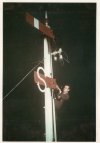
Here I am in 1964, up the signal ladder dismantling the shunt ahead arm. The finial was next! I seem to remember that I paid the salvage gang 10/- for them.
John
Hi JohnHello Martin
And thank you for the information.
Oh dear, this is rather amusing and I hope it does not offend - but this illustrates the difference between us. I actually do have the correct pattern white metal caps in stock, but I just like finials much better (probably being a GWR man at heart). So a finial it had to be. I can see my expulsion from the B-L Society looming ever closer . . .
Just outside my front door, rather covered in Campanula, is the finial from the outer advanced starter at Kingsbridge GWR.
View attachment 257480
Here I am in 1964, up the signal ladder dismantling the shunt ahead arm. The finial was next! I seem to remember that I paid the salvage gang 10/- for them.
John
As I said in a previous post, your model, your decision, none of my business.
But you are right, I would not have chosen the GWR style finial to go with an upper quadrant.
If I wanted a vintage model of a GW-style signal, they can be got fairly easily, either B-L or LMC.
B-L’s LNWR styled signals were very much the company’s classic range, and I think are particularly attractive.
Martin
A follow up to earlier discussions in this thread about clockwork motors. I have just received a copy of the March 1932 Bassett-Lowke catalogue (thank you, @Heather Kay.). This has a full-page entry for the type of clockwork mechanism fitted to my rebuilt Royal Scot:

Several interesting issues are raised by the catalogue description, but especially the wheel spacings listed.
At this date, the large, Northampton-made, 6-coupled motor was still quite new. It had been introduced in 1929, without speed control, for the lithographed Royal Scot. By 1932, the speed-control-fitted variant of the Northampton made motor had replaced the Bing-made 6-coupled mechanism previously used in the four mogul models. In the above catalogue description, the wheel size fitted ‘from stock’ is the size used for the moguls. The Northampton-made large 6-coupled mech also replaced the Bing motor previously used in the J39 model. I do not know whether the speed-control or the Royal Scot version of the motor was used in the J39. My supposition is the J39s, being soldered-construction and hand-painted, would have the speed-control mechanism fitted. The various other models in which the large 6-coupled mech was used all came later than 1932. Specifically, none of the Pacifics, which mostly had 48 mm + 48 mm driving wheel spacing, had yet been introduced to the Bassett-Lowke 0 gauge range.
Anyway, the motor as available in 1932 is offered, it says, with 58 mm + 58 mm wheel spacing. Not a spacing I have ever seen and a very long wheel-base, even allowing for flangeless centre drivers. I can’t think what model would have had a mechanism with that wheel spacing. It seems inconceivable that the 58 + 58 mm spacing was produced only for mechanisms sold for home loco construction. Could the spacing stated be an error in the catalogue description? That’s not impossible, but the 53 + 58 mm spacing, which was standard for nearly all B-L 4-6-0s, is listed as available for an extra charge. The Royal Scot models as sold in 1932 still had the simpler version of the motor without speed control, but with a wheel spacing of 53 + 58 mm. The 43 + 48 mm wheel spacing also offered in the above catalogue entry likewise does not correspond to any catalogued model I can think of, and certainly not to any model included in the 1932 catalogue. The 43 mm spacing between the leading and middle axles would have required stub axles for the middle wheels and is too close to allow the standard diameter express loco wheels to be fitted.
So some unanswered questions. I would be interested to get chance to examine a J39 fitted with the Northampton-made mechanism, to see what the wheel spacing was on this model. Maybe one or more of the many variations of mogul had a wheel spacing corresponding to one of the unfamiliar combinations offered in the above listing?
As they say, every day is a school day.
Martin
Several interesting issues are raised by the catalogue description, but especially the wheel spacings listed.
At this date, the large, Northampton-made, 6-coupled motor was still quite new. It had been introduced in 1929, without speed control, for the lithographed Royal Scot. By 1932, the speed-control-fitted variant of the Northampton made motor had replaced the Bing-made 6-coupled mechanism previously used in the four mogul models. In the above catalogue description, the wheel size fitted ‘from stock’ is the size used for the moguls. The Northampton-made large 6-coupled mech also replaced the Bing motor previously used in the J39 model. I do not know whether the speed-control or the Royal Scot version of the motor was used in the J39. My supposition is the J39s, being soldered-construction and hand-painted, would have the speed-control mechanism fitted. The various other models in which the large 6-coupled mech was used all came later than 1932. Specifically, none of the Pacifics, which mostly had 48 mm + 48 mm driving wheel spacing, had yet been introduced to the Bassett-Lowke 0 gauge range.
Anyway, the motor as available in 1932 is offered, it says, with 58 mm + 58 mm wheel spacing. Not a spacing I have ever seen and a very long wheel-base, even allowing for flangeless centre drivers. I can’t think what model would have had a mechanism with that wheel spacing. It seems inconceivable that the 58 + 58 mm spacing was produced only for mechanisms sold for home loco construction. Could the spacing stated be an error in the catalogue description? That’s not impossible, but the 53 + 58 mm spacing, which was standard for nearly all B-L 4-6-0s, is listed as available for an extra charge. The Royal Scot models as sold in 1932 still had the simpler version of the motor without speed control, but with a wheel spacing of 53 + 58 mm. The 43 + 48 mm wheel spacing also offered in the above catalogue entry likewise does not correspond to any catalogued model I can think of, and certainly not to any model included in the 1932 catalogue. The 43 mm spacing between the leading and middle axles would have required stub axles for the middle wheels and is too close to allow the standard diameter express loco wheels to be fitted.
So some unanswered questions. I would be interested to get chance to examine a J39 fitted with the Northampton-made mechanism, to see what the wheel spacing was on this model. Maybe one or more of the many variations of mogul had a wheel spacing corresponding to one of the unfamiliar combinations offered in the above listing?
As they say, every day is a school day.
Martin
John R Smith
Western Thunderer
Hello Martin
And yes, some very interesting points raised. If you recall, I did question the 58 + 58 mm spacing when I did a brief resume of the six-coupled B-L clockwork motors a few posts back. Likewise, as you say, the 43 + 48 mm spacing makes no sense either. So what goes on?
There was an LMS 4F 0-6-0 tender engine on eBay recently which had the later controlled clockwork mechanism, so it looks as if some of them (and the J39 as well) had this top end fitment. There was no chance to check the axle spacing, though. What I did notice with the 4F was that the tender was very good, much better than the one fitted to the 2-6-0 engines (proper fillers, and air vents, cast axleguards and springs). I was very tempted to go for this one, but the cosmetic condition put me off.
I expect you saw the very late BR "Duchess of Montrose" on eBay last week. It looked to be in super original condition, but interestingly did not have the controlled clockwork motor which I would have thought it should have. I very nearly hit "Buy Now", but then realised that a 21 inch engine would be just a bit too large for Kingswell Street. So common sense prevailed!
John
And yes, some very interesting points raised. If you recall, I did question the 58 + 58 mm spacing when I did a brief resume of the six-coupled B-L clockwork motors a few posts back. Likewise, as you say, the 43 + 48 mm spacing makes no sense either. So what goes on?
There was an LMS 4F 0-6-0 tender engine on eBay recently which had the later controlled clockwork mechanism, so it looks as if some of them (and the J39 as well) had this top end fitment. There was no chance to check the axle spacing, though. What I did notice with the 4F was that the tender was very good, much better than the one fitted to the 2-6-0 engines (proper fillers, and air vents, cast axleguards and springs). I was very tempted to go for this one, but the cosmetic condition put me off.
I expect you saw the very late BR "Duchess of Montrose" on eBay last week. It looked to be in super original condition, but interestingly did not have the controlled clockwork motor which I would have thought it should have. I very nearly hit "Buy Now", but then realised that a 21 inch engine would be just a bit too large for Kingswell Street. So common sense prevailed!
John
Hi JohnHello Martin
And yes, some very interesting points raised. If you recall, I did question the 58 + 58 mm spacing when I did a brief resume of the six-coupled B-L clockwork motors a few posts back. Likewise, as you say, the 43 + 48 mm spacing makes no sense either. So what goes on?
There was an LMS 4F 0-6-0 tender engine on eBay recently which had the later controlled clockwork mechanism, so it looks as if some of them (and the J39 as well) had this top end fitment. There was no chance to check the axle spacing, though. What I did notice with the 4F was that the tender was very good, much better than the one fitted to the 2-6-0 engines (proper fillers, and air vents, cast axleguards and springs). I was very tempted to go for this one, but the cosmetic condition put me off.
I expect you saw the very late BR "Duchess of Montrose" on eBay last week. It looked to be in super original condition, but interestingly did not have the controlled clockwork motor which I would have thought it should have. I very nearly hit "Buy Now", but then realised that a 21 inch engine would be just a bit too large for Kingswell Street. So common sense prevailed!
John
You raise a few different points there.
First, the Duchess. For most of the models usually/always found with speed control mechs, the catalogue descriptions don’t explicitly say they have speed control. The Duchess is one such, certainly post-WW2. By contrast, the catalogue descriptions for the pre-WW2 clockwork moguls do state the locos have speed control. You understand, I have a nowhere-near-complete collection of Bassett-Lowke catalogues. But often the page describing a particular model is used for years unchanged. So whilst it is always possible an edition of the catalogue I don’t have says something different, mostly that’s pretty unlikely. In the absence of ‘speed control’ being specifically mentioned, there was presumably nothing to stop the simpler variant of the mech being installed in some models. I have seen several BR Duchesses without speed control mechs, and I have always assumed (without specific evidence) that they were late production, when the supply of models from Precision Models was becoming ‘difficult’. When models were made both with and without speed control, that does raise the question if the price varied too. Was the occasional litho Royal Scot that turns up with an (apparently original) speed-control mech slightly more expensive than the standard model?
I saw the 4F you mention on eBay and I’m glad you didn’t buy it. It was a mess with a non-original mechanism. The large B/L mech was not used in the 4F model.
The 4F and J39 have tenders essentially made of the components used in the mogul tenders. The tenders of the 0-6-0s are slightly shorter by virtue of not having a platform at the front extending ahead of the side sheets. But the air vents, fillers etc are castings used for the mogul tenders. The mogul tenders are not all the same, the GWR one for example being noticeably plain. But the LNER mogul tender has the same body and detail castings as the J39 tender, just different frames.
Martin
John R Smith
Western Thunderer
I saw the 4F you mention on eBay and I’m glad you didn’t buy it. It was a mess with a non-original mechanism. The large B/L mech was not used in the 4F model.
Yes, one reason I did not go ahead with it was that the original RH winder had been crudely blanked off. But someone paid just over £400 for it . . .
Whereas I thought the "Duchess" was well priced. I had two or three messages back and forth with Peter, the seller, who seemed to be a very nice chap and who provided some useful extra photos.
John
John R Smith
Western Thunderer
The 4F and J39 have tenders essentially made of the components used in the mogul tenders. The tenders of the 0-6-0s are slightly shorter by virtue of not having a platform at the front extending ahead of the side sheets. But the air vents, fillers etc are castings used for the mogul tenders. The mogul tenders are not all the same, the GWR one for example being noticeably plain. But the LNER mogul tender has the same body and detail castings as the J39 tender, just different frames.
Well, you are correct. The Moguls do not all have the same tender detail (for heaven's sake, why not?). It is difficult to find enough photos on the Net to do a proper comparison, but previous auctions do help. From this it looks as if the GWR and SR moguls have a very plain tender, with no filler / pick up dome / air vents, and no rear partition either. Whereas the LMS and LNER moguls do seem to have a detailed tender just like the 4F. This is pretty strange, because the catalogue description for all of them is the same, and they were all the same price - £5-5-0 in 1936 (approx £500 in 2026). Which was not cheap, compared with the Midland Compound at £1-12-6 or even the "Flying Scotsman" at £4-4-0. I know that you are not a Hornby fan, but it does make me wonder about B-L when the four Hornby No 2 Special tender engines (GW County, LMS Compound, LNER D39, SR L1) were available at the same time with correctly modelled tenders for each one, featuring things like fire-iron rests, vac pipes and lamp irons and of course fillers and vents for a price of £1-8-0 for each engine.
John