Rivermead Central

John R Smith

Western Thunderer
I have no idea how many people might want to buy a state-of-art, cutting-edge, clockwork motor suitable for an 0 gauge scratch build.

Martin

Pretty near zero, I would think! I would imagine this whole exercise is just pie-in-the-sky flying kites, but it is a lot of fun.

John
 

40057

Western Thunderer
Is the pleasure in your models specifically the fact that they’re clockwork, or is it the appearance of model, track, and scenery from an earlier age? Or indeed, some combination of these and maybe other factors?
Hi Simon

I have been pondering your questions whilst busy with other things during the day.

I think my answer is all of the above. Yes, I like clockwork. I’m currently working on reinstating the clockwork motor in my rebuilt Royal Scot. The large size Bassett-Lowke motor with speed control and its huge gears is an impressive piece of engineering. I like it as a good piece of engineering. Tom Mallard is just starting to build me a shunter for Rivermead Central using a van Riemsdyk speed control mechanism. This is a very clever and well-thought-out motor using, for example, an unconventional but excellent reversing device. I like it as an ingenious piece of design. Tom’s recent build of CR 828 is reversed by throwing the scale reversing lever in the cab, started by opening the regulator. I think that’s just amazing. We’re almost in automaton territory with features like that. I had my first clockwork 0 gauge locomotive when I was three years old. I still like them just as much as I did then.

The appearance of the track etc from an earlier age. Yes, that too. Steel rails in chairs on creosoted wood sleepers. It may be over 100 years old, but my railway still smells of creosoted wood on a warm day. The operation of points and signals in a prototypical fashion. Sure, the parts are way over scale — but the operating system is similar to real practice. This is a real railway.

There is something about genuine age. Not a clever representation of 100 year old track. Actual 100 year old track. And actual 100 year old locomotives contemporaneous with their prototypes. Telling the story of real railways in model form.

Returning to the question of, perhaps a battery electric loco with radio control. Very practical, but so out of keeping. With Rivermead Central, I am trying to build a vintage model railway using either vintage models or new builds using vintage technology/approaches. There are inevitably grey areas regarding what would be acceptable modern equipment. I don’t plan on burning the house down by using a 1920s electrical controller. A new build loco is by definition not old, but my test for whether it fits in is essentially ‘could it, or something very like it, have been built, say, seventy years ago?’ It wasn’t built seventy years ago, but it could have been.

We all have our own likes and dislikes. I don’t want to be rude about anyone else’s choice of model railway. If it gives them pleasure, that’s fine. Each to his own. But I’m not personally keen on most of the retro styled coarse scale models that have been on the market in recent years. I am not referring here to the very distinguished reproductions made by Pieter Penhall (@Fitzroy) or Ludlow’s of Bolton. But other production with unashamedly modern motors and even sound-fitted. Nothing like real vintage models. Nor very accurate if judged as modern models. When Bing was making models for Bassett-Lowke 100 years ago, these models were as good as they could be — taking into account the track standards in force, the manufacturing technology available and economic constraints. When ‘coarse scale retro styled models’ are produced today, these are deliberately less accurate than is actually possible. I’m not up for that.

On the issue of getting a vintage look, my aim with Rivermead Central is to follow the example set by great past model railways such as the Sherwood Section of the LMS or Paddington to Seagood. I won’t equal the standard set by these layouts, almost certainly, but that’s the approach. These were serious model railways, realistically operated. Rivermead Central is intended to be, I hope, a serious vintage model railway. An awful lot of modern coarse scale 0 gauge seems to be run on layouts that look like the Christmas display from a department store. That’s not my plan at all.

Martin

 
Last edited:

simond

Western Thunderer
Hi Simon

I have been pondering your questions whilst busy with other things during the day.

I think my answer is all of the above. Yes, I like clockwork. I’m currently working on reinstating the clockwork motor in my rebuilt Royal Scot. The large size Bassett-Lowke motor with speed control and its huge gears is an impressive piece of engineering. I like it as a good piece of engineering. Tom Mallard is just starting to build me a shunter for Rivermead Central using a van Riemsdyk speed control mechanism. This is a very clever and well-thought-out motor using, for example, an unconventional but excellent reversing device. I like it as an ingenious piece of design. Tom’s recent build of CR 828 is reversed by throwing the scale reversing lever in the cab, started by opening the regulator. I think that’s just amazing. We’re almost in automaton territory with features like that. I had my first clockwork 0 gauge locomotive when I was three years old. I still like them just as much as I did then.

The appearance of the track etc from an earlier age. Yes, that too. Steel rails in chairs on creosoted wood sleepers. It may be over 100 years old, but my railway still smells of creosoted wood on a warm day. The operation of points and signals in a prototypical fashion. Sure, the parts are way over scale — but the operating system is similar to real practice. This is a real railway.

There is something about genuine age. Not a clever representation of 100 year old track. Actual 100 year old track. And actual 100 year old locomotives contemporaneous with their prototypes. Telling the story of real railways in model form.

Returning to the question of, perhaps a battery electric loco with radio control. Very practical, but so out of keeping. With Rivermead Central, I am trying to build a vintage model railway using either vintage models or new builds using vintage technology/approaches. There are inevitably grey areas regarding what would be acceptable modern equipment. I don’t plan on burning the house down by using a 1920s electrical controller. A new build loco is by definition not old, but my test for whether it fits in is essentially ‘could it, or something very like it, have been built, say, seventy years ago?’ It wasn’t built seventy years ago, but it could have been.

We all have our own likes and dislikes. I don’t want to be rude about anyone else’s choice of model railway. If it gives them pleasure, that’s fine. Each to his own. But I’m not personally keen on most of the retro styled coarse scale models that have been on the market in recent years. I am not referring here to the very distinguished reproductions made by Pieter Penhall (@Fitzroy) or Ludlow’s of Bolton. But other production with unashamedly modern motors and even sound-fitted. Nothing like real vintage models. Nor very accurate if judged as modern models. When Bing was making models for Bassett-Lowke 100 years ago, these models were as good as they could be — taking into account the track standards in force, the manufacturing technology available and economic constraints. When ‘coarse scale retro styled models’ are produced today, these are deliberately less accurate than is actually possible. I’m not up for that.

On the issue of getting a vintage look, my aim with Rivermead Central is to follow the example set by great past model railways such as the Sherwood Section of the LMS or Paddington to Seagood. I won’t equal the standard set by these layouts, almost certainly, but that’s the approach. These were serious model railways, realistically operated. Rivermead Central is intended to be, I hope, a serious vintage model railway. An awful lot of modern coarse scale 0 gauge seems to be displayed on layouts that look like the Christmas display from a department store. That’s not my plan at all.

Martin
Thank you Martin,

I can quite see why r/c isn’t your bag, and I do understand why battery-electric isn’t a substitute for the clockwork.

I also abhor the mickey mouse reproduction locos with lawnmower engines driving steam outline tourist train “models”.

But I guess I suspend disbelief with my own electrically powered models…

cheers
Simon
 

40057

Western Thunderer
Martin

Pretty near zero, I would think! I would imagine this whole exercise is just pie-in-the-sky flying kites, but it is a lot of fun.

John
If the suggestion had come from almost anyone other than Pieter, probably a day-dream. But Pieter makes things, things that seem impossible …

It may not happen. But on the other hand, it just might.

Martin
 

Fitzroy

Western Thunderer
If the suggestion had come from almost anyone other than Pieter, probably a day-dream. But Pieter makes things, things that seem impossible …

It may not happen. But on the other hand, it just might.

Martin
Ooohhh...flattery!
There's always a wild chance, and the key is to come up with a sensible and consistent set of requirements, and then slowly distill a workable architecture from that. One thing worth pointing out is that custom sideframes and an accurate relationship between the key features was once quite an impost for a one-off or a repeatable small run in a home workshop. With cad drafting and laser cutting that is now not the case.
So, a reasonable starting point would be to come up with a set of desirable features based on experience, such as, the best types of ratchet, reversing mechanism, arbor, spring, main and stub axle bearings, governor, etc and let the geartrain arrangement float physically to suit the layout and where daylight might be wanted. Different motors can all be different geometrically but functionally and systemically identical.

Regarding female winding arbors, I have access to a spark eroder and this is one of those things where if there is no way to broach a square hole (a blind hole, for example) that can be done in a pinch.

But not something that would necessarily happen soon, if at all...

Pieter
 

John R Smith

Western Thunderer
Pieter and Martin

Regarding female winding arbors, I have access to a spark eroder and this is one of those things where if there is no way to broach a square hole (a blind hole, for example) that can be done in a pinch.

It would be interesting to know how Bassett-Lowke actually produced the hollow arbors. Broaching a blind square hole is not an easy machining task. Although there is quite a lot of photographic and even cine archive documenting the Winteringham works, there doesn't seem to be any record of the clockwork mechanism production process.

Throwing some light on B-L production are the catalogued offerings, in this case selected from the 1936 catalogue. There were (for O Gauge) the No 199/G four-coupled movement as used in the "Princess Elizabeth" locomotives (and presumably the Compound as well). This came with four coupled 1 5/8 in diameter wheels and coupling rods, with a wheelbase of 2 3/8 in. Although all the mechanisms came with wheels, nowhere does it specify the material used (zinc alloy or cast-iron). The price for this mech was 12/6. (for comparison, the Gauge One four-coupled 2-speed clockwork motor was £3-3-0).

The six-coupled clockwork motor was the No 286/0 controlled clockwork as used in the "Princess Royal". This had six coupled 1 9/16 in wheels with flangeless centre drivers, at a spacing of 58 + 58 mm (?). Coupling rods were fitted. The price was £1-15-0. It could also be obtained without the variable speed control for £1-10-6 (as fitted to the "Flying Scotsman" and "Royal Scot"). Again, no mention is made of wheel material, or the fact that the wheel spacing would be different between the "Scotsman" and the "Royal Scot".

Oddly, the more basic six-coupled mech as fitted to the 0-6-0 tank or the Standard Goods is not listed.

What I do notice is that there are far more wheelbase options offered for the Permag electric motors. I get the feeling that by the late 1930s, electric drive has become the more popular option. And post-1945, you can see looking through the catalogues that clockwork has withered on the vine. By the 1961 catalogue, it seems that only the Compound, the "Prince Charles", 0-6-0 tank and Standard Goods were being offered with spring drive (but you could now have all of them in not only in 3-rail, but also 2 rail electric, at a serious extra cost).

This does bring up the question of wheels, and whether our hypothetical new clockwork motor would be offered with wheels or not? And if so, which wheels? Most wheels these days seem to be plastic centred, which for me would be a total no-no. Where would we find proper traditional cast-iron wheels - Walsall Models, perhaps?

John
 
Last edited:

40057

Western Thunderer
Hi Pieter, John

To respond to various points.

I would have to make a proper examination, but I think B-L hollow winding arbors have a ‘through’ square hole that is blocked by a transverse bar to stop the key going in too far.

Clock keys with hollow squares, how ever made, are available in 0.5 mm increments as UK/European standard sizes, typically at under £5 each. Imperial size clock keys are available in the US. Plenty of cheap hollow squares to be had. As said previously, 828 has a female winding arbor adapted from a standard clock key.

Both of you in different ways allude to the ‘standard’ mechs produced by B-L. B/L’s need was for a small number of standard mechs that ‘would do’ across a range of mass produced or semi-mass produced models. The standard 4-coupled mech (with press-fit usually alloy wheels) was used on the Compound, 2P, Princess Elizabeth/Prince Charles, 0-4-0 tank. The wheel spacing wasn’t right for the Midland designs, but it was an acceptable compromise to produce models at a competitive price. Some, possibly most, post-war 4-coupled mechs got cast iron wheels due, I think, to supply chain issues for the Mazac wheels. The axle design for the 4-coupled motor assumed press-fit wheels. The large six coupled motor was always fitted with cast-iron wheels and the axle design would not have worked with press fit wheels.

As you say, Pieter, with modern technology, a ‘standard’ layout is no longer necessary. As long as the parts are the same, the physical size and shape of the motor can be modified to suit the prototype. Some general principles. It will always be helpful to keep the motor as compact as possible so it can be hidden in the model. The van Riemsdyk reversing device is more compact than the traditional ‘pivoted plate’, so I would recommend that. It will allow for other wheels to be much closer to the driven axle without using stubs. A male key/female winder to keep key-holes as small as possible. A Teleguv type governor. So much better than the traditional type. More power, longer runs, almost silent motor. Drive spring, as long and broad as possible within the space, to maximise energy storage. Ratchet. Again, I would be inclined to the van Riemsdyk approach: not a ratchet as such, but a spring loaded gear wheel which disengages from the down-stream gear train (where the brake is) when rotational force is applied to the winder. Difficult to explain, but worth examining if this project is taken forward.

A general comment. The Bassett-Lowke standard mechs are too tall for most prototypes. Given that pretty good large motors, suitable for large prototypes, are fairly easily got, I would argue for a smaller (specifically, lower) motor as being more use. The height of motors was why Leslie Forrest, for example, had to go to such lengths tilting and trimming motors to fit in the scale models he built for the Sherwood Section. 828’s motor was rebuilt and shortened so it would fit in the model. Specifically, the retaining pillars around the spring were moved to push the outer limit of spring movement downwards so it would fit within a small, low-pitched boiler. The spring now protrudes much further out of the bottom of the motor than originally. The exposed lower part of the spring is covered by the representation of the ash pan (not normally present on a B/L model). 828’s mech also has a Teleguv instead of the original governor and a revised brake (a sprag in the Teleguv) so allowing shortening by c.20 mm.

In fact, Pieter, if you could make a batch of ‘828 motors’ that would be great. Lots of lovely, small, Victorian/Edwardian prototypes for which such a motor is perfect.

Martin
 
Last edited:

40057

Western Thunderer
Martin

What wheels did you use for 828?

John
Cast iron, from JPL. The axles and quartering arrangement are as used by Bond’s.

The Q1 will be getting Walsall wheels as their range includes a casting with the correct number of spokes and crank pin position.

The pattern used for the JPL castings was made by the late Brian Caton for the pair of NBR 0-6-0s he built. The CR 0-6-0s have the same number of spokes and crank pin arrangement, so both my NB and CR 0-6-0s run, correctly, on the same wheels. It would be much easier now to produce a pattern for casting correct wheels if suitable castings are not available. Brian had to make a wheel pattern built up by hand from individually machined spokes etc.

Martin
 

John R Smith

Western Thunderer
Some, possibly most, post-war 4-coupled mechs got cast iron wheels due, I think, to supply chain issues for the Mazac wheels.

I wonder if that was because problems with "Zinc Pest" AKA "Mazak Rot" had already started to show up on some engines? I have now seen several examples of this nasty affliction on B-L Duke of York, 0-6-0 tank and 0-4-0 tank locos, and in fact I think one of my post-war compounds is starting to show early signs. Here are the centre drivers on an engine with a B-L 0-6-0 clockwork motor which fortunately I did not purchase, but had for examination recently -

GWR 0-6-2T web03.jpg

Not a pretty sight!

John
 

40057

Western Thunderer
I wonder if that was because problems with "Zinc Pest" AKA "Mazak Rot" had already started to show up on some engines? I have now seen several examples of this nasty affliction on B-L Duke of York, 0-6-0 tank and 0-4-0 tank locos, and in fact I think one of my post-war compounds is starting to show early signs. Here are the centre drivers on an engine with a B-L 0-6-0 clockwork motor which fortunately I did not purchase, but had for examination recently -

View attachment 256709

Not a pretty sight!

John
The problems with Mazac were certainly well known before WW2 and sometimes appeared very soon after manufacture. I think the reason why so many of the late 1930s Hornby Princess Elizabeth models are in very good condition was their wheels breaking up within a couple of years of purchase. But Hornby then declining to undertake repairs because the factory had been given over to war work.

Meccano Ltd worked out the cause of Mazac disintegration during WW2 and the problem does not appear in their post-WW2 production. Bassett-Lowke (i.e. Precision Models), Leeds Model Co. and others apparently did not solve the problems with Mazac, and disintegration of parts is an ongoing issue. Strangely, it’s almost always just the flangeless centre drivers that go on the B-L 0-6-0 tank, as in your photograph. On the B-L 0-6-0 goods loco, individual wheels seems to be affected at random, but nearly always one or two. I only recently discovered that Mazac castings in current or very recent Chinese production for Hornby can also be affected by Mazac expansion, distortion and disintegration. Considering the problem was well understood — and how to prevent it — more than 80 years ago, that’s very poor.

Martin
 

76043

Western Thunderer
Agreed Martin on Meccano solving it during WW2 and why it's still appearing now is a mystery. Must be poor quality control during manufacturing.
Tony
 

Simon H

Western Thunderer
The problems with Mazac were certainly well known before WW2 and sometimes appeared very soon after manufacture. I think the reason why so many of the late 1930s Hornby Princess Elizabeth models are in very good condition was their wheels breaking up within a couple of years of purchase. But Hornby then declining to undertake repairs because the factory had been given over to war work.

Meccano Ltd worked out the cause of Mazac disintegration during WW2 and the problem does not appear in their post-WW2 production. Bassett-Lowke (i.e. Precision Models), Leeds Model Co. and others apparently did not solve the problems with Mazac, and disintegration of parts is an ongoing issue. Strangely, it’s almost always just the flangeless centre drivers that go on the B-L 0-6-0 tank, as in your photograph. On the B-L 0-6-0 goods loco, individual wheels seems to be affected at random, but nearly always one or two. I only recently discovered that Mazac castings in current or very recent Chinese production for Hornby can also be affected by Mazac expansion, distortion and disintegration. Considering the problem was well understood — and how to prevent it — more than 80 years ago, that’s very poor.

Martin
I've got a 1990s/early 2000s (European made) Roco ferry van with a Mazak underframe that suffered from the same problem, and have seen discussion of it on some German forums; as you say, it does seem pretty poor.
Simon.
 

40057

Western Thunderer
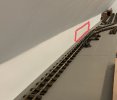
Back to walls. The layout needs lots of them. It’s a while since I built a wall. As a change, a bit of variety, I thought I’d make a start on the next wall. This piece of wall goes here:

1F272FD2-0259-4554-81A1-19AF503D0873.jpeg

It needs to be close to 3’ long. It also needs to be narrow and sit back right next to the wall of the room. This is to allow clearance for the front end overhang of locos with leading bogies entering the yard via the curved road of one of the adjacent turnouts. All the walls I have built for the back of the layout thus far have had a short return at each end, so the main length stood clear of the room wall behind. This wall will I think have to be right up against the room wall.

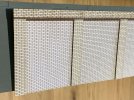
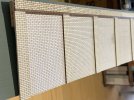
This is where I have got to:

43FDFF88-D9D9-4613-A8C4-513865E4D78C.jpeg

9EF00F6E-DBFA-4842-89EA-C8C868F8D1E7.jpeg

Eleven bays between the piers, total length a little under 3’. Currently working on the overhanging brickwork at the top of the wall. I have some footings on order from Intentio.

I’m inclined to having some engineering blue bricks in appropriate positions in the wall. Also some enamel adverts as the wall will be easily visible from trains entering/leaving the south end of Cairnie Junction station.

Martin
 

40057

Western Thunderer
Some progress with the current scenery build, another wall. I do find it extremely difficult to make such long structures exactly straight. The wall is just over 31.5”/80 cm long. I think there are minute inaccuracies in the brick-effect MDF panels I am using. Either corners a fraction of a degree off right angles, or the interlocking edges being very slightly out of register with the laser cut representation of the brick courses. Plus any misalignment I introduce myself when gluing panels together. The tiny inaccuracies are only a problem because a very slight divergence, say, at one joint is then multiplied up as successive panels are added. On a short building, there would be no issue.

I am now happy that, at this stage, my wall is straight. Seven of the eleven bays separated by the piers have been fully assembled at the top of the wall, given a witness coat of primer, filler added where needed and a first coat of brick-colour paint applied.

CFC0F306-CDB7-4E2C-924D-355FA379BF48.jpeg

No footings yet.

Given the need to keep the thickness of the wall to a minimum, plus it needing to stay exactly upright along its whole length when on the layout, I am minded to use some L-shaped steel brackets — sold as corner braces in B&Q — to fix the wall to the baseboard. I’ll cover the legs of the brackets projecting forward from the base of the wall with a strip of thin plywood painted to match the base-boards.

I have also started looking at what adverts I have suitable for attaching to the wall. Adverts with lots of small-size wording would not work in the location, as the adverts would be seen at some distance from moving trains. So I need adverts with just a product name, logo or slogan, large enough to be seen but small enough to fit between the piers of the wall. That’s quite restrictive. I’ll keep looking at the examples I have to assess the most suitable.

Martin
 
Last edited:

40057

Western Thunderer
Martin,

might magnets and steel screws provide a sufficient support/retention for your wall?

bedt
Simon
Possibly, Simon, thank you.

My fear, expectation really, is that the strips of wood used as supports for the MDF panels and to make the coping will want to warp. Past experience suggests quite thin wood panels, including ply wood, can be very determined to twist and bend. Unless held very firmly in place, I would expect the wall to bend after installation. Surviving 1930s model buildings, even those built of plywood, often have astonishing amounts of bowing and distortion in the walls. Parts can be so ‘determined’ to bend that joined wooden parts are broken by the force. So I tend to use a lot of bracing joined by good size wood screws to try to keep my buildings square. I also cut strip wood supports in half longitudinally and reverse one half before rejoining the two parts. The theory being that any tendency to bend will be counteracted by the two halves wanting to go in opposite directions.

Martin
 

John R Smith

Western Thunderer
Surviving 1930s model buildings, even those built of plywood, often have astonishing amounts of bowing and distortion in the walls. Parts can be so ‘determined’ to bend that joined wooden parts are broken by the force.

I will second that. The new platform I have just installed, had a horribly twisted plywood canopy/roof, which took me ages to straighten up. Even now I am prepared for it to twist back again and force me to make a new canopy. The vintage buildings I have which have survived the best are often the most toy-like, from Hugar and Givjoy, which seem to have very solid foundations of thick solid wood. Bassett-Lowke buildings often seem to survive in very poor condition, judging from the eBay listings I have seen.

The saddest example I have of this problem is a lovely pre-war wooden Milbro first class coach, which has twisted along its length and I can't see any way of rescuing it. There are other issues, too. It is a real shame because it has a wonderful interior, with lace antimacassars on the back of the seats. I paid rather too much for it, and I can't possibly sell it on in its present condition.

John
 

simond

Western Thunderer
John,

i have no idea whether this can be applied to your coach, but I had a scratchbuilt wooden 16mm L&B coach which warped. I welded a steel underframe which fitted within the wooden one. the steel could be beaten into flatness. The wooden body was attached with twists of wire, through small holes in the floor and slowly pulled down until it sat flat on the steel.

I think I eventually Araldited them together, but I’m no longer sure, I sold my 16mm stock some twenty years ago. (I wonder what happened to it, hopefully someone is enjoying it)

I guess the loss of originality might be offset by being able to enjoy seeing it run?
 
Top