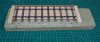
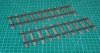
To keep the "Curve-spotters" happy here are two pictures of the current state of play, taken this morning in a temperature of around 4 degrees C (there is dedication for you). The first photo is of the station from the London end (LHS of plan).
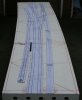
"Real" templates in the majority with my effort to the right hand side. Once I was happy with the lay of the land for the Up Goods Line I went over the centreline of that track with a permanent marker....
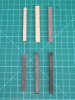
.... cut some strips from the offcuts of the template printout.
.... taped the paper over the marked centreline.
.... traced the line from the baseboard onto the paper strip.
.... added the outline of the ballast shoulder.
.... cut strip along edge of ballast.
.... stick paper to the foam.
.... stick paper / foam to the baseboard.
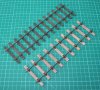
That there is no indication of rail / sleeper positions is not a problem given my methods of constructing track - the jig includes the centreline of the assembled track and that datum is transferred to the sleepers so I can lay the rail/sleepers "to the centreline" on the board.
And from the country end of the station:-

The kink in the ballast to centre right is not a mistake.... that is the curved catch point to protect the entry to the down loop. As there is no commercial template for this sort of thing I have made my own. Take an A5 LH template and cut out the rail and timbers from the toe of the turnout to the heel end of the switches (the first joint in the stock rails). The templates have the centrelines of the through and diverging routes plotted and that helps with the next step. Cut the "switch" template between each pair of timbers and retain the centreline for each timber. Stick the strips onto a piece of paper upon which is marked the required centreline of the through road, aligning the centreline of each "timber" strip with the underlying paper.
What might not be obvious from either the photos or the description so far is that the track templates were supplied as 19 sheets of paper, each sheet being roughly 50cms x 100 cms in size. Thankfully each sheet had been printed with register marks in the corners to assist with the task of aligning the templates on the baseboard. As an interim step in the evolution of the layout plan and track templates I had been given a Templot print file for the initial station plan, I printed the Templot drawing on A3 paper and stuck the 40 or so sheetsa together to create a full-size, draft, plan and that plan was used to determine the orientation of the final templates on the baseboard. No way was I going to commit to sticking the final track templates to the baseboard without having had a trial run - and that trial run was beneficial as the result showed that the platform roads crept towards the baseboard edge. So the draft plan was "slewed" at one end, by about 2cms, to increase the space between the platform and baseboard edge. Wonderful what can be achieved with a tape measure, a permanent marker and helpers to hold the plan.
regards, Graham



 that is going to look pretty darn good in S7. You weren't tempted to get it all printed in a roll?