Hartley Hills, LNWR c1900 - buffer stops, how do you build yours?

Dog Star

Western Thunderer
.... if you manually focus...

Ha-ha... the camera defaults to automatic focus and I have yet to understand how to reset to manual focus. More to the point, I shall have to find out how to stop down as much as possible for the light conditions. Do not laugh, I can get the Practika SLR out to see what is possible in the way of "f" and speed and then try to get the Canon to do the same. Why am I not using the Practika SLR? Given up on trying to get film so the camera just gathers dust.

regards, Graham
 

Buckjumper

Flying Squad
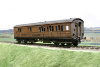
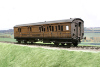
Done just to see if I could! Five shots layered in my cheap and cheerful Adobe PhotoDeluxe with lots of digital erasing and touching up.

e62444e_01.jpg

Not perfect by any means, and there was unavoidable distortion compounded along the length which culminated in the slight rise in the far footboard, but by then my brain was frazzled from fixing the distortion in the lower waist mouldings and I couldn't be bovvered. I guess Helicon would compensate automatically, and now at a distance in time from the deed I ought to go back, put the last bit of effort in and fix it.

Cheating? Yeah. Would I do it again? Unlikely.
 

Dog Star

Western Thunderer
I have some film of it running on Croscombe Magna . There's also some footage of my LNWR jubilee built by Laurie Griffin pulling some fifty footers that I built

I think that the videos can be found on the Scaleseven Group web-site, click through Showcase and then videos.

Or try this.

regards, Graham
 

Wagonman

Western Thunderer
Done just to see if I could! Five shots layered in my cheap and cheerful Adobe PhotoDeluxe with lots of digital erasing and touching up.

e62444e_01.jpg

Not perfect by any means, and there was unavoidable distortion compounded along the length which culminated in the slight rise in the far footboard, but by then my brain was frazzled from fixing the distortion in the lower waist mouldings and I couldn't be bovvered. I guess Helicon would compensate automatically, and now at a distance in time from the deed I ought to go back, put the last bit of effort in and fix it.

Cheating? Yeah. Would I do it again? Unlikely.


Yes Adrian, the Helicon software does correct automatically, though the more images it has to work with the better the result. A colleague of mine has used it for photographing small pieces of jewellery and it really does work – without frazzling one's brain.

Richard
(still analogue at heart)
 

Dog Star

Western Thunderer
Just how do we get an abandoned GER coach on the Buntingford branch into a thread about a LNWR station in Staffordshire? Easy when you are Mr. Adrian B who has a knack of distorting railway history....

A very nice model, could run a toplight in Lake a close call.

regards, Graham
 

Dog Star

Western Thunderer
Going on a bit.. in a location far, far, away from the sharp end, we have the common crossing:-

crossing-1.jpg

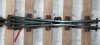
This is a 1:8 crossing made to LNWR PW drawings circa 1900 - and was a bit of a pig as the first one to be built for Hartley Hill. The point and splice rails were made using the appropriate S7 Group filing jig and assembled with the corresponding crossing jig... and then things got awkward. Those with a keen eye, or have a penchant for zoom control, may notice that the wing rails have a pronounced curve at the knuckle... and that the part of the wing rail alongside of the vee is not straight - try getting those features to lie comfortably within the S7 Group assembly jig.

Now the S7 Group supplies the crossing assembly jig in paxolin... and with a fine file I have been able to adjust my jig to accomodate the greater radius at the knuckle and the greater width over the ends of the wing rails.

Why is there a black spot under the crossing? Nothing to do with pie-rats, just a hole in a piece of paper. This crossing has an electrical feed attached to the underside of a rail and the hole allows the crossing to lie flat on the paper (for photography).

regards, Graham
 

Dog Star

Western Thunderer
With the common crossing assembled and aligning with the template the next step is to consider the chairing of the crossing. Reference to the LNWR drawing of crossings shows that there is no "slab and bracket" on pre-1900 S&C work, the same drawing shows that the crossing is supported and held by six block chairs - each of those chairs has to be made by cut-and-paste of standard chairs (no bolts through any of the block chairs). This is the result of the first step towards chairing the crossing:-

crossing-4.jpg

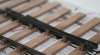
In LNWR parlance here we have, from left to right, block chairs Nos.6, 2 and 1 - the Nos. 3. 4 and 5 chairs are at the locations where I have put the brass straps to retain alignment of the wing rails and Vee. The three chairs in the photograph are sufficient to support the crossing when fixing the unit to the timbers.

The block chairs shown in this photo are made by removing material from one side of a standard chair until two chairs just meet when slid along the rails to the middle of the corresponding timber. If left to their own devices the standard chairs align themselves at right angles to the rail.... which is not what is wanted here as the block chairs are aligned parallel to the edge of the timbers. To overcome the desire of the chair to be difficult I remove some material from the key and inner jaw so that the rail can lie comfortably at an angle to the chair.

The remaining chairs shall be attached as "half" chairs when the crossing is in place.

Black spot still present, no known cure.

regards, Graham
 

Dog Star

Western Thunderer
And finally, enough chairs for the back row complete crossing:-


crossing-5.jpg

crossing-6-web.jpg
No apologies for the out-of-focus phot, still have to find the manual.

Another outbreak of pie-eating rats... this time some of the black circles are foam plugs to cover up screws in the baseboard top!

regards, Graham

[checkrail or closure next... such a choice]
 

Dog Star

Western Thunderer
In passing... there is virtually nothing on LNWR PW and S&C practice in print in either the model railway (eg. Railway Modeller) or historical press (eg. Historical Model Railway Society Journal) so one is rather left to one's own devices in going for circa 1900 LNWR trackwork. Here is a list of sources which have helped to shape the track of Hartley Hill:-

[1] The Railway Photos of P W Pilcher (LNWRS) - some of the best photos of switches / crossings;
[2] LNWR Miscellany, Talbot (OPC);
[3] LNWR West Midland Album, Carpenter, (Wild Swan);
[4] LNWR Railway Heritage (Silver Link);
[5] Proceedings of International Railway Congress, Paris, 1900 (report of Switches and Crossings);
[6] LNWRS web-site for photos;
[7] Warwickshire Railways web-site for photos.

I am aware of LNWR official PW drawings held by the LNWRS... drawings which are available only to members.

Study of photos in the books listed above show just how much the LNWR PW differed from the simple story in the HMRS LNWR Livery Register (try counting sleepers per rail length and see the variations for "standard" 30'0" and 60'0" panels).

regards, Graham
 

Dog Star

Western Thunderer
And for those who like to know such things... the crossing in the previous photos is no. 4B in the plan of post no.#1 of the Hartley Hill thread.
 

Wagonman

Western Thunderer
Excellent stuff, Graham. I sniff an fascinating article in the making here... [no known cure for that either!]

For the benefit of S7 Group members, the August Newsletter went to the printers last week.


Richard
 
Top