Farrington Road

mfsyoung

Active Member
S7centralpointwork.png

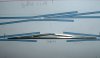
This is a Templot image of the central 4ft by 2ft board of my Island Platform Terminus design which is 14ft long with a 6ft Fiddle yard. Probably not very prototypical but it is what I like and it looks impressive! The scissors crossover is B9 but with 12ft switches. The tandem is B9/B8 also with 12ft switches. The other two are B7s

The Left side is two 3ft by 2ft boards.

Bottom left goes to Platform One, the middle road is Platform Two and the upper road is the Engine Release/Runaround. There is a B8 crossover to release the engine from Platform Two.

The Right side is one 4ft by 2ft board.

Bottom right is the single main line, the next one up is the head shunt and the top two are sidings. There is a B8 crossover between the Main Line and the Head Shunt.

Beyond this board will be a Fiddle Yard consisting of two 3ft by 2ft boards.

The whole is designed to be portable and even, perhaps, an exhibition layout!

My first thought regarding location was somewhere on the S&D as I have acquired an S7 BR Jinty (built from a Connoisseur kit) and will very soon start the MOK 4MT. My original layouts were mainly SR (I went to school in Dover) but I do like Midland and LMS locos. So, any suggestions?
It would have to be a restricted site to warrant the complicated trackwork!

Michael.
 

Dog Star

Western Thunderer
The scissors crossover is B9 but with 12ft switches. The tandem is B9/B8 also with 12ft switches.

If you intend to make your common crossings with prototypical arrangement of point rail and splice rail then you need to be aware that the S7 Group does not offer a 1:9 filing jig for Vees.

I am not sure that a scissors crossover with 1:9 obtuse crossings is going to be reliable... something about the angle through the obtuse crossing - I recall that the prototype used switched diamonds above 1:8.
 

mfsyoung

Active Member
If you intend to make your common crossings with prototypical arrangement of point rail and splice rail then you need to be aware that the S7 Group does not offer a 1:9 filing jig for Vees.

I am not sure that a scissors crossover with 1:9 obtuse crossings is going to be reliable... something about the angle through the obtuse crossing - I recall that the prototype used switched diamonds above 1:8.

I have always filed my own vees anyway, so I am not worried about the filing jigs. The assembly jigs are handy but I can only use them for the B7's. I have already made the triangular pieces (1:9 back to back) in the middle of the scissors, it was a bit of a fiddle and my first effort got scrapped!

If I have problems with the obtuse crossings I will have to convert to switch diamonds.
 

daifly

Western Thunderer
If you intend to make your common crossings with prototypical arrangement of point rail and splice rail then you need to be aware that the S7 Group does not offer a 1:9 filing jig for Vees.

I am not sure that a scissors crossover with 1:9 obtuse crossings is going to be reliable... something about the angle through the obtuse crossing - I recall that the prototype used switched diamonds above 1:8.
Spot on comments. It could all end in tears - even in S7!
 

mfsyoung

Active Member
I am not sure that a scissors crossover with 1:9 obtuse crossings is going to be reliable... something about the angle through the obtuse crossing - I recall that the prototype used switched diamonds above 1:8.

Just thought about what you said overnight.

Two opposing crossovers will give double the angle on the diamond crossing (2:9 or 1:4.5) In fact looking at Templot mine are 1:4.45. As switched diamonds are normally only required with an angle less than 1:8 then there should not be a problem.

I have built a 1:8 single slip in OO-SF on my son's layout and there has not been a problem, even with all the different RTR stock running over it! Which reminds me, I found a flangeway gauge for OO-SF and realised that it was the same as S7! (1mm)
 

Dog Star

Western Thunderer
Two opposing crossovers will give double the angle on the diamond crossing (2:9 or 1:4.5) In fact looking at Templot mine are 1:4.45. As switched diamonds are normally only required with an angle less than 1:8 then there should not be a problem.

True, silly me.

I shall be interested to see how you produce your point and splice rails without the filing jigs. Whilst the S7 Stores holds 1:5 to 1:8 crossing assembly jigs as "standard", other angles are available to order because the jigs are produced by CNC milling. I obtained 1:7.5 and 1:8.5 from the Stores earlier this year.

regards, Graham
 

mfsyoung

Active Member
True, silly me.

I shall be interested to see how you produce your point and splice rails without the filing jigs. Whilst the S7 Stores holds 1:5 to 1:8 crossing assembly jigs as "standard", other angles are available to order because the jigs are produced by CNC milling. I obtained 1:7.5 and 1:8.5 from the Stores earlier this year.

regards, Graham

I tried a 1:8 filing jig from S7 Stores but found that it took as long as me doing it by my usual method. Still, I am used to not having jigs!

The only reason I can do without jigs is that everything is done through Templot. I don't know if you are familiar with this software but the printed drawings can be very accurate as the printer is calibrated first.

First I lift all the crossings from the plan and arrange them on one sheet.

OnePageVees.jpg

Then I omit the timbers and print out the main 'Master Template'

MasterTemplate.jpg

Then using a Mk 1 eyeball and lots of blue-tak I make all the vees and bend all the rails on the Master Template which are then transferred to the layout being built. Usually everything slots in nicely!

I will explain how to make the vees later on when I have some more time but now for some pictures...

ScissorsTriangle.jpg

This was the most difficult one which I did first, back to back 1:9 vees!

DiamondVee.jpg

And here is one of the diamond vees.

FarringtonRoad1.jpg

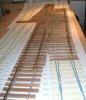
And finally, what I have achieved so far. Looking from the Head Shunt end towards the platforms with the tandem turnout in the foreground. You can also see the top Scissors 'triangle' in the distance. Also note the brass chairs dotted about. I like to use these in critical places and at rail joins. The strips going along the tops of some of the sleepers are copperclad strips which are used initially to support and hold things together.
 

Dog Star

Western Thunderer
Now that makes the knitting more obvious... please continue to post pictures of your progrerss.
 

westernfan

Western Thunderer
I take my hat off to you, thats alot of pointwork going on there . i find it hard enough just to wire up a double slip with those micro switches . those mk1 eyeballs must be working well lots of carrots :thumbs:
 

mfsyoung

Active Member
I take my hat off to you, thats alot of pointwork going on there . i find it hard enough just to wire up a double slip with those micro switches . those mk1 eyeballs must be working well lots of carrots :thumbs:

Thank you for your kind comments. I have been doing this for a number of years now and simple turnouts are too boring!

Mind you, as each rail interacts with others around it, I have to make sure that everything lines up and check and re-check everything. Nice and challenging!
 

mfsyoung

Active Member
DiagramSplice.jpg

As promised I will describe how I make the crossing vees from the Templot crossing sheet lifted from the plan.
I print out onto 250 gsm card for ease of handling from the printer which had been previously calibrated.

By the way, Templot is now free to download so anyone can do this.

So, using a suitable length of rail, place it over the point rail with the end level with the red cross (intersection of rails). You will then be able to see where the splice rail meets the point rail and this will be the start of the notch to be filed. The notch is then filed down to the web and back to nearly the point where the inner side of the splice rail meets the point rail (see diagram). The point rail is then held in position over the printed template with large pieces of blue-tak. (eyeball to make sure that it sits accurately).

A second piece of rail has a angle filed on the end to about the correct angle and offered up to the notch. Adjust the angle until the fit is perfect (lengthen the notch if necessary) and both rails sit perfectly over the printed plan.
If you have done the job correctly then you should be able to hold the splice and point rail together between thumb and forefinger and the angle should be perfect!

Next solder tack a piece of metal across the rails to hold the angle or use a large dollop of blue-tak!

I normally have a nice block of tufnol to solder on but anyway you need to support the vee on a flat surface while you solder it.

After soldering check the angle against the printed plan and if not correct unsolder and adjust.

When you are happy with this then bend the rail in front of the splice so that the centreline of the rail goes through the intersection cross with the vee lined up on the printed plan. Then file both sides of the nose so that it follows the shape of the printed plan. Check for straightness with a straight edge along the side of the top part of the rail. (the important bit!) I usually look into the light or into something white to see if there are any gaps. The vee should come to a point at the marked intersection. When satisfied file the end of the nose back, again with reference to the printed plan.

Bend up the wing rails so that they fit exactly over the printed plan. To fit I normally use a 6" rule mounted on some blue-tak so that the edge sits along the top side edge of the vee. The appropriate wing rail can then be lined up using the rule as a guide with a flangeway gauge in position at the end of the nose to give the correct gap.

I hope you will be able to follow this but if not let me know
 

daifly

Western Thunderer
Looking at the plan and if I'm interpreting your first post correctly, you would barely get a 4MT clear of the loco release turnout in platform 2, particularly if you fit a set of rail-built buffers at the end of the line. The loop is about a scale 150' long which will no doubt influence your choice of coaching stock too. I love the complex pointwork though!
 

mfsyoung

Active Member
Looking at the plan and if I'm interpreting your first post correctly, you would barely get a 4MT clear of the loco release turnout in platform 2, particularly if you fit a set of rail-built buffers at the end of the line. The loop is about a scale 150' long which will no doubt influence your choice of coaching stock too. I love the complex pointwork though!

Yes, there is no chance of rail built buffers, it will have to be a plank on a wall! The constraints of the baseboard sizes decide where the turnouts go and that crossover has been shifted to the right as far as it will go. I don't intend to have large locos anyway and the coaching stock will hopefully be 59ft.

WardBufferStop.jpg

Could use this...
 
Top