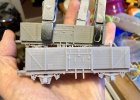
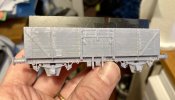
4mm An EM Workbench - Any Old Oil

Ministry of Aviation Tank (Rumney Models)
  • AJC

    Western Thunderer
    Which kit is that then? Looks like you made a good job of it though!
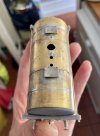
    Thanks Matt - Rumney Models' PC.111 - an Air Ministry 14 ton tank (yes, the same prototype Dapol have just released. You can read the instructions here: https://website.rumneymodels.co.uk/...0/PC.111_7.3_Air_Ministry_Tank_Wagon_Kits.pdf

    It's a country mile ahead of the Dapol one, and only slightly more expensive (but a lot more, mostly quite enjoyable, work). There's still scope to make a mess of it, but the hardest part, the tank, is now almost there. Of course, there's so many detail parts in the box, I might yet have to buy a Dapol one to use them...

    Adam
     
    Ministry of Aviation Tank (Rumney Models)
  • AJC

    Western Thunderer
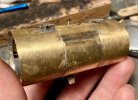
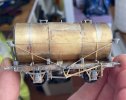
    Anyway, back to the humble tank wagon. Nearly all soldering operations are completed (barring the ladders), and once the various tank fittings are on it will be ready for paint.

    IMG_7569.jpeg

    IMG_7568.jpeg

    This really is an excellent, and surprisingly straightforward, kit, though the iPhone makes it look ever so slightly bananaform...

    Adam
     
    Last edited:
    Roadstone Rake
  • AJC

    Western Thunderer
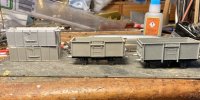
    I haven’t built a 16 tonner of any sort for absolutely ages, so why not do four at once?

    IMG_7739.jpeg

    Ok, so there’s a requirement for a couple: road stone traffic from Podimore will take two, and three other wagons (more anon), which accounts for the welded 1/108 and riveted 1/109. The ‘French’ type are simply because they were in the drawer thanks to other forum members (and thank you, I really appreciate it). They’re a bit more involved in detail terms so will be slower: there’s every chance the plain ones will be done within the week. Basic bodies done, load bases added, those with buffers in hand secured. The ESSO tank is nearly done, too, more of that later.

    Adam
     
    Last edited:
    Roadstone Rake
  • AJC

    Western Thunderer
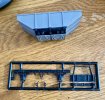
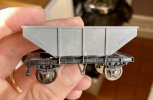
    One more for the roadstone rake, a Parkside/Peco 13 ton hopper. The Parkside bit is in grey, the Peco bit (completed posthumously), black, perhaps in a different type of plastic. I presume that they used drawings prepared to finish the job without Parkside’s understanding and knowledge of the real thing. So we have ok springs, overscale vee hangers, crude axleboxes, and buffers with rounded stocks. Oh, and this is fair enough, very thick end platform sheeting. I can do something about that, and will, so watch this space.

    IMG_7749.jpeg

    A fair bit to replace then. There’s also some poor fit around the hopper base, but that’s forgivable and quite easy to resolve: I trimmed away some of the grey moulding to suit. A spot of filling will be required.

    IMG_7748.jpeg

    A third 16 tonner and another, more exotic, hopper will complete the rake, but they’re for the future.

    Adam
     
    Last edited:
    Roadstone Rake
  • AJC

    Western Thunderer
    By means of contrast, here’s the PECO/Parkside.

    IMG_7766.jpeg

    It’s assembled ok: the end pieces of the frame fit into slots in the hopper assembly. I found that I needed some 10 thou’ packing at the *top* of the slot to get the level right. The location of the solebars is a little tight, but accurate and the application of Daywat did the job (my usual Humbrol liquid poly didn’t cut it).

    To get the end platforms close to scale, I trimmed and filed the moulded representation away: this will be replaced with 5 thou’ plastic sheet.

    Other changes and omissions: the spring stops were horrid, crude lumps and will be replaced. There are no horse hook holes - never seen a kit lacking those before. The vee hangers are round about the correct size for S scale, note how they don’t line up with the rivets, so they’re going and obviously new axleboxes will be added. I quite like the PECO wheels, they drifted out to EM without hassle, though on stepped axle, they seem to be true. This isn’t actually much work, it’s mechanically sound, but whoever cut the moulds for PECO, and those who signed it off, don’t know much about wagons…

    Adam
     
    Last edited:
    Roadstone Rake
  • AJC

    Western Thunderer
    Back from holiday and now all four wagons are on their way. One of the 16 tonners has its drop flap doors dropped, as did happen occasionally. The other two are perfectly normal and all are waiting on brake levers, and one axleboxes/springs because I’ve run out of the very nice Rumney ones. You can just about see that I’ve also reworked the corner reinforcement brackets with 5 thou’, bonded with more superglue; this is worth the hassle, I promise.

    The hopper is missing buffers because the set of LNER/LMS self contained I thought that I had are hiding. More on the end supports later, I’ve had to extend them downwards by 20 thou’ to meet the platforms. Note that these are decked with 5 thou’ superglued in place, along with some proper axleboxes (MJT).

    IMG_7994.jpeg

    IMG_7993.jpeg

    Adam
     
    Last edited:
    A Dübs called Clio
  • AJC

    Western Thunderer
    After a little while - 4mm - An EM Workbench: plastic steels - almost exactly a year, in fact, I’ve picked up my Dübs again. The slidebars turned out to be too short so I started again, with a new and better motion bracket, a dip into my stocks of scrap etch.

    IMG_8754.jpeg

    Now, I know that the chassis does roll with the test set of Romfords, the Gibsons it’s getting are thinner, and measuring suggests that the clearance ought to be there, so subject to paint, it ought to assemble ok, might even run.

    Adam
     
    Last edited:
    73080 - Merlin
  • AJC

    Western Thunderer
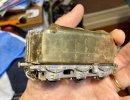
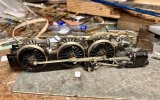
    This has come back to the surface over the last week or so. Merlin’s tender - which we last saw a year and more ago: 4mm - An EM Workbench: pannier pondering - is now ready for paint. It's mostly as DJH intended - though I've rigged up a sprung centre axle and made the brake rigging a little closer to the prototype, it scrubs up pretty well, I think. Now, about the front end...
    IMG_0044.jpeg

    Adam
     
    Last edited:
    73080 - Merlin
  • AJC

    Western Thunderer
    Now, about the front end...
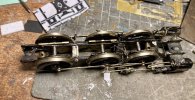
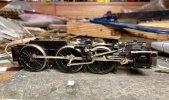
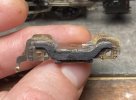
    So what does the front end look like? It's a bit of a mess, to be honest, and I struggle to believe that it ever ran, not least because the connecting rod catches the expansion link bracket on one side and thus the wheels won't go round. Obviously, the chassis also suffers from DJH design principles with incredibly thick frames and very narrow spacers. That said, crossheads on one side apart, I've got all the bits - the crosshead, being whitemetal, is no loss!

    IMG_0132.jpeg

    You can see the offending rod/bracket clash here:

    IMG_0133.jpeg

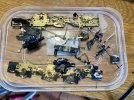
    Stripping has already begun - I think I'll reuse the Romfords, the profile is fine for EM and replacement Gibsons are north of 30 quid. The pick ups were on one side only so either one side is live or American pick up was intended - I don't remember any sign of that on the tender, but given the state it was in, who knows? Anyway, stripping has begun:

    IMG_0134.jpeg

    Replacement parts are already underway: new rods, a new front bogie (below), and a strip of brass sheet cut for new spacers.

    IMG_0131.jpeg

    Onward!

    Adam
     
    73080 - Merlin
  • AJC

    Western Thunderer
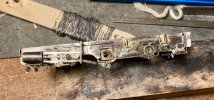
    After trying IPA, which at least softened the paint and showed up a lot of superglue doing inappropriate things (holding bearings in place, for instance: American pick-up must have been the idea, because that doesn't conduct!), a plunge into hot water has taken it to bits: the whole thing seems to have been assembled with whitemetal solder. Only a couple of minor casualties resulted from this process and both are repairable, I think. The crossheads were slated for replacement and I have suitable spares in hand so that at least is no issue. More when I've found the cellulose thinners and the big file.

    IMG_0140.jpeg

    Note that the spring detail on one side was sawn off to make way for pick ups - the front pick up, incidentally, was mounted (quite ingeniously) on the motion bracket. Invisible, but likely impossible to clean/adjust!

    Adam
     
    Last edited:
    73080 - Merlin
  • AJC

    Western Thunderer
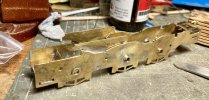
    In between other matters, I've cleaned up the frames, cut a slot at the front to accommodate a stretcher that will hold the cylinders and make them demountable to ease set up of the valve gear and I'm now working out where the spacers go, guided by the existing body mounting positions and the need to include a pivot for the bogie. I need one more in front of the foremost drivers, of only to hold the pick up lands.

    Yes, being DJH there are enormous cut outs for the antediluvian motor arrangements that were in the '80s design brief and these too will be sorted. This one will be rigid, there's plenty of weight and my Hornby Westcountry goes just fine with no suspension. Of course, that's also quicker and cheaper...

    IMG_0198.jpeg

    Adam
     
    73080 - Merlin
  • AJC

    Western Thunderer
    Frames back in one very solid piece. You can’t see it here, but I’ve roughed out some dummy springs to replace those hacked off first time around.

    IMG_0227.jpeg

    I’ll have to check that the motor fits where it ought before proceeding, but there’s holes for mounting the body, bogie and cylinder stretcher, so definitely making progress.

    Adam

    PS - even the six-year-old thought the original spacers were a bit narrow…
     
    Last edited:
    BR Ferry Open, diagram 1/055
  • AJC

    Western Thunderer
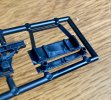
    A pair of wagons for the new year, I’ve long fancied having a go at the BR(S) ferry open, and 3D printing means that I can have two in a fraction of the time I could build one.

    IMG_0398.jpeg

    These were found on eBay, deliberately from two different suppliers. One had separated out the various design elements which made taking the supports away and cleaning up a bit easier, the other more or less as one thing.

    For whatever reason, the former was less stable and the body went distinctly wavy - I think the design is scale thickness for planking and perhaps thickening this up a few thou’ could have helped. The design, especially the axleboxes, was very fine indeed so I am happy enough. The chassis seems fairly substantial, so hopefully it will survive storage and a degree of temperature fluctuation, but I think that keeping these away from radiators is probably sensible.

    Since one is to be sheeted, the solution is easy: a waft with the hairdryer and a solid box box of 60 thou’ epoxied inside. This comes almost to the top and should help ensure that it survives in traffic. The second one - in a slightly different resin? - seems more durable, but I’m doing something similar, hence the pegs. This one will have a load, probably MoD type crates with lift rings - I confess that I have no real idea what these got used for in ferry traffic but since the transfers from Cambridge Custom Transfers include all the markings it would be a shame to hide them, and such crates seem not to have been covered as a matter of routine. The idea is to do enough to fill another open at the same time, but we shall see!

    Lots more on the go, with epoxy and Milliput the common themes, but more of that later.

    Adam
     
    Last edited:
    BR Ferry Open, diagram 1/055
  • AJC

    Western Thunderer
    Building for durability. Now I've added a rib along the centreline to support a representation of the sheet bar. There's no need to model it 'properly', as it's invisible and I'm more interested in a stable model that will survive handling. You can't see here, but the rib overlaps the ends. Based on an excellent image from the Tim Mills' collection, I've learned what I suspected must be the case: these took a pair of sheets as, I guess, the accompanying Pipe wagon would have done (all of these were equipped with tie downs and those explicitly used in paper traffic must have been sheeted regularly).

    img816-tm-23a-film-id80-90065-up-freight-potters-bar-22-dec-62-freight-traffic-b-copyright-fi-jpg.249691


    Ok, so the open illustrated is almost certainly French, running with BR sheets (yes, you can tell!), but the same principle applies. Original post and discussion here: Prototype - Tim Mills' Photos. Thanks, as ever, to @oldravendale for sharing these pictures.

    IMG_0413.jpeg


    Adam
     
    BR Ferry Open, diagram 1/055
  • hrmspaul

    Western Thunderer
    Building for durability. Now I've added a rib along the centreline to support a representation of the sheet bar. There's no need to model it 'properly', as it's invisible and I'm more interested in a stable model that will survive handling. You can't see here, but the rib overlaps the ends. Based on an excellent image from the Tim Mills' collection, I've learned what I suspected must be the case: these took a pair of sheets as, I guess, the accompanying Pipe wagon would have done (all of these were equipped with tie downs and those explicitly used in paper traffic must have been sheeted regularly).

    img816-tm-23a-film-id80-90065-up-freight-potters-bar-22-dec-62-freight-traffic-b-copyright-fi-jpg.249691


    Ok, so the open illustrated is almost certainly French, running with BR sheets (yes, you can tell!), but the same principle applies. Original post and discussion here: Prototype - Tim Mills' Photos. Thanks, as ever, to @oldravendale for sharing these pictures.

    View attachment 254878


    Adam
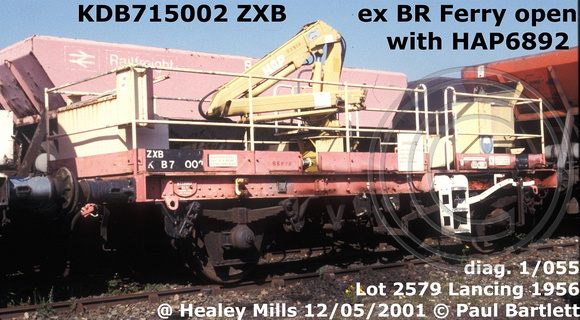
    The 40 BR Ferry opens didn't have any support bars, although they could be sheeted in use.

    Possibly popular model as the drawing was reproduced in Bartlett, P., Larkin, D., Mann, T., Silsbury, R., and Ward, A. (1985) An illustrated history of BR wagons, Volume 1 published by Oxford Publishing Company, 192 pages.


    Paul
     
    BR Ferry Open, diagram 1/055
  • AJC

    Western Thunderer
    The 40 BR Ferry opens didn't have any support bars, although they could be sheeted in use.

    Possibly popular model as the drawing was reproduced in Bartlett, P., Larkin, D., Mann, T., Silsbury, R., and Ward, A. (1985) An illustrated history of BR wagons, Volume 1 published by Oxford Publishing Company, 192 pages.


    Paul

    The drawing in Bartlett et al, fig. 21 on page 71 (and the works photo contained therein immediately above it , plate 99), certainly shows that they did *as built*. They had, as you say, lost them by the time you photographed them (the earliest picture in your gallery is dated 1980, i.e., 23 years after construction), but they're also shown in the diagram books. The sheets shown in your images are the later nylon variety, tailored for this specific use. Thank you, as ever, for the images and your contributions to that book which is utterly invaluable.

    Adam
     
    BR Ferry Open, diagram 1/055
  • hrmspaul

    Western Thunderer
    The drawing in Bartlett et al, fig. 21 on page 71 (and the works photo contained therein immediately above it , plate 99), certainly shows that they did *as built*. They had, as you say, lost them by the time you photographed them (the earliest picture in your gallery is dated 1980, i.e., 23 years after construction), but they're also shown in the diagram books. The sheets shown in your images are the later nylon variety, tailored for this specific use. Thank you, as ever, for the images and your contributions to that book which is utterly invaluable.

    Adam
    Apologies, I didn't dig the book out before replying.

    Wheel diameters are very variable, Specially constructed wagons in particular had all sorts of diameters, not just the model ones sold as "Lowmac" wheels.

    Paul
     
    • Like
    Reactions: AJC
    Top