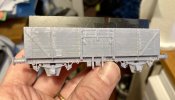
4mm An EM Workbench - Any Old Oil

AJC

Western Thunderer
Interesting to hear about the different suppliers and the stability of the prints. I got some 3D printed plate and Medfit wagons from ebay, great models and nicely printed but they have bowed slightly after painting and adding weights underneath, I'm not sure what part of the process this happened. I used acrylic paints throughout and superglue and epoxy to glue the weights on. I'm not sure how or indeed whether to correct it.

I suspect that bowing is part of the nature of the beast unless designed carefully (and perhaps even then? The resins seem to vary hugely in their composition from the limited reading that I've done). A Plate is probably the most severe test: they're long, flat, and the sides offer limited torsional resistance to bowing. I think I'd stick to the Parkside/Bachmann or even Rumney options for one of those.

Moulded plastic can suffer from this, of course - the long bogie vehicles Cambrian do are a good example: mine are reinforced with bicycle spokes and that seems to have worked. Whether that would work for the printed equivalent, I'm not sure.

Adam
 

Stevers

Western Thunderer
I'm not sure how or indeed whether to correct it.
All the 3D resins I've encountered have been thermoplastic. Heat, either via hot water or from a hair drier can be used to soften a model so that it can be 'trued up'. Most models that I've had printed have benefitted from this approach - for which I favour a hair drier.
 

simond

Western Thunderer
I have found that a bread tin of boiling water works very well, the depth of the water can be such that the wheels of an upside-down assembled wagons are not immersed - 30 seconds in the hot water, and out onto our (very flat) granite worktop to cool.

Interestingly, whilst I concur that these resins are thermoplastic, and soften at relatively low temperatures, I have found that they are also able to withstand soldering temperatures, and I have used them to print soldering jigs. The only way I can square this circle is by concluding that their thermal conductivity is extremely low.
 

steve50

Western Thunderer
All the 3D resins I've encountered have been thermoplastic. Heat, either via hot water or from a hair drier can be used to soften a model so that it can be 'trued up'. Most models that I've had printed have benefitted from this approach - for which I favour a hair drier.

I have found that a bread tin of boiling water works very well, the depth of the water can be such that the wheels of an upside-down assembled wagons are not immersed - 30 seconds in the hot water, and out onto our (very flat) granite worktop to cool.

Interestingly, whilst I concur that these resins are thermoplastic, and soften at relatively low temperatures, I have found that they are also able to withstand soldering temperatures, and I have used them to print soldering jigs. The only way I can square this circle is by concluding that their thermal conductivity is extremely low.
Do you think these methods would work once the model is painted or would the resin be set? I've clamped the wagons and left them overnight, they kept their shape all day today.

dfd8ff43-5ad3-4e00-80ad-2812274cfbb5.jpg
 

simond

Western Thunderer
I’ve had occasion to dip a painted (but not transferred) wagon in the hot water. it seems to have finally stayed flat & square.
 

matto21

Western Thunderer
Hi Adam,

I've see a lot of these Ferry Opens popping up recently and they look good...especially annoying after having slaved over scratchbuilding mine for months!

Matt
 

AJC

Western Thunderer
Hi Adam,

I've see a lot of these Ferry Opens popping up recently and they look good...especially annoying after having slaved over scratchbuilding mine for months!

Matt

I have every sympathy: I dodged the bullet, having a sacrificial Cambrian kit in the drawer for this express purpose. The issue, if it is one, is that muggins here has three of the things already…

Adam

EDIT: In fact, I have TWO Cambrian kits in the drawer. Not sure how that's happened.
 
Last edited:
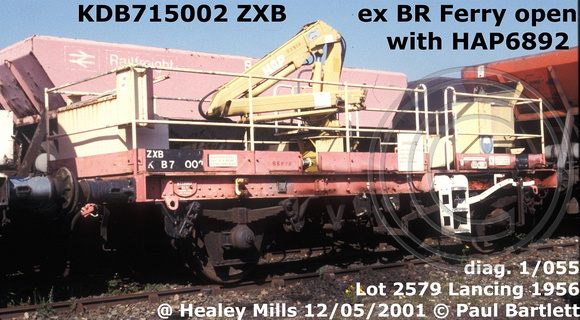
BR Ferry Open, diagram 1/055

AJC

Western Thunderer
Building for durability. Now I've added a rib along the centreline to support a representation of the sheet bar. There's no need to model it 'properly', as it's invisible and I'm more interested in a stable model that will survive handling. You can't see here, but the rib overlaps the ends. Based on an excellent image from the Tim Mills' collection, I've learned what I suspected must be the case: these took a pair of sheets as, I guess, the accompanying Pipe wagon would have done (all of these were equipped with tie downs and those explicitly used in paper traffic must have been sheeted regularly).

img816-tm-23a-film-id80-90065-up-freight-potters-bar-22-dec-62-freight-traffic-b-copyright-fi-jpg.249691


Ok, so the open illustrated is almost certainly French, running with BR sheets (yes, you can tell!), but the same principle applies. Original post and discussion here: Prototype - Tim Mills' Photos. Thanks, as ever, to @oldravendale for sharing these pictures.

IMG_0413.jpeg


Adam
 
BR Ferry Open, diagram 1/055

hrmspaul

Western Thunderer
Building for durability. Now I've added a rib along the centreline to support a representation of the sheet bar. There's no need to model it 'properly', as it's invisible and I'm more interested in a stable model that will survive handling. You can't see here, but the rib overlaps the ends. Based on an excellent image from the Tim Mills' collection, I've learned what I suspected must be the case: these took a pair of sheets as, I guess, the accompanying Pipe wagon would have done (all of these were equipped with tie downs and those explicitly used in paper traffic must have been sheeted regularly).

img816-tm-23a-film-id80-90065-up-freight-potters-bar-22-dec-62-freight-traffic-b-copyright-fi-jpg.249691


Ok, so the open illustrated is almost certainly French, running with BR sheets (yes, you can tell!), but the same principle applies. Original post and discussion here: Prototype - Tim Mills' Photos. Thanks, as ever, to @oldravendale for sharing these pictures.

View attachment 254878


Adam
The 40 BR Ferry opens didn't have any support bars, although they could be sheeted in use.

Possibly popular model as the drawing was reproduced in Bartlett, P., Larkin, D., Mann, T., Silsbury, R., and Ward, A. (1985) An illustrated history of BR wagons, Volume 1 published by Oxford Publishing Company, 192 pages.


Paul
 
BR Ferry Open, diagram 1/055

AJC

Western Thunderer
The 40 BR Ferry opens didn't have any support bars, although they could be sheeted in use.

Possibly popular model as the drawing was reproduced in Bartlett, P., Larkin, D., Mann, T., Silsbury, R., and Ward, A. (1985) An illustrated history of BR wagons, Volume 1 published by Oxford Publishing Company, 192 pages.


Paul

The drawing in Bartlett et al, fig. 21 on page 71 (and the works photo contained therein immediately above it , plate 99), certainly shows that they did *as built*. They had, as you say, lost them by the time you photographed them (the earliest picture in your gallery is dated 1980, i.e., 23 years after construction), but they're also shown in the diagram books. The sheets shown in your images are the later nylon variety, tailored for this specific use. Thank you, as ever, for the images and your contributions to that book which is utterly invaluable.

Adam
 

76043

Western Thunderer
The drawing of diagram 1/055 also appears in the Rowland book, pg.33, with the author noting the 'wheels were one metre diameter rather than the usual 3ft 1½in'. Now that's practically 13mm, a significant increase from the usual 12 or 12.5mm diameter!!! I need to go and lie down with a cold towel on my forehead... LOL.
Tony
 
  • Like
Reactions: AJC

AJC

Western Thunderer
The drawing of diagram 1/055 also appears in the Rowland book, pg.33, with the author noting the 'wheels were one metre diameter rather than the usual 3ft 1½in'. Now that's practically 13mm, a significant increase from the usual 12 or 12.5mm diameter!!! I need to go and lie down with a cold towel on my forehead... LOL.
Tony

Yes, that would be standard in the RIV specifications as the running gear was (for fairly obvious reasons). I confess that this is somewhere I am likely to depart from the prototype!

Adam

EDIT - Gibson do 3' 2" discs and, obviously, spoked carrying wheels where the difference in diameter is a bit more obvious, e.g., for SNCF ferry vans.
 
Last edited:
BR Ferry Open, diagram 1/055

hrmspaul

Western Thunderer
The drawing in Bartlett et al, fig. 21 on page 71 (and the works photo contained therein immediately above it , plate 99), certainly shows that they did *as built*. They had, as you say, lost them by the time you photographed them (the earliest picture in your gallery is dated 1980, i.e., 23 years after construction), but they're also shown in the diagram books. The sheets shown in your images are the later nylon variety, tailored for this specific use. Thank you, as ever, for the images and your contributions to that book which is utterly invaluable.

Adam
Apologies, I didn't dig the book out before replying.

Wheel diameters are very variable, Specially constructed wagons in particular had all sorts of diameters, not just the model ones sold as "Lowmac" wheels.

Paul
 
  • Like
Reactions: AJC
BR Ferry Open, diagram 1/055

AJC

Western Thunderer
A quick bit of fettling. On the evidence of this, there’s no way these fittings will survive to the standard I want on the unsheeted version so that can wait until I next put an order into Rumney Models, but just peeking out from under a sheet will be fine.

IMG_0425.jpeg

In contrast, I think the brake levers ought to be ok, though I did break one. Thankfully that’s the one without the lifting link so is easier to resolve using bits in stock.

Adam
 
BR Ferry Open, diagram 1/055

AJC

Western Thunderer
By one of those happy coincidences, here's a shot of one in a train (the first I've seen in 'traffic' as opposed to engineers' use:


Thanks to Jon Hall for the link. The other wagons, from the camera, seem to be a Belgian ferry van (you can see the 'B' logo on the door), a modern (for the time), monbloc tanker, a pair of vans with wide opening sliding doors and planks - not sure what these are - two chemical tanks, not clear what type; another Belgian van and then a BR shoc high. Destination or origin almost certainly Harwich (well, Dovercourt, really).

Adam
 
Last edited:
BR Ferry Open, diagram 1/055

hrmspaul

Western Thunderer
By one of those happy coincidences, here's a shot of one in a train (the first I've seen in 'traffic' as opposed to engineers' use:


Thanks to Jon Hall for the link. The other wagons, from the camera, seem to be a Belgian ferry van (you can see the 'B' logo on the door), a modern (for the time), monbloc tanker, a pair of vans with wide opening sliding doors and planks - not sure what these are - two chemical tanks, not clear what type; another Belgian van and then a BR shoc high. Destination or origin almost certainly Harwich (well, Dovercourt, really).

Adam
The Chemical tanks are Octels. A common ferry tank working to Harwich from Lostock Gralam or Stanlow Associated Octel tank wagons - international registered

Paul
 
Last edited:
Top