Rivermead Central

John R Smith

Western Thunderer
Nice work, Martin. This reminds me of the sort of conservation issues we used to deal with at work, with Roman pottery and similar artefacts.

Interestingly, a dark grey version of this Carette wagon sold on eBay on Sunday, I don't know if you spotted it. But it was in a shocking state compared to yours.

A similar conservation project has just landed on my kitchen table workbench. But this is a much later (probably 1930s to 1950s) wooden model of a MR six-wheel brake van - it looks at first sight to be in fairly good condition but needs a little TLC. Something to keep me busy for a few evenings!

John
 

40057

Western Thunderer
Nice work, Martin. This reminds me of the sort of conservation issues we used to deal with at work, with Roman pottery and similar artefacts.

Interestingly, a dark grey version of this Carette wagon sold on eBay on Sunday, I don't know if you spotted it. But it was in a shocking state compared to yours.

A similar conservation project has just landed on my kitchen table workbench. But this is a much later (probably 1930s to 1950s) wooden model of a MR six-wheel brake van - it looks at first sight to be in fairly good condition but needs a little TLC. Something to keep me busy for a few evenings!

John
Hi John

Yes, I did see the grey version of the Carette wagon. But there was nothing that could be done with it. Repainting extensive areas of lithographed models totally changes their character, however well it is done. Beyond rescue, I thought.

Is your MR brake the BL model that was offered before and after WW1?

Martin
 

John R Smith

Western Thunderer
Is your MR brake the BL model that was offered before and after WW1?

Hello Martin

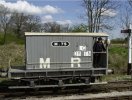
Well, I have only just unpacked it and given it a once over. But I don't think it has anything to do with Bassett-Lowke. It is a model of one of these -

MR 6W Brake-Van.jpg

This is a preserved one which lasted into the 1960s, amazingly. Mine has a wooden body, solebars and headstocks - I think the roof may also be of very thin wood (or perhaps card) -

Midland 6W Brake 01.jpg

All the detailing is in brass - handrails, footboards, and buffers. The drop-link couplings are standard steel items.

Midland 6W Brake 02.jpg

The axleguards are white metal and the wheels are turned steel. As you can see, it needs a bit of work but it is basically all there.

John
 

40057

Western Thunderer
Hello Martin

Well, I have only just unpacked it and given it a once over. But I don't think it has anything to do with Bassett-Lowke. It is a model of one of these -

View attachment 266502

This is a preserved one which lasted into the 1960s, amazingly. Mine has a wooden body, solebars and headstocks - I think the roof may also be of very thin wood (or perhaps card) -

View attachment 266503

All the detailing is in brass - handrails, footboards, and buffers. The drop-link couplings are standard steel items.

View attachment 266504

The axleguards are white metal and the wheels are turned steel. As you can see, it needs a bit of work but it is basically all there.

John
I think it’s Milbro. Heavily modified, but started life as a Milbro product.

Martin
 

John R Smith

Western Thunderer
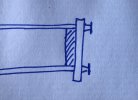
The buffers are definitely Milbro. If Milbro built the body, there should be a separate reinforcing wooden piece behind each headstock, the full width of the wagon between the frames, shown hatched here:

Hello Martin

I have now had a proper look at the underside, and sadly there are no reinforcing pieces -

Midland 6W Brake 03.jpg

So not Milbro, it would seem. The wheels are a bit strange - they are not spoked, but have six holes. They were absolutely filthy, so the van has certainly seen some use in the past.

John
 

40057

Western Thunderer
Hello Martin

I have now had a proper look at the underside, and sadly there are no reinforcing pieces -

View attachment 266548

So not Milbro, it would seem. The wheels are a bit strange - they are not spoked, but have six holes. They were absolutely filthy, so the van has certainly seen some use in the past.

John
As you say, not a Milbro underframe.

Difficult to decide what your brake van is. The scribing for the planking, the cutting out of the end windows, the coupling slots, all appear to be professional standard. But drilling holes in disc wheels to make them look spoked I would say is the approach of an amateur builder. One possibility there would be construction during WW2 when almost nothing in the way of parts was available, so use what you have got.

Martin
 
Last edited:

John R Smith

Western Thunderer
But drilling holes in disc wheels to make them look spoked I would say is the approach of an amateur builder.

Martin

I think that you are absolutely right on this - the holes are intended to make the wheels appear to be spoked at a casual glance. And I think that they are an original part of the build, because I thought about removing them but that would be very difficult the way that the van is constructed. You would have to remove one of the footboards (which is soldered to its supports) in order to slack the axleguards off on one side and get the wheels out. Considering the amount of work involved in the rest of the wagon the holes seem an odd thing to do, unless the correct spoked wheels were not available. So perhaps during WW2 or immediately after as you suggest. Looking at the van more carefully, I have now spotted that it originally had 3-link couplings, and all the smaller handrails are more recent additions. The roof is definitely (very thin) wood.

John
 
Top