I have now paused to emboss every remaining rivet. There are only a few, but they are on both sides of the etch . . .
. . . actually, this was also a mistake. If you are going to twist the axlebox keeper plates to resemble the GER design, it would be better to emboss the bolt heads after forming the parts. But this is proving a bit too intricate for me, so I will leave the keeper plates straight to match my other GER wagons.
I am using the RSU and the microflame torch for nearly all of the assembly, and the result is needing very little clean up. Well, so far.
Meanwhile, I have taken a break from the body of the sand wagon to build the roof.
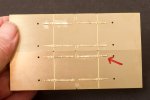
Faults like this crooked hinge show up much more clearly in photos. If fact I could hardly see this on the model, but I did put it right.
Just a knife blade under the hinge and a brief application of the micro flame torch. The hinge simply lifted away, I cleaned it up and put it back. I could not have done this a few years ago.
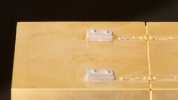
The door stops bring the need to put small castings onto a large expanse of brass. I am told I can use the RSU to do this but I haven’t yet sussed out a method without melting the casting.
My method is therefore to solder them up quite generously underneath with the iron, look for a trace of solder on the good side, and then clean up underneath (next photo).

The brackets underneath are mine, to try to make the roof detachable. At the moment, the roof wants to sit ever so slightly skew, just enough to annoy me, so I may end up with a few blobs of glue on these brackets after painting.

Completed roof.
Earlier this year I was muttering on here about a "plateau" in my modelling ability and do I think I have finally taken a step up thanks to the RSU. There is no mechanical cleaning up here except underneath the door stops. Having such a fine kit to build helps too.



