When I started in 0 gauge (summer of 2021), I thought the FS wheel was really quite a crude thing; but somehow I accepted it without much thought and got on with making models. I now know, the ScaleSeven wheel will run perfectly well on 0-MF track, and a model so fitted looks a lot better. But running such a narrow wheel on a tired 0-F layout is likely to bring disappointment.
I have been looking for a middle-of-the-road wheel profile which will look better than a FS one and still run at on the 0-F tracks at NEEGOG.
The trolley runs fine on 'Heybridge Basin' but really I thought it would. I am now waiting for some cassette-deck style drive bands to let me try it over a distance at NEEGOG.
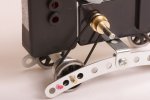
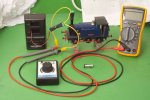
This contraption now has a drive belt. This is a square-section belt sold for cassette players and CD/DVD drives, and it is slightly sloppy. The pulleys have a vee groove with a flat base and 60-degree sides and, more by luck than judgement, they are gripping the belt beautifully. And so, the thing drives itself along. This photo also shows my experimental wheel profile.

I have rebuilt the superstructure(?) to set the C of G centrally above the pivot on the side frame, and to leave the C of G unpleasantly high. All-up weight is about 200 grams and the wheelbase is 70 mm, so much the same as a white metal wagon. Running speed is north of a scale 100 mph, so I fear I have been perceived as more hooligan than mad engineer, but the speed really only adds to the fun.
Well, I put the machine on the track at NEEGOG this morning, and it completed lap after lap without difficulty. It ran perfectly in both directions, including the curved legs of two Peco 6ft points in both leading and trailing directions. In fact, it never derailed. This was more than a mere surprise, I was amazed. I expected it to derail at a moment’s notice.
A better idea might be to reduce the flange to 0.66 mm (the scale height, adopted by the S7 standards) and keep the original tyre width of 3.4 mm. The wider tread giving the wheel as much support as possible when it runs through a 0-F crossing. This is easy to make using the S7 wheel profile tool. It also gives the opportunity to reduce the tyre diameter a little, to improve the appearance.
Arguably I am doing nothing new. The wheel standards from the Guild state that the fine scale flange can be reduced to 0.6 mm if suspension is provided. But I am staggered that this works so well on a track I have seen to derail so many models. The wheel profile seems to relying heavily on its coning too, because the flanges are so far away from the check rails.

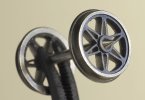
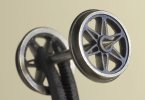
This is the wheel profile I tested at NEEGOG today, photographed beside a ScaleSeven wheel from Peartree. The test wheel has the same shape but it is the same width as a FS wheel.
RG7 would seem to describe the standard you seek.
I don’t have a big enough ego to call this RG7, but what it is seems to fit the bill for future wagon builds on my mixed 0-F and 0-MF Heybridge Railway. It is also very easy to pull the wheels apart on their axle to create a wagon compatible with ScaleSeven, for when I have a layout run such a wagon.
The testing has all been rather satisfactory.