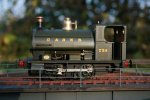
I have made a start on wiring up the NER H2 . . .
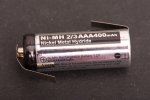
The loco is receiving seven NiMH batteries, these ones are two-thirds AAA size and branded ‘Digimax’.
Choosing NiMH technology removes the worries associated with LiPo, and I can use the charger from my similarly-powered Y14. I have a feeling, 400mAh is plenty of capacity to drive the incredibly efficient motor in the Slater’s SG38.
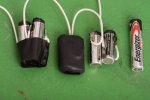
Test running has shown, with the seven batteries partly charged as supplied (8.4 volts off-load), the loco can reach a scale 23 mph. This seems just right to me, which is fortunate because shoe-horning in an eighth battery would be difficult if not impossible. Charging the batteries takes this up to just over 9 volts.

The batteries are in three groups, one for the boiler and one for each side tank. The ones in the side tanks are short enough to leave room for a power switch on one side and a fuse on the other.
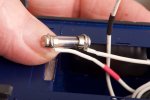
I have gone for one fuse for the whole battery pack. I expect some experts will tell me how potentially dangerous this is but to be honest, I think an open circuit is far more likely as a failure mode.
Thinking about only single fault conditions:
- the charging socket connects the negative side of the battery pack to the metalwork of the model, and so a short circuit across the entire battery pack is possible in the wiring outside the battery pack or in the r/c board.
- a short circuit within one group of two or three batteries needs the factory insulation around an individual battery to fail. This is unlikely, because the heatshrink prevents movement and chafing.
So this is a 3 amp fuse, large enough to never blow in normal operation and placed here as a last resort to save the model before a fire gets underway.
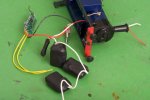
Here are most of the electrical parts to be fitted into the model.
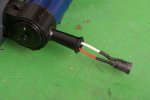
The charging socket is the first part to be fixed into place. This is an interference fit into the chimney, and it is now there forever unless I choose to destroy it by taking it out. I don’t like this sort of approach to assembly but there is very little free space to play with. Putting the socket here is easier than putting it in the coal bunker because the wiring ends up where it is wanted.
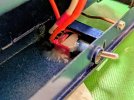
The power switch had to be wired up before fixing it into the model, this is fast-setting epoxy glue. Thanks to
@simond for the suggestion to put the switch here, the result is going to look really neat yet still accessible and easy to use.
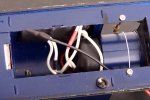
Here are the power switch, the fuse (opposite the switch) and all of the batteries. What seemed like a huge empty space is getting filled up. I have enough room for the Micron MR603 receiver or the motor, but not both. So the assembly pauses again while I await a smaller receiver, this will be the Micron MR601.
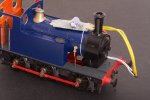
In the meantime I have a temporary lash-up so I can give the loco some test runs.
I have touched in the paint along the edges of the running boards! These are now enamel, the Vallejo acrylic was just falling off through handling the model.