RichardG
Western Thunderer
Hello from Essex
I have been modelling in 0 gauge for less than a year. Last summer I bought a Minerva Manning Wardle K class loco. The idea at the time was to put it on a low loader and to build a 7 mm street scene to show off a rather lovely row of shops I was able to buy from the estate of a modeller who had bought commissions from Allan Downes. Who in turn inspired me a lot when I was modelling in my teens about 40 years ago.
Well, I just sort of looked at this model for a month or so. Put it under a Perspex cover and admired it. I had a look for a suitable “heavy haul” tractor in the diecast ranges and found nothing, and ended up just buying two yards of track and a couple of Dapol wagons as a sort of a fix. I discovered Peco BH rail uses their FB rail joiners. Then I realised the loco ran perfectly out of its box and ran better than most of my 16.5mm gauge models, and I enjoyed this so much I bought a Setrack point and a third yard of track and built a simple baseboard for a little test track.
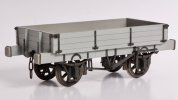
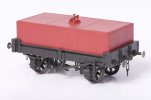
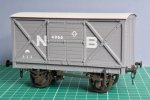
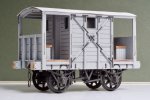
Well the big mistake I made was to buy two wagons and to keep them near each other without a trip to the vet. Nature seems to have taken its natural course now I have four more RTR wagons and I am doing my ninth kit-built one. I have joined the North East Essex group of the Guild, and now signed up to Western Thunderer. Both seem like friendly places to share new models and ideas and progress and so on.
As a beginner in 7mm scale I may well not have much new knowledge to contribute here, but I am hoping to model a railway set in the 1890s; this is a relatively unpopular period and so maybe I can be useful here. I do know, I have given up on the idea of the low loader
Related topics
A private coach in the 1890s
Heybridge Basin (first part of a layout)
Small traverser with added vertical movements (abandoned design for a layout)
Using a R/C loco as the power plant for a small 0 gauge layout
Women are difficult (railway passengers 1889 to 1907)
I have been modelling in 0 gauge for less than a year. Last summer I bought a Minerva Manning Wardle K class loco. The idea at the time was to put it on a low loader and to build a 7 mm street scene to show off a rather lovely row of shops I was able to buy from the estate of a modeller who had bought commissions from Allan Downes. Who in turn inspired me a lot when I was modelling in my teens about 40 years ago.
Well, I just sort of looked at this model for a month or so. Put it under a Perspex cover and admired it. I had a look for a suitable “heavy haul” tractor in the diecast ranges and found nothing, and ended up just buying two yards of track and a couple of Dapol wagons as a sort of a fix. I discovered Peco BH rail uses their FB rail joiners. Then I realised the loco ran perfectly out of its box and ran better than most of my 16.5mm gauge models, and I enjoyed this so much I bought a Setrack point and a third yard of track and built a simple baseboard for a little test track.
Well the big mistake I made was to buy two wagons and to keep them near each other without a trip to the vet. Nature seems to have taken its natural course now I have four more RTR wagons and I am doing my ninth kit-built one. I have joined the North East Essex group of the Guild, and now signed up to Western Thunderer. Both seem like friendly places to share new models and ideas and progress and so on.
As a beginner in 7mm scale I may well not have much new knowledge to contribute here, but I am hoping to model a railway set in the 1890s; this is a relatively unpopular period and so maybe I can be useful here. I do know, I have given up on the idea of the low loader
Related topics
A private coach in the 1890s
Heybridge Basin (first part of a layout)
Small traverser with added vertical movements (abandoned design for a layout)
Using a R/C loco as the power plant for a small 0 gauge layout
Women are difficult (railway passengers 1889 to 1907)
Last edited: