
You are using an out of date browser. It may not display this or other websites correctly.
You should upgrade or use an alternative browser.
You should upgrade or use an alternative browser.


michael080
Western Thunderer
There are a zillion apps for mobile phones that provide a strobe light to check the speed.I don’t have a tacho so I can’t work out how fast it goes, my impression is that it’s very much quicker than the original motor.

simond
Western Thunderer
Thanks Michael, I had one but was never quite convinced. I’ll see if Jim’s suggestion works better.There are a zillion apps for mobile phones that provide a strobe light to check the speed.
simond
Western Thunderer
You’d really not want to spend the time that this would take if made from wood, despite the attractive appearance it would offer

Now, I have a choice, I do have a set of 0BA taps & die, and I don’t have 13BA, so I could reprint, I could carve off the letters and use a labelling machine or I could just leave it on the basis that I use 0BA…., never.
Oh, and for the record, about half an hour to create the model, about 5 hours to print and about four quid.
And if anyone wants one, let me know and I’ll add it to the resources section
Now, I have a choice, I do have a set of 0BA taps & die, and I don’t have 13BA, so I could reprint, I could carve off the letters and use a labelling machine or I could just leave it on the basis that I use 0BA…., never.
Oh, and for the record, about half an hour to create the model, about 5 hours to print and about four quid.
And if anyone wants one, let me know and I’ll add it to the resources section

Lawrence Boul
Western Thunderer
At least when I drop my taps I only break one at a time...

michael080
Western Thunderer
great minds think alike


btw. "great minds think alike" sound much nicer than the German version "Zwei Dumme, ein Gedanke" (two fools, one thought)
Michael
I am sorry if this offends but the first sentence had me in stitches.And of course, you can print your own knob
View attachment 267185
it just doesnt fit the splines as well as I’d like, so I will probably print another in the morning. It took about 14 minutes, and cost about 9 pence.
simond
Western Thunderer
You may think such thoughts if you will. Me, I couldn’t comment…I am sorry if this offends but the first sentence had me in stitches.

Last edited:
simond
Western Thunderer
Thanks Michael,great minds think alike
View attachment 267227
btw. "great minds think alike" sound much nicer than the German version "Zwei Dumme, ein Gedanke" (two fools, one thought)
Michael
I’m progressively tidying up things as the FDM printer opportunities occur to me. Some time back, I laser cut an MDF rack for pliers and cutters and similar tools, and it’s showing its age, so is on the list. My metric taps and dies will get a similar rack (or two) to the BA one.
Screwdrivers, drills in hand chucks, files, etc…
I would like a better housing for the lathe speed control, so will print that, plus some trays for other lathe accessories, chucks etc. I already did one for the collet chuck and the collets.
of course, when you have a new hammer, everything looks like a nail…

Dan Randall
Western Thunderer
Of course, when you have a new hammer, everything looks like a nail…
simond
Western Thunderer
Out of interest and an abundance of curiosity, I tried to print an N6 coal wagon using the FDM rather than the resin printer
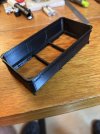
It has printed, and whilst it’s not awful, it’s really not great either. It’s nowhere near as good as the wooden body wooden solebar RCH wagons. The horizontal flanges are the main problem, but the fact that what should be a smooth iron plate is somehow not smooth is the elephant in this particular room.
I think it would be ok in larger scales and it’s certainly less fragile than the resin wagons, but I think this particular experiment has concluded with an “mmmm, no.”
Cost - about a hour of faffing about (three false starts) and less than a quid’s worth of plastic.
I’ll try a steel solebar oriented for printing next. We shall see…
It has printed, and whilst it’s not awful, it’s really not great either. It’s nowhere near as good as the wooden body wooden solebar RCH wagons. The horizontal flanges are the main problem, but the fact that what should be a smooth iron plate is somehow not smooth is the elephant in this particular room.
I think it would be ok in larger scales and it’s certainly less fragile than the resin wagons, but I think this particular experiment has concluded with an “mmmm, no.”
Cost - about a hour of faffing about (three false starts) and less than a quid’s worth of plastic.
I’ll try a steel solebar oriented for printing next. We shall see…

martin_wynne
Western Thunderer
I think it would be ok in larger scales and it’s certainly less fragile than the resin wagons, but I think this particular experiment has concluded with an “mmmm, no.”
Hi Simon,
What nozzle size? What filament? How dry was the filament? What profile settings?
These all make such a huge difference for fine-detail models that just saying "FDM-printed" doesn't mean much by itself.
It can never be as good as resin-printing, but it can get close.
cheers,
Martin.
simond
Western Thunderer
Morning Martin,
it was PETG using an 0.2 nozzle and Bambu defaults except the first layer which I widened and thickened a little.
I am sure it could be improved, but I’m not sure it’s worth the effort. I have ambitions to print a large girder bridge and I’ll have to experiment more to find settings and a material that gives good flatness on the supposedly rolled steel surfaces and good definition of the rivets when their axis is not parallel to the printer Z axis.
Otherwise I’ve got a the challenge of making it in brass, which would look nice, cost a fortune and take years…
But having already created the wagon model it was an easy starting point to “see what happens”.
and from further curiosity, I kicked off exactly the same print this morning, using grey PLA. I’ll see what happened when I get back from the office.
Cheers
Simon
it was PETG using an 0.2 nozzle and Bambu defaults except the first layer which I widened and thickened a little.
I am sure it could be improved, but I’m not sure it’s worth the effort. I have ambitions to print a large girder bridge and I’ll have to experiment more to find settings and a material that gives good flatness on the supposedly rolled steel surfaces and good definition of the rivets when their axis is not parallel to the printer Z axis.
Otherwise I’ve got a the challenge of making it in brass, which would look nice, cost a fortune and take years…
But having already created the wagon model it was an easy starting point to “see what happens”.
and from further curiosity, I kicked off exactly the same print this morning, using grey PLA. I’ll see what happened when I get back from the office.
Cheers
Simon
Last edited:

martin_wynne
Western Thunderer
Morning Martin,
it was PETG using an 0.2 nozzle and Bambu defaults
Hi Simon,
My experience of PETG is that it's not ideal for fine detail. It's more hygroscopic than PLA and needs to be dried, dried, and dried again to get good results. Otherwise typical results with wet PETG are:
Fine detail not crisply defined.
Stringing.
Small parts weak and break off easily.
Flat surfaces rough and uneven.
There's not much point changing to a 0.2mm nozzle unless you also use the finest profile settings, e.g. 0.06mm or 0.08mm layers. Horizontal surfaces can be improved using the ironing settings, or by changing the top surface pattern from rectilinear to concentric. Vertical surfaces can be improved by changing the number of walls and infill density settings. Reducing the print speed always improves the results. There are dozens of other settings available which can make the difference between a great result and a rubbish result. The Bambu defaults were not primarily created for finely detailed scale models at low speed, so we need to find our own.
cheers,
Martin.
simond
Western Thunderer
Thanks Martin,
I say "default" but I can't recall if I changed the layer height or not. I forgot to mention that the AMS was reporting 4% humidity but it appears to be 6% now according to my phone app. From the tiny picture on the phone screen, it does look like it might have printed well, so I shall look forward to getting home from the office (although it is probably a good evening to go to the supermarket, apparently there's some game or other on the telly that "everyone" wants to watch)
I did have it set to iron the topmost layers. Given that this is an iron wagon, the wall thickness is really very small - it is only 0.5mm per the CAD, still a bit thick for prototype realism, I think the plates were around 1/4" real so 0.29mm scale.
More soon
Simon
I say "default" but I can't recall if I changed the layer height or not. I forgot to mention that the AMS was reporting 4% humidity but it appears to be 6% now according to my phone app. From the tiny picture on the phone screen, it does look like it might have printed well, so I shall look forward to getting home from the office (although it is probably a good evening to go to the supermarket, apparently there's some game or other on the telly that "everyone" wants to watch)
I did have it set to iron the topmost layers. Given that this is an iron wagon, the wall thickness is really very small - it is only 0.5mm per the CAD, still a bit thick for prototype realism, I think the plates were around 1/4" real so 0.29mm scale.
More soon
Simon
simond
Western Thunderer
Simon,
What will it look like with a coat of paint, or two.
Let's see how the PLA one turns out. The PETG one has stringing and poor definition so not worth the paint!
Simon
simond
Western Thunderer
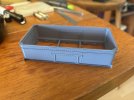
For the record, the layer height was 0.1 and AMS humidity was 6%
The model has definitely printed better in PLA than PETG, there is some banding but generally the iron plates look passable
Support for the flanges is an issue and there is some stringing, probably less than the PETG.
Overall much better, but still not at resin levels of fidelity.
ATB
Simon
martin_wynne
Western Thunderer
@simondOverall much better, but still not at resin levels of fidelity.
Hi Simon,
You are not going to match resin with FDM, you can only hope to get close. Then decide if you can live with the difference for the lower cost of equipment and user-friendly FDM mess-free working.
But that looks very good. With a 0.2mm nozzle, a layer of 0.1mm is a bit too much. With layers much more than 40% of the nozzle diameter you lose dimensional control. For a 0.2mm nozzle I would suggest 0.06mm or 0.08mm layers.
I think 0.06mm layers would solve the problem with the side flanges. Maybe with a tweak to the CAD to put a slight draft angle on the underside of the flange.
0.06mm layers are going to increase the print time, but not necessarily by a lot. You could use the Height range modifier function to swap to 0.06mm layers for just the layers through the flanges and then back to maybe 0.08mm or 0.09mm elsewhere to save time.
6% RH is good. Are you using silica gel baskets in the AMS?
cheers,
Martin.
Last edited: