Richard's American Train Adventures

richard carr

Western Thunderer
It took about 2 hours to drive to Davenport, it's on the Mississippi about 30 miles south of Clinton. We tried to get a good view of the UP yard in Cedar Rapids, but there is so much new construction going on that proved impossible, it looked like huge data centres under construction.

So we followed US 30 back towards the Mississippi we saw a couple of trains but both times the train appeared when the line was well off in the distance where as most of the time the road is parallel to the railway line about 100 feet apart.

As usual when we arrived in Davenport we saw a train heading north as we descended the hill into the town, so we went and checked in and dumped our bags, of course a south bound train now went through.

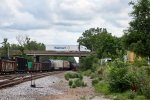
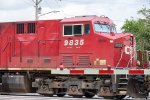
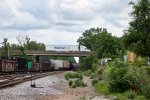
We headed out to the yard to see what was there. There are 2 yards close together this is the northern yard, it's fairly empty, this is a CP GP20 ECO
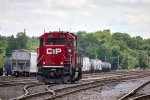
davenport036A8821.jpg

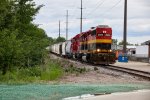
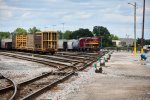
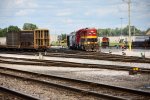
We then went to the southern yard, the south bound train had stopped in the yard and was switching cars.
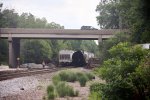
davenport036A8822.jpg

davenport036A8826.jpg


davenport036A8827.jpg
davenport036A8830.jpg

A long cut of cars, including this 1980 hopper car


davenport036A8834.jpg

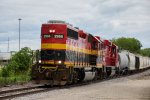
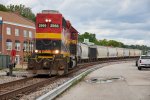
Finally the locos came into view

davenport036A8836.jpg

davenport036A8838.jpg
An equally old Missouri Pacific hopper car

davenport036A8840.jpg

This loco wasn't working

davenport036A8841.jpg

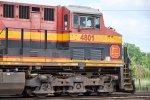
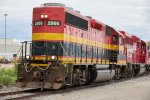
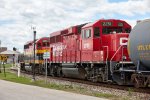
This monster was doing all the work
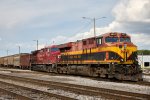
davenport036A8844.jpg

davenport036A8849.jpg

Eventually after plenty of toing and froing, these two locos parked up the fuelling tank On my scanner we heard the driver being asked to leave the CP loco in DPU mode.


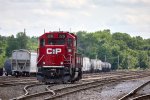
davenport036A8854.jpg
 

simond

Western Thunderer
leave the CP loco in DPU mode.

that begs a “DCC question”.

when the locos are consisted and working a train, how do they ensure that the correct loco gets the correct commands? Not an issue on the wild prairies, where there isn’t another loco in sight (or radio range), but in a yard?

Do they have to somehow bind them as one would with Micron RC or Bluetooth, or is it an address (eg cabside number) process?

cheers
Simon
 

Jordan or Plymouth Mad

Mid-Western Thunderer
that begs a “DCC question”.

when the locos are consisted and working a train, how do they ensure that the correct loco gets the correct commands? Not an issue on the wild prairies, where there isn’t another loco in sight (or radio range), but in a yard?

Do they have to somehow bind them as one would with Micron RC or Bluetooth, or is it an address (eg cabside number) process?

cheers
Simon
Wireless Radio Link: The primary control method. The lead locomotive sends encrypted digital commands via dedicated VHF or UHF radio frequencies. These signals sync the remote engines to mirror the lead unit’s throttle and dynamic brake settings automatically.
The settings can be adjusted, for example on grades, so if the lead locos are over the summit & going into dynamic braking, but the DPU is still climbing, the DPU will be set to still be pushing under power.
 
Last edited:

Jordan or Plymouth Mad

Mid-Western Thunderer
Re some of the photos in Richard's last post....

davenport036A8821.jpg
Set track points are SO unrealistic, aren't they? :rolleyes: Though I do note the self-guarding frog. :)

davenport036A8830.jpg
If you can't get a bus on a bridge, what's the next best cliché..? :thumbs:

davenport036A8834.jpg
Wibblewibblewibble.... :drool:

My apologies, yes I've got better things to do on a work morning :oops: :))
 
Last edited:

richard carr

Western Thunderer
After all that switching we made our way back to the hotel to get some food.
There is bar that has outdoor seating with a good view of the tracks, so we got seats there and waited.
Eventually this turned up, an Iowa Interstate grain train

davenport036A8868.jpg


Then this ethanol train arrived on the CP main. It was getting dark by then

davenport036A8876.jpg

davenport036A8877.jpg

Finally David's burger turned up too, I'd already eaten my pizza so we got that for free.

The hotel is very near the tracks, so I heard the trains come through at 1:45, 2:45 4am, and another just before 6.
The GP started at 8am so we had arranged to meet for breakfast after it.

About 9am I heard a train, it was the local double headed taking about 30 loaded freight cars up the hill to Eldridge.
We met up at 10 and went for breakfast by the Mississippi, once we had finished we set off after the local and found it just west of the crossing on North Brady Street

davenport036A8885.jpg

I have no idea what it was waiting for but it was half an hour before it finally headed east back to town

davenport036A8887.jpg

davenport036A8889.jpg

davenport036A8893.jpg


davenport036A8899.jpg

The branch turns west of the mainline just be the restaurant we had been to for breakfast. The switch is manual, so the train has to stop for the conductor to operate the switch , then move through it and hten the conductor puts the switch back to the main line and then walks the length of the train back to the loco. It's not exactly a fast way of operating.
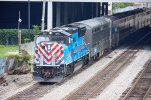
We got back to the junction well before the train and waited.

davenport036A8905.jpg

The train parked a good distance from the junction before pulling up to the switch

davenport036A8913.jpg

davenport036A8915.jpg

davenport036A8917.jpg

The train drew forward then it took the conductor 10 minutes to walk back to the loco, that cleared the crossing and we could leave, we headed to the yard at Schmidt road and waited for it to turn up.

davenport036A8924.jpg

The tracks on left lead up to the Iowa Interstate route that passes through the town.

davenport036A8927.jpg

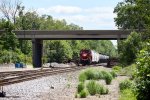
The train headed into the yard and carried on going, we drove round to the next crossing and caught it there.

davenport036A8934.jpg


davenport036A8936.jpg
 

simond

Western Thunderer
Wireless Radio Link: The primary control method. The lead locomotive sends encrypted digital commands via dedicated VHF or UHF radio frequencies. These signals sync the remote engines to mirror the lead unit’s throttle and dynamic brake settings automatically.
The settings can be adjusted, for example on grades, so if the lead locos are over the summit & going into dynamic braking, but the DPU is still climbing, the DPU will be set to still be pushing under power.
Ta,

so the DCC aspect of the question. How does the driver of the lead engine know which locos to consist?

Does he have to visit each loco down the train, put it in “remote control” mode, and keep a note of its “address” to enter in the control box in the lead loco?

Presumably a bit of walkie talkie discussion (and the potential for “oops” that implies) but I can imagine someone in a pick-up truck driving up and down the despatch yard?

cheers
Simon
 

richard carr

Western Thunderer
We then drove on to the southern end of the south yard, once we had seen the train go in.

davenport036A8943.jpg


davenport036A8947.jpg

It then started to switch a few of these cars around

davenport036A8950.jpg

I then spotted another tain arriving on track 1

davenport036A8952.jpg

It turned out that they were stopping for a crew change but it took them nearly an hour to do it.

davenport036A8957.jpg

Then another local arrived from the south

davenport036A8959.jpg

davenport036A8963.jpg

By now it was nearly 4pm in the afternoon, so we decided to head back to Chicago about 3 hours away.
As we drove back through Davenport to go over the Iowa Interstate Bridge (the lower deck is for road traffic) we passed another local heading towards the yard, something to remember for next time.

I fly back to Chicago on Monday, so I'm hoping to get out again next weekend.
 

Jordan or Plymouth Mad

Mid-Western Thunderer
so the DCC aspect of the question. How does the driver of the lead engine know which locos to consist?

Does he have to visit each loco down the train, put it in “remote control” mode, and keep a note of its “address” to enter in the control box in the lead loco?
So that I don't know, & it's not that easy to 'google' for a clear answer either.
I guess as the train needs visual inspection anyway it's done then, whatever 'it' entails.
Calling our State-side resident experts..... :)
 

simond

Western Thunderer
Thanks Jordan,

for anyone wondering what I’m wittering on about in relation to DCC, there is a challenge where if you are in shed “A” and the train you are going to drive towards you is in shed “B”. It’s dead easy on DC, but in DCC, you need to know which way the loco is facing, so you know in which direction to drive, and perhaps less obviously, the address of the loco coupled to the train.

it seems to me that the same problems are faced by the loco crew of a multi loco consist, particularly when some of the locos are half a mile away, maybe more.

best
Simon
 

Yorkshire Dave

Western Thunderer
davenport036A8947.jpg

A nice line of self guarded frogs in this photo.
 

mickoo

Western Thunderer
Wireless Radio Link: The primary control method. The lead locomotive sends encrypted digital commands via dedicated VHF or UHF radio frequencies. These signals sync the remote engines to mirror the lead unit’s throttle and dynamic brake settings automatically.
The settings can be adjusted, for example on grades, so if the lead locos are over the summit & going into dynamic braking, but the DPU is still climbing, the DPU will be set to still be pushing under power.
I think it might all be done automatically now with the inception of GPS to each unit so it knows where the grades are and when to push or dynamic brake.

I watched several trains crest the divide at Flagstaff, lead units were flat out up to and over the grade and down the other side, mid train were either in change over or pushing/dynamic depending on the load each side and trailing units were already in dynamic long before the summit. All very impressive to watch/hear.
 

mickoo

Western Thunderer
Thanks Jordan,

for anyone wondering what I’m wittering on about in relation to DCC, there is a challenge where if you are in shed “A” and the train you are going to drive towards you is in shed “B”. It’s dead easy on DC, but in DCC, you need to know which way the loco is facing, so you know in which direction to drive, and perhaps less obviously, the address of the loco coupled to the train.

it seems to me that the same problems are faced by the loco crew of a multi loco consist, particularly when some of the locos are half a mile away, maybe more.

best
Simon
That's an interesting point and I've not actually tried that and I will be running at least two head end and a solo rear. I do know that you can consist locos with some set ups so you only need determine the lead unit and then add the others to that consist before setting off, as to forward or backward that's an interesting conundrum; you may have to digitally assign forward or backward and then not turn the engine around.

One thing you do need to do with that set up is speed match all your engines to prevent mid train derailments.

The other way is two controllers, one for the head end pair (both with the same address) in my case and one for the DPU, that way you can cut off on the fly which BNSF are now doing in practice on several grades. It was quite common to add extra power up Cajon which was then cut off at Barstow some 50 odd miles away, that did give the sight of some massive engine only balancing moves back to San Bernardino, the biggest I saw was 13 (maybe 15) engines going back.

Now they're cutting off at the summit on the fly and heading back down the pass.
 

richard carr

Western Thunderer
While you have all been cooked alive back home, it's actually been pretty cool here in Chicago, most of last week was about 20 degrees.
I finally managed to get out for a walk on Thursday lunchtime and came across this.

chicago036A8965.jpg


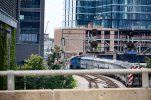
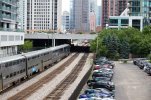
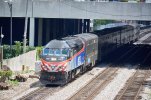
I'm on the overbridge on North Halstead street and Fulton, this came out of Union Station came to a halt as the signal was red. The signal went green and off it went.

chicago036A8966.jpg

2 minutes later the next one arrives and pulls up and stops as the signal is red. Then an inbound train arrives on the near track.

chicago036A8967.jpg

chicago036A8970.jpg


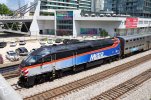
This one pulls up and waits for a green signal

chicago036A8975.jpg


chicago036A8978.jpg

Then I noticed this, another train right behind this one with no signals in between them

chicago036A8981.jpg


chicago036A8982.jpg

513 pulls away then this one pulls up and waits.

chicago036A8990.jpg

chicago036A8996.jpg

Then another one comes in behind this one.

chicago036A9000.jpg

It move up once the other one has cleared the signal

chicago036A9004.jpg

I have to say that I've never seen operations like that before, it seems a bit risky if you ask me.


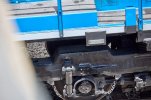
Here's a close up of the axle nearest the fuel tank, you can see there is no traction motor on those axles only 4 axles are powered.

chicago036A9009.jpg
 

Yorkshire Dave

Western Thunderer
I have to say that I've never seen operations like that before, it seems a bit risky if you ask me.

I've only seen it once in the UK at Stoke-on-Trent in the early 1980s. A local train to Manchester was departing the platform while another local was pulling in behind - there must have been about two or three carriage lengths between them.
 

Big Train James

Western Thunderer
I have to say that I've never seen operations like that before, it seems a bit risky if you ask me.
I wouldn't consider it common, but there's really nothing extraordinary about it. You can do just about anything with a train as long as you've got permission and you're moving at restricted speed and are prepared to stop. In the case of multiple trains sharing the block, the second train should have stopped at the previous red signal. It then would have received permission from the dispatcher to move forward past the signal at restricted speed. Speed has to be no higher than would allow for the train to stop within visual distance of the train in front of it.

I would presume that in the case of Richard's experience, there was something in particular going on that required maintaining clear trackage from whence they came, or there was a schedule clog that was backing things up. Bringing trains together like this would speed up the process of moving them all through. If common "minimum" spacing of moving trains here is two clear blocks between occupied blocks, then spacing out five trains adds significant distance still left to cover to reach the platforms. Or it could be something else entirely. I've spent needless hours trying to decipher signals or other indicators to figure out what has just happened or is about to happen, and most often the results are wholly inconclusive or just plain wrong. :rolleyes::oops:
 

richard carr

Western Thunderer
Dave

I was surprised by this, there could have course have been a signal problem and that was why it was happening. If I get the chance tomorrow I'm going back for another look.

Friday lunchtime I went for a wander to the Roosevelt Road Bridge. This time I caught a few Rock Island route metra trains.
This one is heading into Van Buren Street station. This site is going to change enormously, as they intend to buils a new soccer stadium here and possibly a white sox baseball stadium too..

chicago036A9010.jpg

There's loads of construction work going on with the bridges in the background.

chicago036A9015.jpg

So here the first train is still waiting to go in as outbound train passes it with 2 locos on the front.

chicago036A9017.jpg

chicago036A9022.jpg

I carried on across the bridge and this was in the Amtrak sidings

chicago036A9028.jpg

chicago036A9031.jpg

There was no sign of the BNSF loco that they had been using as a switcher.

chicago036A9032.jpg

After work I took a train from Millenium Park Station to Matteson. It was a fun journey with lots of the city to see and lots of other rail routes crossed. At Matteson there are the interconnectors to the J, nothing was happening so I took the next train back to Homewood, where I passed a very interesting lashup on the way out.

chicago036A9034.jpg

Yes 8 locos, 2 ex UP gensets, an EJ&E SD38-2, a former Illinois central GP40, a pair of zebra stripe wide cab SD40-2, another CN wide cab SD40-2 and another former IC GP40 leading.

As I headed into the car park to get a bette shot the train started to pull forward, fortunately it soon stopped.

chicago036A9042.jpg

chicago036A9045.jpg

chicago036A9047.jpg

chicago036A9056.jpg

chicago036A9063.jpg

The driver came out and went into the 3rd loco and started revving that. He eventually went back to the lead loco and after about 20 minutes the train headed out. I assumed it was going to Kirk yard. The SD38 and the gensets were dead, but the other 5 locos were working.
 

richard carr

Western Thunderer
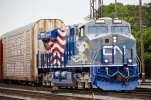
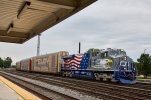
The last thing of the evening was catching one the America 250 celebration locos. Most of the big railroads have repainted at least 2 locos one numbered 1776 and the other 2026. UP has even put Trump on one of theirs.

CN have got in on the act and here we have 1776 coming out of the yard in it's screaming eagle livery.

chicago036A9067.jpg


The train had to stop to let the conductor out to change the switch to the correct route before they could leave.
chicago036A9071.jpg

chicago036A9082.jpg

chicago036A9086.jpg

This was taking an express overnight service to New Orleans, mainly containers of course, it wasn't a very train.
 
Top