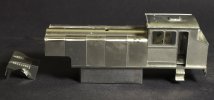
Rewanui (1940 NZR in 1:64)

Lawrence Boul

Western Thunderer
great minds - I have been working on servo drives for turnouts, on and off for some time. Arduinos offer the control, and can easily be interfaced with a CAN bus, which is the architecture I have elected to pursue for everything that is not loco control which remains DCC (I do have a couple of R/C but they are the exception and are not really intended for regular use - more an experiment).

CAN has many advantages, it is very tolerant of electrical noise, and can effectively work "plug and play" - for example, a lever frame can be plugged into the bus outdoors on a nice day, and indoors if the weather is inclement - though I guess you might not want the trains running in the rain. And lights, etc., can all be controlled by similar CAN compliant modules.

I saw an elegant solution for the servo cam drive a week or two back, I think it was one of the guys who are regular contributors to the Templot forum - rather than a cam, it used an eccentric and a small profile rolling element bearing. I didn't see or hear it operating, but it looked to be very well designed, with space to fit up to 4 microswitches I think. It's quite a bit bigger than your design, but that doesn't worry me as I am working in 7mm.

The beauty of a cam or eccentric drive is that the blades are pretty much locked with negligible power demand, backdrive is not possible. I guess that could also be a disadvantage, but generally I think not.

cheers
Simon
At the time I was hung up on something compact (and this is 16.5mm gauge). I also use servos for uncoupling so it simplified matters to use them for both. DCC - Ex is pretty much plug and play and the Rewanui control needs are relatively simple. No detection, signals, interlocking or anything of that nature.

CAD, 3D printing and cheap Chinese hardware does allow the creation of elegant solutions that in times past would have been impractical at home. Once upon a time you read about something and maybe built it with a few refinements. These days it's far more about gleaning the germ of an idea and building something tailored to need.

If this was a home layout the noise would be an issue for me, and I'd be looking for something silent or at least quiet. At a show audible confirmation is not a bad thing.
 

Lawrence Boul

Western Thunderer
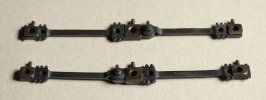
Rods on NZR engines were typically what I understand as 'marine' style. It's possible to model them with laminated etches (as on the 1:48 W class below), but it is not all that convincing in the close up photos that I'm prone to. Compare the cast con rod, with the etched trailing coupling rod.

_HLB1694.jpg

The problem with cast rods is that they don't have the innate accuracy that etches do and some means to address that is needed.

Of late I've tried a new idea, which is to cast the rods, but model the ends to receive separate, adjustable brasses (just like the protype). This allows relatively simple, yet accurate adjustment of centres to the wheelbase.
Ab-rods.jpg
These are rods for a 1:64 Ab pacific. Note the elongated holes and the sprue of brasses to suit. Castings a little mediocre in this case.
9mm-We-bigends.jpg
In 9mm scale (We) the detail is a lot better (above), but even in 1:64 (class U below) it can still be very good.
U-conrod-big-end.jpg
Below a set of finished We rods in 1:64.
We-Rods.jpg
The method is pretty simple and works well. The main constraint is the practicality of casting workable ends and brasses and coping with crankpin diameter. For smaller engines in 1:64 it's more difficult as things are tight.
 

simond

Western Thunderer
Lawrence,

I love the cast rods, but surely you’d be better boring the crankpin holes on a mill rather than adjusting them with loose bushes?
(another 3DP jig to hold them for boring…)

I note you used lasered frames, and my experience with that was also very good, though I rather fancy waterjet would be better, as it would not soften the brass. Either way, with accurate frames and the rods machined, you’d be on track for a “freewheels first time” chassis.

best
Simon
 

Lawrence Boul

Western Thunderer
Lawrence,

I love the cast rods, but surely you’d be better boring the crankpin holes on a mill rather than adjusting them with loose bushes?
(another 3DP jig to hold them for boring…)

I note you used lasered frames, and my experience with that was also very good, though I rather fancy waterjet would be better, as it would not soften the brass. Either way, with accurate frames and the rods machined, you’d be on track for a “freewheels first time” chassis.

best
Simon
Simon

Thanks for the feedback.
Bear in mind that the rods are for kits and are supplied as raw castings. Almost all my work is 1:64, so boring on mills, while doubtless a good engineering option, doesn't really suit.

The 9mm We has lasered/etched frames, so combining the two processes is handy. It's the first time I've lasered metal, and was done as the frames are relatively thick. I like it but, for 1:64, etching is fine, and a good deal cheaper.
 

Lawrence Boul

Western Thunderer
we377 1937 Rockliff coll ed.jpg

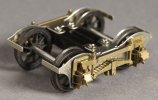
In the conversion from 4-8-0 to 4-6-4T, the thrifty folk in engineering reused one of the B class tender bogies as the trailing truck for the We. This was modified with leaf springs and external compensation beams.

How to model it? I like compensated bogies, and it would have been relatively simple to have modelled each side as a solid lump that rocked. But I took a slightly different course.

We-rear-bogie-v2.jpg
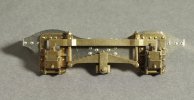
Above is the 1:64 version. A rigid frame consisting of a 3D printed block with nickel frames. The rest of the side detail is a single casting that pivots on a pin behind the cosmetic one below the leaf spring. The casting slides/rocks in 'horns' in the etch. Not at all prototypical, but easy to assemble and effective. The fact that the wrong bits wiggle is not apparent of course.
We-rear-truck.jpg
This is the 9mm version - more or less exactly the same, but an expensive casting.
 

Lawrence Boul

Western Thunderer
9mm-We-cab.jpg
Almost all of my experience is with tank engines with enclosed cabs.

Two minor hassles with these are a) fitting cab detail and b) getting the cab roof to stay securely fastened during handling etc. In an NZR locomotive access to the tail lamp wiring is also useful, and sound/decoders often sit in the bunker. So access is important.

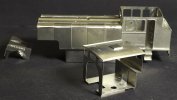
My solution is to form the cab interior as a plug in unit. This solves all the problems, with the only slight niggle that fixed crew cannot lean out of doors and windows. This is the We again, 9mm top (375) and 1:64 (198) below. The cab unit is a snug push fit and the roof sits nicely in place. Its curvature is fixed by the front and rear profiles.

We-progress4jpg.jpg
We-progress3.jpg
 

Lawrence Boul

Western Thunderer
While on the subject of cab interiors...

One of the quite early things I wanted to print were fireboxes and their fittings. These tank locos with their enclosed cabs mean that prints are at no risk of damage once installed, so robustness is not much of a factor.

They are time consuming to draw, but get increasingly easier as many fittings are standard and can be reused. Pipe work is a bit challenging and various software addresses it in different ways. Not too bad once you work it out though.

This is a 1:64 WE backhead. Not the best in terms of print or paint, but it is very satisfactory inside the cab where any deficiencies are impossible to discern. This was for a 40s era engine that still had the original screw reverse, for which good drawings are available. The Westinghouse equipment is incorrect (I'm reliable informed by those who know). The shorter of the two stands is the automatic brake as originally installed. The straight air brake (engine only) was installed later (August 1945 for We377, September 1948 for We198 - renumbered 376 by then). So at my 1940 setting, 377 and 198 should only have the automatic brake.

We-backhead-2.jpg

375 backhead.png

This is the model for We375 in 9mm. Similar to before, but with lever reverse (scant information for that, so I've grafted in the lever from another class) and the Westinghouse gear revised for 1940. I need to revise the latter for 375 in the 60s to include the straight brake.

The great thing about digital models and prints is that these esoteric discussions can be had and appropriate models made with little hassle.
 
Last edited:

simond

Western Thunderer
Lawrence,

do I understand that you are printing the pipework?

I’m only just starting on this journey, but was printing the “things” and joining them up with copper wire, on account of it looking rather like copper pipe (without the ‘ole). :)
 

Lawrence Boul

Western Thunderer
do I understand that you are printing the pipework?

Yep. Basically a 1 piece print. Support IS a bit tricky, but then the result is easy. A doddle in 7/9mm, a bit more fraught in 1:64.

In truth, with this backhead I've started to do the lubricator as a separate/split part. It's the hardest thing to support and has the finest details. It's best printed in more or less the opposite orientation to the rest of the thing. Supported on the mating face it's clean and a dob of CA fixes it easily. This is a better approach that I'll carry forward.

These models are complex, but they are made from relatively simple elements, so it just takes a bit of time.

Screenshot 2026-06-28 073203.png
 

Lawrence Boul

Western Thunderer
yellow-gig_HLB5389.jpg
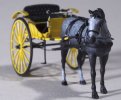
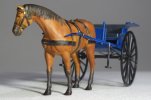
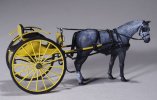
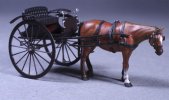
Here's a bit of retro stuff in 1:64, from a few years ago. Every now and then (ie often) I get distracted by a challenge. Over the years this has resulted in a number of somewhat orphan projects that really have no use to me. This frustrates Mrs B a bit, but I've come to realise that my enjoyment in the hobby stems primarily from applying myself to difficult tasks.

The gig was one such. It arose from a friend's somewhat low resolution CAD file with a request to try to print it. This resulted in the usual rabbit hole of research, measuring up preserved examples, learning how to model horses, talking to equine people about tack etc, etc.

horse_HLB5054.jpg

This is the original gig more or less. It didn't match the example I had available and is fairly low detail. Probably my favourite image though as it's the best horse paint I've managed. The harness still needs some work here too.


yellow-gig_HLB5380.jpg
The only gig I properly finished with appropriate draw chains (twisted wire) and reins (tissue paper strips). This magnification is harsh - It's a small model. These days I'd tone it down a bit. While a smart gig would be kept clean, the brightwork is a bit much and it's chunkiness is emphasised in glossy silver.

gig_HLB5367.jpg

Another example - missing the chains between singletree and the vehicle chassis reins etc. While not unrealistic, the chest band is more typical of modern tack. Period tack was more likely to have a light collar, something I've modelled more recently.

gig horse 4_2026.jpg
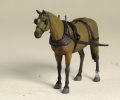
A long way off my best painting and lacking a final glaze, but does illustrate the more appropriate tack.
 

Lawrence Boul

Western Thunderer
Mmmm, these are very nice, I need to get my finger out, it would appear…
Ta. The thing I love is that given a historical image (or mental concept), the opportunity exists to create a unique cameo. There's a number of ways to do this and AI may (or may not) help. All the foregoing predates AI, but AI will generate reasonable horse models. In my experience these can be on the Thelwell side though. There's quite a few approaches to a good result these days, requiring various levels of input and skill. The horses here used a rigged base model with tack and manes/tails sculpted in Blender.
 
Top