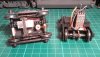
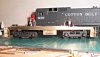
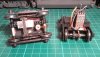
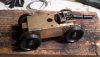
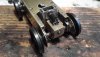
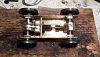
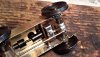
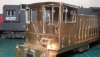
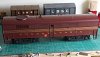
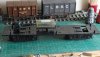
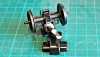
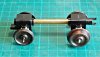
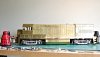
P48 for Cotton Belt: Roster addition SW1200

Dash 8-40B
  • Yorkshire Dave

    Western Thunderer
    Today......

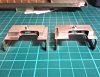
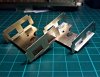
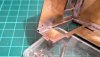
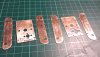
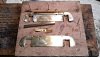
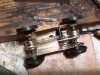
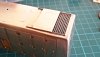
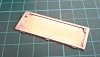
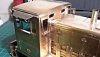
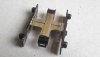
    ........was spent making these brackets from brass - for the truck bolster.

    Dash 8 40B 047.jpg

    They are to try and hide the area between the highlighted section on the truck and the bolster.
    Dash 8 40B 051.jpg
    It looks okay in the photo but the highlighted section is rather 2D and really needs to be 3D, however, it is a rather complex shape. Just need to work out how to make this. Below is one of Mickoo's photos of the area
    post-3-0-38805600-1411318096.jpg

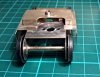
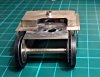
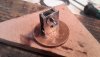
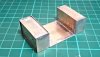
    This is on the geared side of the truck. As the Atlas frame is rather wide I've mounted the brackets temporarily on a block behind the frame. In reality it is bolted to the frame.
    Dash 8 40B 048.jpg
     
    GE 70T
  • Yorkshire Dave

    Western Thunderer
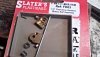
    This brass kit was purchased at Telford earlier this year and although the SP had some they were the later phase variant with different louvre positions. This kit represents the first phase of production.

    It is designed to use Slaters lowmac wheels - but not for me though as this will be built to P48 track standards.
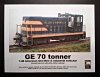
    70T 01.jpg

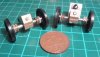
    So having robbed these insulated 33'' wheels from some Northwest Short Line freight car wheelsets I set about making axles for P48 gauge.
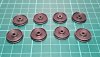
    70T 02.jpg

    Not bothering to follow convention to use steel, and not having a lathe to turn any, I used what I had in stock i.e. brass tube. I proceeded to make up the axles up from sleeved brass tube to fit standard 1/8'' top had bearing and accept the insulated wheels. Four axles were made and during the process I ran out of 1/8'' brass tube so one axle has an aluminium tube - gosh shock horror :eek:. The outer sleeve allows the wheels to be pressed on to P48 track gauge.

    70T 03.jpg

    Now the fun begins...... Aluminium and brass are generally not compatible due to galvanic corrosion, however in my defence - the locomotive will be in a dry environment; the aluminium has sat around long enough to form a passive oxide layer and is held to the tube with Loctite retaining compound; the oil lubricant is not electrolytic, the axles will not be electrically live and finally....... no marine environment.

    I did think of buying more brass tube then thought naaah, I'll leave the aluminium tube on the axle and see what happens as an experiment :rolleyes: . So I have three brass axles in brass bearings and one aluminium axle in brass bearings - convention? what convention :).

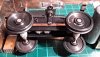
    The next step was to check the trucks..... so I folded one up to check against a spare 40'' P48 wheelset.
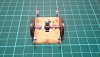
    70T 04.jpg
    A bit of an oh :shit: moment and now had to think about narrowing, yes folks that's narrowing the trucks. So as Napoleon and Snowball said while trotting around the rail yards... S7 wide frames P48 narrow frames, S7 wide frames P48 narrow frames, S7 wide frames P48 narrow frames......

    Again, using materials to hand I tack soldered a piece of 3mm brass angle to the inside of the truck using some brass bar as a spacer.

    70T 06.jpg

    Snapped off the truck side frame.....
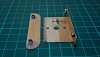
    70T 07.jpg
    ...cleaned it up and re-soldered this to the truck top and brass angle. This was repeated for the other side whilst maintaining the axle centres with 1/8'' aluminium tube.

    And hey presto! The new truck with a P48 wheelset to check clearances.

    70T 08.jpg

    After repeating this for the second truck I now have a pair of P48 compatible trucks and axles.
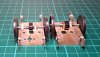
    70T 09.jpg
    70T 11.jpg

    Obviously the ride height has been altered by a fraction but, if necessary, this can be compensated for during the remainder of the build.

     
    GE 70T
  • Yorkshire Dave

    Western Thunderer
    Well...... :rant:- this kit very nearly ended up in outer space to join Voyager beyond the heliosphere.........
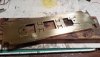
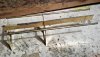
    I started today knocking up the sill/chassis for the switcher and all was going well - apart from not being the mickootricki school of soldering.
    70T 12.jpg
    So far so good. The next step was to make up the skeleton to form the hood/body which, again, was relatively simple. This is after I used the end piece in the hood.
    70T 13.jpg

    The idea is to solder the centre beam to the centre of the hood piece and use it as a bending template to form a three sided box. Aah, seems straight forward I thought.... Ha! no....

    Before bending the sheet to form the hood the louvre etches were made up and soldered in place.

    As I was bending the hood the sides naturally wanted to bend at the half etch at the top of the doors - one bend seemed to go okay but the other was an absolute nightmare :mad:. So much so that the half etch at the top of the doors (blue box below) on one side split :rant::shit:. As I kept trying to form the bend the air went from light blue through azure to ultramarine and was slowly diminishing my confidence with brass kits.
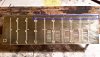
    At this stage I may as well have taken the cash out of the bank, chucked a match at it and watch it melt. On the other hand tenners contain beef tallow so may have burnt brightly :).

    70T 14.jpg
    I kept on going and finally made up the bend with the assistance of a hammer for a bit of panel beating. The split mentioned above was repaired and now of course the end result is that the corners have more dents and bumps than a French car in a scrapyard. Anyway here is the hood thus far (on a 20 year old lump of wood).

    70T 15.jpg
    70T 16.jpg

    And the inner end.70T 17.jpg
    The hood corners have since been filed and coarse wet and dry sanded to try and reduce the dents but it won't be until the first coat of primer that I'll be able to see the damage :(. If it isn't too bad I'll incorporate them into the weathering.
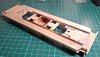
     
    GE 70T
  • Yorkshire Dave

    Western Thunderer
    Things have gone better today....:)

    Added some 2mm angle on the chassis over which the hood sits. This serves two purposes; one - to keep the base of the hood straight; and two - to assist location on the chassis. The fuel tank was also assembled.
    70T 18.jpg

    Then I started messing with the messing (groan, groan :oops: deutsche - messing = brass) cab. The doors have been cut out as I intend modelling them open and both front and rear replacement cab doors are provided on the etch.
    70T 19.jpg
    70T 20.jpg

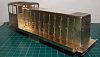
    The :headbang: Doh! moment . The cab ends are formed of a laminate and it was only after soldering them together I realised I could of used the inner laminate as the template for the glazing........ oh well. The cab end laminates also provide a neat way to to install the roof - especially as the corners are rounded.
    70T 21.jpg

    And this is how the ensemble looks thus far....
    70T 23.jpg

    This was the side which was repaired following the earlier disaster
    70T 22.jpg
     
    GE 70T
  • Yorkshire Dave

    Western Thunderer
    Yes, it's truck time........ :)

    ..... for the 70 tonner.

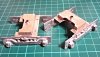
    Having narrowed the truck frame chassis earlier in the build now it came time to narrow the truck mounts as these carry the cast whitemetal sideframes.

    Again it was a question of snapping the side mounts off the stretcher and re-soldering them inboard by the width of the cast whitemetal frame

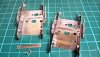
    Before (left) and after (right).
    70T 31.jpg
    70T 31.jpg

    70T 32.jpg

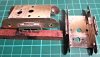
    This time temporarily mounted on the truck chassis. Again before....
    70T 33.jpg
    And after.
    70T 34.jpg
     
    GE 70T
  • Yorkshire Dave

    Western Thunderer
    Troublesome - well not now as I've done some more work on them and as usual with the benefit of hindsight - such as using screws when I narrowed the trucks and the photo is the final one of this sequence. If I thought it about the construction initially - rather than winging it as usual - I would have built the trucks differently.

    I had originally intended to use an off the shelf 4mm drive from the Bachmann Al5 as it has the correct wheelbase but after checking it out it is too much of a faff to fit. So it's back to square one for the drive - bicycle delrin chain.... I've never assembled one before so it's a learning curve.

    Anyway to continue....

    Firstly the sideframes have been attached. They could do with a bit more depth around the springs - something which I may attend to later.
    70T 35.jpg

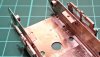
    Then I added some 3mm angle brackets, drilled and tapped for M1.4 machine screws, inside the frames.
    70T 36.jpg

    To support the stretcher which will carry the chain tensioner - made removable for access.
    70T 37.jpg

    70T 38.jpg

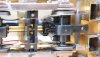
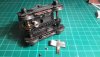
    Brake gear added and the area supporting the motor 'beefed up' above and below with scrap nickel silver etch. I've also added M1.0 screws to provide additional fixing into the brass angle for the top and sideframes which prevents the whole ensemble collapsing into modern sculpture when applying heat from a soldering iron :rant:.
    70T 39.jpg
    However, the additional fixings are all rather academic since the trucks are complete apart from the motor etc. On the other hand it has provided some valuable experience - Don't buy any more brass locomotive kits! :eek:.

    It'll be unheeded as there will be another one on it's way ;). So I'll know what to do now in order to narrow the trucks for P48 if the kit is designed for OW5.......
     
    GE 70T
  • Yorkshire Dave

    Western Thunderer
    With the festivities over some time was spent messing about with the trucks.

    I've never used the Delrin chain drives before so the first stage was to try and quieten the noisy (to me anyway) gears. In order polish them I used silicon carbide lapping compound as used by the automotive industry and stone/rock polishers.

    The trucks were supported in free space (well sort of) and the silicon carbide paste dripped onto the gears. They were then left to run for 60 minutes (30 in either direction). Care was taken to ensure the lapping paste did not enter the motor and once complete the motors were removed from the trucks. The worm gears and trucks were then washed in a degreaser , rinsed and left to dry.
    70T 41.jpg

    The motors were reinstalled and the Delrin chain added. As is the case - take a link out of the chain it's too tight and leave the link in it's too loose. I opted for the latter and made up some some 'slipper blocks' / tensioners from scrap nickel silver and brass channel. These mount with M1.4 machine screws into tapped brass angle soldered to the inside of the truck frames.
    70T 43.jpg

    The assembled trucks and the home brewed power pick up and motor connectors. A separate wiring loom will be made to connect to the decoder.
    70T 44.jpg

    This just shows how far the motors reach above the sill. The steps were also added.
    70T 45.jpg
    As I had not built the kit as per the instructions and in order to secure the cab to the chassis I tapped (for M1.4 machine screws) four lengths of brass tube and soldered these into the corners of the cab. They sit below the cab floor which has been modified to to accommodate these.
    70T 47.jpg

    And the 70T so far.
    70T 48.jpg
     
    GE 70T
  • Yorkshire Dave

    Western Thunderer
    Valhalla

    Well...... I spent ages trying to get these to run smoothly but not to my satisfaction :rant:.

    70T 44.jpg

    So after ripping out the consumable items: truck frames, motors, gears etc both of the internal truck frames were given a viking funeral with the aid of a blowtorch :D.

    Ashes

    Not the disaster of the series down under - instead the truck chassis remains of after cleaning up...
    70T 49.jpg


    Phoenix

    Not even Arizona as it been snowing again this morning...... to continue I decided to remake the truck chassis using parts rummaged from the 'that'll come in useful one day' crate. Aye, there's nowt like a good old rummage...:).

    These were parts left over from my 4mm and HO modelling days way back when. Alan Gibson hornblocks, one flexible coupling and a pair of Exactoscale 2:1 reduction gearboxes (one shown below of which the bottom gear is mounted on a sleeve to accommodate a 2mm shaft
    70T 52.jpg

    I also purchased four of these...
    70T 53.jpg

    As the Alan Gibson hornblocks and Slaters gearboxes utilise 1/8'' axles so I cut four new axles from steel rod (two have already been used). Protocraft 36'' Grabowski insulated wheels were used this time as they fit onto a 1/8'' shaft.
    70T 51.jpg

    After cutting the frames to take the hornguides the first job was to install these and add the 3mm brass angle to the top for mounting to the top plate.
    70T 50.jpg

    The Protocraft wheels have a pronounced boss on the inside the top of the truck chassis was narrowed to 23mm to allow for this and insulated spacing washers.

    After Much Faffing in the Marsh and building the Slaters gearboxes, mounting the hornblocks, insulating washers and wheels to the axles - this is the end result.
    70T 54.jpg
    70T 55.jpg

    Not elegant from the underside but it does work.... I've lost some of the mounting holes but no worries. - my prime objective here is to get the entire drive train working first and consider the rest later :rolleyes:.
    70T 56.jpg
    70T 57.jpg

    And testing..... Eventually the motor will sit in the fuel tank and the propshafts will be shortened to fit and horizontal. 70T 58.jpg

    Just another one to make now..... and source a short flexible coupling followed by fine tuning.

    It might not be the most efficient drive and as it's for a switcher kicking a few boxcars - am I bovvered :p..... nah.
     
    GE 70T
  • Yorkshire Dave

    Western Thunderer
    Well...... constant velocity full of double entendres.

    The silicon tube and stainless steel ball bearings arrived today all for the princely sum of £4.89. I have sufficient materials to make loads if they fail I can just make up another set. The idea was taken from the CLAG guys Construction, assembly and application notes for constant velocity couplings

    I made up a pair CV joints from 1.5mm I/D silicon tube, 3mm ball bearings and a length of steel rod between the balls :rolleyes: . Ohhhhh I say!

    And this is the result - the top joint is yet to be fitted to the second truck. It runs well and now not sure whether to use a larger O/D but same I/D tube to increase the rigidity.... Ohhh hello nurse :). On the other hand if it ain't broke don't fix it.

    20180125_205844.jpg
     
    GE70T
  • Yorkshire Dave

    Western Thunderer
    We finally have a drive.

    The 1833 motor was a purchase from Bristol show last weekend. A motor cradle was made up from brass to the same length as the fuel tank and soldered into place between the frames.

    Excuse the blu-tac as this is holding the motor in place whilst testing - once complete the motor will be held in with double sided car rear view mirror tape. The drive shafts were cut down from the branchlines universal joints.
    70T 64.jpg

    Underside 70T 66.jpg

    Normal viewing angle and the drive shafts disappear. The whole drive system is within the sill and fuel tank- nothing protruding into the body.70T 67.jpg

    Side view - the drive shaft is just visible however most will be hidden by the air tanks which are situated either side of the fuel tank.70T 68.jpg
     
    GE70T
  • Yorkshire Dave

    Western Thunderer
    A couple of weeks worth of evenings has seen some dawdling.

    Making up the radiator screen surround from scrap etch and adding the strengthening strips (again scrap etch) and visible on later photos to the radiator shutter.
    70T 79.jpg

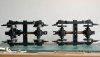
    Adding scrap etch to the underside of the hood roof engine hatch.
    70T 77.jpg

    Then rounding the corners and top edges to make it look 3D.
    70T 78.jpg

    With the motor now in the fuel tank the latter had a channel sliced out of it and the two panniers boxed in, filled with lead shot and a lid soldered on.
    70T 75.jpg

    Fuel tank in situ.
    70T 76.jpg
    Then making 29 of these from 0.45mm brass wire - door handles ......
    70T 69.jpg

    The other detail added - door hinges, bonnet engine hatch, exhaust stack, cab steps, doors, opening windscreen.
    70T 70.jpg

    Rear cab door and steps
    70T 71.jpg

    Also glimpsed here are the air tanks which were supplied with concave ends. Here I added chemical metal and domed the ends using wet'n'dry emery cloth.70T 72.jpg

    Fireman's side cab door and steps.
    70T 73.jpg

    Engineer sides cab front window70T 74.jpg
     
    GE70T
  • Yorkshire Dave

    Western Thunderer
    Well, until today I still had :shit: trouble with the drive in the 70T which was on the verge of becoming a Pachyderm Blanco :oops:.

    One of the trucks with the flexible coupling drive was perfect. However, the other was an absolute nightmare :headbang: and becoming a bit of a Debbie downer in danger of scuppering the whole build :(.

    So it was the last resort. Call it The Great Escape, Escape From Alcatraz or just plain last chance saloon....... it was back to the original plan - not for the purists though - of using the drive system from the 4mm Bachmann AL1 which has the correct wheelbase for the 1:48 GE 70T truck :).

    First was to strip the trucks of their original wheels and ream the final drive gear to 2mm. New axles were cut from 2mm steel rod and the gear, nylon washers (to reduce side play), the original bearings and 2mm i/d to 3mm o/d
    brass tube were installed. The steel rod was knurled for the gear and brass tube. Once on the axle, the brass tube was knurled before pressing on the wheels as 3mm is just a gnat's whisker shy of 1/8''. I also used a retaining compound during fixing - apart from the bearings of course.
    70T 80.jpg
    70T 81.jpg
    Mounting brackets were made up from tapped brass tube, some scrap brass and an outer sleeve on which the bracket rests.
    70T 82.jpg
    Trial fitting of the Taff Vale 1833 motor.
    70T 83.jpg

    Broadside view and, again the propshafts are hidden within the sill.
    70T 84.jpg
    The trucks have keeper plates for which I shall make up a brass structure to attach to these in order to support the truck side frames and brake gear.

    Although the axles appear flimsy, only time will tell if the weight of the loco will bend these in the style of the old Matchbox cars I used to have.

    In the meantime the loco drives smoothly (under analogue control) to my satisfaction which has provided the impetus :) to complete the kit :eek:.
     
    GE70T
  • Yorkshire Dave

    Western Thunderer
    Carry on Trucking.....

    Well we have reached the stage of adding the sideframes.

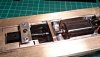
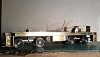
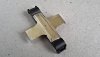
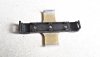
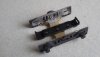
    In order to accomplish this two crosses were marked out and cut from 0.5mm brass sheet and the outer ends bent up to provide the sideframe mounts. A spine was soldered on in order to add some strength and provide a solid anchor for M1.4 machine screws.
    70T 85.jpg

    Three holes were drilled and tapped for M1.4 machine screws and the ensemble screwed to the keeper plate. 70T 86.jpg

    The sideframes and brake gear was soldered carefully to the mounts.70T 87.jpg

    1mm brass wire was added to the transverse arms to reduce flexing. 70T 88.jpg

    And finally some new pick up plates were made up from 0.5mm paxolin board, insulated and slotted between the original pick up and the truck body. 70T 89.jpg

    The trucks are part way through being painted at present and photos of these will appear in the next exciting episode of How Not to Build a Brass Kit...... featuring Club Hammer and the Piercing Saws :D
     
    U23B
  • Yorkshire Dave

    Western Thunderer
    Well, the U23B has made a reappearance....:)

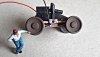
    Having secured a pair of non-running 3 rail Weaver FB units for the drive mechanisms and took delivery of two sets (8 axles) of Right O'Way P48 replacement 40'' geared wheels, I set about modifying the Weaver AAR type B trucks.

    The trucks were narrowed to scale width which meant removing 4mm from the bolster(2mm from either side). This of course made the frames too narrow to accept the new wheels - as in US style the side frames carry the axles rather than the usual British subframe. Rather than shorten the axle ends I drilled the frame bearings deeper to accept the wheels. The trucks are temporary until a good replacement AAR type B truck becomes available.

    The wheels are a DIR (drop in replacement) for the standard Weaver 2 or 3 rail wheels.

    U23B 026.jpg

    The temporary set up to test the drive. And yes, it is a cable tie on the universal joint to hold it on as it had split.
    U23B 025.jpg
     
    U23B
  • Yorkshire Dave

    Western Thunderer
    A few more photos in relation to the Weaver drive.

    The donor Weaver FB unit
    U23B 025a.jpg

    With body removed - I had already removed the weights and circuit board. U23B 025b.jpg

    In respect of the truck narrowing this is how I deepened the frames to accept the new wheels axles U23B 026a.jpg

    Wheel installed in gearbox. U23B 027.jpg

    Comparison of the P48 wheel and the Weaver 3R pizza cutters. U23B 028.jpg

    Pizza cutters (left) and P48 wheels (right) in the existing trucks - which is why the frames need to be drilled when narrowing the bolster.U23B 029.jpg

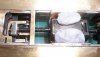
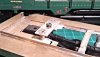
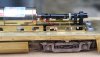
    Just to demonstrate the space in the long hood after installation. The ruler is resting on top of the sill. U23B 030.jpg

    Inspection by the authorities......:eek: U23B 031.jpg
     
    Top