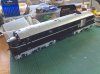
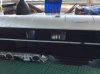
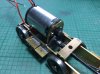
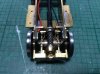
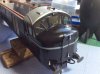
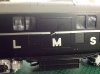
10001 has reached a point where it can be handed off to the electronics department. With that in mind, I turned my attention to the loco's slightly older sibling. Both locos will need to be matched, so I wanted to get the odds and ends sorted out on 10000 with a view to handing both locos over in due course.
As you will recall, I agreed to take the client's build of 10000 so that a new power bogie could be installed to match the new build. At the same time, one or two cosmetic repairs were requested. First, though, time to see what was going on inside the beast.
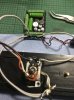
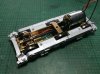
Sheesh! Well, it's a bit of a mess. The original power bogie was a traditional vertical motor driving on the rear axle, with Delrin driving the leading axle. Sitting atop the motor, not in the picture because I removed it to get at the connections, was a flywheel.

The DCC board was originally glued to the chassis using superglue, which had inevitably aged and pinged off, leaving the board rattling about in the body.

Ballast was in the battery box well in the form of liquid lead, while sat on top was a styrene box, filled with the same. Happily, I managed to lever the box off the chassis, so the planned cosmetic 16SVT can be fitted in the orthodox manner (including added weight as for 10001). Plan B, if the ballast box wouldn't budge, was to consider slicing and dicing the diesel engine to fit around the box. I'm glad that didn't have to happen.
On top of the ballast box was a dicky-looking speaker, positioned so the sound would sort of emanate from the exhaust ports. Additionally, the scavenger fan had been powered by a tiny motor and miniature gearbox. I hoped to keep that, as it was a working solution.
In the view above, you can see I've marked where major surgery is required to the chassis to accommodate the ABC motor bogie.
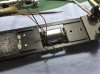
After surgery, but before I'd found suitable bolts for the motor bogies. Thereby hangs an amusing tale…
I thought I could use the kit 4BA bolts to fit straight into the motor bogie mounting plates. The kit bolts are hex head, the recesses in the mounting plates circular. I purchased some 4BA cheesehead bolts from a well-known model railway tools and components Emporium, but neglected to check the length of bolts I'd purchased. Needless to say, they were too short. I decided I could take the kit bolts down to the Big Shed and skim the heads to circular on the lathe. While stashing the new bolts in my Nuts, Bolts And Washers Box, I discovered some 4BA cheesehead bolts of a more suitable length which I had forgotten I even had. So, no need to return the short ones and no need to get chilled in the Big Shed.
On with the motley!
With the motor bogies now capable of being actually attached to both locos, I turned to the cosmetic repairs on 10000.
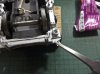
A couple of bogie steps, cast brass items, had been knocked off over the years. I sourced replacements from JLTRT. One step, however, had also taken a chunk of the bogie moulding with it. I cleaned up the break, and fashioned a thin styrene sheet fillet. This was glued to a larger piece of styrene which overlapped the edges to allow for gluing in place.

Yes, you can see it's thicker from some angles, but it fills the hole up neatly. The step was glued to this, and the various repairs painted over in silver.
Oh, I forgot to mention the bogie frames need some sanding and filing to fit over the ABC bogie. It's not a major job, just a bit fiddly. The backs of the coil spring units need to be trimmed back, for example, and while I was at it I stuffed Milliput into the fixing holes. Once set, I fitted the frame over the bogie, marked it for the fixing holes and drilled them out in the right places for the 10BA screws to hold it all together.
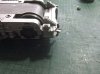
Here's the repaired bogie framing, before the step was fitted and everything painted.
Time to see if the body fitted nicely over the chassis, with the cosmetic engine popped in for good measure. Oh dear. Something was causing a problem, preventing the radiator end from seating properly.
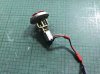
So, out came the neat little fan motor assembly. Sadly, it is long enough that it hits the power bogie motor, which is orientated horizontally. The original motor was vertical and wasn't a problem.
A new fan motor system need to be sourced for 10000, so I'll get a pair so I can fit one in 10001. Both locos are now at the point where electronification can be done. I'm chatting to my guru at the moment, and the plan is for him to actually wire things up properly while installing the electronics. I won't actually fit final details to my build until the thing has the control and sound systems installed.