7mm On Heather's Workbench - another other Twin

Heather Kay

Western Thunderer
image.jpeg

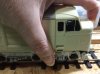
I went with brush painting the silver in the end. Getting into all the nooks and crannies is a bit easier with a brush, especially having to turn the frames in all directions to cover everything.

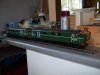
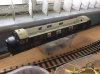
It is a striking livery choice. When I built Best Beloved's model, we had interesting discussions with all kinds of people about the chosen colours. The lettering is straight LMS 1946 livery, albeit cut out of sheet metal. The choice of black and silver, though, seems very bold. My pet theory is 1948 would have been the silver jubilee of the formation of the LMS. I suspect we may never know the real reason.
 
Last edited:

Heather Kay

Western Thunderer
For some reason I can't put my finger on, I've been out of sorts this week. It might have been various domestic things getting in the way and disrupting my work schedule. All I've managed to do is fiddle about with a few bits and pieces here and there.

IMG_2246.jpg

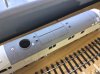
Today I managed to sort out the various mushroom vents on the roof. From left to right are engine fuel header tank, radiator, boiler fuel and water tank, and tucked by the boiler flue what I presume was the safety valve for the steam heating.

I need to work out the engineering for the radiator fan, which has to spin. The next big job will be arranging the cab end castings to fit neatly to the bodywork.
 

Heather Kay

Western Thunderer
A new year, and time to pick this model up again.

image.jpeg

I am finalising the cab details. The driver has had a lick of paint (R8 from the Heroes of the Footplate range); his fireman will be busy relighting the train heating boiler - an arrangement surprisingly common and which helps to make the loco look a little less overpopulated when running in multiple with its twin. I've made some little shelves for the extinguishers to sit on. Photographs show the extinguishers should really be closer to the cab doors, but I can't help thinking that's an optical illusion. The cab doors would be impossible to open if they were.

Cab and body fit fettling next.
 

Heather Kay

Western Thunderer
Right, after a frustrating afternoon, here's where we are.

image.jpeg

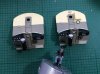
The driver has been installed in No2 End, with only minor surgery required for clearances. A start has been made on the glazing, though the less said about that the better. Another case of glass being about a scale three inches back from where it should be. While I contemplate ripping it all out and starting again and making it properly flush at the front, I attempted to get the cab to actually fit.

I've also managed to make the cab a sliding fit down over the driver and his brake column. You'll never know what was sacrificed to make room for that.

image.jpeg

I can't see what is preventing the cab from meeting the body side. There's something causing the nose to lift slightly, I think. Whatever, that's it for today. I've stopped before I break something!

A new regime of one commission build per day has been brought in, so tomorrow will be another adventure.
 

Heather Kay

Western Thunderer
A milestone has been reached in construction. It didn't entail all that much vocabulary extension, surprisingly.

image.jpeg

The main body parts have been assembled - though the roof is still loose at present - and fitted over the chassis.

I have decided to roll with the glazing. Yes, it's recessed, but it'll match with the partner loco already constructed. So, the cabs were fitted with the rear bulkheads to better help me fettle for fit with the bodysides. After a little argumentation, a little careful sanding and filing, things more or less went together. I was left wondering why I shouldn't actually glue the sides and cabs together at this stage, so I did.

Next, working out how to spring the buffers, and assembling the couplings. I really don't think we are far off a visit to the paint shop with this beastie.
 

Heather Kay

Western Thunderer
Very nice, Brian. I have had the joy of building one of those kits, too.

As a pedant, and realising you've posed them for the photo, they should be paired up the other way round. I am led to believe this was to make it easier for the poor fireman working his way back and forth between locos relighting the train heating boilers.

Actually, I'm not sure how often the pair ran in multiple in the post-1957 livery. I think by then the had been cascaded to secondary duties.

Enough! I need to work out a way to make a spinning fan that isn't made of cast whitemetal.
 

oldravendale

Western Thunderer
Thanks for your kind words, Heather. The RJH kits build well but need a measure of knowledge and experience, as you know. They were designed with the total knowledge available at the time. I updated mine in accordance with the information available but that has now been superceded. Since they were designed there's been a load more information which helps to put them right - in the few cases they are wrong - but I found it difficult to get the slight down grade over the cabs correct but after a lot of checking and filing managed to incorporate a measure of correction. Memory is a bit wobbly now but I know the roofs of the two locos were different, and I blanked off the boiler filler, on 10000 I think, and flush filled that on 10001, but I'd need to check the completed locos which are now packed ready for "the move". I also remember that the bogie frames were not "handed" so I cut and shut to correct them.

I started to take an interest in railways in 1958. I lived close to the West Coast main line and, at the time, it was an almost daily occurrence for the twins to work the Royal Scot in multiple. For sure, soon after they were demoted to the Bletchley locals and operated singly.

You are absolutely correct in saying that I have the locos coupled up wrongly - most photos show them the other way around. But I'm not entirely wrong - see:
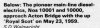
10000 with 10001.  Acton Bridge.  23 May 1959.jpg

10000 with 10001.  Acton Bridge.  23 May 1959 (2).jpg

I truly didn't pose them that way around to try to catch anyone out! I have another six photos with them the "correct" way round.

In any event, that loco you've just built is the mut's nuts.

Brian

 

Heather Kay

Western Thunderer
Now, let's see. Where was I? Oh, yes.

image.jpeg

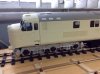
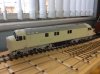
I've been waiting for the weather to warm up a bit so I could get some serious paint shop action going. Well, that's my excuse anyway. I do dislike having to make fiddly masking around windows, much preferring to have painted a model before glazing takes place, so I pondered how to paint this beastie for a while. One idea, as with the Western currently under construction, was to brush paint round the windows a way, then mask for spraying the rest.

Only I got a bit carried away. Call it an experiment, if you like, but I wondered whether I could brush paint as well as I could airbrush. If it doesn't work out, then stripping back and sanding won't be too much of an issue. This is the first coat of gloss black, which will now dry off and harden before I contemplate the results.
 

Yorkshire Dave

Western Thunderer
I could brush paint as well as I could airbrush.

Going by the photograph the brush painting looks good. I still brush paint (acrylics) most of my SR and BR(S) wooden bodied goods stock and military vehicles. My US freight stock is airbrushed acrylics.

I've found a lot depends upon the quality and viscosity of the paint and the quality of the paintbrush.
 

Heather Kay

Western Thunderer
Brush painting hasn't really worked, so it's off up to the paint shop for a squirt of gloss black. I've a nasty feeling things may need to be completely stripped, because there are some issues with paint not adhering to the surfaces. I had cleaned things before I started, but there must be something that's been deposited during handling.

Anyway, if I need to sacrifice the glazing, which I hope I don't but that remains to be seen, I do have a spare sheet. Now for some patience while paint dries...
 

Ian G

Western Thunderer
Before I start any kit brass/white metal/plastic & resin, I go over the main surfaces with a fine abrasive paper or a fibre brush that has not been soaked in PVA, this gives me a good key for painting later.

Ian G
 

Heather Kay

Western Thunderer
Thanks for that idea, Ian. I have to say that I've never encountered the same problems with coaches and they're made from the same stuff. Perhaps there's a new mould release agent being used that's harder to scrub away with cream cleaner and hot water.

Anyway, a quick second coat of gloss black went on just now. Things can dry off overnight, and I'll have a good look at it again in the morning to see if the plan has worked or not.
 

warren haywood

Western Thunderer
Heather, I've just done a 37 and a 50, gave them both a light coat of pp etch primer. Top coats in both precission enamel and celly no issues.
I painted a 10000 in LMS a while ago and used precission aluminium (p983) with a ruling pen and brush, brilliant paint which doesn't leave any brush marks. I'm just about to do a blue streamliner and will be using the same paint for the silver and blue bands.
 

Yorkshire Dave

Western Thunderer
I wash all my models whether brass, whitemetal or resin in a solution of bicarbonate of soda (baking soda), rinse with warm water and leave to dry before painting.

Bicarbonate of soda being slightly alkaline ensures any residue acid from soldering is neutralised. It is also slightly abrasive (bicarbonate of soda was as an early form of toothpaste and later as tooth whitener) which leaves a keying surface for painting. The resin kits I've built also seem to be okay after this treatment...... but alas they don't have the Colgate ring :(.

Baking powder is no good as it contains bicarbonate of soda and a weak acid.
 

isleofthanet

Western Thunderer
Brush painting hasn't really worked, so it's off up to the paint shop for a squirt of gloss black. I've a nasty feeling things may need to be completely stripped, because there are some issues with paint not adhering to the surfaces. I had cleaned things before I started, but there must be something that's been deposited during handling.

Anyway, if I need to sacrifice the glazing, which I hope I don't but that remains to be seen, I do have a spare sheet. Now for some patience while paint dries...

Do you use a primer on these resin bodies Heather or just go on with the colour coats?

Alan
 
Top