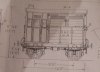
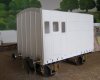
LBSCR Early Horsebox

Jon Nazareth

Western Thunderer
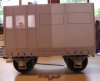
Here she is, at last, up on her feet. I may have to shorten the little coil springs a tad to get her to sit down a little more. In the other picture are the brake shoes which were a bit of a trial. Well, not the shoes but trying to case harden the filing 'buttons'. I bought some case hardening compound but just couldn't get it work satisfactorily. The compound was probably okay and I expect it was me not being able to get the steel blank to the right temperature. I have to thank Jamie Page here as he kept me supplied with quite a few of the steel profiles and I wouldn't have been able to complete the shoes without his help. Thank you again, Jamie.
Next job is to make up some rigs to hang the shoes on.

Jon
IMG_1144-001.JPG IMG_1145-001.JPG
 

Jon Nazareth

Western Thunderer
Ian
The W irons were laser cut from a LBSCR drawing and the axle boxes are some of Mikes but I've cleaned them up, removing all of the sticking out bits. Can't think which they were off the top of my head but, I'll check. For one of my wagons, I made up some axle boxes from scratch and applied an etch to the front that had 'LBSC 1869' written on it. I've run out of those and keep meaning to get some more, one day.

Jon
 

Jon Nazareth

Western Thunderer
P.S. Mike Williams has one of my early scratch built boxes, with the lettering and date on the front, that he can cast more from if you should need any.

Jon
 

Jon Nazareth

Western Thunderer
Once you have all finished laughing at this question, could someone please answer it ?:)
I'm making up the cylinder and shafts that hang underneath my horsebox, I've a sneaking feeling that it is something to do with the brakes but d*&^$" if I know what. Do the shafts/pipes connect to those pipes mounted on the ends or are the shafts that are connected to the cylinder connect to the brake cross shaft? I suppose not much of will be seen but nice to know what they do.

Jon

IMG_0961-001.JPG
 

Mike W

Western Thunderer
Jon,

This looks like a horizontally mounted double acting cylinder. That is to say there are two pistons inside the cylinder, one working the brakes at each end. So, the rods you can see at either end of the cylinder are connected to, and pull, the crossbar of the outer pair of brakes at each end towards the cylinder, and via simple cranks, then also pull the inner pair of blocks outwards.

Mike
 

Yorkshire Dave

Western Thunderer
Would the LNW brake be vacuum? If the Stroudley horse box is air braked would the the air inlet valves or the linkages be in a different position?

Or is the horse box being finished before the LBSC went fully over to air brakes?
 

Mike W

Western Thunderer
Ah, good point Dave. The LNWR did indeed always use vacuum and I forgot the LBSC didn't. I don't see the linkages would be any different - only the arrangement inside the cylinder?

Mike
 

Mike W

Western Thunderer
Surely the rods must pull? If they pushed they would need to be larger and with supports along their length. I see no point making them push at all.

Mike
 

Overseer

Western Thunderer
Surely the rods must pull? If they pushed they would need to be larger and with supports along their length. I see no point making them push at all.

Mike
All Westinghouse brake cylinders push the rod outwards. The compressed air is let into the cylinder behind the piston in the same way a steam cylinder does (but only on one side, a spring returns the piston to the end of the cylinder when the pressure is released). The piston rods are high quality polished steel so don't need to be excessively large, again similar to a steam piston rod. I don't have a diagram for the double ended cylinders but they were common in the US at the time as the two rods operated the brakes in each bogie (truck). It was usual to have a fulcrum lever attached to the end of the push rod to reverse the push into pull but the HMRS drawings linked to by Ian clearly show that for these horse boxes the cylinder pushed the vertical levers to apply the brakes to both sides of the wheels - the lever is before the axle instead of after the axle as on the LNWR vacuum example.

Edit - checked LBSCR Carriages Vol 1 and p140 has a clear diagram of the arrangement copied from page 203 of the 15 March 1878 edition of Engineering, available online at Grace's Guide here http://www.gracesguide.co.uk/images/e/e9/Eg18780315.pdf.

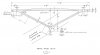
The attached detail of a brake truss may be useful, it is for a 5'3" gauge wagon so the dimensions would need to be adjusted to suit standard gauge.
Brake Truss Detail.jpg
 
Last edited:

Mike W

Western Thunderer
Well, I am amazed, and stand corrected. Thank you Overseer.

So far as the truss beam is concerned, when amending the dimensions for gauge remember to also check the wheel size and amend if different, because a truss designed for 3ft 7in wheels won't physically fit on 3ft 1in wheels - as I unfortunatey found out the hard way!

Mike
 

AndyB

Western Thunderer
So far as the truss beam is concerned, when amending the dimensions for gauge remember to also check the wheel size and amend if different, because a truss designed for 3ft 7in wheels won't physically fit on 3ft 1in wheels - as I unfortunatey found out the hard way!
Mike,
Certainly in MR practise, the triangular part of the truss was the same size no matter what the application* - they just had different lengths of 'neck' to connect on to the linkage.
*Carriage bogies and most fitted freight and NPCS used a common triangle, of square or rectangular section instead of the round sections shown on the drawing above. Those used on brake vans were of a much more substantial section and the brake shoe pins were also a bigger diameter.

Andy
 

geoff_nicholls

Western Thunderer
The Great Eastern used cylinders exactly like that under the LBSC horsebox. I would have said the same as Mike, but the article in the GERS journal confirms what Overseer says: they pushed the rods outwards. The truss beams on the GER were the same ( as described by Andy) for both 3' 1" and 3' 7" wheels, but with different neck lengths.
Did all the different railways used the same geometry for their truss beams? I'll check my drawings...
 

AndyB

Western Thunderer
Did all the different railways used the same geometry for their truss beams
I doubt it exactly, Geoff, but I don't expect the angles were too different.
Did the RCH ever get as far as trying to standardise parts for fitted freight stock? Maybe someone can tell us?
I would post the MR drawing, but I can't manage to shrink it and maintain readability whilst complying with the forum picture size limit (pixels) - so here are the key features and dimensions described:
  • The long side of the triangle has a 1/4" offset (c.f. 3/4" shown above), and has a single bend in the centre (not curved throughout)
  • The triangle is 11 3/4" high (inside) (c.f. 1'-3 1/8" shown above)
  • Brake shoe pins are the same dameter at 1 1/2"
  • Distance from shoe pin centre to pull rod pin centre is 1'-4 1/4" for the smallest size.
  • 1/2" dia. split pins used for brake block retention
  • 'Short' sides 1" square section, 'long' side 2" x 1" section
Andy

Edit - P.S. It took me ages to find the relevant drawings in the MR list initially - they are simply called 'Triangular Cross-Bars'. This might help anyone looking in other company's drawing lists.
 

Yorkshire Dave

Western Thunderer
The Great Eastern used cylinders exactly like that under the LBSC horsebox. I would have said the same as Mike, but the article in the GERS journal confirms what Overseer says: they pushed the rods outwards. The truss beams on the GER were the same ( as described by Andy) for both 3' 1" and 3' 7" wheels, but with different neck lengths.

I would expect this would have been the case as the GE used air brakes.
 

Jon Nazareth

Western Thunderer
IMG_1177.JPG

The horsebox so far. All of the brake shoe fastenings are temporary and here just to see how it goes together. The vac pipes will be fitted next together with windows, roof and then hinge straps. Sorry it's a bit dark but the side disappeared when I lightened the picture too much but the idea is there.

Jon
 
Top