Locksley
Active Member
Been a little while since posting here so thought I better show some pics of my latest project. I was actually going to post this as a WIP but then kind of accidentally finished it so this'll be a retrospective WIP 
I'd had a set of Scale Model Scenery layout in a box baseboards hanging around for a bit that were screaming at me to do something with. I originally bought them for an N Gauge cameo that was supposed to be based on the video game series 'STALKER', set in Chernobyl. The plan was to 3D print a Soviet VL80 and some rolling stock, which I did, but it quickly became clear that the chassis I planned the whole thing around just wasn't suitable so it all went on the back burner. I may go back to it at some point.
So, what to do with the baseboards I'd already bought? As I'm sure is the case for a lot of us here, my layout ideas list is as long as my arm, so naturally I picked something completely new and impulsive. Forge Island is loosely based on the real Forge Island in the centre of Rotherham. It really is an island, located between the River Don on one side, and the Sheffield and South Yorkshire Navigation on the other. Up until around the 70s, the island was home to the Rotherham Forge and Rolling Mill Co. Ltd. and had a tiny little spur of track which split off at Rotherham Central Station, passed over the canal via a swing bridge at Rotherham Lock, and into the works. All of this can be seen in some excellent aerial photos on Britain from Above taken in the 1920s and 1950s. It's nothing hugely exciting, but the combination of the dense industrial setting, and a bridge over the canal had me itching to model it.
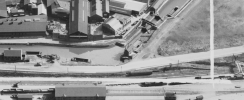
I know very little about the works itself, the aerial photos show a few open wagons dotted about, but no hint of a loco so I don't know if the small amount of track in the works even warranted its own shunter, or if whatever was available at Rotherham Central was called upon to shunt in and out. As such, this leaves things nicely ambiguous to allow me to run pretty much anything I like, from the 1920s through to the 1970s or so (I doubt the actual works itself changed much in that time!)
The layout is not a 100% likeness of Forge Island, in fact only really the right hand side of the layout looks anything like the real location, and even that is a compromise. The left hand end is actually quite heavily based on the Scalescenes Boxfile layout buildings, which have a nice generic industrial feel.
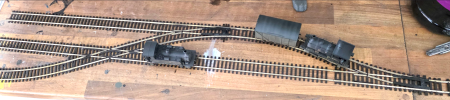
The track plan is pretty much completely fictional from the real site, put together from Peco Settrack (it'll be inset into concrete so I wasn't too bothered about how fine the track was!). It also features a completely superfluous crossover, but I really fancied having a crossover for a bit of visual interest, so there .
.

To allow for the height of the canal, the trackbed was elevated by 40mm. The canal sides and swing bridge base were 3d printed in PLA, while the left hand end was a piece of 6mm MDF, cut to size and then epoxied into place onto 3d printed standoffs. Knew there was a reason I bought 4 knackered old ammo boxes.

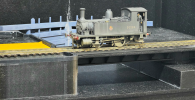
After a quick slosh of black paint, the track was screwed in place, and the point servos attached.
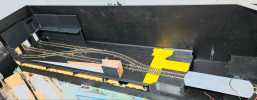
As the track will be inset, I added the droppers afterwards as I wasn't too bothered how neat these would be. You can also see in the image above that I've started some of the scenics at this point. All the buildings were designed in TinkerCAD and printed as shells in PLA, they'll then be clad in a mixture of Wills plasticard and Scalescenes textures.
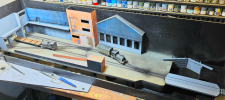
Track done! This was covered over with about 3 coats of tile grout and left to dry. The flangways were then gouged out using a hook-like implement I discovered on an old multitool. This took forever, and my arm ached like hell the day after, but it did work fairly successfully, and more importantly still works! The points were more of a faff. I managed to 3d print some insert type things that I used to keep as much grout out of the movable bits as I could. The inserts were then removed and more manual scraping took place to get them just about working again! This was then all painted up with various airbrushed greys, splattered acrylics, and sponged on washes. This wasn't quite the final iteration, I added a bit more weathering later on.
You can also see the beginnings of the buildings, now all printed out, and the swing bridge clad in Wills treadplate.
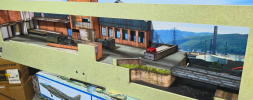
More progress - the buildings are now clad and weathered with an airbrushed mix of very dark black/brown. The backscene was also affixed at this point with double sided sticky tape. The boundary walls have been added, these are a nice kit from Scale Model Scenery. The second iteration of the fascia board is also visible here. The first one I got the measurements on hopelessly wrong This was designed in TinkerCAD along with the rest of the layout, exported as an SVG, converted to a DXF drawing and then uploaded to a company online who will cut the MDF to those specs. Far neater than I could ever hope to achieve myself.

The windows have been added at this point, though still awaiting glazing, along with the now painted lock gates. I also popped in some Scale Model Scenery sliding doors on the loading dock to the left hand end.
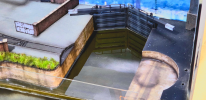
The resin canal pour went surprisingly well with no leaks.

Now finally at my favourite part - adding all the little detaily bits and bobs. Seen above is a laser cut Scale Model Scenery caged ladder, railings on the balcony above the loading dock, a scratch built downpipe made using plasticard tubing with 3d printed brackets, and a few little signs added to liven the place up!
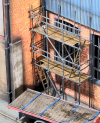
The wonderful SMS scaffolding kit, used here to try to disguise the join between the 2 buildings.
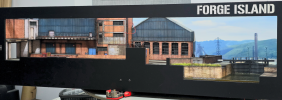
Fascia painted and the canal surface textured with AK Interactive 'Puddles'.
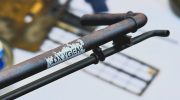
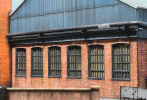
Some pipework painted up to add some nice detail to the right hand building. This comprises of 3d printed elbows and valves with plastic tubing and I beam. The 'OXYGEN' marking was done using a mask cut on the Silhouette Cameo. The acetate windows are also in at this point, highly grimed up to disguise the fact that there's very little space between them and the backscene behind! I also popped in some racking/shelves to hint at an interior. This is also lit however unfortunately the LEDs I chose turned out to be far too dim to be very effective.
TBC!
I'd had a set of Scale Model Scenery layout in a box baseboards hanging around for a bit that were screaming at me to do something with. I originally bought them for an N Gauge cameo that was supposed to be based on the video game series 'STALKER', set in Chernobyl. The plan was to 3D print a Soviet VL80 and some rolling stock, which I did, but it quickly became clear that the chassis I planned the whole thing around just wasn't suitable so it all went on the back burner. I may go back to it at some point.
So, what to do with the baseboards I'd already bought? As I'm sure is the case for a lot of us here, my layout ideas list is as long as my arm, so naturally I picked something completely new and impulsive. Forge Island is loosely based on the real Forge Island in the centre of Rotherham. It really is an island, located between the River Don on one side, and the Sheffield and South Yorkshire Navigation on the other. Up until around the 70s, the island was home to the Rotherham Forge and Rolling Mill Co. Ltd. and had a tiny little spur of track which split off at Rotherham Central Station, passed over the canal via a swing bridge at Rotherham Lock, and into the works. All of this can be seen in some excellent aerial photos on Britain from Above taken in the 1920s and 1950s. It's nothing hugely exciting, but the combination of the dense industrial setting, and a bridge over the canal had me itching to model it.
I know very little about the works itself, the aerial photos show a few open wagons dotted about, but no hint of a loco so I don't know if the small amount of track in the works even warranted its own shunter, or if whatever was available at Rotherham Central was called upon to shunt in and out. As such, this leaves things nicely ambiguous to allow me to run pretty much anything I like, from the 1920s through to the 1970s or so (I doubt the actual works itself changed much in that time!)
The layout is not a 100% likeness of Forge Island, in fact only really the right hand side of the layout looks anything like the real location, and even that is a compromise. The left hand end is actually quite heavily based on the Scalescenes Boxfile layout buildings, which have a nice generic industrial feel.
The track plan is pretty much completely fictional from the real site, put together from Peco Settrack (it'll be inset into concrete so I wasn't too bothered about how fine the track was!). It also features a completely superfluous crossover, but I really fancied having a crossover for a bit of visual interest, so there
.To allow for the height of the canal, the trackbed was elevated by 40mm. The canal sides and swing bridge base were 3d printed in PLA, while the left hand end was a piece of 6mm MDF, cut to size and then epoxied into place onto 3d printed standoffs. Knew there was a reason I bought 4 knackered old ammo boxes
.After a quick slosh of black paint, the track was screwed in place, and the point servos attached.
As the track will be inset, I added the droppers afterwards as I wasn't too bothered how neat these would be. You can also see in the image above that I've started some of the scenics at this point. All the buildings were designed in TinkerCAD and printed as shells in PLA, they'll then be clad in a mixture of Wills plasticard and Scalescenes textures.
Track done! This was covered over with about 3 coats of tile grout and left to dry. The flangways were then gouged out using a hook-like implement I discovered on an old multitool. This took forever, and my arm ached like hell the day after, but it did work fairly successfully, and more importantly still works! The points were more of a faff. I managed to 3d print some insert type things that I used to keep as much grout out of the movable bits as I could. The inserts were then removed and more manual scraping took place to get them just about working again! This was then all painted up with various airbrushed greys, splattered acrylics, and sponged on washes. This wasn't quite the final iteration, I added a bit more weathering later on.
You can also see the beginnings of the buildings, now all printed out, and the swing bridge clad in Wills treadplate.
More progress - the buildings are now clad and weathered with an airbrushed mix of very dark black/brown. The backscene was also affixed at this point with double sided sticky tape. The boundary walls have been added, these are a nice kit from Scale Model Scenery. The second iteration of the fascia board is also visible here. The first one I got the measurements on hopelessly wrong
This was designed in TinkerCAD along with the rest of the layout, exported as an SVG, converted to a DXF drawing and then uploaded to a company online who will cut the MDF to those specs. Far neater than I could ever hope to achieve myself.The windows have been added at this point, though still awaiting glazing, along with the now painted lock gates. I also popped in some Scale Model Scenery sliding doors on the loading dock to the left hand end.
The resin canal pour went surprisingly well with no leaks.
Now finally at my favourite part - adding all the little detaily bits and bobs. Seen above is a laser cut Scale Model Scenery caged ladder, railings on the balcony above the loading dock, a scratch built downpipe made using plasticard tubing with 3d printed brackets, and a few little signs added to liven the place up!
The wonderful SMS scaffolding kit, used here to try to disguise the join between the 2 buildings.
Fascia painted and the canal surface textured with AK Interactive 'Puddles'.
Some pipework painted up to add some nice detail to the right hand building. This comprises of 3d printed elbows and valves with plastic tubing and I beam. The 'OXYGEN' marking was done using a mask cut on the Silhouette Cameo. The acetate windows are also in at this point, highly grimed up to disguise the fact that there's very little space between them and the backscene behind! I also popped in some racking/shelves to hint at an interior. This is also lit however unfortunately the LEDs I chose turned out to be far too dim to be very effective.
TBC!
Last edited:
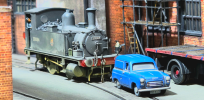

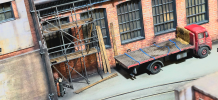





 ) pulls it all together!