Beginners OO 1950's Banff

John Duffy

Western Thunderer
The choice between sector plate and traverser is down to a few factors;
Location, entry point, build complexity and practicality.

A swinging sector plate is (I would suggest) an easier build overall and can work well with a limited number of roads facing a single, square on entry point. The main downside is that the farther from the centre line of your swing plate you have tracks the more the point of entry has to curve. In OO this is probably not too big an issue but worth considering.

If you are building this as your primary project in a permanent location then I would consider the additional build requirements as being a long term investment and consider the traverser. It means that each entry road is exactly the same. It is also easier to have a fixed end plate which allows for locos to “run round” their stock without being handled. This might be useful for you as the branch loco will work in and out regularly.

Traversers are also well suited to motorising or automating if that is something you might look to add.

One consideration - for either option - is if possible avoid having the entry point and the board joint in the same location. (From experience - it just makes alignment harder).

I had planned to build traversers but the overhang at the sides was a factor for me as I am limited there space wise. I used swinging sector plates as temporary yards and typically for me, have never replaced them.

I do think that either option is preferable to the fan of points as there is no wasted space.

John
 

aardvark

Western Thunderer
The choice between sector plate and traverser is down to a few factors;
Location, entry point, build complexity and practicality.

A swinging sector plate is (I would suggest) an easier build overall and can work well with a limited number of roads facing a single, square on entry point. The main downside is that the farther from the centre line of your swing plate you have tracks the more the point of entry has to curve. In OO this is probably not too big an issue but worth considering.

If you are building this as your primary project in a permanent location then I would consider the additional build requirements as being a long term investment and consider the traverser. It means that each entry road is exactly the same. It is also easier to have a fixed end plate which allows for locos to “run round” their stock without being handled. This might be useful for you as the branch loco will work in and out regularly.

Traversers are also well suited to motorising or automating if that is something you might look to add.

One consideration - for either option - is if possible avoid having the entry point and the board joint in the same location. (From experience - it just makes alignment harder).

I had planned to build traversers but the overhang at the sides was a factor for me as I am limited there space wise. I used swinging sector plates as temporary yards and typically for me, have never replaced them.

I do think that either option is preferable to the fan of points as there is no wasted space.

John

Thank you John: your contribution is simply outstanding. You've answered several questions that I was beginning to think of asking!

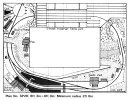
The only thing I wish to add is one of C.J. Freezer's plans from 60 Plans for Small Railways, 4th edition (perhaps 1990), featuring a traverser.

CJFreezer - SP28.jpg

In this case, the traverser is a through fiddleyard, with fixed storage to both the left and right of the 5-track traverser: it looks like loco storage to the left and train storage to the right. I would expect to construct the transverser along with both the fixed end sections as a single unit, as you recommend.

Most traversers that I've seen on-line and and the one that I've seen in real life seem to operate as drive-on/drive-off storage, whereas adding the fixed storage makes the traverser look like a 5-way double slip.

Now, whether I would need all that fiddleyard space for my diminutive layout is a valid question, but I think that it's much easier to start small and add additional tracks as needed to either traverser or sector plate than it is to extend a fan-of-turnouts fiddleyard.

I also like that the traverser doesn't extend beyond the baseboard when moved in either direction.

cheers
 

aardvark

Western Thunderer
In case anyone is following along, Model Rail #247 May 2018 includes an article on the construction of a traverser. I do like the idea of having ply on the bottom fixed section to strengthen the frame, but I'm less sure about using door bolts for track alignment, which I think would have too much slop, at least for OO.

1778047337724.png

For modellers of a different persuasion, the same issue has articles on construction of a sector plate and of cassettes.

Other leading model railway magazines probably have similar articles, but I haven't found those yet.
 

aardvark

Western Thunderer
After some grunting and puffing, I have a plan.

Of sorts.

I can't claim that I know what I'm doing, so if you see anything questionable or that could be improved, then please don't hold back. A simple "Like" would also be encouraging.


Banff - mkIIa3.jpg

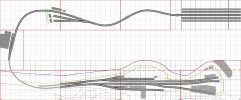
As before, the 4 existing baseboards are at the bottom, totaling 4.8m in length. The board on the left will require relaying of track, but that will be easy enough as my track isn't glued down.

Above that, at the left, is the Inverboyndie siding, servicing the Inverboyndie Distillery, also known as the Banff Distillery. There was no platform at the siding which was serviced from Banff by "specials", probably operated by the shuttle loco in between scheduled passenger services. Photos of the prototype show 7 wagons in the siding - the model might allow 2 or 3. The building to the left is one of the distillery warehouses.

Above that is Ladysbridge station, the intermediate station on the diminutive branch, which has a passenger platform and station building at the top, plus a double-sided goods platform below. To the left of the station is a level crossing with gates. I believe that Ladysbridge sidings were serviced by scheduled services. The model sidings might allow 3 or 4 wagons.

The track to the right of Ladysbridge is just space for train-in-the-landscape, as is the track though Inverboyndie, where scheduled services didn't stop. I wonder whether I have the skill to model this scenery.

At the top right is the traverser, supporting up to 4 trains of up to 880mm. The movable bit between the blue lines is 930mm long and 5 tracks wide. With a 55mm track pitch, it would be ~275mm in width and move ~220mm, meaning that it can be accommodated within the 600mm baseboard with no need for an overhang. There's additional 250mm loco storage tracks to the right. Trains might come in from Banff, the loco decouple and move onto the loco storage track, then the traverser moved to allow the loco to run around. With no means to turn locos at Banff, prototypically, trains ran tender-first in and smokebox first out.

Should the need arise, there's space to add 4 more loco storage tracks to the right as well as other Freezer-like storage off the front of the traverser. I'm not convinced this will be needed, but then again ...

I looked at this plan for a while, and pondered my sanity to more than double the length of the existing layout, and whether indeed it might ever be completed to any degree.

So, ...

Banff - mkIIa2.jpg

Much the same as above albeit much less exciting: just the same traverser joined to the existing layout.

So the plan might be to start with the fiddleyard that the layout always needed, then, when I get bored, add Inverboyndie and Ladysbridge. Perhaps that step too could be staged.

Should I ever get all that completed, or get I bored running end-to-end trains, then I could join the middle loco storage track with the middle track at the end of the Banff station for continuous running. The middle Banff station track original ran through the station and down to Banff harbour to collect freight direct from the quayside, so extending this track is not too far beyond reality, or at least as it was for a little while before the harbour siding was lifted in 1910.

It's good to have a plan, even if it is never achieved. At least I will know what I was trying for.
 

Nick C

Western Thunderer
I think a plan that can be enacted in stages is a very good idea!

I think if it were me, I'd get rid of the waggly bit in the top-middle, and move Ladysbridge closer to the fiddle yard. That'd then allow you to make the sidings there a bit longer, and give it a bit more of an open feel. I'd then push the distillery more into the upper left corner, to make use of that space.
 

40057

Western Thunderer
I like your top (more elaborate) plan. I too would move Ladysbridge a little closer to the fiddle yard to enable sidings of more prototypical length. Many more operational possibilities with the larger layout, effectively you will have modelled the branch, albeit drastically shortened.

Put in the track, run trains, and gradually extend the scenic area over time.

Martin
 

aardvark

Western Thunderer
Many thanks to @Nick C and @40057 for your suggestions, and thanks to the others for your "Likes". It is encouraging.

As built, the model Banff goods platform siding holds 8 wagons, while the kickback siding holds 11. The layout was "designed" by laying track over an OS map, so these capacities are pretty much prototype capacities. Today, I might have tried to make everything a bit smaller.

The redesign of the left-most baseboard as shown previously would reduce the kickback siding to 8 wagons, which should still be plenty.

As for Inverboyndie and Ladysbridge, the earlier design was probably based on making everything small so as not to overshadow Banff, and to ensure that it all fits in. Having these sidings in the layout should make for operations that are more interesting than just running backwards and forwards between the fiddleyard and the terminus.

In regards to Inverboyndie, the prototype held 8 wagons from the OS maps, with the one photograph showing 7 in situ. As previously designed, it's only 2.6 wagons, and is probably too much compression. There isn't too much space to move the siding up or down, but the siding itself can be extended upwards for a couple of wagons without having it disappear too far into the corner. In the prototype, the siding was parallel with the branch, but in the model, the branch has to curve to get it around the corner in a vaguely agreeable manner. The design also flipped the prototype so that the distillery warehouse(s) would be behind the siding.

In regards to Ladysbridge, the prototype actually had 3 sidings with capacity of 16, 12 and 21 wagons from the OS maps! Huge! The only image I have which shows wagons in these sidings is from Britain from Above, forlornly showing just 5, 4 and 2. As previously designed, 3 wagons in each of two sidings with the 3rd siding dropped, and again, the design was flipped so that the station building would be viewed from the front and sidings in front of that. I think that full prototype capacity would be way too much, but perhaps these sidings could be increased to 5 or 6 wagons each.

In terms of operation, I read now the 1952 TT which shows 1 goods, 2 mixed, 4 passenger and 1 EBV service into Banff; 1 goods, 1 mixed, 5 passenger and 1 EBV service out. Mixed services could have up to 10 wagons and take 5 more minutes than the passenger services, which suggests that mixed services also serviced Ladysbridge. I think that the model mixed services will only have 2 or 3 wagons, while the full goods maybe 8.

There are other notes that Ladysbridge goods was serviced via Banff, and that there might be an additional delay when uplifting fish traffic, which was a surprise. Perhaps this fish traffic came from the harbour at Whitehills.
 
Last edited:
Top