7mm 7mm Mick's Workbench - JLTRT Royal Scot

mickoo

Western Thunderer
Thanks for the advice fellas, I'll give that ago I think:thumbs:

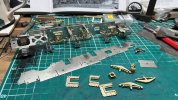
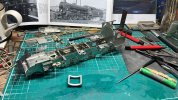
Before I can make good the motion bracket area I needed to be sure the fit underneath the footplate was snug as otherwise it just wouldn't look right. So I set about fitting the two huge lumps of pewter (footplate + Smoke box/boiler/firebox ) together and this was where the fun started. To say they need some fettling is understating things. The footplate has a mind of it's bloody own! I wanted to make the boiler removable to aid painting but the footplate can't maintain it's own form under it's own weight, so sadly this is not an option, the two have to be permanently fixed. So I got on with that and found I needed to also fit the cab in the process.

And so to fit the cab I needed to fit the roof because the higher temperature solder would mean I couldn't fit it afterwards. The more I looked at the prototype the more I realised that the rear beading just wasn't good enough. I remember @mickoo having a crack at this with his A3 and I've nicked the idea. So 1mm soft copper wire was used and filled to half round using some suitable N/S sheet as a jig. First attempt;
View attachment 111574
Great, I thought. I thought wrong, no chance of manipulating the wire once it's filled, it just wants to bend the way physics intended and that's no good! So the second attempt was formed first and then filled down;
View attachment 111575
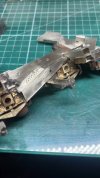
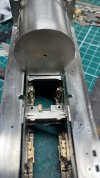
Much better. Once this was fitted and the cab roof was in place I was ready to push on. I then found, having straightened the footplate as best I can that the rear of the firebox needed some work, a quick bench grab shot;View attachment 111576
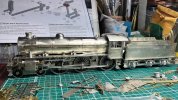
Far from ideal !! Anyway I have not got the main structure together and the chimney tacked in place until i'm 100% happy with the position. I do like the Thompson budget sheet metal chimney on this class!
View attachment 111577
View attachment 111578
View attachment 111579
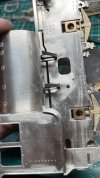
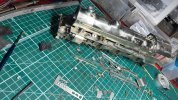
You'll see from the above shots and certainly the following shot that there's still lots of cleaning up to do of the pewter but at least the basic shape is coming together and this will allow me to pick the work up on the frames again;
View attachment 111581
Incidentally this is how the whole side of the footplate arrives, the feed pips are a real pain to clean up and make a tidy job of.

Cheers

Mick
Mick, I'm going to guess here, on the first attempt with the beading you filled half off and then attempted to bend it to the right profile, as you've found that wont work.

The trick is to solder the long upright on first and stop just short of the first bend, then bend the beading in situ around a drill shank for something; on the County tender I found the end of a pair of tweezers had roughly the right radius.

It will try to twist and may even do so, but the trick is to form the bend and then flatten the twist with a pair of flat nose pliers. The problem with copper is that it marks very easily and using the pliers can add a flat surface to the half round part. Once the first curve is done you just repeat around the rest.

The stuff I've linked to has to be used the same way, solder the longest and straightest part first, then work in the curves.

Either way, the correct beading makes all the difference and well worth the effort :thumbs:

Looking at that footplate and the work ahead, I can't help but think you'd be better off working a new one up from sheet brass ;), it probably won't take much longer time wise either.
 

adrian

Flying Squad
It will try to twist and may even do so, but the trick is to form the bend and then flatten the twist with a pair of flat nose pliers. The problem with copper is that it marks very easily and using the pliers can add a flat surface to the half round part. Once the first curve is done you just repeat around the rest.

The stuff I've linked to has to be used the same way, solder the longest and straightest part first, then work in the curves.

All good advice - likewise I much prefer brass half round for beading because as you say copper is just too soft and marks easily - especially with my heavy handed cleaning. I always soften the wire before use and then likewise solder the longest and straightest bit first.

Drill shanks are great for bending to the correct radius for small radius bends but for the larger radius I don't shape it before soldering but start at one end and do a little section at a time. I use little hardwood strips to rub and ease the wire into the correct radius, it doesn't mark the wire and gives a nice smooth transition on the curves. I use the hardwood strips all the way along to hold and rub the wire in place whilst soldering to smooth out and kinks and keep it flat.

The other suggestion is start at one point and work your way along. Do not tack solder at each end and then go back to fill in. The wire will expand when you solder it and if it's been tack soldered then it will buckle to some extent.
 

7mmMick

Western Thunderer
Mick, I'm going to guess here, on the first attempt with the beading you filled half off and then attempted to bend it to the right profile, as you've found that wont work.

The trick is to solder the long upright on first and stop just short of the first bend, then bend the beading in situ around a drill shank for something; on the County tender I found the end of a pair of tweezers had roughly the right radius.

It will try to twist and may even do so, but the trick is to form the bend and then flatten the twist with a pair of flat nose pliers. The problem with copper is that it marks very easily and using the pliers can add a flat surface to the half round part. Once the first curve is done you just repeat around the rest.

The stuff I've linked to has to be used the same way, solder the longest and straightest part first, then work in the curves.

Either way, the correct beading makes all the difference and well worth the effort :thumbs:

Looking at that footplate and the work ahead, I can't help but think you'd be better off working a new one up from sheet brass ;), it probably won't take much longer time wise either.

Thanks Mick and Adrian, really good advice fellas. Stuff which I will follow and i'll get an order in for some of the half round brass :thumbs:

As for the footplate, I reckon you've got a good point there mate. If I do another one of these kits I'll go down the fabrication of a new footplate, it would have been a damn sight easier:D

Cheers

Mick
 
Blowing the dust off !!

7mmMick

Western Thunderer
Well, evening all. I don't think six and a bit years since I posted here is too bad :D Thinking back across that time a lot has happened for me, a couple of house moves, some forced, some chosen. The day job has been all consuming at times and time has just got away from me. Still, lots going on in the hobby and plenty of building, so there's no better place to catch up than with the test build of the Finney7 B1. To be fair it's been well over due hasn't it but I'll stay away from that and focus on the build. A series of crap phone grabs to follow to get you all up to speed.

The frames are the usual @mickoo standard, superbly detailed and the castings are sublime. The axle box springs and horn keeps were drilled and bolted through with 12BA screws. A lot of work to get here as each frame stretcher is a series of folded up parts...
B1 Frame plate.JPG
The screws can be seen here
B1 Hornguide.JPG
Some shots of the frames further on with the motion brackets being fitted etc
B1 Frames 1.jpeg
B1 Frames.jpeg
And another shot with the cab coming together
B1 frames cab.JPG
 
More B1 progress

7mmMick

Western Thunderer
I missed the below photo in sequence, but here's the firebox and ashpan being fitted
B1 Ash Pan.JPG
This shows the test of the firebox fit with the frames, this needed no fettling at all and fitted perfectly. The construction method is not something I'm used to, having built bodies on cradles and from the footplate up. This kit asks you to build the frames, then the cab, followed by the front end. All is then bolted together and the footplates are attached using the built frames as the jig. All works exceptionally well and serves to build a square and true model.
B1 Firebox fit.JPG

Next is the firebox throatplate, looking down through the frames you can see the internal sandboxes, which are etched and later the sandpipes to the sandbox lids were fitted
B1 Cab front.JPG
Footplates fitted and coming together on a messy bench !
B1 Coming together.JPG
Basic loco and tender built. The tender is a Finney7 Group Standard and is the correct version for 61010. This build followed @adrian earlier build and the only difference is this is an earlier version, pre 1955 with low division plate
4C990A05-84B2-4B7A-8877-7C2249F74FFF.JPG
Starting to build cylinders and motion...
B1 in progress.JPG
First shot with the wheels, motion and brake gear, well on the way...
B1 on the bench.JPG
Loco and tender posed together, grubby bench shots !!
B1 Loco.JPG
Cylinders being detailed now
FIOT8815.JPG
And a completed front bogie. The detail here is superb and there has to be about 50 parts in this !
BFSZ8404.JPG
Finally, some prototype inspiration of the loco i'm modelling
A whistle stop tour of a few months of building on and off around other projects. More glossy (not grubby bench) photos to follow soon as the loco is almost complete. I must say it's great to be back here as FB and Whatsapp just dont tick all the boxes and I have really missed posting on WT. More to follow as I refresh other threads,

Cheers

Mick
 

Dave Holt

Western Thunderer
Quite stunning. A very neat build of what looks to be a superb kit. Sadly, for me, even the very best 4 mm kits don't get anywhere near that level of fidelity to the prototype, especially between the frames.
Dave.
 

7mmMick

Western Thunderer
Thanks for the kind comments and the likes everyone, sadly the photos of this snap shot don't do the kit justice. More to follow soon...
 

oldravendale

Western Thunderer
Quite stunning. A very neat build of what looks to be a superb kit. Sadly, for me, even the very best 4 mm kits don't get anywhere near that level of fidelity to the prototype, especially between the frames.
Dave.
Great to see your work back here fella. Looking forward to seeing more!
You do realise that this is 7mm? Also where are you going to find anything near that level of fidelity in the spacers alone?
 

adrian

Flying Squad
Great to see you back and back in style - what an entrance!!
Next is the firebox throatplate, looking down through the frames you can see the internal sandboxes, which are etched and later the sandpipes to the sandbox lids were fitted
Judging from the gap between the frames and the running plate, plus the inward step just behind the cylinder do I have to assume this unfortunately is a finescale build rather than Scale7? As a test build I can see the sense as the vast majority of them will be built to this standard - it just means I shall have to buy one now to see what it's like in Scale7!
 
Last edited:

Dan Randall

Western Thunderer
Judging from the gap between the frames and the running plate, plus the inward step just behind the cylinder do I have to assume this unfortunately is a finescale build rather than Scale7? As a test build I can see the sense as the vast majority of them will be built to this standard - it just means I shall have to buy one now to see what it's like in Scale7!
Although the wheel flanges have an S7 look about them…


Regards

Dan
 

mickoo

Western Thunderer
Great to see you back and back in style - what an entrance!!

Judging from the gap between the frames and the running plate, plus the inward step just behind the cylinder do I have to assume this unfortunately is a finescale build rather than Scale7? As a test build I can see the sense as the vast majority of them will be built to this standard - it just means I shall have to buy one now to see what it's like in Scale7!
I pushed the frames out as far as I could (28 mm over rivet detail) to suit finescale and 6' minimum radius I'm afraid.

However Mick built his to Scale 7 as his choice but it also cross checked all the castings to make sure they fitted that gauge as well, aka brake hangers and brackets, motion and other clearances.
 
Last edited:

7mmMick

Western Thunderer
Great to see you back and back in style - what an entrance!!

Judging from the gap between the frames and the running plate, plus the inward step just behind the cylinder do I have to assume this unfortunately is a finescale build rather than Scale7? As a test build I can see the sense as the vast majority of them will be built to this standard - it just means I shall have to buy one now to see what it's like in Scale7!
Thanks @adrian good to be back, long overdue !

You should know me by now :D, this is a Scale7 loco and as Mick points out we discussed this during the build. I would have liked wider main frames but this is a test build for the kit so needs to prove concept in F/S too. In F/S its very snug but works well around 6ft radius. The design of the kit allows the most visible feature to be easily adapted though, this being the front bogie. Very prominent on the class and through the addition of N/S sheet the centre bolster it pushes the bogie side frames out to scale width. The great thing about the main frames is that the frame stretches could be treated in the same way if so required, so with a little work the frames could be wider and no castings are effected. We other than the brake hanger brackets but again a quick pass with a piercing saw would sort it,

Cheers

Mick
 

65179

Active Member
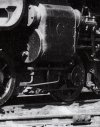
Will the kit include provision for the Metropolitan-Vickers axle mounted generator? I ask as I've never got my head around how these were actually mounted or quite how they work.

61162manchestercentral041949-edit-20260211222531.jpg

Thanks,
Simon
 
Top