Rivermead Central

40057

Western Thunderer
Hello Martin

Just an update on my progress at Kingswell Street. Sadly, I have made no advance with the problem Bassett-Lowke SR 2-6-0 Mogul, which still refuses to run properly in forward gear (but runs fine in reverse). Nothing daunted, I have jumped in at the deep end again, this time with rather happier results.

Another B-L engine caught my eye in a Vectis auction. Not this time the giddy heights of a B17, but a fairly commonplace LMS 4-4-0 Compound, but in this instance a rather uncommonplace example of one. This is the final iteration of the LMS liveried Compound, numbered 1082, produced for a short period in the late 1940s before the change to the black BR version. (On the internet I have found an original sales receipt for one of these from 1952, so they were being sold as late as this).

View attachment 265299

What caught my attention was the fact that the engine was clockwork, and also its splendid condition. I could also see that a previous owner had made some tasteful modifications - sprung buffers, three-link couplings, and larger diameter bogie wheels. I also spotted that the driving wheels were not the expected 14 spoke Mazak variety, but 18 spoke. They turned out to be cast-iron, like the electric drive version, but pressed-on rather than centre-nutted. When the loco arrived, it did not disappoint.

View attachment 265300

The new bogie wheels are cast-iron, and the tender wheels have been changed too, so there is no Mazak on this engine. As you can see, the buffer and coupling changes have been done very neatly (and I would think it was a professional job). Of course, these changes mean the Compound is no longer really collectible, which was to my advantage in the auction.

View attachment 265305

As you can see, the engine does not seem to have had much use - there is very little wear on the mechanism, and hardly any dust on the finish, let alone dirt. It almost makes me wonder whether it has been stored in a display case (it did not come with a box).

View attachment 265309

The larger bogie wheels really do improve the appearance of the front end, but I would think there is no chance that it would negotiate 2 foot radius curves with this setup. The very good news is that 1082 is a splendid runner - I just gave the mech a service and lube, and she goes like a new engine. Quiet, smooth, and with excellent controls.

View attachment 265310

So here is the latest addition to our MPD, seen on a running-in turn at the head of a local train to Gloucester. These Compounds were a Bassett-Lowke classic, in this tinprinted and tabbed form lasting from introduction in the 1928 catalogue as number 1190 right through to the end of Bassett-Lowke in 1965 in its BR livery.

John
Hi again John

By way of a PS.

Check the tender wheels on your compound. The tender appears to be riding far too low. I wonder if someone has fitted BL cast iron wagon wheels — 21 mm in diameter — rather than tender wheels which should be c.28 mm diameter. 3.5 mm would bring the platform at the front of the tender up to the level of the loco footplate.

Martin
 

40057

Western Thunderer
Yes Martin, well spotted. The tender wheels seem to be too small enough! So now I have another hard to find item on my list . . . .

John
Hi John

I think your options for replacement tender wheels are:
1. Find a set of alloy B/L tender wheels and put back what was there originally.
2. Get new wheel-sets made by Walsall Model Industries, or if you have the facilities, buy their castings and turn them yourself. Walsall will have a casting very close in appearance to B/L 28 mm tender wheels.

You cannot, unfortunately, use original B/L cast iron tender wheels. Not easily, anyway. A standard B/L item as used on the Stanier tenders for the Duchess and Royal Scot. However, the frames on the Stanier tender are much closer together than on the tab-and-slot tenders, so the axles on B/L cast iron tender wheel sets are not long enough to use in a Compound tender.

I don’t think you will find it too difficult to obtain original alloy tender wheel sets. Walsall will turn their castings to B/L standards if that’s what you specify. My experience is they are quick and reliable.

Martin
 

Fitzroy

Western Thunderer
Hi John

I think your options for replacement tender wheels are:
1. Find a set of alloy B/L tender wheels and put back what was there originally.
2. Get new wheel-sets made by Walsall Model Industries, or if you have the facilities, buy their castings and turn them yourself. Walsall will have a casting very close in appearance to B/L 28 mm tender wheels.

You cannot, unfortunately, use original B/L cast iron tender wheels. Not easily, anyway. A standard B/L item as used on the Stanier tenders for the Duchess and Royal Scot. However, the frames on the Stanier tender are much closer together than on the tab-and-slot tenders, so the axles on B/L cast iron tender wheel sets are not long enough to use in a Compound tender.

I don’t think you will find it too difficult to obtain original alloy tender wheel sets. Walsall will turn their castings to B/L standards if that’s what you specify. My experience is they are quick and reliable.

Martin
John and Martin, there is a third option. When I did the A1/A3s, I commissioned die tooling and had a run done of the pressure diecast B-L style alloy tender wheels. Martin, if you look at the wheels on Firduassi you will see what I mean.

Cheers

Pieter
 

40057

Western Thunderer
John and Martin, there is a third option. When I did the A1/A3s, I commissioned die tooling and had a run done of the pressure diecast B-L style alloy tender wheels. Martin, if you look at the wheels on Firduassi you will see what I mean.

Cheers

Pieter
Hi Pieter

Thank you, yes indeed, I had noticed those. Perfect copies. And Mazac, so durable, not white metal.

Can you supply spares or did you just get the number you needed?

Martin
 

Fitzroy

Western Thunderer
When I had the dies made I had enough shots done to lay on a copious supply. I also had a repro done of the Hornby 8 spoke diecast wagon wheel in the same die set. So if anyone is interested in either type they can PM me.

Cheers

Pieter
 

40057

Western Thunderer
Just a little modelling progress in between efforts at weed control.

I have started making the length of sleeper-built fence to go immediately south of the wall shown most recently in post #978:

5C6225F4-8850-41A8-8A34-63A3050B4F2E.jpeg

A foot long, so far. I’m aiming at 18–20”. I had two part boxes of Bassett-Lowke sleepers and the first of these is now used up. The last of the sleepers from that first box are the eleven in the centre above. The sleepers from the second box are the distinctly blue-ish ones at either end. They really are that colour, and a different much yellower wood. I will have to paint this length of fence more thoroughly, rather than just a light spray of matt black.

The (unlikely) starting point for a locomotive:

189E7DBD-92D5-4698-968A-BAB5B33DD293.jpeg

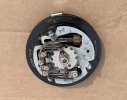
Purchased on a well-known internet auction site for a few pounds, it arrived in the post today. This is — or, rather, was, since I have now dismantled it — a complete dial with all the ‘works’:

D849FEE7-F2FE-4A31-816D-C06EFF00AA33.jpeg

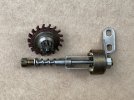
The bits I was after are these, the dial regulator:

2D85A6D7-2F7A-4BD7-B265-631B31641207.jpeg

In model railway terms, this is a ‘Teleguv’. Fitted to a clockwork locomotive mechanism in place of the traditional rotary governor, the clockwork motor will pull more, make less noise, run more slowly and travel further.

I bought three Teleguvs about twenty years ago from a small business supplying parts to telephone collectors. The last of these three went into Caledonian Railway no. 828. This time, I couldn’t find a supplier for just the dial regulator parts, hence the purchase of the complete dial assembly.

Now I have the necessary Teleguv, serious thought can be given to the rest of the locomotive and what will be needed to build it.

Martin
 

Fitzroy

Western Thunderer
Interesting! I have a couple of dials in the shed and I've just thought of another cunning use for the skewed gear set. The physical engineering that went into 20th century telecoms equipment is just breathtaking, and underpinned by a vast array of standards and practices. Some of that kind of expertise is being resurrected on a much smaller scale in medical equipment, but in a completely ad-hoc and non-standardised way, so a lot of the benefit of the engineering knowledge needed is sadly just dissipated.
As a matter of interest, do the bobs ever splay out enough to rub inside the cup- i.e. is that just a retainer for extreme travel, or does rubbing form part of the governing function, like a knee in the torque curve?
Edit:- By the way, if anyone hasn't been there, the phone box museum at Avoncroft definitely warrants a visit- as well as the lovely phone boxes, they have a working mechanical mobile telephone exchange connecting them all up. A friend and fellow B-L Soc member is heavily involved in keeping it all going. Fun fact, small children react well when they are at the Police box and someone rings from the exchange and when they pick up said someone says "Where is the Doctor????" with a Dalek voice. Don't ask me how I know.
 
Last edited:

simond

Western Thunderer
In model railway terms, this is a ‘Teleguv’. Fitted to a clockwork locomotive mechanism in place of the traditional rotary governor, the clockwork motor will pull more, make less noise, run more slowly and travel further.

I understand that this is a speed governor and working by the bob weights swinging out and rubbing inside the drum to provide friction braking. I can imagine that it’s well made, effective and quiet.

I have no knowledge of “traditional rotary governors” but I don’t understand how a friction device can improve haulage or length of run. Is it that the traditional devices were yet more wasteful?

Puzzled of Sandgate.
 

John R Smith

Western Thunderer
I have never understood just how a Teleguv is fitted into a standard B-L or Hornby clockwork mechanism. Surely one would have to firstly disengage the drive from the final pinion to the standard governer, and then transfer this drive to the Teleguv. So how is the Teleguv mounted (without increasing the overall height of the mech), and how is it driven from the original clockwork?

John
 
Top