
You are using an out of date browser. It may not display this or other websites correctly.
You should upgrade or use an alternative browser.
You should upgrade or use an alternative browser.
7mm Heybridge Basin
- Thread starter RichardG
- Start date
Threadmarks
View all 28 threadmarks
Reader mode
Reader mode
Recent threadmarks
( Diversion : shipping of timber to Chelmsford ) Backscene . . experiments and discussion Backscene . . completed Low level photos . . using DSLR on a monopod . . using a phone camera . . using a pinhole 'lens' . . removing shadows from display case . . softer lighting

magmouse
Western Thunderer
but be aware the wide-angle lens is throwing out verticals left and right.
Well, strictly speaking, it’s not the lens, it’s the point of view - the raised viewpoint means the verticals appear to converge towards a vanishing point somewhere below the floor of the room…
Could you redo this picture from the same camera position, except at scale head height? My suspicion is the perspective of the three buildings on the backscene will click into place - unlike the earlier pictures taken with the camera further from the layout. In those pictures, the perspective of the buildings - the way they diminish in height as they recede - is too great for the distant viewing position. From the closer position - as you say, a typical operator‘s view - it will work nicely, I think.
Nick.

RichardG
Western Thunderer
Could you redo this picture from the same camera position, except at scale head height?
Of course!
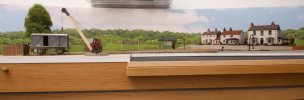
Wide-angle zoom lens (focal length = 13 mm)
This time, the camera is kept at the same horizontal distance from the layout (being a typical viewing distance), while the centre of the camera lens is returned to be about 38 mm above rail level.
The verticals are looking a whole lot better.
magmouse
Western Thunderer
The verticals are looking a whole lot better.
Yes, and the way the three buildings recede is much more convincing.

Low level photos . . using DSLR on a monopod
RichardG
Western Thunderer
I have dug out my monopod. I haven't used this for years, quite possibly not since 2006 when I let finally go of slide film. Not quite the top deck of the bus but I have set it up as if the photographer is standing on top of a load of timber in a barge.
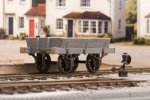
Back to the 85 mm lens. This is always my favourite, it makes models a nice shape, it gets me far enough back to fit in a reflector (this lifts the shadows in the underframe) and I can control the background too.
Fundamentally, I think I have done the right thing by having the roadway on the backdrop - being a vertical surface, the lens doesn't foreshorten it at all and I can knock it out of focus in a consistent way to match the buildings
Back to the 85 mm lens. This is always my favourite, it makes models a nice shape, it gets me far enough back to fit in a reflector (this lifts the shadows in the underframe) and I can control the background too.
Fundamentally, I think I have done the right thing by having the roadway on the backdrop - being a vertical surface, the lens doesn't foreshorten it at all and I can knock it out of focus in a consistent way to match the buildings

Yorkshire Dave
Western Thunderer
Back to the 85 mm lens. This is always my favourite, it makes models a nice shape, it gets me far enough back to fit in a reflector (this lifts the shadows in the underframe) and I can control the background too.
To create 'period' shots you would need to use a 35mm lens as this would have been the norm at the time.
Fundamentally, I think I have done the right thing by having the roadway on the backdrop - being a vertical surface, the lens doesn't foreshorten it at all and I can knock it out of focus in a consistent way to match the buildings
For modelling purposes the depth of field is useful to keep the subject in focus and the background out of focus.
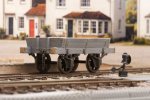
However, to create a 'period' photograph you would have to mimic the conditions it would have been be taken in. In the early 1900s film/emulsion speeds were much slower at around 10 to 50 ASA/11° to 18° DIN**. As such most photographs would be taken on bright days therefore requiring a higher aperture setting such as f.8, 11, 16, 22 or even 32 (as shutter speeds were generally limited) which would in turn bring practically everything into focus due to the depth of field.
** both ASA (US) and DIN (Europe) are relatively modern standards photographically speaking, being introduced in 1943 and 1934 respectively superseded by ISO in 1974.


RichardG
Western Thunderer
To create 'period' shots you would need to use a 35mm lens as this would have been the norm at the time.
Thinking about the lowly status of the Heybridge Railway, it would not have attracted many pro photograhers. My period is a bit early for 35mm roll film, but I could try to emulate 120 roll film. Kodak introduced this in 1901.
Any image taken with a "standard" lens is going to be difficult because the camera will be sitting on the baseboard. I have a compact which ought to be able to do this but I've never quite worked out how to set the aperture manually!
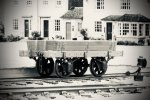
This is staying with the 85 mm lens because it lets me fill the frame and keep the monopod on the floor. f/32 at ISO 8,000, fixed-output studio flash of unknown guide number. Image edited for silvertone effect, grain effect and vignette.
The trouble is, this lens is too good. A lens of the period would have all kinds of distortion. Maybe there is an online tool to introduce suitable faults.
Last edited:
RichardG
Western Thunderer

I am happier to take photos like this.
Everything here except the Setrack point (in the foreground shadow) has been made as a one-off. The buildings look the right size. It's a bright sunny day (mild shadows visible on the rooflines) and all it really wants for is some stronger weathering on the loco and for me to attend to the coping stones along the edge of the waterside.

Rob R
Western Thunderer
Nice view looking North(ish).View attachment 257278
I am happier to take photos like this.
Everything here except the Setrack point (in the foreground shadow) has been made as a one-off. The buildings look the right size. It's a bright sunny day (mild shadows visible on the rooflines) and all it really wants for is some stronger weathering on the loco and for me to attend to the coping stones along the edge of the waterside.
Not so sure about the shadows on the South(ish) facing chimney walls.
RichardG
Western Thunderer
Nice view looking North(ish).
Not so sure about the shadows on the South(ish) facing chimney walls.
For the location, both the railway and the building fronts should be parallel and orientated roughly east-west. On the model, the angle between them is about 15 degrees though it does look rather more than this in my photo.
I suggest, imagine the building line is at a compass bearing of about 97 degrees to 277 degrees. The date is 31st May. In which case, the eastern (right-hand) sides of the chimney stacks will fall into shadow around 14:00.
The shadows are thus correct for mid-afternoon, but this does rather put the kibosh on any ideas of me softening the distant trees with an early-morning mist. I'm using the licensed version of 'Sun Position Pro' on my Android phone.
And I thought I was a detail person

magmouse
Western Thunderer
My period is a bit early for 35mm roll film, but I could try to emulate 120 roll film. Kodak introduced this in 1901.
Any image taken with a "standard" lens is going to be difficult because the camera will be sitting on the baseboard. I have a compact which ought to be able to do this but I've never quite worked out how to set the aperture manually!
The Kodak Brownie No.2 was the first to use 120 film (Kodak Brownie No.2) and took a 6x9cm image. The 105mm focal length lens is just a fraction under the 108mm diagonal of the frame, so a "normal" lens with an angle of view equivalent to a 42mm lens on 35mm format.
If you really want the vintage look, your going to need to find a single element meniscus lens of a suitable focal length - or perhaps a cheap old lens in 42mm thread mount from the 1960s or 70s, which you can mount to your SLR with an adaptor?
Nick.

Overseer
Western Thunderer
Have you tried a Holga lens? They make very cheap lenses to fit Canon and other brands of DSLR cameras. It will give you all the distortion and vignetting you could desire without having to digitally manipulate the image.The trouble is, this lens is too good. A lens of the period would have all kinds of distortion.
RichardG
Western Thunderer
I don't know very much about these. There seem to be two versions - a pinhole lens and 60mm f/8 lens. I am guessing, the 60mm lens will focus down to a metre or so. Not really close enough. I fancy trying a pinhole lens and I can try making one of these using a body cap.Have you tried a Holga lens? They make very cheap lenses to fit Canon and other brands of DSLR cameras. It will give you all the distortion and vignetting you could desire without having to digitally manipulate the image.

Brian McKenzie
Western Thunderer
I fancy trying a pinhole lens and I can try making one of these using a body cap.
Material at the pinhole needs to be ultra thin. A hole in a body cap is likely to create much diffraction.
Suggest using a piece of the thinnest shim at hand, and making the tiniest hole by abrading very gently with a disc in a motor tool.
RichardG
Western Thunderer
Material at the pinhole needs to be ultra thin. A hole in a body cap is likely to create much diffraction.
Suggest using a piece of the thinnest shim at hand, and making the tiniest hole by abrading very gently with a disc in a motor tool.
My instructions are to use kitchen foil, coloured black on the inside and taped over an oversize hole drilled in the body cap. The pin hole should be 0.26 mm diameter, so really I'll try with a sewing needle in the foil and see what happens.
RichardG
Western Thunderer
I offer some notes on the assembly of the backscene in case they are useful . . .

Location.
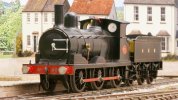
Here is a final photo to show the limits of the perspective effect of the buildings.
- The AI produced something perhaps 80% right for the buildings. It did this very quickly, but subsequent refinements proved remarkably difficult. So the final version for print is a manual edit of the second draft, removing unwanted details and cleaning up a few edges.
- We tried to get the machine to enlarge the canvas and fill in the areas left and right with open countryside. This failed, so I went for the scene from ID Backscenes. The choice of commercial scenes without obvious hills and/or modern infrastructure is really limited, most backscene manufacturers seem to love hills!
- At the draft stage I had the horizon about 90 mm above the baseboard. This looked especially good near and behind the buildings (the trees looked a long way away) but I lost too much foreground elsewhere on the layout. So I ended up with a 120 mm horizon, still low enough to disappear behind the buildings and giving me up to 50 mm of foreground grassland.
- This is a paper backscene. ID Backscenes offer a version printed onto a plastic film and I used this on my lockdown layout. Whilst very good I think the paper version is easier to alter.
- This scene is marketed for 00 gauge but I think it works well in the larger scale.
- The backdrop board is 3mm hardboard, primed on both sides and painted gloss on the back over a year ago. I have been storing it on end since then and it hasn’t shown any signs of warping.
- I used permanent spray adhesive to hang the paper, the spray being applied onto the primer not the paper about 300 mm of length at a time.
- The colour printing was a bit pricey. I formatted the buildings for two sheets of A4 paper, and two 10x8 inch sheets would have saved a few pounds.
Location.
Here is a final photo to show the limits of the perspective effect of the buildings.
Last edited:
Yorkshire Dave
Western Thunderer
Any image taken with a "standard" lens is going to be difficult because the camera will be sitting on the baseboard. I have a compact which ought to be able to do this but I've never quite worked out how to set the aperture manually!

Rather than a camera use a smart mobile phone. I took this on my Samsung smart phone which has Pro camera settings with the lens at HO scale eye level. Smart phones, being thin, have the advantage they can be set almost anywhere on the layout.

Threadmarks
View all 28 threadmarks
Reader mode
Reader mode