
You are using an out of date browser. It may not display this or other websites correctly.
You should upgrade or use an alternative browser.
You should upgrade or use an alternative browser.
Rivermead Central
- Thread starter 40057
- Start date

adrian
Flying Squad
Looks very much like Private Eye to me.Never mind all that, what was the paper you've been reading?
John R Smith
Western Thunderer
Given the need to keep the thickness of the wall to a minimum, plus it needing to stay exactly upright along its whole length when on the layout, I am minded to use some L-shaped steel brackets — sold as corner braces in B&Q — to fix the wall to the baseboard. I’ll cover the legs of the brackets projecting forward from the base of the wall with a strip of thin plywood painted to match the base-boards.
Martin
I think that this is an excellent plan. Seeing as the layout baseboards and the wall of the room are bound to move slightly relative to each other (due to climatic temperature and humidity changes), then it will be very prudent to attach your background buildings to the layout baseboards so that they can move as one.
John
Our absolutely miserable, cold, wet weather continues. So rather than post a photograph taken in poor light of incremental progress with a wall, I want to look at Bassett-Lowke’s pre-grouping range of models from a different perspective.
The pre-grouping models under consideration were all made prior to 1923. Model railways portraying former times were virtually unknown until relatively recently. The Bassett-Lowke catalogues regularly emphasised that the models offered were up-to-date and represented the latest developments on the real railways. It is clear ‘out-of-date’ models were hard or impossible to sell. For example, the model of Caledonian Railway no.142 produced at Northampton shortly before the grouping then stayed in the catalogues until c.1930. Clearly, a slow seller. In later years, the catalogue entry included the offer to repaint the model in LMS colours for an extra charge. It probably didn’t help that the models of CR no.142 made in Northampton did not look much like the real engine. The 1921/22 range of lithographed 0 gauge corridor coaches (made by Bing) consisted of brake/3rds and all-firsts in three liveries: GWR lake, LNWR and MR. After 1923, the unsold models in pre-grouping liveries were updated to reflect the latest position on the real railways. The Midland livery coaches had the ‘Midland’ wording below the cantrail painted over and transfers for ‘LMS’ applied in a waist panel. The obsolete GWR lake livery required a more drastic solution. The coaches were carefully over-painted green without covering details such as the doors to the gangways and hand-lettered for the Southern Railway. The price of the over-painted Southern coaches was higher than for the other post-grouping liveries offered. Nevertheless, Bassett-Lowke clearly took a commercial judgement that models in pre-grouping liveries would have been hard to sell post-1923.
In my posts #92 and #172, I looked at the range of 0 gauge tank locomotives Bassett-Lowke offered before and after WW1. In my post #388, I considered prototype selection for locomotive models in regard to practical considerations such as choosing prototypes with large boilers, so the models could accommodate standard clockwork and electric mechanisms.
But, as a business, above all, Bassett-Lowke needed to produce models that would sell. So, yes, an accurate model had to be technically feasible, but it also was going to have to be popular with customers. Market trends were not always correctly anticipated. The Gauge 2 versions in the pre-WW1 range of lithographed wagons clearly sold slowly. Even during the shortage of models for sale during WW1, the Gauge 2 tinplate wagons made before 1914 didn’t sell well. They were still in the Bassett-Lowke catalogues in the late 1920s — by then c.15 years old — being offered at reduced price and with the option of having them fitted with Gauge 1 wheel-sets at no extra charge.
To sell, potential customers needed to decide a model was both appealing and affordable. Part of the appeal was that Bassett-Lowke was producing ‘scale models’ of real locomotives (and coaches and wagons and lots else). Also, the concentration on models of the very latest, most well-known and up-to-date real locomotives. And models of locomotives and rolling stock from the leading and largest railway companies. A rough break-down of the pre-grouping tinplate models sold by Bassett-Lowke emphasises that some railway companies were strongly favoured over others.
In 0 gauge (and larger gauges), the LNWR was the best represented railway company. By miles. In 0 gauge, the only company to get a model goods loco. A Cauliflower 0-6-0, also made in Gauge 1. One of the five 0 gauge scale model tank locos was an LNW Precursor tank. The LNWR express locos offered in 0 gauge were Jubilee no.1902 Black Prince (live steam, Bing), George the Fifth plus Queen Mary (Bing) and no.513 Precursor. The model of no.513 offered in 0 gauge was made by Marklin and a ‘bought in’ model not exclusive to Bassett-Lowke, whereas the Gauge 1 model of no.513 was a Greenly design made by Bing. Further LNWR locos were made in the larger gauges including a Claughton (Gauge 1) and Bowen-Cooke 4-6-2T (Gauge 2). The post-WW1 range included five freelance design locos in LNWR livery. The ‘standard’ pre-WW1 mainline coaches — a 1st/3rd composite plus a full brake — made by Carette, were produced in LNWR livery in gauges 0, 1, 2 and 3. In gauges 0 and 1, shorter versions with opening doors were also listed. Also, even shorter, 6-wheelers. Two model coaches — a TPO and a 12-wheeled diner — were made in gauges 0 and 1 in LNWR only; there was no catering vehicle in other companies’ trains on Bassett-Lowke model railways, nor any postal services. Lithographed tinplate models of various types of LNWR NPCCS were offered, such as an OCT, CCT and horse box, but the tinplate range included no equivalent vehicles from other railway companies. Post-WW1, the new Bing-made corridor coaches were produced in LNWR livery in gauges 0 and 1. The LNWR-dominance amongst Bassett-Lowke models was repeated amongst the lithographed tinplate and wooden goods wagons. Pre-WW1, in addition to open wagons and goods vans which were made in versions representing many different companies’ vehicles, the only gunpowder van modelled was LNWR, also the only single-bolster wagons. Post-WW1, when the range was greatly reduced to only six lithographed tinplate wagons, three of these were LNWR (plus one MR, one GWR, one PO).
The impressive range of LNW models offered by Bassett-Lowke could well have been partly due to Bassett-Lowke being based in Northampton. But it must have been informed too by commercial reality. LNWR models clearly sold well. The LNWR was a major company covering a wide geographic area, so its trains were seen and used by millions.
No other railway company came close to the LNWR in terms of numbers of Bassett-Lowke models. Three other large companies were pretty well represented: the Midland, GWR and GNR. Coaches for all three were included in the pre-WW1 lithographed tinplate range made by Carette, the Midland, GWR and GNR in gauges 0, 1 and 2, the GWR additionally in Gauge 3. But there were no GWR 6-wheelers. Post-WW1, the Bassett-Lowke catalogue again included lithographed tinplate coaches for all three companies. The post-WW1 GWR and Midland coaches were made by Bing to a modern corridor design. The post-WW1 GNR coaches were produced at Northampton using bought in Marklin bodies married to Bing-made bogies using an adaptor plate to overcome the mismatch between the Bing bogie design and the Marklin bogie bearing. Pre-WW1, a variety of tinplate goods wagons were produced for the GWR, GNR and Midland, including goods brake vans for all three companies. There were two Midland 4-4-0s (one live steam) in the pre-WW1 0 gauge range. In Gauge 1, a Midland compound, an 0-6-0 goods locomotive, a Tilbury 4-4-2T and, post-WW1, a 2P. The 112 tank was made in MR livery, and the freelance Bing 4-4-0T and live-steam 4-4-0. The GNR was represented by a large-boilered Atlantic (gauges 0 and 1, clockwork, steam and electric), and various freelance models. In Gauges 1 and 2 there was the outstanding representation of the prototype N1 tank, in Gauge 1 also an Ivatt single. For the GWR, in 0 gauge pre-WW1, the first express loco produced was a model of Atbara class no.3410 Sydney (Bing), followed by a much better model of a ‘City’ (also made by Bing), replaced post-WW1 by a ‘County’ (made by the Leeds Model Co.). Sydney was also made in gauges 1 and 2. The pre-WW1 0 gauge range included a Birdcage tank. In gauges 1 and 2, a live steam 2-cylinder 4-6-0 was made, also a live steam County that was additionally produced in Gauge 3. The 112 tank and freelance 0 gauge 4-4-0T were sold in GWR colours amongst the many other liveries applied to these models.
Between c.1909 and 1923, a model railway representing the LNWR, GNR, GWR or Midland could be assembled from catalogued ready-to-run Bassett-Lowke models in at least gauges 0 and 1. It wasn’t possible to satisfactorily represent any other railway company using Bassett-Lowke standard models. Beyond the four railway companies just mentioned, the only tinplate coaches made were LSWR (gauges 0 and 1, pre-WW1) and NER (Gauge 3 only, pre-WW1). No lithographed tinplate goods brake vans were made for other companies. Undoubtedly, the huge number of different railway companies was a problem for model manufacturers. The production costs meant lithographed tinplate was only economic for making large quantities. Production by other methods was much more expensive per model. It was clearly Bassett-Lowke’s assessment that producing coaches or goods brakes for other railway companies was not commercially viable. The result was locomotives were offered that had nothing to pull, or not much. For the L&Y, the models offered pre-WW1 were a Hughes Dreadnought in Gauge 1 and an open wagon in gauges 0 and 1. There was an NER 0-4-4T in gauges 0 and 1, an NER trolley wagon in gauges 0, 1 and 2 and an NER 4-4-0 and tinplate coaches in Gauge 3 — but no other catalogued tinplate NER models. An SECR 4-4-0 In Gauge 1 but no SECR rolling stock. An LBSCR 4-4-2T but no coaches, just an open wagon in gauges 0 and 1. Successively, three different Caledonian Railway 4-4-0s and post-WW1 three freelance locomotive models in CR livery, but no coaches. I guess the CR and LBSCR locos were expected to pull LNWR stock. Pre-WW1, the only tinplate 0 gauge GCR, GER and NBR models made were open wagons. There were GCR locos in gauges 1 and 2, but not in 0 gauge. The post-WW1 Bing-made freelance 4-4-0T was offered in NBR livery — by which time the NBR open wagon was no longer made.
The concentration on four of the largest railway companies was I guess commercial pragmatism by Bassett-Lowke. Between them, the four companies had extensive geographical coverage. The companies chosen may reflect the economic centre of gravity of the time, where the spending power was for model purchases. Not the south east, but the industrial north of England. The choices may also reflect popularity amongst enthusiasts. Was the GWR especially favoured pre-WW1?
Relative to the importance of the real companies, I can’t help feeling the NER was under-represented in the Bassett-Lowke range.
I have to post a photo. As per comments above, one of the many liveries listed in catalogues for the 112 tank model was GNR. And indeed, 112 tanks in GNR colours turn up fairly frequently. The 112 tank shown below was offered in an auction a few years ago described as a GNR example. Not in especially good condition, though respectable, it wasn’t going to attract much interest. I bought it, and at a favourable price. The reason I bought it was the livery. It’s not GNR, but NER green:
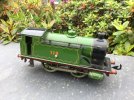
Unquestionably in original condition, painted at the Bing factory. So an uncatalogued model, as NER is not included in the list of liveries available in the catalogue entries for 112 tanks in 1921 or ‘22, when this model must have been made. I have also seen 112 tanks in black with double-red lining out. This too doesn’t correspond to any of the liveries listed in catalogues. I’m inclined to think the black-lined-red locos were intended to represent NER goods livery, though I would welcome other views on this!
Maybe, like me, Bassett-Lowke also thought the NER was under-represented in their range of models.
Martin
The pre-grouping models under consideration were all made prior to 1923. Model railways portraying former times were virtually unknown until relatively recently. The Bassett-Lowke catalogues regularly emphasised that the models offered were up-to-date and represented the latest developments on the real railways. It is clear ‘out-of-date’ models were hard or impossible to sell. For example, the model of Caledonian Railway no.142 produced at Northampton shortly before the grouping then stayed in the catalogues until c.1930. Clearly, a slow seller. In later years, the catalogue entry included the offer to repaint the model in LMS colours for an extra charge. It probably didn’t help that the models of CR no.142 made in Northampton did not look much like the real engine. The 1921/22 range of lithographed 0 gauge corridor coaches (made by Bing) consisted of brake/3rds and all-firsts in three liveries: GWR lake, LNWR and MR. After 1923, the unsold models in pre-grouping liveries were updated to reflect the latest position on the real railways. The Midland livery coaches had the ‘Midland’ wording below the cantrail painted over and transfers for ‘LMS’ applied in a waist panel. The obsolete GWR lake livery required a more drastic solution. The coaches were carefully over-painted green without covering details such as the doors to the gangways and hand-lettered for the Southern Railway. The price of the over-painted Southern coaches was higher than for the other post-grouping liveries offered. Nevertheless, Bassett-Lowke clearly took a commercial judgement that models in pre-grouping liveries would have been hard to sell post-1923.
In my posts #92 and #172, I looked at the range of 0 gauge tank locomotives Bassett-Lowke offered before and after WW1. In my post #388, I considered prototype selection for locomotive models in regard to practical considerations such as choosing prototypes with large boilers, so the models could accommodate standard clockwork and electric mechanisms.
But, as a business, above all, Bassett-Lowke needed to produce models that would sell. So, yes, an accurate model had to be technically feasible, but it also was going to have to be popular with customers. Market trends were not always correctly anticipated. The Gauge 2 versions in the pre-WW1 range of lithographed wagons clearly sold slowly. Even during the shortage of models for sale during WW1, the Gauge 2 tinplate wagons made before 1914 didn’t sell well. They were still in the Bassett-Lowke catalogues in the late 1920s — by then c.15 years old — being offered at reduced price and with the option of having them fitted with Gauge 1 wheel-sets at no extra charge.
To sell, potential customers needed to decide a model was both appealing and affordable. Part of the appeal was that Bassett-Lowke was producing ‘scale models’ of real locomotives (and coaches and wagons and lots else). Also, the concentration on models of the very latest, most well-known and up-to-date real locomotives. And models of locomotives and rolling stock from the leading and largest railway companies. A rough break-down of the pre-grouping tinplate models sold by Bassett-Lowke emphasises that some railway companies were strongly favoured over others.
In 0 gauge (and larger gauges), the LNWR was the best represented railway company. By miles. In 0 gauge, the only company to get a model goods loco. A Cauliflower 0-6-0, also made in Gauge 1. One of the five 0 gauge scale model tank locos was an LNW Precursor tank. The LNWR express locos offered in 0 gauge were Jubilee no.1902 Black Prince (live steam, Bing), George the Fifth plus Queen Mary (Bing) and no.513 Precursor. The model of no.513 offered in 0 gauge was made by Marklin and a ‘bought in’ model not exclusive to Bassett-Lowke, whereas the Gauge 1 model of no.513 was a Greenly design made by Bing. Further LNWR locos were made in the larger gauges including a Claughton (Gauge 1) and Bowen-Cooke 4-6-2T (Gauge 2). The post-WW1 range included five freelance design locos in LNWR livery. The ‘standard’ pre-WW1 mainline coaches — a 1st/3rd composite plus a full brake — made by Carette, were produced in LNWR livery in gauges 0, 1, 2 and 3. In gauges 0 and 1, shorter versions with opening doors were also listed. Also, even shorter, 6-wheelers. Two model coaches — a TPO and a 12-wheeled diner — were made in gauges 0 and 1 in LNWR only; there was no catering vehicle in other companies’ trains on Bassett-Lowke model railways, nor any postal services. Lithographed tinplate models of various types of LNWR NPCCS were offered, such as an OCT, CCT and horse box, but the tinplate range included no equivalent vehicles from other railway companies. Post-WW1, the new Bing-made corridor coaches were produced in LNWR livery in gauges 0 and 1. The LNWR-dominance amongst Bassett-Lowke models was repeated amongst the lithographed tinplate and wooden goods wagons. Pre-WW1, in addition to open wagons and goods vans which were made in versions representing many different companies’ vehicles, the only gunpowder van modelled was LNWR, also the only single-bolster wagons. Post-WW1, when the range was greatly reduced to only six lithographed tinplate wagons, three of these were LNWR (plus one MR, one GWR, one PO).
The impressive range of LNW models offered by Bassett-Lowke could well have been partly due to Bassett-Lowke being based in Northampton. But it must have been informed too by commercial reality. LNWR models clearly sold well. The LNWR was a major company covering a wide geographic area, so its trains were seen and used by millions.
No other railway company came close to the LNWR in terms of numbers of Bassett-Lowke models. Three other large companies were pretty well represented: the Midland, GWR and GNR. Coaches for all three were included in the pre-WW1 lithographed tinplate range made by Carette, the Midland, GWR and GNR in gauges 0, 1 and 2, the GWR additionally in Gauge 3. But there were no GWR 6-wheelers. Post-WW1, the Bassett-Lowke catalogue again included lithographed tinplate coaches for all three companies. The post-WW1 GWR and Midland coaches were made by Bing to a modern corridor design. The post-WW1 GNR coaches were produced at Northampton using bought in Marklin bodies married to Bing-made bogies using an adaptor plate to overcome the mismatch between the Bing bogie design and the Marklin bogie bearing. Pre-WW1, a variety of tinplate goods wagons were produced for the GWR, GNR and Midland, including goods brake vans for all three companies. There were two Midland 4-4-0s (one live steam) in the pre-WW1 0 gauge range. In Gauge 1, a Midland compound, an 0-6-0 goods locomotive, a Tilbury 4-4-2T and, post-WW1, a 2P. The 112 tank was made in MR livery, and the freelance Bing 4-4-0T and live-steam 4-4-0. The GNR was represented by a large-boilered Atlantic (gauges 0 and 1, clockwork, steam and electric), and various freelance models. In Gauges 1 and 2 there was the outstanding representation of the prototype N1 tank, in Gauge 1 also an Ivatt single. For the GWR, in 0 gauge pre-WW1, the first express loco produced was a model of Atbara class no.3410 Sydney (Bing), followed by a much better model of a ‘City’ (also made by Bing), replaced post-WW1 by a ‘County’ (made by the Leeds Model Co.). Sydney was also made in gauges 1 and 2. The pre-WW1 0 gauge range included a Birdcage tank. In gauges 1 and 2, a live steam 2-cylinder 4-6-0 was made, also a live steam County that was additionally produced in Gauge 3. The 112 tank and freelance 0 gauge 4-4-0T were sold in GWR colours amongst the many other liveries applied to these models.
Between c.1909 and 1923, a model railway representing the LNWR, GNR, GWR or Midland could be assembled from catalogued ready-to-run Bassett-Lowke models in at least gauges 0 and 1. It wasn’t possible to satisfactorily represent any other railway company using Bassett-Lowke standard models. Beyond the four railway companies just mentioned, the only tinplate coaches made were LSWR (gauges 0 and 1, pre-WW1) and NER (Gauge 3 only, pre-WW1). No lithographed tinplate goods brake vans were made for other companies. Undoubtedly, the huge number of different railway companies was a problem for model manufacturers. The production costs meant lithographed tinplate was only economic for making large quantities. Production by other methods was much more expensive per model. It was clearly Bassett-Lowke’s assessment that producing coaches or goods brakes for other railway companies was not commercially viable. The result was locomotives were offered that had nothing to pull, or not much. For the L&Y, the models offered pre-WW1 were a Hughes Dreadnought in Gauge 1 and an open wagon in gauges 0 and 1. There was an NER 0-4-4T in gauges 0 and 1, an NER trolley wagon in gauges 0, 1 and 2 and an NER 4-4-0 and tinplate coaches in Gauge 3 — but no other catalogued tinplate NER models. An SECR 4-4-0 In Gauge 1 but no SECR rolling stock. An LBSCR 4-4-2T but no coaches, just an open wagon in gauges 0 and 1. Successively, three different Caledonian Railway 4-4-0s and post-WW1 three freelance locomotive models in CR livery, but no coaches. I guess the CR and LBSCR locos were expected to pull LNWR stock. Pre-WW1, the only tinplate 0 gauge GCR, GER and NBR models made were open wagons. There were GCR locos in gauges 1 and 2, but not in 0 gauge. The post-WW1 Bing-made freelance 4-4-0T was offered in NBR livery — by which time the NBR open wagon was no longer made.
The concentration on four of the largest railway companies was I guess commercial pragmatism by Bassett-Lowke. Between them, the four companies had extensive geographical coverage. The companies chosen may reflect the economic centre of gravity of the time, where the spending power was for model purchases. Not the south east, but the industrial north of England. The choices may also reflect popularity amongst enthusiasts. Was the GWR especially favoured pre-WW1?
Relative to the importance of the real companies, I can’t help feeling the NER was under-represented in the Bassett-Lowke range.
I have to post a photo. As per comments above, one of the many liveries listed in catalogues for the 112 tank model was GNR. And indeed, 112 tanks in GNR colours turn up fairly frequently. The 112 tank shown below was offered in an auction a few years ago described as a GNR example. Not in especially good condition, though respectable, it wasn’t going to attract much interest. I bought it, and at a favourable price. The reason I bought it was the livery. It’s not GNR, but NER green:
Unquestionably in original condition, painted at the Bing factory. So an uncatalogued model, as NER is not included in the list of liveries available in the catalogue entries for 112 tanks in 1921 or ‘22, when this model must have been made. I have also seen 112 tanks in black with double-red lining out. This too doesn’t correspond to any of the liveries listed in catalogues. I’m inclined to think the black-lined-red locos were intended to represent NER goods livery, though I would welcome other views on this!
Maybe, like me, Bassett-Lowke also thought the NER was under-represented in their range of models.
Martin
Last edited:

simond
Western Thunderer
It is interesting to reflect on the similarities between “then” and now.
There are clearly a few voices bemoaning the ubiquitous presence of GWR models nowadays which obviously contrasts with the preponderance of LNWR a century ago. And the recent announcement by Heljan that they are moving to a pre-order business model, and Hornby’s financial woes, suggest that the difficulties of producing a model that was “both appealing and affordable” has perhaps not changed much over the years.
Despite a more prosperous and much more numerous* society, toy trains are never going to be the priority purchase. And with a lot more alternatives nowadays, I’m sure it’s a difficult business.
* 1925 average annual pay in region of £250, GB population ca 44M, today around £40k & 69M.
best
Simon
There are clearly a few voices bemoaning the ubiquitous presence of GWR models nowadays which obviously contrasts with the preponderance of LNWR a century ago. And the recent announcement by Heljan that they are moving to a pre-order business model, and Hornby’s financial woes, suggest that the difficulties of producing a model that was “both appealing and affordable” has perhaps not changed much over the years.
Despite a more prosperous and much more numerous* society, toy trains are never going to be the priority purchase. And with a lot more alternatives nowadays, I’m sure it’s a difficult business.
* 1925 average annual pay in region of £250, GB population ca 44M, today around £40k & 69M.
best
Simon
Last edited:

James Spooner
Western Thunderer
An interesting discussion and I take points from both Martin and Simon. Any manufacturer has to gain confidence that whatever is designed and produced will sell in sufficient quantities to cover the initial tooling as well as the cost of producing the overall production run. As true a hundred years ago as today. What I find interesting is that a hundred years ago, the LNWR was deemed the most production worthy line but, post WW2, that switched to the GWR, despite the LMS being even larger than the LNWR. I wonder whether that is, in part due to fond memories of holidays in the West Country, or possibly due partly to Sydney Pritchard (who was an excellent publicist) basing his business, and the Railway Modeller, in Devon.
Nigel
Nigel
Hi NigelAn interesting discussion and I take points from both Martin and Simon. Any manufacturer has to gain confidence that whatever is designed and produced will sell in sufficient quantities to cover the initial tooling as well as the cost of producing the overall production run. As true a hundred years ago as today. What I find interesting is that a hundred years ago, the LNWR was deemed the most production worthy line but, post WW2, that switched to the GWR, despite the LMS being even larger than the LNWR. I wonder whether that is, in part due to fond memories of holidays in the West Country, or possibly due partly to Sydney Pritchard (who was an excellent publicist) basing his business, and the Railway Modeller, in Devon.
Nigel
I really don’t know how or when the GWR gained its apparent posthumous popularity.
In respect of making generalisations, Bassett-Lowke was just one company, albeit a pre-eminent one. Generalising from a sample of one is not ideal. The choice of models will have been influenced by saleability, suitability for use on small radius tinplate track, room for the motor etc. And possibly the personal preferences of Mr Bassett-Lowke and/or model designer Henry Greenly. Greenly’s father was a GWR employee, so he could easily have had a personal preference for the GWR.
A to some extent independent test would be to look at another major manufacturer’s contemporary models. I say ‘to some extent independent’ because copying other companies’ products was common. Equally, a manufacturer might decide to make something different rather than go head-to-head with a model of the same locomotive. Bassett-Lowke did include some Marklin models in its catalogue and much later, in the 1930s, commissioned Marklin to make some locomotives on an exclusive basis. But before and after WW1, Bassett-Lowke’s German manufacturing links were overwhelmingly with Bing and Carette. Marklin’s pre-grouping era British-outline trains were retailed principally by Gamages and were in direct competition with Bassett-Lowke’s range. The London shops weren’t even that far apart. The Marklin for Gamages range of lithographed tinplate coaches and wagons was much less comprehensive than Bassett-Lowke’s. Marklin produced a 1st/3rd composite and a full parcels brake in gauges 0 and 1 in the style of three railway companies: LNWR, GNR and Midland. Tinplate Pullman cars were also made, but these were painted and transferred, not lithographed. The Marklin lithographed coaches look very similar to the equivalent Carette-made vehicles in the Bassett-Lowke range. There were only ten Marklin lithographed tinplate goods wagon models (compared with about 50 different wagons in the Bassett-Lowke range) all made in gauges 0 and 1. Marklin’s wagon models were five from the Midland and five from the GNR, including a goods brake van for both companies. I would comment that the construction of the Marklin wagons, and their excellent lithography, was very similar to Bassett-Lowke’s offerings. Note, however, no LNWR goods vehicles in the Marklin range, and no GWR or other companies’ rolling stock of any kind (except the Pullmans). Marklin’s locomotive models were also confined to gauges 0 and 1. There were five LNWR locomotives made, all offered in both gauges and some in live-steam versions; Precursor, George the Fifth, Precursor tank, Experiment and Bowen-Cooke tank. Note that Marklin had an 0 gauge standard 6-coupled mechanism in production much earlier than Bing. It wasn’t used though in Marklin’s model of a Midland Flatiron as this was arranged as a 2-4-4 to get it round standard radius curved track. Marklin, like Bing-for-Bassett-Lowke, made a GNR Atlantic and a Midland 999. And like most of Bing’s models for Bassett-Lowke, Marklin locomotives were of soldered construction and hand-painted as standard. However, a cheaper, lithographed, 4-4-0 was made by Marklin in GNR and Midland colours. Marklin also made a soldered-construction freelance 0-6-0T given a variety of liveries (I have even seen GER in dark blue). Also like Bassett-Lowke, there were locomotives made for other companies: an LBSCR 4-4-2T and later 4-6-4T, a Gauge 1 LSWR Paddle-box, an NBR Atlantic and, in Gauge 1 only, ‘The Great Bear’ for the GWR.
Despite the lack of goods wagons, the LNWR was very well represented in the Marklin range. The biggest difference from the mix of models offered by Bassett-Lowke was in respect of the GWR. In the pre-grouping Bassett-Lowke range, the GWR was one of ‘the big four’ companies. In the Marklin for Gamages range, the GWR was an also ran.
A couple of other points about the GWR representation in the Bassett-Lowke range. In the mid-1920s, Bassett-Lowke introduced a series of 2-6-0 models, in 0 gauge one model for each of the four principal railway companies. There is no question that the LMS and LNER versions are far more common today than the GWR and SR models. I recall an exchange of letters in the Model Railway News shortly after the mogul models were launched. An enthusiast complaining about the lack of GWR models being offered by the trade. A response from Mr Bassett-Lowke complaining that they had introduced a model of a GWR 2-6-0 but it had sold very poorly compared with the LNER and LMS mogul models. A further response from the original complainant suggesting that the low sales figures for the Bassett-Lowke GWR mogul were not because it was a GWR loco — but because it was a terrible model. (It was indeed awful).
The GWR was distinctly under-represented in the 1930s Bassett-Lowke range. As a rough estimate, maybe about half of all the locomotive models in the late ‘30s catalogues were LMS. By this date, the prototypical goods locos (Cauliflower and later a 4F and J39) had been dropped from the range. Instead, there was a freelance 0-6-0 and 0-6-0T. These were lithographed tinplate. The 0-6-0 was printed black with red lining and given an LMS or LNER identity using transfers for the company initials and number (also a different chimney, to suit the company). The 0-6-0T was made similarly in LMS and LNER versions. But also in an SR version with green lining in place of the red and the company name and running number included in the litho printing. These were freelance models but could pass for locomotives of the respective companies. What they could not do was look like a GWR loco. So there were no GWR versions. After WW2, with a reduced range, there were no GWR models offered at all in the Bassett-Lowke catalogues except for the staggeringly expensive hand-built locos made to order.
Martin
Last edited:
Speaking for my generation at least, and for the latter part of my childhood at one remove in the colonies, I think some important influences in "bigging up" the GWR posthumously were (in no particular order):
-The unique corporate identification of Duck and latterly Oliver in the Rev W Awdry railway series, making the GWR the only in-your-face pre-nationalisation railway to generations of toddlers, featuring Duck's incessant, profligate and wanton boosterism for the GWR, * until the Fat Controller has to stage an intervention and put him and Oliver on a branch line with their like-minded friends, to keep them away from all the normal rolling stock who cheerfully accept the Sodor corporate identity.
-Appearance of City of Truro as a working preservation engine in the same period -1960s- and portrayal (or as we would say today, cross-promotion) in said books.
-Triang Lord of the Isles at same time and interest in Victorian revival over the same period, where it was probably the only Victorian era toy train about.
-Early 1970s Hornby adverts featuring pannier tanks.
-The Railway Children film release.
Thoughts?
*It would be ironic if the Rev had been taking the mickey of GWR aficionados at the time.
-The unique corporate identification of Duck and latterly Oliver in the Rev W Awdry railway series, making the GWR the only in-your-face pre-nationalisation railway to generations of toddlers, featuring Duck's incessant, profligate and wanton boosterism for the GWR, * until the Fat Controller has to stage an intervention and put him and Oliver on a branch line with their like-minded friends, to keep them away from all the normal rolling stock who cheerfully accept the Sodor corporate identity.
-Appearance of City of Truro as a working preservation engine in the same period -1960s- and portrayal (or as we would say today, cross-promotion) in said books.
-Triang Lord of the Isles at same time and interest in Victorian revival over the same period, where it was probably the only Victorian era toy train about.
-Early 1970s Hornby adverts featuring pannier tanks.
-The Railway Children film release.
Thoughts?
*It would be ironic if the Rev had been taking the mickey of GWR aficionados at the time.
simond
Western Thunderer
I can’t say that any of those points consciously influenced my interests. Although a year or two older than me, Duck et al did not figure in my recollections until reading the series with my own kids. I do remember the TriAng LotI. Never had one, though I did have a few c&c clerestories.
I think personally, it was much more to do with the popularity in RM - at 11 or 12 I was given a huge box of magazines by a schoolmate whose dad had died - and the GW BLT was already ubiquitous - one in every issue! Possibly something to do with Prichard & Freezer, though the latter’s interests were obviously catholic. A Christmas brought a book, one of Tustin’s, which described GW locos in Birkenhead (where I grew up) and I suspect these factors were key. I also recall an RM article showing an enormous 4mm layout depicting the 4-track main line along the Mersey to Woodside and the docks. Of such delights are schoolboy’s dreams made…
I think personally, it was much more to do with the popularity in RM - at 11 or 12 I was given a huge box of magazines by a schoolmate whose dad had died - and the GW BLT was already ubiquitous - one in every issue! Possibly something to do with Prichard & Freezer, though the latter’s interests were obviously catholic. A Christmas brought a book, one of Tustin’s, which described GW locos in Birkenhead (where I grew up) and I suspect these factors were key. I also recall an RM article showing an enormous 4mm layout depicting the 4-track main line along the Mersey to Woodside and the docks. Of such delights are schoolboy’s dreams made…

simond
Western Thunderer
That was undoubtedly a factor when it came to building brass kits!I always thought modellers in the 1970s favoured the GWR because the locos had simple outside motion. This was good for affordable products like Tri-ang Hornby too. The 1970s being when I started.
John R Smith
Western Thunderer
Martin
To drag this interesting debate just slightly back in the direction of Bassett-Lowke. Your comment caught my eye -
It would seem that this series of engines used a six-coupled mechanism for the clockwork versions that is rather different from the two that I am already familiar with (specifically the six-coupled motor as used in the 0-6-0 tank and Standard Goods and the more sophisticated six-coupled motor as used in the "Scotsman" and "Royal Scot" etc). I recently got interested in one of the SR versions of the 2-6-0, similar to this -
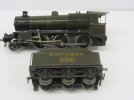
This one is electric, but the one I am looking at is clockwork. The motor has a very broad spring, and the winder is on the right-hand side of the engine, which is unusual for B-L. Looking at photos of the mech, I think I can see something odd -
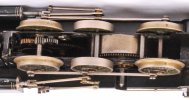
It looks as if the ratchet (?) is immediately behind the winder, in between the centre and rear drivers and on the outside of the frames rather than inside. Is this correct, or am I imagining it? And do you have any experience with these clockwork 2-6-0s?
Sorry to pick your brains yet again!
John
To drag this interesting debate just slightly back in the direction of Bassett-Lowke. Your comment caught my eye -
In the mid-1920s, Bassett-Lowke introduced a series of 2-6-0 models, in 0 gauge one model for each of the four principal railway companies. There is no question that the LMS and LNER versions are far more common today than the GWR and SR models.
It would seem that this series of engines used a six-coupled mechanism for the clockwork versions that is rather different from the two that I am already familiar with (specifically the six-coupled motor as used in the 0-6-0 tank and Standard Goods and the more sophisticated six-coupled motor as used in the "Scotsman" and "Royal Scot" etc). I recently got interested in one of the SR versions of the 2-6-0, similar to this -
This one is electric, but the one I am looking at is clockwork. The motor has a very broad spring, and the winder is on the right-hand side of the engine, which is unusual for B-L. Looking at photos of the mech, I think I can see something odd -
It looks as if the ratchet (?) is immediately behind the winder, in between the centre and rear drivers and on the outside of the frames rather than inside. Is this correct, or am I imagining it? And do you have any experience with these clockwork 2-6-0s?
Sorry to pick your brains yet again!
John
The early moguls have Bing motors. After the Royal Scot was introduced, its mechanism (made in Northampton) was used in the moguls too. So the key-hole on the moguls changed sides.Martin
To drag this interesting debate just slightly back in the direction of Bassett-Lowke. Your comment caught my eye -
It would seem that this series of engines used a six-coupled mechanism for the clockwork versions that is rather different from the two that I am already familiar with (specifically the six-coupled motor as used in the 0-6-0 tank and Standard Goods and the more sophisticated six-coupled motor as used in the "Scotsman" and "Royal Scot" etc). I recently got interested in one of the SR versions of the 2-6-0, similar to this -
View attachment 257120
This one is electric, but the one I am looking at is clockwork. The motor has a very broad spring, and the winder is on the right-hand side of the engine, which is unusual for B-L. Looking at photos of the mech, I think I can see something odd -
View attachment 257125
It looks as if the ratchet (?) is immediately behind the winder, in between the centre and rear drivers and on the outside of the frames rather than inside. Is this correct, or am I imagining it? And do you have any experience with these clockwork 2-6-0s?
Sorry to pick your brains yet again!
John
The 4F and J39 0-6-0 models introduced shortly after the moguls, and sharing many components with them, also had the same Bing motors. When the Royal Scot motor was adopted across the range for 6-coupled locos, the 4F was no longer offered in clockwork, as the Northampton made motor wouldn’t fit. (The 6-coupled version of the B-L standard 4-coupled mech only came later). The 4F didn’t last long as an ‘electric only’ model. Very unusual for a loco to be offered with no clockwork version. The J39 continued for years (until c.1934?) using the Royal Scot mech in the clockwork version.
I would comment that the moguls and J39 and 4F have quite a different character to the earlier Bing models and later Northampton production. They are over-scale with extremely broad wheels and scant detailing, much of it crude. The moguls are absurdly wide with the robust valve gear designed for the live-steam versions. Approximately 75 mm over the valve gear — so watch your platforms.
Martin
Last edited:
John R Smith
Western Thunderer
I would comment that the moguls and J39 and 4F have quite a different character to the earlier Bing models and later Northampton production. They are over-scale with extremely broad wheels and scant detailing, much of it crude. The moguls are absurdly wide with the robust valve gear designed for the live-steam versions. Approximately 75 mm over the valve gear — so watch your platforms.
I think that you have just put me right off! So we will forget that particular plan and save some money . . .
Many thanks, Martin
John
Sorry!I think that you have just put me right off! So we will forget that particular plan and save some money . . .
Many thanks, Martin
John
The SR mogul, introduced a year later than the other three, is probably the best model of the original four designs. But undeniably, the valve gear is well outside the scale loading gauge on all the moguls until the Royal Scot type valve gear was substituted on clockwork and electric versions of the LMS and LNER models just before WW2.
Martin

AJC
Western Thunderer
An interesting discussion and I take points from both Martin and Simon. Any manufacturer has to gain confidence that whatever is designed and produced will sell in sufficient quantities to cover the initial tooling as well as the cost of producing the overall production run. As true a hundred years ago as today. What I find interesting is that a hundred years ago, the LNWR was deemed the most production worthy line but, post WW2, that switched to the GWR, despite the LMS being even larger than the LNWR. I wonder whether that is, in part due to fond memories of holidays in the West Country, or possibly due partly to Sydney Pritchard (who was an excellent publicist) basing his business, and the Railway Modeller, in Devon.
Nigel
Maybe as simple as Northampton being LNWR territory?
I'm sure that the GWR was partly luck - in 4mm, anyway, two of K's earliest kits were for the 14xx and the Dean Goods. Freezer liked the GWR and so... in any event, it covered a very large area and had a fairly consistent brand image and loco policy. Ditto the LNWR. Ditto the Midland, too. Dad recalls the Plymouth club in the '70s as being pretty much all pre-war GWR: readily available in various forms, regionally specific. Ok, that wasn't what he did and that undoubtedly influenced the kind of modeller he is, but that's a rather different point.
Adam
Hi PieterSpeaking for my generation at least, and for the latter part of my childhood at one remove in the colonies, I think some important influences in "bigging up" the GWR posthumously were (in no particular order):
-The unique corporate identification of Duck and latterly Oliver in the Rev W Awdry railway series, making the GWR the only in-your-face pre-nationalisation railway to generations of toddlers, featuring Duck's incessant, profligate and wanton boosterism for the GWR, * until the Fat Controller has to stage an intervention and put him and Oliver on a branch line with their like-minded friends, to keep them away from all the normal rolling stock who cheerfully accept the Sodor corporate identity.
-Appearance of City of Truro as a working preservation engine in the same period -1960s- and portrayal (or as we would say today, cross-promotion) in said books.
-Triang Lord of the Isles at same time and interest in Victorian revival over the same period, where it was probably the only Victorian era toy train about.
-Early 1970s Hornby adverts featuring pannier tanks.
-The Railway Children film release.
Thoughts?
*It would be ironic if the Rev had been taking the mickey of GWR aficionados at the time.
Your various suggestions might have contributed, but …
City of Truro was not the only Victorian/early 20th century loco returned to use c.1960. Most of the locos so treated were Scottish — C.R. 123, Jones’ goods, GNSR 4-4-0, NBR Glen.
The Triang Lord of the Isles had a sister model, C.R.123.
The 57XX did have a prominent role in ‘The Railway Children’, but in a fictitious livery. Only a tiny fraction of the audience would have known the 57XX to be GWR in origin. There is nothing else GW about the film, explicitly set in Yorkshire and filmed there.
When I had the Rev Awdry’s books read to me, Duck hadn’t been invented. I think the rise in GW modelling pre-dates any possible influence of Duck.
Martin

Roger Pound
Western Thunderer
If I may add a further point about the 'GWR Syndrome' of the fifties and onwards, many of my contemporaries became bored with the RM's constant pursuit of GWR Branch line layouts and GWR style 'Plans of the Month'. Being in the East Midlands then, GWR locos were rare beasts - one could see the odd 'Hall' on the former GCR from time to time but that was about all. My own interests were more LMSR and LNER influenced. Any ideas of modelling the GWR that I could have had were killed stone dead by very uninspiring journeys, rather regularly, on that system on the several occasions I had to use it.
May I thank you once more for your further detailed notes on the products of Bassett Lowke and their associates - most enlightening.
Roger.
May I thank you once more for your further detailed notes on the products of Bassett Lowke and their associates - most enlightening.
Roger.
John R Smith
Western Thunderer
Maybe as simple as Northampton being LNWR territory?
The LNWR at Castle Station was not the only railway company to serve Northampton. St John's Street Station opened in 1872 and was the terminus of the Midland Railway branch to Bedford. My maternal grandfather used this station in the early 1900s when he was working at Bassett-Lowke, to pay court to my grandmother Elizabeth Norman, who was then living at 22 Vulcan Street, Bedford. This was the family home, presided over by my Grandfather's future mother-in-law -
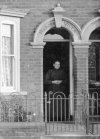
Eliza Norman, a fearsome lady, who would have kept a strict eye on the young lovers in the front parlour!
John