The Heybridge Railway, 1889 to 1913

>> Four years on

RichardG

Western Thunderer
I am less happy to realise I haven’t built a wagon for over a year, yet I have five unbuilt kits to choose from. I also want to extend “Heybridge Basin” and give it a cassette-based fiddle yard.

I have posted reviews of progress at the anniversaries of the Heybridge Railway project getting underway in October 2021. This year I forgot so I am stretching “Year Four” through to December. Future reviews can be at Christmas time too.
DSC_1502.jpeg
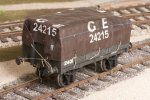
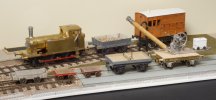
I have these items of new stock to show for Year Four. This doesn't seem very much for 15 month's effort, though I refurbished two wagons built by others and painted Nellie the crane tank along the way. The horse box (Gladiator) was quite involved - about half of the detail parts need to be fabricated by the modeller. The H2 in comparison (Connoisseur) was a complete kit.
DSC_1387.jpeg
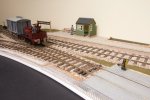
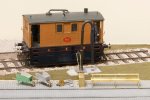
‘Heybridge Basin’ now has a fiddle yard and a lighting rig; also some scenic models ready for painting. I disposed of the first water column and made a better one to replace it. The scratchbuilt C53 is from Peter Thompson.

DSC_1466.jpeg
The running-in board is now at the correct end of the station, and set forward to reduce shadows onto the backdrop. The backdrop board is still in gloss magnolia, so if I can control shadows on this then I should be okay when it carries a backscene. The challenge with this layout, and one which I keep putting off, is to finish it off while keeping a bare and open appearance.

The most glaring omissions from the project are still some wagons for use by E H Bentall for their agricultural products and cars; and indeed a sample Bentall car. If I can apply myself to these, I expect I will be happy with the results. The difficulty is making a start. A GER brake van has been on the list of “essentials” since the project began too.

The models which give me the most pleasure are the ones from kits where I have added details of my own design, and the ones built by others which I have refurbished. The rail clamps on the mobile crane are a sort of modelling where I am especially happy with the result. I am making things from raw materials, the models are indicative but not really scale models, and I am working up a simple kit in my own way.

The stash of unbuilt kits is now down to nine wagons and one loco, and there is a year to wait for Kempton. This show is my greatest risk of impulse-buying. The plan for 2026 is to try to alternate between the kits I want to build as designed, and those I expect to alter and build my own way. It would also be good to improve the fiddle yard, this needs some shelves to hold cassettes to make it more workable.
 

RichardG

Western Thunderer
This year I have built most of the wagons the railway needs for its service trains. I will pass on something to carry 40 ft lengths of rail because it will dwarf the layout, so this leaves only a second brake van to build, something like the one preserved at the Middy. This can wait a while.

I have neglected the wagons to carry the products of E H Bentall because it has taken me ages to get my head around what they should be. I think the solution has to be five-fold:

1 Agricultural implements and motor cars shipped to Heybridge Basin for export
(a) Open wagons belonging to the railway​
(b) Some kind of flat wagon pressed into use as a carriage truck, crane-loaded​

2 Agricultural implements despatched to Witham for onward distribution throughout Great Britain
Open wagons belonging to the GER​

3 Motor cars despatched to Witham for collection by Glover's, the agent of E H Bentall
Carriage trucks belonging to the GER​

4 Product samples (including a motor car) carried in the E H Bentall exhibition train
(a) An open wagon​
(b) A flat wagon or carriage truck​
(c) A coach​
all privately owned and belonging to E H Bentall​

5 Motor cars being returned to the manufacturer for repairs
Carriage trucks belonging to the GER and other railways​
So . . .

DSC_8407.jpeg
This Dapol wagon (which happens to be the very first 7mm wagon I bought) can satisfy 1(a) and 4(a). A second wagon, something older would be good for the internal traffic.

DSC_1521.jpeg
This model by Peter Thompson addresses item 2 and saves me making the implements for a while.

The GER carriage truck item 3 needs to be scratchbuilt, so I may as well put this off as long as I can in case a model turns up on the market or I feel inspired to try. Carriage trucks from other foreign railways can be had as kits, though I will need a fresh explanation if they appear at Heybridge Basin.

The exhibition train really needs dedicated wagons, so the railway can still function when the train is on tour. Nevertheless, some kind of flat wagon of a standard able to travel on the network as well as within the confines of the railway would fill a large gap in the current fleet of rolling stock.

I don't write much about what I intend to do because it causes confusion and back-tracking if I do something else, but some gestures towards the Bentall traffic would be good for next year.
 
RCH flat wagon (1887 on) . . chassis and deck

RichardG

Western Thunderer
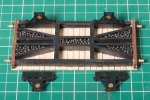
Having bought a catering pack of coffee stirrers for the mobile crane, I want to try another model where I can use them to some effect. The new model is a flat wagon, there is no specific prototype but the underframe is a standard Charles Roberts one from Slater’s. I imagine E H Bentall bought a damaged wagon secondhand and stripped it down to the floor. So this is a private owner wagon, as distinct from the stock of the Heybridge Railway.

DSC_1523.jpeg
The Slater’s underframe parts are curious for plastic mouldings because they don’t align properly all the way round. I put styrene shims in three out of four corners.

DSC_1524.jpeg
I am using Revell ‘Contacta Professional’, this softens the Slater's parts enough to let the plastic flow into the wood grain and then set. I think the Contacta is a bit more aggressive than the usual Plastic Weld and Mek-Pak.

DSC_1530.jpeg
There is a feel good factor here, though soon to be removed by adding ballast weight.

DSC_1542.jpeg
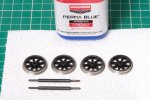
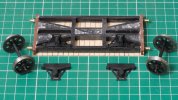
This time I pulled the wheels off their axles. Blackened the axles (heat to cherry red then quench in cooking oil) and cold blued the sides of the tyres.

DSC_1538.jpeg
The W irons don’t fit properly either - they are too close together. I countersunk the bearings into the mouldings but next time (if I remember!) it would be better to set the solebars further apart.

DSC_1546.jpeg
The lead shot is fixed with CA glue and then encapuslated in epoxy glue, this filed flat to neaten things up a bit.

I want to try painting this underframe before I add the second pair of W irons and the wheels, because I think the masking will be a lot easier.

This is an implement wagon (unfitted) not a carriage truck (fitted). So it can be a match truck with the mobile crane, or marshalled next to open wagons carrying long lengths of timber; or it can carry motor cars within the confines of the Heybridge Railway(*). But it cannot form a part of the Bentall’s exhibition train, which needs to be fitted throughout.

(*) This wagon could carry motor cars further afield, but this would leave the railway unable to use it. So I think it is internal use only.
 
Last edited:

RichardG

Western Thunderer
This is an implement wagon (unfitted) not a carriage truck (fitted) . . .

Thinking more carefully about this flat wagon, few of the wagons belonging to the Heybridge Railway would been fit to travel on the rest of the railway network. E H Bentall would have needed to dispatch completed motor cars, and to recover any cars needing major repairs or alterations; and there is no guarantee the GER were able to provide an implement wagon (or a carriage truck) at short notice.

No-one ever saw or recorded a wagon belonging to the Heybridge Railway, because the railway never existed. I doubt if E H Bentall ever owned any wagons (they had no railhead) but somehow I find a fictional PO wagon to be much more "historically believable".

So I envisage this model to represent a wagon belonging to E H Bentall, used to carry motor cars. Traffic will be from their works in Heybridge to Witham (the location of their agent, Glover's) and to Heybridge Basin (for export).

This is an implement wagon (unfitted) so it cannot form a part of Bentall’s exhibition train (a future project). This carried passengers and needs to be fitted throughout. The wagon might find itself pressed into use for other purposes on the railway (e.g. as a match truck), but these uses will be of a secondary nature.

I think this makes more sense.
 

RichardG

Western Thunderer
The models which give me the most pleasure are the ones from kits where I have added details of my own design, and the ones built by others which I have refurbished. The rail clamps on the mobile crane are a sort of modelling where I am especially happy with the result. I am making things from raw materials, the models are indicative but not really scale models, and I am working up a simple kit in my own way.

I am waiting for paint to dry so here are some more thoughts as a supplement to my review of 2025 . . .

From time to time, I read through and refine my plans for locomotives and rolling stock to appear on the Heybridge Railway. Because the entire railway is a might-have-been (in contrast to a fresh branch line extending an existing railway company), I have two sensible choices for items belonging to the railway:
  • items sold by their original (real) owners, bought and possibly refurbished or modified by the railway
  • items of my own (fictitious) design
Because I like making things, I am happy enough with both as long as the result looks plausible.

As the project continues, the first subject where I have run out of ideas is private owner wagons. With the navigation carrying the bulk of the coal, lime and timber, there isn’t much scope for loads that the railway itself or the adjoining GER could refuse to convey in their own wagons. Really, it is not surprising I have managed only two tar wagons (plus this flat wagon) so far.

As far as I can make out (happy to be corrected), the pre-grouping railway managed to function and prosper by allowing wagonload freight to make its entire journey without transhipment. This certainly makes sense for coal, building materials and livestock. Transhipment being reserved for “smalls”, catered for by a relatively small number of strategically located sorting centres – much like the operations of present-day parcel couriers. So I can expect to see ‘foreign’ wagons on my layout, and these may have come from hundreds of miles away. Examples are urgent spares for a sea-going vessel from Scotland, or steel girders from South Wales. Good!

My main constraint is, in these times before pooling the foreign wagons had to return empty unless a convenient cargo was by chance to hand. My wagon loads have to be removable.

Setting the project in GER territory has let me source half a dozen wagons from kits and built by others. These sources are drying up (I have two GER kits left to build) so I have got to start thinking about scratch building. This is going to be a bit of a challenge if I want to make models to stand up against what I managed so far.

In the meantime, I have a few unbuilt kits for other foreign wagons too, so I can defer the scratch building for quite a while! I expect I will enjoy it when the time comes :)
 
Painting scenic models . . bench seat

RichardG

Western Thunderer
. . .

View attachment 250598
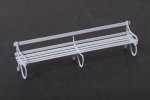
I have ended up with one of those rather uncomfortable seats with a gap in the back.

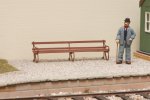
Those who know Heybridge Basin will understand why the seat goes here, it is sheltered from the blasts of easterly winds.

The bench seat is my first model to finish for 2026.

I have discovered, I can spray primer from rattle cans in the bathroom. I am working inside a large carton to contain the overspray.

DSC_1549.jpeg
The stench lingers for an hour or more after painting a tiny model like this, but I can keep it out of the rest of the house by closing the bathroom door. Other uses of the room must be planned.

DSC_1552.jpeg
As far as I can make out, the business of fixing these down is a 20th century practice. This one can stay loose for the time being.

This looks so much better than a plastic moulding! This particular model really underlines why I am so happy in 7mm scale - I could not cope with assembling something similar in a smaller scale.

Happy New Year to everyone.
 

spikey faz

Western Thunderer
The bench seat is my first model to finish for 2026.

I have discovered, I can spray primer from rattle cans in the bathroom. I am working inside a large carton to contain the overspray.

View attachment 254382
The stench lingers for an hour or more after painting a tiny model like this, but I can keep it out of the rest of the house by closing the bathroom door. Other uses of the room must be planned.

View attachment 254381
As far as I can make out, the business of fixing these down is a 20th century practice. This one can stay loose for the time being.

This looks so much better than a plastic moulding! This particular model really underlines why I am so happy in 7mm scale - I could not cope with assembling something similar in a smaller scale.

Happy New Year to everyone.
Happy New Year Richard. :)
 

Ian@StEnochs

Western Thunderer
The bench seat is my first model to finish for 2026.

I have discovered, I can spray primer from rattle cans in the bathroom. I am working inside a large carton to contain the overspray.

View attachment 254382
The stench lingers for an hour or more after painting a tiny model like this, but I can keep it out of the rest of the house by closing the bathroom door. Other uses of the room must be planned.

View attachment 254381
As far as I can make out, the business of fixing these down is a 20th century practice. This one can stay loose for the time being.

This looks so much better than a plastic moulding! This particular model really underlines why I am so happy in 7mm scale - I could not cope with assembling something similar in a smaller scale.

Happy New Year to everyone.

My wife says the bathroom is the only room in which I don’t have some railway things!

Happy New Year, lang may your lum reek.

Ian
 

RichardG

Western Thunderer
Happy New Year, lang may your lum reek.
Marion (born in Fife) tells me, party guests used to take along a lump of coal, especially at New Year.

The really important thing I have learnt about using aerosols indoors is to discharge the can to clear the nozzle inside the carton used for painting. Do not (ever) use an open window, because tiny droplets will find their way onto the car, and (certainly in the case of a 2005 MX-5), they are a pig to remove. In fact, I am sure some of them stayed until I said goodbye to the car.

The bathroom approach seems to be working. The fumes from Halford's grey primer and their gloss car paint are pretty low. It is the acid etch primer which really stinks, even in small doses.
 

spikey faz

Western Thunderer
Marion (born in Fife) tells me, party guests used to take along a lump of coal, especially at New Year.

The really important thing I have learnt about using aerosols indoors is to discharge the can to clear the nozzle inside the carton used for painting. Do not (ever) use an open window, because tiny droplets will find their way onto the car, and (certainly in the case of a 2005 MX-5), they are a pig to remove. In fact, I am sure some of them stayed until I said goodbye to the car.

The bathroom approach seems to be working. The fumes from Halford's grey primer and their gloss car paint are pretty low. It is the acid etch primer which really stinks, even in small doses.
I have been known to venture up into our loft to wreak havoc with aerosols. Otherwise it's off to the shed and stick the heater on. Commence spraying with the door eide open and heater off.

Mike
 

Ian@StEnochs

Western Thunderer
Marion (born in Fife) tells me, party guests used to take along a lump of coal, especially at New Year.

Here in Ayrshire, it was traditional for the ‘First Foot‘ arriving just after the bells, to bring something to eat, something to drink and something to heat . Black bun, a very rich fruitcake baked inside a pastry case, Whisky and Coal were the norm when I was a boy but alas the custom has mostly died out.

Ian.
 

simond

Western Thunderer
“First footing”

given my dad was Irish and my mum was from Wallasey, I have no idea why I know that.

but it was much appreciated by my Scots neighbour…
 

JimG

Western Thunderer
Here in Ayrshire, it was traditional for the ‘First Foot‘ arriving just after the bells, to bring something to eat, something to drink and something to heat . Black bun, a very rich fruitcake baked inside a pastry case, Whisky and Coal were the norm when I was a boy but alas the custom has mostly died out.
On Clydeside it was preferred if your first foot had dark or black hair. I had jet black hair inherited from my mother and her side of the family, so was welcomed as a first foot with my lump of coal and a bottle of whisky in my back pocket. Was just thinking about first footing the other night.

Jim.
 

RichardG

Western Thunderer
Or perhaps worked in the pits where copious quantities of coal were part of a miners wages!

I asked Marion, her father was a miner at Wellwood near Dunfermline. Coal was not included in the wages, but the miners would take a little coal to give to families where the miner had had an accident and was unable to go to work. Or worse, if a miner had been killed at work and his wife and family had to be out of the mine's house within a week. This would have been during the 1930s.

Marion knows the saying as, "lang may your lum reek whenever folks call".
 

Ian@StEnochs

Western Thunderer
I asked Marion, her father was a miner at Wellwood near Dunfermline. Coal was not included in the wages, but the miners would take a little coal to give to families where the miner had had an accident and was unable to go to work. Or worse, if a miner had been killed at work and his wife and family had to be out of the mine's house within a week. This would have been during the 1930s.

Marion knows the saying as, "lang may your lum reek whenever folks call".

I spent my teen years in a mining village although my dad was not employed in the pits. The miners coal, loose, was dropped on the pavement and had to be barrowed round the back to the bunkers. Scout Bob a Job week inevitably meant shoveling coal for me until I became a bit selective in which houses to seek a bob.
 
. . ground frame

RichardG

Western Thunderer
DSC_1163.jpeg

So, a simplified model. I have my doubts about the longevity of the levers. Nickel silver would be stiffer.

I have painted the lever frame I built two months ago.

DSC_1572.jpeg
The lever frame has gained a nut as a spacer between the levers. The levers still move, I think this is sensible for when someone tries to move them.

DSC_1577.jpeg
I remember studying the levers to see which way round they should go. I still got the blue one back to front.

I know I will make this sort of mistake again, however hard I try. The best solution I can think of is to take photos earlier on, just to check things. I doubt a magnifying glass would let me “see” the problem.

DSC_1582.jpeg
Still, the model has a reasonably "scale” look to it and, in spite of my fairly drastic alterations, I am very grateful to Model Signal Engineering for making the kit available to buy.
 
. . point indicator

RichardG

Western Thunderer
DSC_1203.jpeg

Posed over a convenient hole in the baseboard.

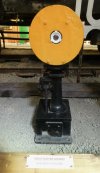
Mangapps museum have one of these or something very similar, I might remember to take this model along on my next visit.

If I painted my models when I built them then this Workbench thread would be a lot less fragmented . . .

DSC_1591.jpeg
I had the presence of mind to solder a brass tube onto the bottom of the point position indicator. So I have something to hold the model when I glue it into the layout.

DSC_1589.jpeg
Yellow paint is a strange product. This took four coats, the white took one.

DSC_1600.jpeg
This is a somewhat contrived scene, but I want a point position indicator to help to show the period of the scene.

I am not a student of signalling and if the indicator should be somewhere else do say! The two sets of points are worked independently. I want to make the indicator move with the blades of the Setrack point and I expect a servo is the easiest way to do this. I doubt I will want to try for a mechanical linkage.

P1050369 23 Aug 23.jpeg
Here is a similar-looking signal, photographed at Mangapps on 23 August 2023.
 
Top