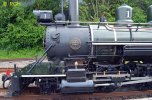
7mm Welsh Narrow Gauge Railways

Osgood

Western Thunderer
That's a shame but understandable with no limitless resources.
I don't know what happens if / when a listed structure becomes dangerous - I guess a committee takes a decision as to its importance and worthiness for expenditure to preserve / conserve and its fate is thus decided.
 

Paul_H

Western Thunderer
They are listed:
Pen-yr-Orsedd Quarry, Blondins and Associated Structures, Llandwrog, Gwynedd

But like the Dorothea beam engine, with no provisions for restoration, preservation or public access as far as I'm aware.
Wow, I didn't know they were listed. From that link it sounds like they were listed when there were more still standing.
Presumably someone still owns the land at PYO and ought to be responsible for them, but I doubt they'd take any interest in conservation or restoration of the Blondins. They seem to be left to decay and fall apart. The final one standing will eventually fail unless some expensive action is taken. It's the sort of project that might once have been funded by the EU, but now it seems unlikely that state funds could be found for it.

As I understand it, the beam engine house and engine is currently privately owned which prevents access. The owner either can't or won't engage with the engine's conservation and it has suffered a lot in recent years from that neglect.
I've heard of people taking an active interest in trying to save the beam engine, but the Blondins don't seem to have anyone as their advocate :-(
 

Paul_H

Western Thunderer
I think a lot of the necessary legislation is already there. The difficulty is working out who might be responsible for the artefacts listed.

I'm only speculating here, but the example of PYO might be an interesting one; The land may be owned by a large estate that sub-let (maybe a hundred years ago or more) to a company (and/or successive companies) that bought a lease to exploit the mineral rights. If the company that had the last working liability for the site has gone bust/disappeared and has no assets, who do you pursue to maintain the artefacts it should have had liability for ?
Then there's whole issue of how you should conserve/preserve/restore these particular assets. Dealing with the buildings and their contents ought to be straight forward, but the existent standing Blondin is quite a complex issue, not to say potentially extremely expensive.

It's worth reading 'Welsh Highland Railway Renaissance' by Gordon Ruston about the complications of dealing with old industrial assets and how difficult it is to deal with collapsed companies and their liabilities.
 
Last edited:

PhilH

Western Thunderer
At the country end of your 'Moving coal' layout, add a narrow gauge line to carry coal to an off-layout industrial premises. I realize it drives a coach & horses through the imaginary 'Somewhere around Wigan' aura, but.......

Hat, coat & door..... :p

No, absolutely definitely not !

22. Photo 1.jpg

But, hang on a minute what the heck is that doing up there ? :eek:


23. Photo 2.jpg
Oh, that's OK, its just passing, maybe the Scammell driver is taking a break :)


PhilH

Western Thunderer
3 British Film Institute films should be of interest to fans of the Welsh narrow gauge:

Watch Slate Quarrying - BFI Player
Taken at Penrhyn Quarry in 1946, shows a Blondin ropeway in use, also the Hunslets GERTRUDE and LILLA, an ex car conversion petrol loco and briefly the Kerr Stuart SGT.MURPHY.

Watch The Roof over Your Head online - BFI Player
Mainly taken at Blaenau Ffestiniog Quarries

Watch Their Purpose Served online - BFI Player
Includes Penrhyn Railway; Padarn Railway and Dinorwic Quarry; early preservation at the Talyllyn and Festiniog; pre preservation Welshpool & Llanfair and Vale of Rheidol, taken about 1955.
 

Osgood

Western Thunderer
See here for a couple of videos of the Gravity train - quite amazing:

Have you taken a ride Phil?
 

PhilH

Western Thunderer
On the weekend of 7/8th June the Brecon Mountain Railway celebrated 45 years since opening by steaming two locos and double heading all trains. The normal service only requires the use of one locomotive. The following colour photos were taken on 8th June.


1. BMR Pant © PGH.jpg

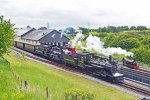
At Pant the southern terminus, No.1 leads No.2 on the train ready to depart, with the railway's workshops and station in the background. MARGARET the Hunslet 0-4-0ST was on loan for the weekend from the Vale of Rheidol Railway on 'drive an engine' duties up and down the yard.


2. BMR Torpantau © PGH.jpg

The train on arrival at the northern terminus Torpantau


3. BMR Torpantau © PGH.jpg

From here the original BR line continued to cross a minor road and curve right into Torpantau Station, the highest station on the Brecon & Merthyr Railway, and then enter the Torpantau Tunnel, which took the line through the shoulder of the hill into the next valley for the descent to Brecon.


4. BMR Torpantau © PGH.jpg

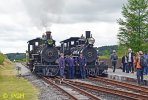
The footplate crews pose for a photo at Torpantau


5. BMR Pontsticill © PGH.jpg

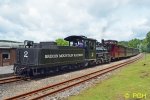
No.2 at Pontsticill on the return journey. No.1 was taken off here and moved to the back of the train to make running round easier at Pant.


6. BMR Pontsticill © PGH.jpg

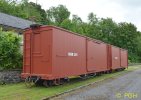
American style boxcars at Pontsticill​
 
Last edited:

PhilH

Western Thunderer
7. BMR No.1 © PGH.jpg


8. BMR No.1 © PGH.jpg

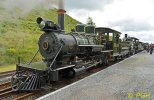
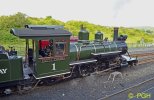
No.1 SANTA TERESA originally built by Baldwin Works (Burnham Williams & Co) in 1897 as a metre gauge 2-6-0 for the Moygana Railway in Brazil. It was later sold to a sugar mill and converted to 2'-6" gauge. It was imported to the UK in 1990 and work began to convert it to 2'‑0" gauge, but this was only completed after its purchase by the BMR in 2002 who rebuilt it as a 2-6-2. In fact very little of the original loco remains, just the cylinders, main frame, valve gear and some of the running gear. New parts included boiler, smokebox, cab, wheels, axles, rear subframe, rear truck, front pilot and new tender (info from BMR website)


9. BMR No.2 © PGH.jpg


10. BMR No.2 © PGH.jpg

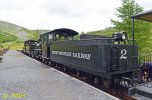
No.2 was built by Baldwin in 1930 for the Eastern Province Cement Co. of Port Elizabeth, South Africa, where it worked trains of limestone on the branch line from the South African Railway's Avontuur Line at Chelsea to the works. It was based on the SAR's Class 10 4-6-2 locos supplied by Baldwin to the Avontuur Line in 1916. By 1973 it was normally spare to a diesel loco, but in September while the diesel loco was under repair, it was left in steam unattended and ran away, leaving the track at the end of a siding causing considerable damage. The cement company's insurers considered the loco a write off and it was sold to a scrap merchant, then purchased by Tony Hills and imported to the UK.
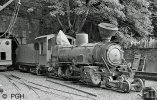

11. 18917B BMR No.2 © PGH.jpg

No.2 as originally imported into the UK in 1974 at Tony Hill's workshop in Llanberis. This was before Tony, in partnership with Peter Rampton, purchased the trackbed to build the Brecon Mountain Railway. The front truck was torn off in the accident and part of the rear pony truck appears in the bottom right of the photo. The loco was subsequently rebuilt at the BMR workshops.
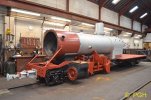

12. BMR No.3 © PGH.jpg

New build No.3, a Forney type 2-4-4T in the workshops at Pant. This is being built from the original Baldwin drawings of Sandy River & Rangeley Lakes Railroad No.10, built in 1916 and scrapped when the railroad closed in 1936. Another long term project is to build a replica of SR&RL RR No.23 a large 2-6-2 tender loco, and some parts have been manufactured although the project is on hold until the 2-4-4T is finished.
This is railway modelling to 12" to a foot scale !
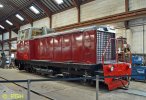

13. BMR No.1698 © PGH.jpg

No.1698 is a Class Tu7 400hp Bo-Bo diesel hydraulic built by Kambarka Engineering of Russia in 1981, obtained from a peat railway in Latvia and regauged by the BMR from 750mm gauge. This is capable of deputising for the steam locos and taking a full train up to Torpantau. It proved invaluable during the hot spell earlier this year when fire risk prevented use of the steam locos. Apparently a total of 3,361 Class Tu7 and the upgraded Class Tu7A were constructed to various gauges and used throughout the former Soviet Union. Needless to say spares would be difficult to obtain from the builder at the present time, but the railway has acquired a similar loco from Slovakia as a source of spares.


14. PENDYFFRYN © PGH.jpg

PENDYFFRYN built by DeWinton in 1894 for the Pen-yr-Orsedd Slate Quarry, Nantlle. It was restored at the BMR workshops but is normally on display in the new museum at Aberystwyth on the Vale of Rheidol Railway. It returned to the BMR just for the weekend.

 

simond

Western Thunderer
Phil,

thanks for posting these images, and the potted history. I had no idea this even existed!

cheers
Simon
 

Giles

Western Thunderer
I do remember when we lived in the Valleys in the mid '70s one of the locos at least arrived, and we started making trips to see progress, and met Tony Hill. The railway was embryonic at that time... I haven't been back since about 1980.
 
Top