warren haywood
Western Thunderer
Absolutely ..........., no, wonderful doesn't go far enough



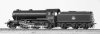
Thanks, Dibateg.An excellent article in the MRJ Tom - the B2 is lovely, I cannot see any trace of solder!
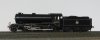


Impressively clean and sharp work. The beading on the side of the cab and splashers is it half etched or have you profile milled the overlays? Given the sharpness of the beading I suspect the latter.I have tried hard to reproduce the subtle variation in rivet size and type throughout the model, so for example the cab has 4 rivet sizes.
Impressively clean and sharp work. The beading on the side of the cab and splashers is it half etched or have you profile milled the overlays? Given the sharpness of the beading I suspect the latter.
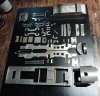
 Progress has been made again, now I've been able to resume model making.
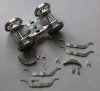
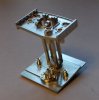
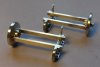
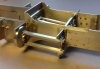
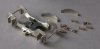 Not got onto the motion yet, as I wanted to get more of the bogie done. There are numerous fabricated and machined parts to the compensation/spring arrangement some of which in future might be better served being cast items. I wasn't prepared to accept any lead time on this, so made them all myself.
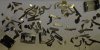
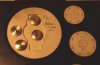
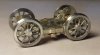
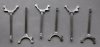
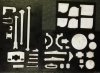 Although I enjoy the use of CAD tools to design my models I do have to use numerous old fashioned processes to make them. One of the most dated and quite traditional machining processes is to use a pantograph milling machine, in my case to make a number of blanks. Some of you have invested in CNC desktop and/or laser cutting devices, which look quite appealing every time I undertake these tasks...
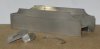
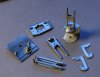 Some of the metal confetti has ended up in the slide bar assemblies. The slide bars are from machined lengths of nickel silver, sawn from 1.6mm sheet. Lots of cosmetic bolt heads are used, as none of these parts of the motion used rivets on the prototype.
 That was 'fun'.
Cheers Richard. When you get to it, if it helps, I'll let you have a look at my working drawings which separate it all out.Great Stuff!
I have a Chowbent Compound with Laurie Griffin inside valve gear to do sometime. This thread will help me no end as I got a little confused with all the different planes when I had a brief look at it.
Richard

Cheers Richard. When you get to it, if it helps, I'll let you have a look at my working drawings which separate it all out.

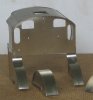
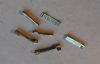 A small assembly to add this time, which introduced another technique which has been passed down to me - using a pantograph milling machine to machine a component in two planes giving useful relief for the arms attached to the reversing shaft. I try to avoid name dropping unnecessarily but in this case it's polite as this came from Martin Finney who knows a thing or two about pattern making... Maybe I would have come up with this myself in the end, but it is all to easy to get consumed by one approach or another when someone else has already done the lateral thinking to save a bit of effort.