Sir Lamiel’s 777 Quest - A Scale7 Micro Layout Challenge

magmouse

Western Thunderer
This discussion of baseboards is interesting for me at the moment as I am currently drawing up a design for laser-cut construction:

Screenshot 2026-04-19 at 09.05.58.png


This is the fiddle yard board for my 777 project, 400mm x 1000mm. Changes from the standard G&H design are a denser supporting structure, which is also full depth (100mm). I'm hoping this will bring the necessary stiffness. My lightening/access holes are larger, so weight shouldn't go up too much.

I will be changing the ends to a full double layer (6 + 6 = 12mm thick) to accommodate the pattern-maker's dowels. Joining bolt holes and handhold holes still to be drawn...

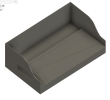
After that the more complicated main board:
Screenshot 2026-04-19 at 09.11.15.png

The sky background will have rounded corners made with a thin ply insert, bringing the footprint nicely within the 7 sq ft rule!

Nick.
 

adrian

Flying Squad
There are many ways of making it torsionally stiff. Bracing the lower edges of the sides (all round) and then somehow stoping one side moving relative to the other is key
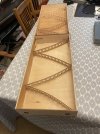
and for another variation, instead of cross bracing I’m trying curved spars. These are short boards to test principles and joints for a test track. 2 boards at 2’ by 1’ each and in total weigh about 2.5kgs just over 5lbs for the pair joined together.IMG_2309.jpegIMG_2306.jpeg
 

daifly

Western Thunderer
There has been a bit of a discussion here about bracing of baseboards. Whilst I want my boards to resist twisting, this is not a force/motion to which they will often be exposed. There will be a fully adjustable leg at each corner so, in use, there should be no twist anyway.

Sagging between cross-members is surely a greater consideration and needs to be minimised to avoid heavy locomotives riding a series of ridges and furrows as they cross a baseboard.

Or am I missing something?

Dave
 

RichardG

Western Thunderer
My main concern is, twisting can encourage chairs to pop up off sleepers. More likely in 7 mm scale than 4 mm because the rail is that bit stiffer.
 

adrian

Flying Squad
Sagging between cross-members is surely a greater consideration and needs to be minimised to avoid heavy locomotives riding a series of ridges and furrows as they cross a baseboard.
This is some of what I was trying to test with the curved spar.
 

simond

Western Thunderer
A traditional “open box” baseboard is more prone to twisting than to bending. You can make the shoebox deep, and it won’t bend, but it’ll still twist!

your four supports are fine, of course, but you’ll need to level both ends. I guess that’ll be necessary whether torsionally stiff or not, but it’ll not be as obvious on a flexible baseboard, until, something breaks, or falls off…
 

RichardG

Western Thunderer
Sagging between cross-members is surely a greater consideration and needs to be minimised to avoid heavy locomotives riding a series of ridges and furrows as they cross a baseboard.

If ridges and furrows develop, they are most likely because the baseboard top is absorbing or losing moisture in an imbalanced way. For example, if there is bare board underneath and layers of PVA and scenics on the top. I primed the tops of my G&H boards on both sides - I used MDF sealer or diluted PVA, whatever was to hand - and they have stayed flat. Truly, I don't think the weight of a 7mm train will have any affect, not even something like a big mainline diesel.
 

magmouse

Western Thunderer
The legs are sold as kits lacking the vertical 35x35mm bits but the braces, brackets etc. are a joy to work with and have accurate etched holes for the screws, bolts etc. I positioned the cross-braces much closer to the floor than shown here. Contents of the kit are in the darker colour here:

2d6ff0_89d7c14ac6c9494d9dffcc0e20f3fd71~mv2.png.png

@daifly - could you explain how the top of the legs attach to the baseboard, please? A picture or two would help. The holes in the top stretcher appear to correspond to those for the dowels.

Thanks -

Nick.
 

daifly

Western Thunderer
Hi Nick

The layout had been temporarily dismantled but I've lashed up a couple of bits and the photos should illustrate things.

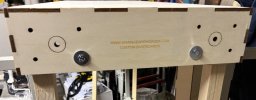
Here, I've just placed the leg outside the board.
IMG_5101.jpg

Now with the leg in position inside the baseboard. Only the inner two pairs are available for bolting at the moment.
IMG_5102.jpg

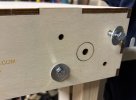
I'm going to drill through the legs and use a 6mm x 60mm bolt in the upper, outer position each side as indicated below:
IMG_5103.jpg

In fact I'll drill through both upper and lower positions and use as many bolts as needed for stability.

Dave
 

RichardG

Western Thunderer
The layout had been temporarily dismantled but I've lashed up a couple of bits and the photos should illustrate things.

Dave thank you for these photos. I had struggled to comprehend how the G&H leg kit worked.

I am still a bit troubled because the heads of the M8 bolts seem to prevent another module attaching up against the baseboard. Unless I suppose you open up the 8mm holes to take the bolt heads.
 

magmouse

Western Thunderer
Thanks, Dave - very helpful. Like Richard, I was unclear quite how this was supposed to work. I suppose you could bolt through the legs and both adjacent boards, but that would mean assembling everything with the boards on their sides then standing it all up in one go, or balancing the boards on the legs before they are secured. Neither seems ideal.

Perhaps pieces of wood attached to the underside of the board, parallel with the end but spaced away from it, would create a socket for the legs to go into and hold them in place while the bolting is done? Please let us know how you get on with this in practice.

Nick.
 

daifly

Western Thunderer
This is the end of the FY so nothing butts up against it.

With a leg in an intermediate position, I'll simply use a longer bolt through both baseboards and one leg. c70mm should do it.

Dave
 

daifly

Western Thunderer
Thanks, Dave - very helpful. Like Richard, I was unclear quite how this was supposed to work. I suppose you could bolt through the legs and both adjacent boards, but that would mean assembling everything with the boards on their sides then standing it all up in one go, or balancing the boards on the legs before they are secured. Neither seems ideal.
It's a fair point, Nick but I have a cunning plan involving a few small clamps. The King board (a FY board) - with two pairs of legs will have the mating leg held in position by clamping to the side frame whilst the adjacent board with its only leg, also clamped, is offered up and everything bolted up to the King board. And so on to the far end of the layout. A garage practice/trial is called for to see if the cunning plan theory works.

Dave
 

magmouse

Western Thunderer
It's a fair point, Nick but I have a cunning plan involving a few small clamps. The King board (a FY board) - with two pairs of legs will have the mating leg held in position by clamping to the side frame whilst the adjacent board with its only leg, also clamped, is offered up and everything bolted up to the King board. And so on to the far end of the layout. A garage practice/trial is called for to see if the cunning plan theory works.

Dave

That makes sense - sounds just cunning enough...
 
Top