Rivermead Central

40057

Western Thunderer
Fortunately there are a large number of surviving Art Deco buildings around in the UK for inspiration so you could easily adapt one to suit the space. The main thing as I see it is to create something with screams Art Deco.
I definitely do want an Art Deco building somewhere. The question of which building(s) to have in this style will be determined by:
The space available
The kits available
The time available (given that whilst I am building a large or elaborate Art Deco structure, I won’t be doing other work on the layout).

The trick will be to find the right building for the right place, handsome but not massively complex to make. I would much prefer a kit. Until now, all my windows, for example, have been (parts of) laser-cut MDF frames, glazing bars in a regular grid, and the glass (part of) a microscope slide. I would need a kit because I can’t scratch-build more elaborate windows or replicate curving glass. (Actually, I have just noticed a drinking glass on the table; I can see curving glass would be possible. That’s a thought.)

Martin
 

40057

Western Thunderer
Hello Martin

The overall plan looks fine. The coal merchant's siding will be a nice space filler and a useful source of traffic, too. One thing that we both have is a good selection of private owner coal wagons. You are inevitably constrained for backdrops by the location of your layout (in a loft? roof space?) so that you have less than 6 inches vertical height of room wall above the rear of the baseboard. So any conventional printed backscene or even sky paper is ruled out. Hence the wall and fence solution is a very good one, and if you keep your construction standardised it should be fairly quick to build.


I love these enamel adverts - but unfortunately,, they now seem to have become very collectable, and hence somewhat expensive. Like a lot of things in this vintage hobby!


A road in front of a terrace could also be combined with the access road to the coal yard - and be a nice opportunity to display some of your wonderful Minic road vehicles. One thing I might suggest - unlike my fine scale layouts, almost nothing on Kingswell Street is glued or otherwise fixed in place. The only things which are screwed down are the signals (because otherwise it is very difficult to operate them) and a very few screws at critical points on the track (to provide a datum). Otherwise all the buildings are simply popped down and rest in place. This way, if I change my mind about something or want to try out various arrangements I can easily move things around. It also simplifies things when I want to clean the layout - I just lift all the buildings off, give them a brush individually, and run the vacuum cleaner over the track and the bare boards.

John
Hi John

Thank you again for your observations.

Original Bassett-Lowke enamel adverts can be expensive. I am sure there are people who have worked out all the different types made, which ones were printed together on the same sheet, which ones were repeated in different sheets, so which ones are common, which ones are rare etc etc. They would form a fascinating collection and take up far less space, and be far cheaper, than full size ones. Plenty of interest and not just from model railway builders/collectors.

The most I paid for an advert for my wall was £13. Mostly the ones I bought were £5–10. Individually, not expensive, but it does add up. However, enamel adverts were such a prominent part of the real and model railway scene in the first half of the twentieth century, I don’t really see them as optional. For the layout to look right, they are necessary.

Regarding fastening buildings etc down, I think it depends on the circumstances. Some the structures against the west wall at the back of my layout are fastened down, some are not. But none of them is ever going to be picked up because they are heavy (at arm’s length) and I can barely reach them. The important thing is they don’t move due to vibration, temperature related expansion/contraction, seismic activity etc. Also, a three foot long wall or building made of wood will almost certainly warp. So screwing it down helps keep it straight and prevents the middle or ends rising up off the ‘ground’.

None of my buildings is glued or nailed in place. If fastened at all, I have used wood screws which can be removed (the heads are not covered).

The anti-plunge wall at the north end of the layout and the retaining wall between the high- and low-level base-boards are ‘built in’, part of the structure, and not removable.

Martin
 

John R Smith

Western Thunderer
None of my buildings is glued or nailed in place. If fastened at all, I have used wood screws which can be removed (the heads are not covered).

The anti-plunge wall at the north end of the layout and the retaining wall between the high- and low-level base-boards are ‘built in’, part of the structure, and not removable.

I was not really thinking about your walls, fences etc. I would certainly screw those in place, too. I had in mind buildings like the signal box, coal office etc. I often "cheat" for photography by moving a building or water crane out of shot where it is spoiling the composition.

John
 

Brian McKenzie

Western Thunderer
Martin,

I've been following your thread with interest, and congratulate you on preserving items of early hobby manufacture.

Something I've puzzled over is the mix of items, using modern modelling techniques - such as for the background brick walls etc., versus the coarse production techniques of old.

What prompted this is your use of heavy track pins (albeit Bassett-Lowke) to affix the advertisements to the wall. I have to say the effect is good, giving a nod to the railway 'tinplate'. At first, I had anticipated seeing a wall of lithographed pressings.

-Brian McK.
 

40057

Western Thunderer
Martin,

I've been following your thread with interest, and congratulate you on preserving items of early hobby manufacture.

Something I've puzzled over is the mix of items, using modern modelling techniques - such as for the background brick walls etc., versus the coarse production techniques of old.

What prompted this is your use of heavy track pins (albeit Bassett-Lowke) to affix the advertisements to the wall. I have to say the effect is good, giving a nod to the railway 'tinplate'. At first, I had anticipated seeing a wall of lithographed pressings.

-Brian McK.
Hi Brian

The ‘enamel’ adverts (actually lithographed) have holes for fastening with pins and this was the method used by Bassett-Lowke, Milbro etc for fixing adverts to their factory-made wooden buildings. I used post-WW2 brass track pins which have slightly smaller heads than the steel track pins generally used to nail adverts in place in the 1920s.

The challenge of integrating new build structures with vintage items is still very much a ‘work-in-progress’ for me, learning as I go. If I want buildings, bespoke to fit the layout, I have to design and make them. There is no practical alternative to using some modern building materials. However, I am also using vintage components. Looking at this section:

CF5D4A89-D639-4EAA-BC61-09F114369F47.jpeg

The track is pre-WW2 — possibly even pre-WW1 — Lowko Track. The brick-work is modern MDF. The sleeper fence is made of post-WW2 Bassett-Lowke sleepers. These sleepers are smaller in section than the older Lowko Track sleepers, but still considerably over-scale. I have also made the sleeper fence deliberately too tall because if it was scale height it would look short due to the height of the track (ground to rail top c. 20 mm). Both buildings in the above photo have roofs made of vintage material — plywood impressed to represent slates. The slates are large but not necessarily over scale. The cream-painted wooden shed has walls made of vintage material — plywood impressed to represent planks. The planks are broad but not necessarily over scale. Both buildings have doors made of the same plank effect plywood. Other materials, though new, are ‘traditional’. Wood detailing is wood, the glass windows are glass, the door handles are brass nails.

I have to make a conscious effort not to add too much detail to the buildings. And it can seem perverse to spend time making a sleeper fence that is intentionally too tall relative to scale. It is a judgement each time what will ‘look right’ on a vintage layout.

Martin
 
Last edited:

John R Smith

Western Thunderer
Something I've puzzled over is the mix of items, using modern modelling techniques - such as for the background brick walls etc., versus the coarse production techniques of old.

Hello Brian

That is a very good question, and I think Martin has given you a very thorough reply. My own view is that a project of this kind, if the aim is at least in part to recreate a typical model railway of say the 1930s, will always have some inevitable compromises. Otherwise one would be obliged to use vintage baseboards and historic woodscrews, perhaps.

On my own layout I have made some decisions which are slightly different to Martin's - not better, or worse I think, just different -

Hailey Platform 04 Web.jpg

Very early on I decided that I would not build any structures myself for Kingswell Street, but I would use only buildings of the period (say 1925 to 1955) from Bassett-Lowke, Milbro, Hailey etc which had previously been in use on someone else's coarse scale layout. Of course the problem with this approach has been that I have had to plan and build the layout around what was available to buy on the vintage marketplace (rather than plan the layout and then build structures to suit). This has made the process rather lengthy and of course expensive as well, so it has taken three and a half years to get from the purchase of the first building (the signalbox in the picture above) to the most recent acquisition, the station building.

And I have my own compromises, of course. One very obvious one is the backscene. This is not vintage, or even a replica of a vintage backdrop, but a modern printed backscene from a present day supplier. Even worse, it is printed on Vinyl, when plastic is usually banned on my layout. Another of my compromises is road vehicles - Martin has not compromised here, but is using the wonderful Minic range of tinplate cars and lorries. Whereas I have used the French Age d'Or series of Solido cars which are a great deal cheaper but not truly vintage. And that bit of grass in the photo above is not vintage grass, either! Shame on me . . .

John
 
Last edited:

40057

Western Thunderer
The storage shed + wall + length of sleeper-built fence assembly, most recently seen in post #925 above, is now fastened down on the layout. No point in posting another picture as it looks exactly the same as before. But good to have it fixed without mishap.

In terms of ‘something’ covering the wall at the back of the layout, I am now more than half way down the west side of the room. Once the wall with the adverts is installed, I will be close to two-thirds done. It looks as though I will have to loosen the fastenings and temporarily slightly slew the track in front to get the new length of wall into position. I am once again reminded, ‘start at the back of the layout and work forward’.

Meantime, onward with the next section of wall covering:

B39620C1-D702-4ABA-ACC6-966219ECCA6E.jpeg

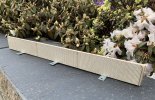
The main wooden structure is made, the right-angle metal brackets screwed to the wooden frame and covered with brick-effect MDF panels. I’ve opted to use brick panels I already had in my box of building materials. These have set the length (just over 20”) and height. This piece of wall is much less tall than the other boundary walls I have made. It is almost exactly the same height as my sleeper-built fences.

Martin
 

40057

Western Thunderer
I knew fastening the wall with adverts onto the layout would be hard. I did not realise quite how hard. In addition to the previous known difficulties of working at arms’ length and under the coom ceiling, I discovered the right-angle metal brackets I built into my wall had created a further problem. The holes in the brackets for the screws that will hold the wall in position, straight and upright are too close to the face of the wall, so there is not enough room for the drill, so I can’t make a vertical pilot hole in the baseboard. Nor can I easily hold a screw-driver that close to the wall.

Lesson learnt.

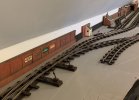
However, the wall is in position, with four wood screws fastening it down. I had to lift the track in front to get the wall into place, so in the pictures below, the track is there but not screwed down or accurately aligned. Nevertheless, how the wall will look is clear:

80FAEF20-13CC-4E45-91AA-CF0CF3BE93F8.jpeg

A72172CF-35DF-43F7-8EC7-5389887567FB.jpeg

A proper vintage model railway appearance, I think. I am happy with how it looks.

And below is the previous addition to the layout, the storage shed + wall + fence, with the fixing screws painted over in ‘base-board grey’ — so it’s final appearance:

8F1ADD8C-DC5F-4B29-AB7B-396DA15E0A3C.jpeg

The wooden shed is sort-of new — I made it late last year — but sort-of old — the roof, walls and door are all made of vintage (1930s?) building material, plywood impressed with a slate or plank pattern. It was made in 2025, but it could have been made ninety years earlier.

Martin
 

John R Smith

Western Thunderer
And below is the previous addition to the layout, the storage shed + wall + fence, with the fixing screws painted over in ‘base-board grey’ — so it’s final appearance:

It is looking good, Martin, and I think that posting on here is making us appreciate the size of the task. No small matter, to cover so much ground!

To give us a sense of scale, I would like to see a couple of shots with some wagons and an engine, perhaps, on the tracks in front of the new scenic section.

John
 

40057

Western Thunderer
It is looking good, Martin, and I think that posting on here is making us appreciate the size of the task. No small matter, to cover so much ground!

To give us a sense of scale, I would like to see a couple of shots with some wagons and an engine, perhaps, on the tracks in front of the new scenic section.

John
Hi John

I’ll take some photos when the wall is fully fastened down, the track properly reinstated etc.

The size of the task! I would really like to get a better understanding of that myself. If I continue at the present work rate, will it take three years to get the west half of the layout finished? Or five years? Or ten years? If it’s much longer than that I will need to exceed my life expectancy.

It is really difficult to judge how much is still to be done. Just considering the base-boards on the west side of the room. Once the wall with the adverts is fully installed, there is about 9’ of uncovered wall to the south. I will need a wall covering for about 5’ of this. South of that, in the corner of the room, whole buildings, away from the wall, should make a wall covering as such unnecessary. But so far, buildings-wise, I have only worked on the wall covering. There’s everything in front of that to do as well. However, Rivermead Central is not a scenic layout in the modern style. In front of the wall covering, it’s all railway. There will be some station platforms + buildings, signal boxes, plate-layers’ huts etc, but nothing beyond the railway itself. The only place on the layout where I expect to have ‘non-railway buildings’ well forward of the walls of the room is Cavendish Goods.

As I try to gauge progress, I can of course adjust what I make. If I covered the next 5’ of the west wall with sleeper-built fence, it could be done in a few weeks at most. Not very interesting to make or to look at when finished. At the other extreme, a wall with elaborate piers, string courses, etc. would be a major project.

The next wall covering is to be a plain, simple, wall.

I will aim to save time by using kits for buildings if I can. I am not sure how possible that is going to be. All the components of the Benham’s works were necessarily scratch built to fit in the space available. I don’t rule out commissioning someone to build certain buildings for me — the ultimate time saver. However, I would need to be very sure I had the exact measurements for the space available and a builder who understood the approach being taken to the layout.

Overall, I am optimistic I will produce a useable layout. And I will aim to complete the west half of the layout before starting on scenic work for the eastern half. The base-boards on the eastern side are narrower. There is no low level section in front of the high-level base-boards. So I can lay most or all of the track on the eastern base-boards and use it as a fiddle yard. Then gradually extend the scenic area onto the eastern base-boards.

Martin
 

40057

Western Thunderer
Back in my post #888, I mentioned that I had purchased an open merchandise wagon and a covered van made by A.W.H. Pealling.

These two wagons have now arrived. The covered van has Leeds Model Co. wheels that are too fine for my track. The construction is almost entirely in card, laminated for the frames and other structural parts. Unfortunately, perhaps because of the material used, the W-irons are glued in place. I can’t see a way of changing the wheels without causing serious damage, so the van won’t be kept.

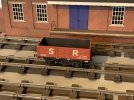
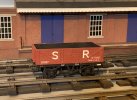
The Pealling open merchandise wagon is an excellent addition to my railway. I have cleaned it today, but it requires no repairs so is now ready for use:

38826AB9-CEBA-42D8-89D3-5BC9AE38F505.jpeg

The wagon has Pealling’s trade-mark very neat hand-lettering and his ‘standard’ brake gear made of card. The brake shoe push rods are arranged as if the wagon had independent either-side brakes, but the two sides are joined by a cross-shaft and each side has only a single V-hanger. So the brakes wouldn’t actually work as they have been modelled. But, hey, only the most detailed wagon models had any representation of brakes at all …

The Pealling SR merchandise wagon is built using the final type of Hornby 0 gauge tinplate wagon chassis (made after 1957). The Hornby castings for the headstocks + buffers have been retained but the couplings replaced. Pealling has also used the Hornby hard-plastic wheels but drilled holes to make them into a good representation of three-hole disc wheels. The body-work is scratch built in wood and card with metal detailing.

These Pealling models sit comfortably with post-WW2 Bassett-Lowke wooden wagons. Comparing the Pealling merchandise wagon:

EDD6A643-4D72-4117-8376-9EFF4BB0AAA1.jpeg

With a Bassett-Lowke example:

CB12A22C-1568-4A12-81C9-61BBE5C9CCA2.jpeg

The Pealling wagon is obviously more detailed but the body-work construction is similar. From the point of view of my layout, the Pealling wagon adds welcome variety. Post-WW2, the range of very nice hand-built wagons offered by Bassett-Lowke comprised just four types: open merchandise and mineral wagons, covered vans and brake vans, each produced in LMS and LNER versions. GWR versions were advertised in the catalogue from time to time but I have never seen a GWR example and I am sceptical they were actually made. Later, Bassett-Lowke also offered a BR liveried cattle wagon, but it had moulded plastic sides and ends which shrink and warp such that any surviving examples of the cattle van are now unuseable. So, if having to rely on Bassett-Lowke wooden wagons alone, a post-WW2 railway would have just eight types of wagon (4 LMS, 4 LNER).

Martin
 

John R Smith

Western Thunderer
The size of the task! I would really like to get a better understanding of that myself. If I continue at the present work rate, will it take three years to get the west half of the layout finished? Or five years? Or ten years? If it’s much longer than that I will need to exceed my life expectancy.

Hello Martin

I think that you have to be realistic about progress, and not beat yourself up about it if it seems slow. The size of your room is very large for one person to take on as the home for an O Gauge layout, whether it be coarse or fine scale. And the sloping roof makes working towards the rear of the baseboards much more difficult than it would normally be. Most layouts of this size would not usually be the work of a single builder, but would involve two people in a joint project at least, if not in a club situation. I know that Crewchester and Sherwood were larger than Rivermead Central, but they did both involve a team of people rather than one. Our Club layout in Devon was in a room about your size, but there were always at least four of us working on it, and often more.

I have often wondered (and have never seen it fully explained) how W S Norris managed to complete all the trackwork and many of the buildings on his finescale opus, housed in a 70 foot building, in so short a time after WW II (featured in MRN in 1960). I know that in later years Bernard Miller was virtually a full-time employee, but his main role seems to have been in building locomotives and other rolling stock. (P.S. and Norris apparently did all the painted backscene as well!)

Time ticks on for all of us, and I think I am a bit older than you so I am also careful not to take too much on. If the railway ceases to be fun and rewarding, but starts to become a task and a burden which has to be finished, then it is probably time to assess our prorities. I think that you are very wise to have several smaller projects on the go at once, so if walls become a chore then you can do a bit of wagon refurbishment instead!

John
 
Last edited:

40057

Western Thunderer
Hello Martin

I think that you have to be realistic about progress, and not beat yourself up about it if it seems slow. The size of your room is very large for one person to take on as the home for an O Gauge layout, whether it be coarse or fine scale. And the sloping roof makes working towards the rear of the baseboards much more difficult than it would normally be. Most layouts of this size would not usually be the work of a single builder, but would involve two people in a joint project at least, if not in a club situation. I know that Crewchester and Sherwood were larger than Rivermead Central, but they did both involve a team of people rather than one. Our Club layout in Devon was in a room about your size, but there were always at least four of us working on it, and often more.

I have often wondered (and have never seen it fully explained) how W S Norris managed to complete all the trackwork and many of the buildings on his finescale opus, housed in a 70 foot building, in so short a time after WW II (featured in MRN in 1960). I know that in later years Bernard Miller was virtually a full-time employee, but his main role seems to have been in building locomotives and other rolling stock.

Time ticks on for all of us, and I think I am a bit older than you so I am also careful not to take too much on. If the railway ceases to be fun and rewarding, but starts to become a task and a burden which has to be finished, then it is probably time to assess our prorities. I think that you are very wise to have several smaller projects on the go at once, so if walls become a chore then you can do a bit of wagon refurbishment instead!

John
Hi John

Some good advice there — thank you.

A layout the size of Rivermead Central is certainly an ambitious project. Compared with a modern layout using modern equipment, I probably have far less scenery work. On the other hand, a lot of time has to be given to track repairs and refurbishment.

I would be pleased to finish the ‘wall covering’ stage along the west wall. Then I could get on with much more interesting tasks. It is a constant temptation to lay additional track, but I know, sensibly, to get the back scenery done first. And mostly the wall covering is now done.

Martin
 
Top