O-EM-OO9 workbench - wheely good? Maybe

76043

Western Thunderer
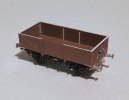
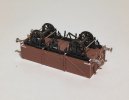
So ye olde open is now ready for painting. I ended up spending far too much time on it, correcting the corner plates and rivet detail, adding all sorts of parts in plastikard as you can see from the white bits. Scribing the inside planking went wrong, the end planking is vertical, so out came the filler. Would have been easier to acquire the retooled version, but there we are. I've seen some resin loads on eBay which might do to add weight.
Tony
IMG_20260122_224302288_HDR~2.jpg

IMG_20260122_224248163_HDR~2.jpg
 

76043

Western Thunderer
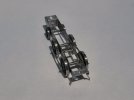
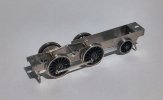
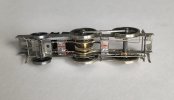
So here we are, my first EM compensated chassis. Is it worth the hassle? I don't know, time will tell. I can't see any binding so far, but then I did use a 1.1mm drill for the 1mm Romford crankpins. No idea if in this world 0.1mm slop is allowed.

Twin rocking beams for the drivers, possibly badly placed in hindsight, but I'm not changing them now.

I might chemically black the hornblocks as paint around these parts will just gum everything up. Still not convinced anything other than Romfords are a good idea.

Tony

IMG_20260215_210528648_HDR~2.jpg

IMG_20260215_210514609_HDR~2.jpg
 
Last edited:

simond

Western Thunderer
I always compensated EM locos. I find that they can be lighter, as all wheels have traction. Whether or not this is just a feeling or actually so, I do not know.
Theory says that the tractive weight is the tractive weight, whether shared across three wheels* or all of them, and the maximum tractive effort will be the tractive weight multiplied by the coefficient of friction. The friction coefficient may vary from point to point on the track (and I guess between wheels too) so the theory may fall short of reality, but only a bit, I suspect.

* if you don’t have compensation or springing, you will have two wheels on one side and one on the other touching the track except by (rare) chance.

If it doesn’t really affect traction, some form of suspension certainly helps pickup.
 

76043

Western Thunderer
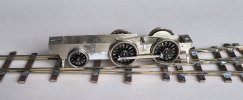
So one extra frame spacer, maybe another is due. But rods soldered on in old fashioned Romford style as this is what the previous owner used. Realised the drivers are Stanier type wheels, but again they came with it, so for a teaching aid they'll do.

But the best thing is the thing rolls ok! So it's only an 0-4-0 rod wise, so the chances of binding are less, but happy with my first attempt at compensation.

It navigates the pointwork shown that's not so great, so maybe I can be a believer now.

One question though, is there a household product that can clean up Fluxite solder flux?

Tony

IMG_20260218_085416427_HDR.jpg
 
Last edited:

simond

Western Thunderer
An old toothbrush and Jif or Cif or cream cleanser, followed by lots of hot water.

You might want to metal-black the wheel rims and oil them too, tho’ the drivers appear to be plated or stainless?
 

76043

Western Thunderer
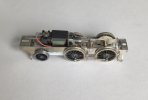
Next up, motor options. It came with a nice Mashima 1015 and a 54:1 high level box. I'm tempted to save this for a 1361 CSP chassis and use this DS10 and 50:1 Branchlines gearbox. Ricey claimed a DS10 and a 38:1 box is all you need for a 14xx and an autotrailer, but his book was written before high level boxes existed...

Tony

IMG_20260219_083039352_HDR.jpg
 

Overseer

Western Thunderer
Next up, motor options. It came with a nice Mashima 1015 and a 54:1 high level box. I'm tempted to save this for a 1361 CSP chassis and use this DS10 and 50:1 Branchlines gearbox. Ricey claimed a DS10 and a 38:1 box is all you need for a 14xx and an autotrailer, but his book was written before high level boxes existed...

Tony

View attachment 257919
I thought someone else would have responded earlier. In my experience the Mashima 1015 is very good in small locos but is a lot less powerful than the 1024 and the 12 series Mashima motors. I think it will be under powered in a 14xx. The DS10 will have a higher starting voltage and current than Mashima cans so harder to achieve smooth starts. Romford 50:1 gears are ok but I find the Romford 40:1 seem to work better, I think they have less friction so the motor starts more easily. The DS10 and 50:1 will work but a High Level gearbox with one of their current motors will be easier to set up to be quiet and will be nicer to operate. I only have one of their small iron core motors in a very small loco, with a higher gear ratio, and it works well but the coreless motors are more refined and more powerful.
 

76043

Western Thunderer
Thanks for you thoughts, the high level boxes score because they have a low starting worm ratio, meaning less friction. What I've learnt through my Dublo ramblings is that a true ringfield motor with two thrust bearings has so much torque it can shift a 60:1 at creeping speeds, as Ricey mentions in his book. Sadly it seems motor technology has gone in reverse.

What I will do is test both, I can because I'm using Romfords. Once I've done the brake gear and fitted the busbars and pickups it should be a doddle to test. Maybe the DS10 can fit the high level box, then friction won't be an issue.

I do only want it to pull one autocoach with pinpoint bearings.

Cheers
Tony
 

AJC

Western Thunderer
What I've learnt through my Dublo ramblings is that a true ringfield motor with two thrust bearings has so much torque it can shift a 60:1 at creeping speeds, as Ricey mentions in his book. Sadly it seems motor technology has gone in reverse.

Up to a point: they're two very different requirements that happen to be employed in similar applications. One is a mass-production solution with space at no premium, often with an integral gearbox. I agree that they were pretty well engineered (the motor bogie in a Dublo Type 1 looks lovely and runs well, for example - not sure about current draw). The other is a small motor with magnets of a type unavailable to Dublo married to a gearbox for home assembly with minimal tools in an environment where having a cab full of motor is not what the market wants. Lower current draw, etc. comes with these small, lightweight, motors. The High Level iron core motors seem to be pretty good, but I haven't had one in extended use yet.

Anyway, I would leave the 1015 for a prototype where that small size is needed. I've only used a DS10 once and it was perfectly fine, so long as said autocoach isn't the K's whitemetal one. The 1024 was a much better motor, however, occupying the same physical space.

Adam
 

Quintus

Western Thunderer
Just caught up with this thread, nice job but a bit concerned about the compensating beams soldered on top of the pivot, meaning those joints will have to carry the weight of the loco. If they pass under the pivot the solder joints will be less stressed (OK, it's not that heavy anyway)
I have a couple of 14xx’s in EM with Perseverance compensated chassis, built many years ago.
One has a DS10 with a 80:1 double reduction gearbox, the other has a Sagami or Mashima can motor (can't remember which) with Ultrascale 38:1 gears.
Both have flywheels and are excellent runners, but I would say the DS10 combination has the edge.
Cheers
Mike
 

Simon H

Western Thunderer
All interesting stuff, and glad to see your progress...I'll have to check the two EM 14XX I've got; both are on Perseverance chassis, though I can't remember what the motors are.
Simon.
 

76043

Western Thunderer
Thank you all for your thoughts, Adam @AJC on Dublo current draw, it's supposed to be half an amp or just under if the motor is recently serviced and rubbish if knackered. :)

Mike, @Quintus yes, I can see that now, so agreed on the beams, all I can say it's my first attempt at a compensated chassis. :) I did think about running them underneath but I realised I had got the pivot hole in the wrong place and thought the beams would be severely contorted to make it work. Never mind.

Speaking of weight, are there any recommendations on loco weight like there is for wagons?

Thanks all for the thoughts on the DS10, I am going to try the Mashima and HL gearbox just to see, I am using Romfords after all. :cool:

Cheers
Tony
 
Top