Nick Dunhill's Workbench - Queen #3

RichardG

Western Thunderer
I am pondering whether the constant slippage will make for dirtier tyres on the wheels with electrical pickups. Or whether the effect will be negligible.
 

PaulRhB

Western Thunderer
In reality both wheels slip on any loco by a fractional amount anyway and dirt is more likely from poor contacts, as wheels lift slightly if uncompensated, than slipping. There are a few rtr models driving the large and small wheels without any problems so the problem is only if one wheel slips noticeably and looks odd. Rapido Stirling Single and Bachmann’s 009 Kerr Stuart both have drives to different sized wheels.
 

Nick Dunhill

Western Thunderer
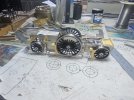
The chassis is done and here it is:

55425738405_9232063363_b.jpg

I had to do some minor adjustments to the motor mounts to allow a little tollerance between the gear and worm, so that the peaks of the worm didn't sit in the bottom of the valleys of the final drive gear.


Despite a 1.4% mismatch in rotation (big wheel too fast) it runs well.
 

RichardG

Western Thunderer
Despite a 1.4% mismatch in rotation (big wheel too fast) it runs well.
When an 0 gauge loco runs through a 2m radius curve, the outer wheels are travelling about 1.6% further than the inner ones. I imagine (no calculations), the coning and the 20 degree cant of BH rails accommodates some of this; but if the track were to be FB without any cant on the rails, the coning would have less effect and the model would still run fine.

So I suspect the 1.4% mismatch is of no consequence, except perhaps the wheels will get dirtier because of the constantly slipping electrical contact. And if this is actually true, I'm still not sure anyone will see a difference.

Surely the drive to second axle serves only to help the loco haul longer trains.
 

Nick Dunhill

Western Thunderer
Well that was my reasoning too. In model form, and with a 6ft rad and no banking, it'll skid anyway. You should see the difference between the length of inside and outside rail on a 6ft rad curve on broad gauge. The locos 'drift' round the curves!

It's just to help to get the train moving from a standstill. Hopefully it'll pull more too.
 
Top