7mm MOK 8F - 8425

Rob Pulham

Western Thunderer
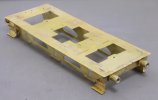
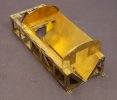
The last couple of days has seen a bit of progress with the JLRT Stanier tender.

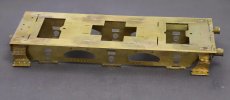
On a whim I decided to get most of the upper works done before detailing the inner chassis.

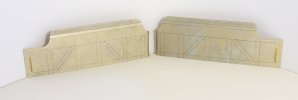
Starting with the outerframes and steps. These required much riveting.
54360297782_2c367fb752_h.jpg

54360297772_1182cb1f03_h.jpg

54361174426_5ca1b25d9e_h.jpg

54361571965_33c3baa2f4_h.jpg

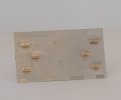
There are lots of small etched parts that have a couple of rivets each which are very close together. Aside from those already pressed out, all the parts marked '55' also need two rivets each.

54361411193_07dfc6576a_b.jpg

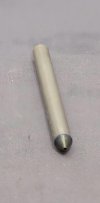
To make a better job of these, I took fifteen minutes out and made another rivet setting tool with a finer end to get in between these rivets.
54361395423_af96e7cbb3_h.jpg

Like the ones that I made previously, it's made from 6mm steel rod recovered from empty toner cartridges with the turned ends heat blued to help prevent them rusting.
 

Rob Pulham

Western Thunderer
Despite having a busy week with real life happenings I have made progress on the JLRT Stanier tender. I have been doing some more to the body of the tender.

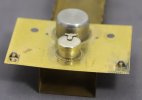
I had a choice of two whitemetal water scoop domes or I could turn up a new one from brass or nickel as I had with the Princess tender. In fairness one of the domes was better than the other and was nice, apart from a pit of pitting on the top. The second wasn't quite as good but looking at the thickness of the casting I decided to have a go at cleaning it up in the lathe. I gripped the mounting spigot in a collet and very carefully skimmed both the top and the outer edge removing about 0.3mm from the diameter but making an average casting into something much better.

54369709577_4a4059e73c_b.jpg

54370978295_6fb2491fb4_b.jpg

Bolstered by my success I took the second casting and took a skim off the top of that and then blended the curved edge back in with a homemade wet and dry sanding stick used wet with WD40 as the lubricant.

54369715922_4a0c6cd234_b.jpg

54370795384_3675f8d072_b.jpg

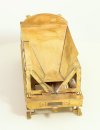
One of the things that I have noted while looking at photos of the rear of Stanier tenders is just how many of them had the lid up while in service. This is something that I fancied replicating if I could so made a basic drawing from the GA and I started with a couple of different thicknesses of nickel bar to make the filler and it's cap.

54367203298_e9a1b99f1a_b.jpg

54367372715_d82c99703a_b.jpg
 

Rob Pulham

Western Thunderer
The body of the JLRT tender is built around a fold up cage, I confess that I wasn't too keen on it initially but it's growing on me.

All the parts are just rested in place at the moment - The front and rear panels are made up of two half etched faces with a capping strip added after soldering them together. So far I have only fitted the front one together because the front of the rear panel is folded to create the coal space and I haven't got that far yet.

54372755654_bbb12d5e56_h.jpg

It was a bit fiddly but I did manage to get the filler cap to open and close.

54371231639_9529e862c7_h.jpg

54371024401_749ad8bf92_h.jpg
 

Rob Pulham

Western Thunderer
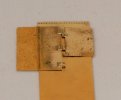
I have been working away on small bits for 8425 and I have now got to the front lockers on the tender. These have a number of hinges which have tiny rivets that need to be pressed out very close together.

I tried my smallest anvil and that didn't allow tight enough spacing so I made another.

The one on the left is the smallest one that I had made previously and one that I have used a number of times recently. The one on the right is the new one and since the photo was taken I have blackened it and used it successfully to press out the rivets on the locker front

54553867624_931f3d7d70_h.jpg

These are really quite magnified in the image.

54552805337_dd5508a48d_h.jpg
 

adrian

Flying Squad
I did something similar for my Ivatt 2 tender - although slight difference on the rivet anvil instead of tapering it to the hole I simply filed a flat on one side prior to hardening.
crow - 2.jpeg
The other thing is I remember make double the number of hinges required so I could select the best ones for the model. Also I "scrawked" a line across the hinge prior to riveting and then once in place a short length of 0.3mm brass wire sits nicely in the groove to represent the hinge pin. [ needs a damn good clean up!]
crow - 1.jpeg
 

Rob Pulham

Western Thunderer
Thanks Adrian,

I have one with a flat filed on one side too but that was a little on the big side as well. I confess that I haven't bothered hardening mine (yet).
 

Rob Pulham

Western Thunderer
Due to my change of plan necessitating a replacement welded tender, I have had to modify the JLRT tender by adding welded skins from MOK in place of the supplied riveted versions, which I had in the spares box.

I started with the rear plate which has the footsteps. On the JLRT tender rear plate there are half etched holes for pressing out the rivets for the mountings for the step treads. Sadly the MOK ones leave you to work out the spacing yourself. Having determined the spacing, I made myself yet another anvil. The ones that I had made previously were all either too wide or too narrow rivet spacing. I could probably have worked it out using one of the original eccentric type anvils but making another didn't take long.

Even though I made an anvil and carefully marked the rivet spacing out prior to pressing them. I still managed to make a pigs ear out of all but one of them. After scratching my head for a bit, I hit upon the solution. I flattened and filed off the rivets that I had pressed. Then I riveted a stip of the correct width with the required 3 rivet sets. I left a gap in between each 3 rivets so that I could cut them to length before fitting.

Fitting them was as follows. First fit the step treads with by good fortune had a tab at the rear which folded down so less risk of disturbing them when I fitted the riveted stips afterward.

54605933847_5e616273f8_h.jpg

If I hadn't told you what I did I doubt that you would have guessed.

Next I made a water gauge for the tender front plate to replace the rather chunky casting which was with the kit. A reasonably simple milling job before parting off in the lathe to leave a mounting spigot.

54607111825_de62928b8f_h.jpg

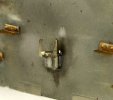
I had also built up the tender front and added the door locking levers which I couldn't resist making operate.

54608304015_efcf5a7fd5_h.jpg

54607999251_f12cf9817b_h.jpg
 

Rob Pulham

Western Thunderer
I had waited in the hope that the missing posts might get restored but I see I will need to replace them to keep the narrative intact.

Some time ago I made some Dual lamp irons for the loco.

52631836765_b6628b7c45_b.jpg

I should have made some for the tender at the same time but I hadn't decided to swap the tender at that point so saw no need for them. Then when I did need them I had completely forgotten how I made them.

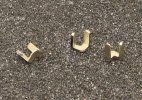
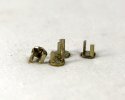
So some trial and error over the last couple of weeks has given me these which still need some hand filing to finish them off

54652269596_bb114294cd_h.jpg

54652589270_704a7556e8_h.jpg

Then came the problem of the upper lamp iron for the rear of the tender. It has been a bit elusive but I did eventually find photos of one and then worked out a way to mill it.

After squaring the end of some stock up last night I milled out the main shape today.

54651426122_c64137af47_h.jpg

Again, it needs cutting of and hand filing to final shape.
 

Rob Pulham

Western Thunderer
When looking at fitting the lower lamp irons I referred to my photos to see where they were located and realised that I had made an error in my hand filing of them.

This is how I had done them.

54665810742_c0a07a1e61_b.jpg

This is what they should look like. These are the replacements that I made to replace the replacements...

54666881469_b53c505e44_h.jpg
 

Rob Pulham

Western Thunderer
Alongside making the replacement lamp irons I also assembled more of the basic structure of the tender.

54668988567_4a550038fd_h.jpg

54669824011_3f98c7c11e_h.jpg

It was at this point that the difference between the upper lamp iron and the replacement lower ones started to bug me. It gnawed at me for a few days, before I succumbed to making a replacement for that too.

54687601031_c9267e3ebd_z.jpg

54687601071_f3fb86837b_h.jpg
 

Rob Pulham

Western Thunderer
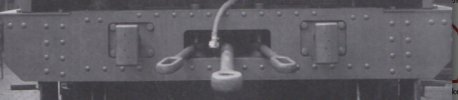
Having got the back sorted I turned my attention to the front of the tender and the next on my list was the intermediate buffers. The parts list has them as whitemetal casting but I cannot find them so I decided to make my own as I have done for other tenders. However looking through the Wild Swan 8F book, showed that at least some of the Stanier tenders had intermediate buffers that were different from the usual round type.


This is a snip from the tender front photo on page 90

54690041160_1bd14d7836_z.jpg

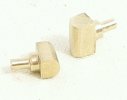
They are interesting enough for me to have a bash at making some.

54668988632_e92ec34277.jpg

54668988667_60b065419f_z.jpg

54670061144_db19f849bc_h.jpg

Here we are with them fitted. I have no idea whether the tender fitted to 8425 had this type of intermediate buffer fitted and almost zero chance of finding a photo to confirm or deny their existence, so I can enjoy them being a little different from the other Stanier tenders that I have built.
 

Rob Pulham

Western Thunderer
After a short interlude to finish of building a Gauge 1 Warship that was started way back in 2017 (see elsewhere) I am back on the 8F since attending Guildex last weekend.

I started by replacing the wrong handed upper lamp iron.

54780912547_2306f65d7f_h.jpg

Then I folded the bends on the tops and fronts of the two MOK replacement welded sides and added the handrails. I also took the time while they were accessible to file the tails of the handrail knobs and the wire of the rear ones flat.

54782071361_734a16f441_h.jpg

With that done I marked up where the solid bits were on the tender cage so that when I solder them on I apply the heat in the right place.

54780613893_8c1972c3af_h.jpg
 
Top