
LNWR Lady of the Lake

Yorkshire Dave

Western Thunderer
I could still have a torsion bar between them. I could fit a tube to one of the gearboxes, with a wire soldered to the other. This would fight pitching while allowing twisting. I'll have a think about that.

A torsion/torque bar linking the two gearboxes will be desirable as it will prevent the gearboxes independently rotating around the axles when power is applied.

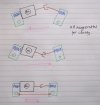
For the benefit of observers (and apologies for teaching grandmother to suck eggs) it's easier to illustrate with a simple sketch to show how the forces work when power is applied to the motor - albeit exaggerated. When the motor turns in one direction it will pull the worm and in the other direction, push the worm against the gear in the attached gearbox - both of which affect the orientation of the driveline and remote gearbox. Even though the movement is imperceptible in the model it still can affect drive quality.

With a torsion/torque bar linking the two gearboxes this effectively negates the independent gearbox rotation and keeps the driveline in one plane. It also ties the components together which will then become a single unit within the chassis.
Drive 505.jpg
 

Lawrence Boul

Western Thunderer
A torsion/torque bar linking the two gearboxes will be desirable as it will prevent the gearboxes independently rotating around the axles when power is applied.

For the benefit of observers (and apologies for teaching grandmother to suck eggs) it's easier to illustrate with a simple sketch to show how the forces work when power is applied to the motor - albeit exaggerated. When the motor turns in one direction it will pull the worm and in the other direction, push the worm against the gear in the attached gearbox - both of which affect the orientation of the driveline and remote gearbox. Even though the movement is imperceptible in the model it still can affect drive quality.

With a torsion/torque bar linking the two gearboxes this effectively negates the independent gearbox rotation and keeps the driveline in one plane. It also ties the components together which will then become a single unit within the chassis.

View attachment 267911
Are you sure? Surely both gearboxes will be inclined to rotate in the same direction? That doesn't negate your overall point that the bar should address the problem.
 

simond

Western Thunderer
Both gearboxes will surely try to rotate in the same direction (ie “do a wheelie”), but the one with the motor on has a longer arm to resist the torque, so my expectation is that the one with the UJ on will “win” and force the motor out of line. Which is how I interpret Dave’s sketches.
 

Kevin MH

Western Thunderer
I got my bag of new couplings today. I had to shorten one by about .100". If you look at the photo, you'll see there is a little slack on the shaft at the motor.

I adjusted it about five times, but found a sweet spot. It runs fine without weight.

I'm pondering the idea of making a new shaft for the cannon gearbox, and grinding it half width for a bit. Then running the screw onto it, and backing it off half a turn. I'd need to fix the grub screw with purple loctite. This would allow the shaft to find an ideal length between axles, but resist the gearboxes pitching.

Or. I could open up the bearings slightly, allowing a bit of slop on the axles, and again, not choking the gears with too long or short of a shaft.

But. The mechanism still does not like the weight of the body. Could it just be too heavy? At 15.5 oz? I weighted it with lead shot secured with epoxy dribbled on the bottom. I'm thinking I can get at that epoxy and drain about half the lead out. With the WM fittings still to be added, I'm pretty sure I'd be down to about 10 oz all in.

The mechanism draws about .7amp as it sits.

Thoughts?IMG_1362.JPG
 

Kevin MH

Western Thunderer
I got my bag of new couplings today. I had to shorten one by about .100". If you look at the photo, you'll see there is a little slack on the shaft at the motor.

I adjusted it about five times, but found a sweet spot. It runs fine without weight.

I'm pondering the idea of making a new shaft for the cannon gearbox, and grinding it half width for a bit. Then running the screw onto it, and backing it off half a turn. I'd need to fix the grub screw with purple loctite. This would allow the shaft to find an ideal length between axles, but resist the gearboxes pitching.

Or. I could open up the bearings slightly, allowing a bit of slop on the axles, and again, not choking the gears with too long or short of a shaft.

But. The mechanism still does not like the weight of the body. Could it just be too heavy? At 15.5 oz? I weighted it with lead shot secured with epoxy dribbled on the bottom. I'm thinking I can get at that epoxy and drain about half the lead out. With the WM fittings still to be added, I'm pretty sure I'd be down to about 10 oz all in.

The mechanism draws about .7amp as it sits.

Thoughts?View attachment 267922
No, grinding the shaft half round and allowing it to slide in the coupling will negate the thrust control on the left gear. No good. How about making the four bearings about .003" oversize? To make setting the length of the shaft less critical?
 

Yorkshire Dave

Western Thunderer
Are you sure? Surely both gearboxes will be inclined to rotate in the same direction? That doesn't negate your overall point that the bar should address the problem.
Both gearboxes will surely try to rotate in the same direction (ie “do a wheelie”), but the one with the motor on has a longer arm to resist the torque, so my expectation is that the one with the UJ on will “win” and force the motor out of line. Which is how I interpret Dave’s sketches.

Having thought about it.

If the motor is not fixed or retained in the chassis my sketch is based on what I have observed.

If the motor is fixed in the chassis then both gearboxes will rotate on their axles in the same direction, however, there's a reliance on the drive shaft and UJ to keep the remote gearbox level and in line - a job they are not really designed for inn my view. From my own experience the torsion/torque bar helps keep both gearboxes level and in line removing the reliance of the driveshaft and UJ to do so. And it gives me a functioning unit I can fit into a chassis knowing it will work.


Ich werde zu meinen Bussen zurückkehren. :)
 
Top