LNWR 8-wheel coach

NickB

Western Thunderer
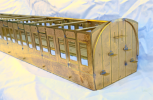
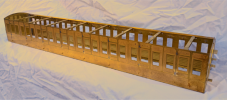
This is a Williams Models not-a-kit. A couple of years ago Mike Williams produced a batch of etches for the ends and sides of an 8-wheel all third suburban coach. When I expressed an interest, he was at pains to explain "this is not a kit, you know." But he then went on to say that many fittings from his range of 6-wheel coaches would fit this one also. Anyway, I bought a set of etches and recently got round to starting the coach while waiting for some warm weather when I do some painting.

The photos show how far I've got. It's an arc roof prototype so making a roof should not present many problems. The late Ken Cottle made drawings of the underframe and bogies and Mike sent me copies. But I have now learned that John Candy has plans to make available STL files for these components and I might be able to make use of them. I'll wait and see when they arrive.

This is a "background" project that I will work on now and again when it's convenient, so there won't be frequent updates here, but I will post any significant developments when they happen.

Nick
LNWR 8w coach_01.png

LNWR 8w coach_02.png
 

NickB

Western Thunderer
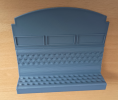
For the interior, Mike offered me some cast resin compartment dividers and seats, as used for his 6-wheel coaches. Sadly the quality wasn't great (as Mike noted to me) because the molds were well past their best. Resin isn't my favourite material either, I find it is dimensionally not very stable and reluctant to adhere to other materials, so instead I decided to do a 3D print. Mike supplied me with lots of drawings and photographs, unfortunately none of them of this particular prototype but some fairly close, so I was able to come up with a solid model that we both thought was quite realistic.

Using the economies of scale, I got a large number of prints done, sufficient for my needs and a stock for Mike, at a very reasonable price. So if you're buying one of Mike's coach kits, this is what you might find in it.

LNWR 8w coach_03.png

The layer lines are a noticeable on the cushions, but under a coat of paint they should be too obvious, particularly because you can't see them that well when the roof is on.

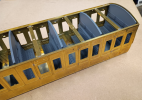
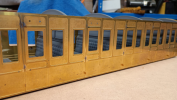
I added a flange on the bottom with a couple of holes which I tapped for fixing screws through the floor. I prefer that to gluing.

LNWR 8w coach_04.png

LNWR 8w coach_05.png

We discussed luggage racks - not for printing, obviously, but as separate metal components - but decided to forget them because we could not find any definitive information about them, or even if they existed (did the LNWR assume that third class passengers wouldn't have much luggage to carry?), and besides, when the roof is on you really can't see them.

So that takes care of the interior. I'm still mulling over options for the chassis. Do I make a fully framed one using the drawings that Ken Cottle made (probably not), a simplified version with only the visible parts accurate, or a 3D printed one using the solid models that John Candy has produced? That is tempting but I am not sure about the strength and durability of a plastic chassis for what is already a heavy coach. Hmm ...

Nick
 

NickB

Western Thunderer
675mm over the body. Yes, I like the LNWR colour scheme and the lining, although extensive, isn't difficult to apply because it is a single colour that simply follows the edges.

Nick
 

paulc

Western Thunderer
675mm over the body. Yes, I like the LNWR colour scheme and the lining, although extensive, isn't difficult to apply because it is a single colour that simply follows the edges.

Nick
Errr not sure a lot of people would agree with you there Nick , especially those working in the smaller scales . The L& Y livery is a lot simpler .
 

NickB

Western Thunderer
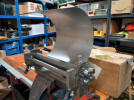
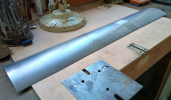
Building an 8-wheel coach really brings home how large G3 is. The roof is about 700mm long. I thought about various methods of making it, and in the end I decided to roll it in metal because that would hold its shape well without any support. But my rolling bars can only cope with 250mm wide material, so it would have to be made in several parts. I rolled a strip of mild steel (steel because it's a lot cheaper than brass or NS) and cut off three segments.

LNWR 8w coach_06.png

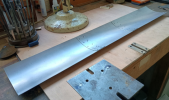
Each segment was squared up and finished to size, together with a couple of joiner pieces, and the segments were then riveted up. I planned to use just a couple of rivets and then solder the joins, but then decided instead to add enough rivets to hold it all securely without soldering. It saved a task. When soldering steel, you have to be scrupulous about cleaning up afterwards to avoid the demon rust.

LNWR 8w coach_07.png

LNWR 8w coach_08.png

The intention is to glue a sheet of card to the outside surface to hide the joins, give the roof the proper thickness, and simulate the canvas finish of the prototype.

Nick
 

NickB

Western Thunderer
I'm sure your remarks were at least partly tongue in cheek. I suppose if there are "rules", they are, first, to think through and decide the best way to tackle each job (and be prepared to experiment), to take it slowly and carefully - don't cut corners, and if it's not good enough, be prepared to do it again. I'm not alone, I see lots of high quality work on this forum and elsewhere that leaves me in awe.

Years ago, I spent a lot of time admiring the work of the late Tony Reynalds in 7mm. Initially I was aghast. "How does he do that?" and "I could never do anything like that", were my first thoughts. Gradually over time and discussions they modulated to "yeah, I could manage that". It transitioned from formidable to inspirational. Not that I can hit his heights, they always will remain something I aspire to.

And Mike's comment does remind me that another reason for choosing steel is that it has less spring back than brass and the like. I forgot to mention that.

Nick
 

Ian_T

Western Thunderer
OK Nick, I'll ask.

What did you use to 'cut' the segments and how did you 'finish' them to size? I can think of a number of methods/tools but please humour me :)
Regards,

IanT
 

AllenM

Active Member
Very, very many years ago I was told that a finished model is a collection of bits that did not make it to the scrap bin. (I think by the late Collin Binnie)
In other words have a go, give it your best, with practice things will get better and you will get there.
It still applies. Remember none of us was born able to walk. ;)
Regards
Allen
 

simond

Western Thunderer
Many years ago I was at an exhibition and chanced upon a discussion between some rather more knowledgeable and experienced modellers, one of whom was showing a master for a GW loco brake cylinder. I asked if I might examine it, and on doing so, remarked "I wish I had the patience to make something as good as that", to which the somewhat dismissive retort was "What about the skill?".

My reply was "If I had the patience, I could learn the skill". He was not impressed.

Here we are probably more than twenty five years on and I made an entirely acceptable loco brake cylinder for Tony's loco using CAD and 3DP...

I had the patience, just learned a different skill :)

Remember none of us was born able to walk

True!
 

NickB

Western Thunderer
Sorry, Ian, I didn't mean to be dismissive. Here we go ...

I started with a sheet of material with two straight and parallel edges, which is how it came. If it hadn't, I would clean up one edge using a straight edge and file, then make the other parallel to it. Roll, making sure the straight edges are perpendicular to the rollers so as not to introduce any twist. Then I have to make cuts across the sheet, parallel to the axis of the roll. Using a square, I scribed a line across. Then I put the heaviest piece of round bar or tube I could find in the vice, clamping it with a large (>300mm) overhang. I clamped the sheet to the overhung bar so that the scribed line was offset just to one side of the bar, sufficient to get the saw in.

I should say at this point that the sheet was 0.8mm thick, and that was enough to be able to saw it without support. Had it not been, I would have clamped a sacrificial piece of material underneath it to stop it flapping around. I used an ordinary hacksaw with the finest blade I had (32 tpi), sawing at a very shallow angle to maximise the number of teeth in contact with the material. Saw carefully as close to the line as possible. Sorry, no shortcuts there. Then, with the material still clamped, clean up the cut edge with a file back to the scribed line. Check with a straight edge as you go and keep going until it is acceptably straight.

Make two marks on a strip of paper to the developed width of the roof. I got that by wrapping the strip of paper over the end of the body, marking the length and then adding a suitable overhang each side. Use the strip to mark out the position of the next cut on the rolled sheet. Cut and clean up as before. Repeat until enough segments are done.

To join the segments, I found a piece of straight material longer than the roof, clamped it to the workbench, and used that as an edge to align each pair of segments so that I could drill them and a joining piece for rivets. I then pushed in a couple of rivets to hold the parts in position, turned the whole lot over and held it with one hand on the rivet dolly and hammered it down with the other. That was the most tricky bit, but once a couple of rivets were set, the rest were easy.

Nick
 

Ian_T

Western Thunderer
Thanks for the explanation Nick - and I didn't think you were being dismissive - just overly modest.

Having read your description - I still hold that opinion - you make that sound a lot easier than I suspect it was.

Regards,

IanT
 

Mikemill

Western Thunderer
The fear of making a mistake should not deter anyone from having a go, the person who never made a mistake never made anything.

What ever the task you can practice on a piece of scrap, that way you learn, if it goes wrong no harm.

I have been a model engineer for over 50 years, and I often make mistakes, the trick is how to put it wright.

Mike
 

Bigjohn

Western Thunderer
There is an alternative approach. Concentrate on getting the body as square as possible, make the roof a tad over size, fix the roof to the body. Then file or abrade the ends to whatever the desired overhang, thus removing the need for exactitude for square ends.
If you are planning to make the roof removable then you are playing a different game than me…………
I did exactly that on my G3 Bogie minks which required a joint in the roof as the overall roof length exceeded my guillotine any roller length.
I have used 1/64” and 1/32” birch plywood which “rolls” quite well but does crack a little, but covered with pva and photo copy paper to represent canvas is made invisible.
For metal roofs I have a preference for Ali which holds its rolled shape , avoiding the spring back of other materials.
But as ever , your model your choice, you know what you wish to achieve……..HTH BigJ
 

coal tank

Western Thunderer
For the interior, Mike offered me some cast resin compartment dividers and seats, as used for his 6-wheel coaches. Sadly the quality wasn't great (as Mike noted to me) because the molds were well past their best. Resin isn't my favourite material either, I find it is dimensionally not very stable and reluctant to adhere to other materials, so instead I decided to do a 3D print. Mike supplied me with lots of drawings and photographs, unfortunately none of them of this particular prototype but some fairly close, so I was able to come up with a solid model that we both thought was quite realistic.

Using the economies of scale, I got a large number of prints done, sufficient for my needs and a stock for Mike, at a very reasonable price. So if you're buying one of Mike's coach kits, this is what you might find in it.

View attachment 243735

The layer lines are a noticeable on the cushions, but under a coat of paint they should be too obvious, particularly because you can't see them that well when the roof is on.

I added a flange on the bottom with a couple of holes which I tapped for fixing screws through the floor. I prefer that to gluing.

View attachment 243736

View attachment 243737

We discussed luggage racks - not for printing, obviously, but as separate metal components - but decided to forget them because we could not find any definitive information about them, or even if they existed (did the LNWR assume that third class passengers wouldn't have much luggage to carry?), and besides, when the roof is on you really can't see them.

So that takes care of the interior. I'm still mulling over options for the chassis. Do I make a fully framed one using the drawings that Ken Cottle made (probably not), a simplified version with only the visible parts accurate, or a 3D printed one using the solid models that John Candy has produced? That is tempting but I am not sure about the strength and durability of a plastic chassis for what is already a heavy coach. Hmm ...

Nick
Hi,Nick, would it be possible to do those prints in 7mm ?
John
 
Top