Liver & Fry's workbench

Liver & Fry

Western Thunderer
A month later and I should probably post something to show I'm still alive...

A mix of life getting in the way and lack of motivation when I have had five minutes spare has precluded me from getting up to much modelling.

I have made progress on the cattle wagons for @Herb Garden (as he can attest to, having watched me working on them on a social call last night!) but I needed to get my head back into that project and make some meaningful progress before I started posting about them again (these will appear on Herb's thread in due course).

One thing I have been up to, which kind of counts, is building a spreadsheet of pre-grouping era East Anglian Private Owner wagons that I'd like to model in the near future. This has involved several hours trawling through the Windwood collection held by the Great Eastern Railway Society (GERS) and documenting names of merchants, the types of wagons they ran and where I can source suitable kits/base models from. It's been a fun bit of research to get my teeth in to and I've learnt a few new things along the way.

Incidentally, if anyone knows a source for a 6 plank wagon with side doors and external strapping, please let me know, as that one is proving elusive (most kits seem to be Gloucester types and Gloucester favoured internal strapping).

- James
 
SR Dia.1541 'Road Van' New

Liver & Fry

Western Thunderer
Exactly a month later, again, and I figured I'd best show my face on my own thread!

Some of you may have noticed I've taken a virtual vacation in Skeetsmere whilst I work on those cattle vans for @Herb Garden, however, things have been developing in the background (namely on the East Anglian private owner 'project' but more on that another time!) and today I actually did something of my own!

You see, recently I went down a bit of a Southern themed rabbit hole that concluded with the need to acquire a fitted Southern brake vehicle. However, at first glance, the only fitted brake vehicles on the Southern were either Queen Mary brake vans, or 'Van C' utility vans. The latter would certainly be interesting, but I'm not sure wholly appropriate for my needs, and the former meant trying to wrangle something usable out of Bachmann's now outdated tooling.

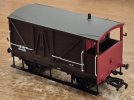
Fortunately I was then made aware that six of the Dia.1541 'Road Vans' were fitted with vacuum cylinders in LSWR days for use on traffic out of Southampton, with one of these, SR 54885, being preserved.

So with that, I purchased the Kernow model (of which many have sold out, bar the variant I was after which is in plentiful supply!).

20260717_175031.jpg

To this, a vacuum cylinder and bufferbeam pipes need fitting, as well as renumbering.

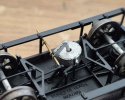
Today saw the vacuum cylinder going under:

20260717_191334.jpg

20260717_191500.jpg

The bufferbeam pipes and renumbering will follow this week between painting the cattle vans.

As a side note, Kernow's rendition of these vans are quite nice; they are detailed but sturdy vehicles and certainly the better of the aforementioned options.

- James
 

Liver & Fry

Western Thunderer
Today was quite successful really, with time found for both projects that are currently on the go (it did help that both required the use of black paint!).

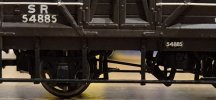
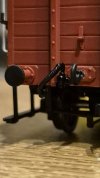
Of course, this thread will focus on the SR brake van, which saw the bufferbeam pipes fitted, those and the underframe painted and finally, the renumbering on one side.

20260719_221924.jpg20260719_222120.jpg

It's a minor side quest, and it's nearly over, but it's been a fun exercise all the same!

- James
 
Joseph Boam Limited New

Liver & Fry

Western Thunderer
Time for another side quest! Kind of...

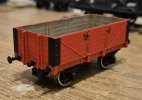
This wagon actually forms part of my upcoming East Anglian PO wagon project I've been working on in the background, but unlike the other wagons, this one benefits from using an RTR wagon as a base for repainting, versus the nine (yes, nine!) Meon Valley Models kits I've recently taken delivery of...

So, the basis is a Rapido RCH 1907 5 plank:

20260725_163550.jpg

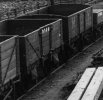
And the intention is to repaint this as a wagon operated by Joseph Boam Limited of Leicester, who had significant business interests in West Norfolk (specifically sand traffic out of Bawsey, Leziate and Middleton, but also as a coal factor in the area). I'm intending to go with No.153, as there is a clear photo of this wagon at Beccles in the Windwood collection (held by the GERS) on 11/10/1911 (cropped version included below for illustration purposes):

Screenshot_20260515_131655_Chrome.jpg

So far the wagon has been stripped of its lettering, ready for a coat (or two) of red:

20260725_165647.jpg

I'm hoping this will be a quick one to hit the ground running with now the cattle wagon builds for Skeetsmere are reaching their conclusion. When it comes to the subsequent nine wagons, I'm likely to batch build all nine Brassmasters chassis kits in one go before focusing on each body individually. But I'm getting ahead of myself! That's for another time...

- James
 

Liver & Fry

Western Thunderer
Red can be a difficult subject in Edwardian photography, often blending in to the shades of grey around it. Of course that means that trying to identify wagon liveries on black and white photographs can be somewhat hit or miss.

Take the reference photo for No.153 as an example:

Screenshot_20260515_131655_Chrome.jpg

There's very little differentiation between the parts one might expect to be black, and those that are red (and it worth noting that it is generally accepted that the wagon should be red).

So, what else do we have? Well, there's this later photo of No.510:

FB_IMG_1785193519436.jpg

Sadly I cannot credit a source as this was posted on Facebook "photographer unknown". However, it has clearly been the source or various (inaccurate) models over the years by Hornby and Dapol.

If we look at the corner plating nearest the camera, you can clearly see the plate is black, vs what we are told is a red body. You will also note that there is a distinct line on the diagonal ironwork where the black of the corner plate section ends, and the ironwork is then red to match the body. Tracing this at a zoomed in level suggests that this rule applies to all the ironwork on the bodyside, although it is worth nothing the Dapol model has the uprights either side of the door in black.

So, if were are to understand that a later wagon, in a later livery, but owned by the same operater is painted in this style, can we infer (for lack of better evidence) that this same pattern can be applied to No.153? Or is it more a case of "well there's no evidence to deny it either"?

- James
 

Rob R

Western Thunderer
Red can be a difficult subject in Edwardian photography, often blending in to the shades of grey around it. Of course that means that trying to identify wagon liveries on black and white photographs can be somewhat hit or miss.

Take the reference photo for No.153 as an example:

View attachment 269242

There's very little differentiation between the parts one might expect to be black, and those that are red (and it worth noting that it is generally accepted that the wagon should be red).

So, what else do we have? Well, there's this later photo of No.510:

View attachment 269243

Sadly I cannot credit a source as this was posted on Facebook "photographer unknown". However, it has clearly been the source or various (inaccurate) models over the years by Hornby and Dapol.

If we look at the corner plating nearest the camera, you can clearly see the plate is black, vs what we are told is a red body. You will also note that there is a distinct line on the diagonal ironwork where the black of the corner plate section ends, and the ironwork is then red to match the body. Tracing this at a zoomed in level suggests that this rule applies to all the ironwork on the bodyside, although it is worth nothing the Dapol model has the uprights either side of the door in black.

So, if were are to understand that a later wagon, in a later livery, but owned by the same operater is painted in this style, can we infer (for lack of better evidence) that this same pattern can be applied to No.153? Or is it more a case of "well there's no evidence to deny it either"?

- James
James,
I Think what you are seeing at the top of the left hand diagonal is the joggle in the diagonal from side plank level to corner post level.
That said, the far diagonal does look body coloured. The upright passing through the O in Boam looks black to me, not so sure about the door ironwork.
Rule one applies.
Rob
 

Liver & Fry

Western Thunderer
James,
I Think what you are seeing at the top of the left hand diagonal is the joggle in the diagonal from side plank level to corner post level.
That said, the far diagonal does look body coloured. The upright passing through the O in Boam looks black to me, not so sure about the door ironwork.
Rule one applies.
Rob

Now you've pointed it out, I can see the "joggle". I do still think the diagonal is a different colour over the corner plate to what it is on the body though.

I did previously wonder about the outer uprights, as the black shading of the P and O disappear against them, but I couldnt convince myself of a conclusion one way or the other.

That said, I have since ran the image (somewhat crudely) through MS paint, and the colour selection tool showed those outer uprights to be darker than the diagonals and the door ironwork, both of which appear to be a closer match to the body colour they're next to.

I shall mull it over before I sit down at the bench later...

- James
 

adrian

Flying Squad
Now you've pointed it out, I can see the "joggle". I do still think the diagonal is a different colour over the corner plate to what it is on the body though.
I think I would agree - again tenuous but the lettering has an obvious drop shadow a different colour to the body so making the assumption that would also be black. Where the white of the J crosses the ironwork so does the drop shadow and there does seem to be a subtle colour change between the drop shadow and the iron work.
 

Liver & Fry

Western Thunderer
So in the end, my inability to see the diagonals as anything but red won out. It was then pointed out to me by a few individuals that it would be an odd choice to paint the diagonals body colour, but go to the effort of picking out the uprights in black. Far simpler (and cheaper, from a business perspective) to be consistent. It would also ensure there was no clash between the ironwork and any shading that crosses it. The same logic was applied to the solebars as well (why go to the effort of some and not all?).

As such, I now have a wagon that looks like this:

20260728_222745.jpg

Will I ever know if it's correct? Probably not, but at least I feel I have a vague logic to support it! I did leave the moulded chains black, as well as the V hanger on the opposite side.

After that, I turned my attention to the inside, applying some tonal variation:

20260728_222529.jpg

Lettering to follow!

- James
 
Top