Dave Holt
Western Thunderer
As mentioned in my B1 61159 thread, I'm working on a L&Y Class 27 owned by my friend David Clarke in return for him painting, lining and weathering my Ivatt Class 2 tank.
The model is based on a Craftsman kit but with a CSB sprung chassis (I think by Dave Carter). It was partly built but without the centre drivers, motor or gearbox and no chassis for the tender. My task was to get the loco running and finish off the chassis and to build the tender chassis using a Palatine Models etch.
Work on the loco is now complete from my perspective although it still needs the body finishing.
To minimise visibility of the motor and gear box, and to allow filling in the cut-out in the boiler, a compact High Level models gearbox and motor have been fitted. The other main jobs were to make the brake gear and sand pipes, all of which have to be removable to allow the wheel sets to be dropped out for painting and any maintenance. The front sand pipes in particular were a challenge to figure out as they bend round the outside of the front brake hangers very tightly. The solutions was the fix the sand pipes to cross-frame brackets with 14 BA countersunk screws. All very fiddly.
However, some of the ideas can be carried over when I come to build my own model of one of these locos.
Here are a few shots of the loco and chassis during the work.
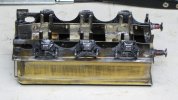
Bare chassis after fitting the centre drivers (with axle mounted gearbox).

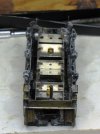
With brake gear fitted.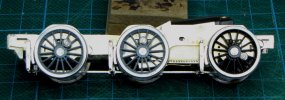
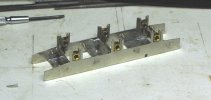
With sand pipes added.

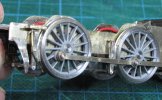
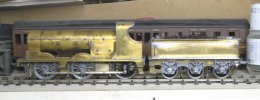
With the body fitted, before the boiler cut out was filled.
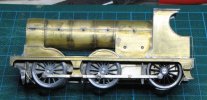
Dave.
The model is based on a Craftsman kit but with a CSB sprung chassis (I think by Dave Carter). It was partly built but without the centre drivers, motor or gearbox and no chassis for the tender. My task was to get the loco running and finish off the chassis and to build the tender chassis using a Palatine Models etch.
Work on the loco is now complete from my perspective although it still needs the body finishing.
To minimise visibility of the motor and gear box, and to allow filling in the cut-out in the boiler, a compact High Level models gearbox and motor have been fitted. The other main jobs were to make the brake gear and sand pipes, all of which have to be removable to allow the wheel sets to be dropped out for painting and any maintenance. The front sand pipes in particular were a challenge to figure out as they bend round the outside of the front brake hangers very tightly. The solutions was the fix the sand pipes to cross-frame brackets with 14 BA countersunk screws. All very fiddly.
However, some of the ideas can be carried over when I come to build my own model of one of these locos.
Here are a few shots of the loco and chassis during the work.
Bare chassis after fitting the centre drivers (with axle mounted gearbox).
With brake gear fitted.
With sand pipes added.
With the body fitted, before the boiler cut out was filled.
Dave.