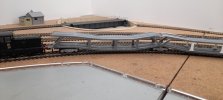
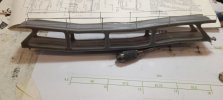
John I's Occasional Workbench Thread

cctransuk

Western Thunderer
Hi,

Having now a fully operational (but scenically barren) layout - based very loosely on Evercreech Junction - I find the imperative to model somewhat diminished.

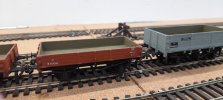
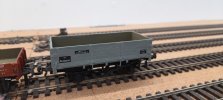
However, I try and keep at least one rolling stock project going; and the next one up is a 4mm. scale BR 1/007 20T PIG IRON wagon.

This will be based upon the body components of an Appleby Model Engineering kit, which I found amongst a hoard of castings given to me by John Talbot; (see the AME listing on the Cambridge Custom Transfers website for what remains available).

I am currently getting together various chassis components from my 'wagon bits' box, and the transfers have been designed and printed. Construction will commence shortly.

A recently completed project was the refurbishment of eleven Trix 'Whisky wagons' - one of each of the variants produced.

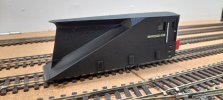
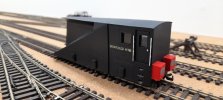
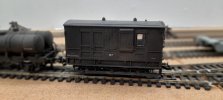
Another was an ancient Anbrico kit for the GWR diesel railcar No.14. This has been completed as running in early BR condition, with some of the valance panels removed.

20240806_111102.jpg

The model is of its time, but looks well running alongside an upgraded Lima ex-GWR railcar, and I have a cast kit for the 'Lambourn Car', and the makings of W33W + W1096W + W38W amongst my pending projects.

John Isherwood.
 

cctransuk

Western Thunderer
October 11th 2025.
I have an ongoing co-operation with Jonny Duffett, (Ironmink on Thingiverse) to produce transfers for the 3D print files that he uploads for free download.

251012_121838.jpg.0b2a31463813cbbc147fcab6d70f6b00.jpg
BR 1/055

251012_121853.jpg.04754015861398a6e7b6541bfd8c4078.jpg
BR 1/016

251012_121916.jpg.908b2938c349cf16236f84a6330ba018.jpg
BR 1/017

251012_121923.jpg.395e6b5fd88931282471a94e5dd20fe3.jpg

BR 1/033

John Isherwood.
 
Last edited:

cctransuk

Western Thunderer
Currently, I am converting two of the mythical K's 'Cartic-2' kits into one four wagon set.

These kits were produced for BR publicity purposes at the end of the 1960s, and there are recollections of completed models being displayed in travel agents, promoting the MOTORAIL service. They were also used on a Hornby Dublo / Hornby Acho model of the then-proposed 1960s Channel Tunnel - project subsequently deferred. For a very short time, K's offered these kits for sale via adverts in the model press, but they have now become like hen's teeth!

The conversion of the kits to form an authentic CARTIC-4 is quite easy, using 1mm. thick plastic card; a copy of the Skinley CARTIC-4 drawing proving invaluable.

1766147741913.jpeg

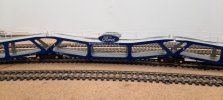
These are the side members, as shortened and modified to the profile of the centre vehicles. The deck mouldings simply required shortening to suit.

The K's mouldings came from low-cost, short-life brass tools, and had warped a little over time - 60 years or thereabouts? Some 'gentle persuasion', and plenty of masking tape, produced reasonably square bodies once assembled.

The whitemetal bogie castings are superb - though, assembled as supplied, they 'crab' somewhat. A minor adjustment to one end of the bolster solved that.
20251214_123332.jpg.3dfcfcaf6efbf82b71400fc3b5f68810.jpg
20251214_123343.jpg.e912f3cf08fad9b49a92f925f812f5fe.jpg

20251214_123347.jpg.8c5e79a044f79cafa32b27a6cea6d3fb.jpg

20251214_123353.jpg.c44a4d10c48581d9162529bf276aa50c.jpg
20251214_123359.jpg.3c5caaa136fb8395ce25c36f9501bcbe.jpg

A brief on-track trial produced excellent running - including propelling - and the skeletal nature of the prototype is well represented.

Much tidying-up and detailing will follow in due course, and the ever-present fragility of nearly sixty-year-old plastic will make this a delicate task.

One of the sets of transfers provided in the kits - just the MOTORAIL branding - has crazed beyond redemption, but the other is capable of being scanned and 'cloned'.

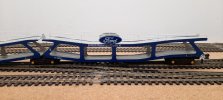
My set will be the first prototype in FORD livery, using my own transfers.

To be continued ....

John Isherwood.
 
Last edited:

cctransuk

Western Thunderer
Not done too much to the CARTIC-4 lately - Xmas disruption and all that!

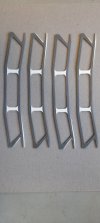
However, I have smoothed-off the construction joints; detailed the bufferbeams at the ends of the set; fitted brake reservoirs to the outer wagons - the FORD prototype had vacuum and air braking; produced eight eliptical mounting plates for the FORD logos; and designed and printed soldering templates for the tubular handrails. I am awaiting delivery of nickel-silver wire to fabricate the handrails.

The next job is fitting the vacuum piping between the solebars and articulation bogies; I have some very flexible synthetic beading 'thread' that will be ideal for this.

I have some photos of FORD sets, which indicate that there were two iterations of the FORD logo - distinguishable by the thickness of the blue borders outside the white ellipses. So it would seem that there were more than one rake in FORD livery.

The other distinguishing feature between the FORD sets is that one had solid tubular railings, and one had what appear to be chains encased in some form of flexible tubing. It is possible, though, that the prototype set was modified by having the horizontal rails removed and fitting chains, plus repainting, including slightly different FORD logos. All traps for the unwary!

The thorny subject of livery now arises! As records indicate that the FORD set was painted in Ford Blue, which is specified elsewhere as RAL 5010 GENTIAN BLUE; I duly ordered and received 250mls. of RAL 5010 as a semi-gloss brushing enamel.

On opening the tin, the contents appear to be a slightly more vivid shade of Rail Blue! This reminded me that, over the years, there has been much debate as to whether XP64 blue, and early repaints in BR blue, were a more vivid shade than that used for the fleet-wide repainting of BR stock. I now wonder whether the XP64 shade was, in fact, RAL 5010 Gentian Blue! We will have to see what it looks like when applied to the CARTIC-4.

John Isherwood.
 

cctransuk

Western Thunderer
I managed to recover a little motivation this afternoon.

I set to with 0.45mm. nickel-silver wire, cutting /soldering jig drawings and the soldering iron, intending to fabricate the first set of upper-deck handrails.

1000002424.jpg

3mm. dia. drills were inserted into holes drilled in the diagram / workboard, around which to bend the end curves, and 0.5mm. holes at the end of each vertical rail.

The top rail, with the two end uprights, was bent as one piece, with the ends bent at right-angles as fixing pegs.

Each upright had its end fixing peg bent and inserted into the locating hole drilled in the jig diagram, and cut to length to butt up to the top rail.

Each length of wire was taped onto the diagram, pending soldering. The joints were dabbed with paste flux, and the soldering iron, loaded with the absolute minimum of solder, was touch on each joint.

This process was repeated for the lower horizontal rails.

A little cleaning-up and adjustment of the attachment holes will be required, but I am pleased with the results - I had been putting-off what I thought would be a horrible task!

John Isherwood.
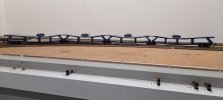
 

Dave F.

Western Thunderer
And I've recently received the transfers for my Ammonia tanks, John did two new sheets covering the white liveried Liquified Ammonia tanks in ICI and W^D livery.
Not got round to painting the tanks yet as busy with buildings.
Thanks for doing these John.
Ammonia tanks cropped.jpg

Dave F.
 

cctransuk

Western Thunderer
Painting has been undertaken on the CARTIC-4 - though by brush rather than airbrush. Weather, and a lack of motivation to get out the airbrush 'clobber', were responsible!

As a consequence, the finish is not perfect, but as a 'layout' set, it fulfils my requirements.

The set still lacks 3D printed access ladders - these await suitable temperatures for printing.

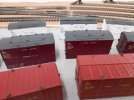
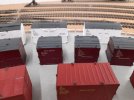
20260212_114814.jpg
20260212_114822.jpg20260212_114829.jpg20260212_114834.jpg20260212_114843.jpg

I think that the FORD corporate blue livery is perfectly captured by the Ford / Gentian Blue paint that I ordered, and combines well with the Precision Rail Grey. I found an ancient tin of BR Chassis Brown in my paint drawer, so I was able to reproduce the prototype painting specification.

John Isherwood.
 

Dave

Western Thunderer
241108_130724.jpg.6b6d5f294b13cb5142d528d00e5d9aa0.jpg
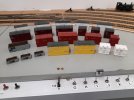
Hi John. What type are the small grey open containers? Is the larger one above them a D type?
 

cctransuk

Western Thunderer
The small grey containers are 'H' type - 'H' standing for 'HOD' (a builders' brick carrier) it has been suggested.

The larger one is indeed a 'D' type.

The yellow one is a converted 'FM' type, now 'F' type - for carrying (empty) egg boxes in bulk! Conversion comprised a coat of yellow paint, applied AROUND the existing lettering, and over the 'M' of 'FM'!

John Isherwood.
 

cctransuk

Western Thunderer
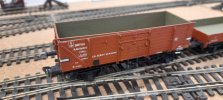
1000002508.jpg
20260304_140354.jpg.eddf4cfc54996f684ab9e5e0ed3673c3.jpg

S&DJR 41 / 26 as DM358326 in inauthentic early BR condition; (3D print).

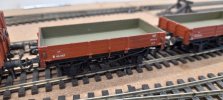
20260304_140408.jpg.8c11973384b6bbf144122c50f01d6308.jpg

S&DJR 2 as DM2 in inauthentic early BR condition; (3D print).

These are test prints, generously donated to me by a friend. The prints MAY appear on the market in due course.

John Isherwood.
 

cctransuk

Western Thunderer
I am about to start building a 4mm. scale David Geen kit for a 14T tank wagon.

I would like to finish the model as an ESSO Class A wagon with a cradle tank mount, but I am having trouble finding a photo of a prototype vehicle.

Bachmann produced this : -

s-l1200.jpg
Can anyone say whether the model is authentic - or just a figment of the imagination.

Failing that, does there exist a database of the numbering of the Standard Oil / ESSO fleet?

John Isherwood.
 

cctransuk

Western Thunderer
I am about to start building a 4mm. scale David Geen kit for a 14T tank wagon.

I would like to finish the model as an ESSO Class A wagon with a cradle tank mount, but I am having trouble finding a photo of a prototype vehicle.

Bachmann produced this : -

View attachment 262317
Can anyone say whether the model is authentic - or just a figment of the imagination.

Failing that, does there exist a database of the numbering of the Standard Oil / ESSO fleet?

John Isherwood.

Very helpful information from 'the other place' has pointed me to Volume 2 of Geoff. Kent's 'The 4mm. Wagon'. I'd completely forgotten the extended treatise that he gives on all manner of tank wagons, and the building thereof.

ESSO Class A 14T No.1210 (and 1211) are illustrated there, and it transpires that these wagons were 18' over headstocks with a 10'-6" wheelbase. The Bachmann model is 17'-6" over headstocks, with a 10' wheelbase.

So far, so good - the Dave Geen (neè Cambrian) kit is 18' over headstocks, with a 10'-6" wheelbase.

So - for 1210 or 1211, as per 4mmW2 - saddle mount; omit the bottom discharge; add syphon and breather fittings; single strand securing cables / rods with hidden solebar fixings (result!!); we should have an accurate model!

No doubt it will in future be knowingly identified as the Bachmann model, and I'll be told that it has the wrong length / wheelbase. I think that I'd better number it as 1211!

John Isherwood.
 

D869Zest

Active Member
I've never come across an exhaustive list of Esso/AA tanks but I do tend to collect references to photos of them and notes on detail differences.

Those two I think were built by G.R.Turner in 1919 loosely to the RCH 1911 14T spec. Other builders interpreted the spec equally loosely. A lot of 1911 spec AA/Esso 14 tonners were built by Hurst Nelson. Some at least of those I think were 9'6 wheelbase (I scaled from the side-on photo of Esso 2878 in the same book). Looking now at the picture of Shell 3682 in the same book I could believe the wheelbase is longer so maybe not all Hurst Nelson built 14T 1911 spec wagons had the same wheelbase. If only they wrote the wheelbase on the solebar more often!

I've never seen a 1911 spec 14 tonner 'in the flesh', only the smaller Hurst Nelson 10 tonner at Didcot... which my tape measure said was 9'6 wheelbase.

The fastening of the diagonal ties is another point of difference - 1210/11 have them passing through the saddles and fixed behind the solebar. HN fixed them to the outside of the solebar.

FWIW I was planning to model one of those two in 2mm until I realised that they were by G.R.Turner and my model was Hurst Nelson.

Barrel diameter is another place where some 4mm RTR stuff may go astray. This was a function of the density of the stuff inside and should be in the region of 7ft for a class A 14 tonner.

HTH.
 
Top