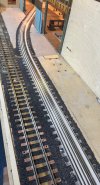
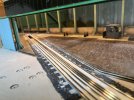
Hunslet Works in 7mm

Andy Ross

Western Thunderer
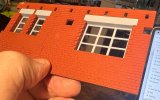
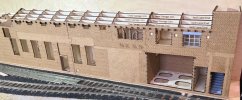
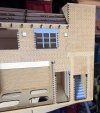
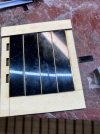
Since Easter I have spent a lot of time redrawing the structure between the test track and boiler shop. This included sorting out how to do the recesesd widows

D56.jpeg.c6d6f446d5756e3409cc0716c29844c5.jpg

This involves several trial runs with the 3d printer and the laser.

IMG_4229.jpeg.69c85cab2fd2ae3a7b650cd67e456c38.jpg IMG_4230.jpeg.e38f5020c961e6cff9b9b82904825d3d.jpg

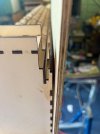
You can see that when you interlace the corners you have to allow for the variance in the thickness of MDF. I have done a final test since I took these photos and based the corners on 2.2mm thick and they are now flush.
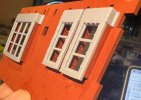
IMG_4231.jpeg.b3b6dfad7f682fbec06d3292abf3e483.jpg

The depth to the window frames is also critical.

The plan now it to cut all the MDF for the wall details from one batch which should have a consistent thickness.

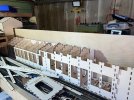
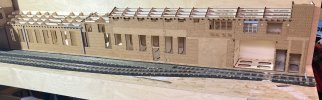
With this all sorted I then got on with redrawing the main sub structure - this is now all 3mm thick and on a proper base. Allowances have also been changed to accommodate the window frames including the stone lintels etc.

It took best part of a weekend to cut all the parts and this weekend to put them together.

IMG_4331.jpeg.b3e404055557b38a7af2f18c6f8e1d19.jpg

IMG_4321.jpeg.e86516ce2b0cb12f4949d109e9d74317.jpg

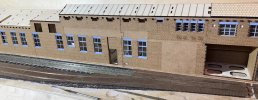
The whole structure is just over 1.3m long.

IMG_4335.jpeg.308a6a86a4b6f644ab0a8eff3d38bc42.jpg

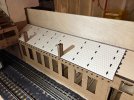
Today I fitted all the roof trusses.
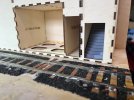
IMG_4340.jpeg.3767ec5e2dd0c5afb2dd980a223ef15c.jpg

IMG_4338.jpeg.e09dcb1bcfc2807168717c17a4fcedf8.jpg

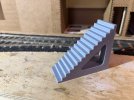
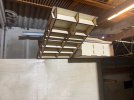
One of the doorways has stairs up to the offices - these ave been 3d printed.
IMG_4341.jpeg.08088e139c361ec152d623e7debf37bc.jpg

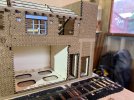
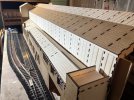
The other thing that has taken time is the design of the false wall for the boiler shop and the half roof.

The structure is designed to produce a groove for the wall and roof section to drop into. (The needs to be removed for transportation).

IMG_4342.jpeg.f6f283fb73b6f65cab50378c2bafd01b.jpg


IMG_4345.jpeg.1e6cde28b765690575d4caab0a5bf9ba.jpg

The photo shows a short test section - the real one will go the full length of the builded and around the back of the tower.
IMG_4351.jpeg.1a53de53c030ad82434ff32d611de0eb.jpg

On the full roof, every fourth brace will have a lug with a 6mm hole.

IMG_4353.jpeg.9fec5ac8efd7c56b4bb729cc852c9ed4.jpg

To help support this during shows there will be some braces in a position represented by the ruler. These will locate into holes drilled in the back board.

The roof will be tiles and glazed to match the roof on the main base board.
ChannelTunnel.jpg.d63cf4735512209b058c1f043fdd632b.jpg

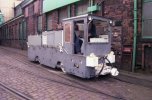
The vertical face will be dummy glazed as can just be seen on the photo with the TML loco.

The only issue in all of the above is that I have had to remove the point lever as it ended up in the garage on the building.

I am now looking at fitting a DCC point motor under the base board but as luck would have it we are very close to a diagonal cross brace. I will let you know how I get on with getting the point back in to commission.

Andy
 

Andy Ross

Western Thunderer
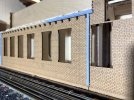
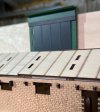
After a lot of adjusting and checking, the three section of MDF that make up the brickwork on the main yard building is now finalised and cut. This incudes the brick brackets for the gutters.

IMG_4362.jpeg.9ae45fc12ad7f2350a8cdd43d243aeea.jpg

There were a couple of errors in the patterns of the bonds, especially where they change when the building was altered over the year.

IMG_4363.jpeg.8c6a415f15f0c9862538213bb0421852.jpg
The rate brickwork still needs to be fitted before the panels are glued to the structure.

I have also done some trial down pipes and gutters on the 3d printer.

IMG_4365.jpeg.ffbdee1e0b9a5966722ace46fabdc3fe.jpg

There is a location peg at the back of the brackets, and these locate in laser cut holes in the panel.

IMG_4366.jpeg.49bf6a594ef1a4b3aef90205517a021c.jpg

They do really good job of covering the joint in the panel.

There is still lots to do, but it is coming together now.


Andy
 

Osgood

Western Thunderer
This incudes the brick brackets for the gutters.

- which I hadn't even noticed until now!
An interesting architectural feature not often seen (or should that be not often noticed?).

I'm going to have to get to a show to see and appreciate your work - do please keep us up to date on outings.
 

Andy Ross
Western Thunderer
- which I hadn't even noticed until now!
An interesting architectural feature not often seen (or should that be not often noticed?).

I'm going to have to get to a show to see and appreciate your work - do please keep us up to date on outings.
The next outing for the layout is not until October next year at Warley at Statfold. I made the conscious decision to stop taking the layout to shows so I could finish all the main features. this has already proven to be the right thing to do as I have already had to remove items that will prevent it from being able to operate at shows.

I will of course continue to update the progress on here. To give you some idea of what is left to do I am putting a list of outstanding jobs which I will share over the next few days.

Andy
 

Andy Ross

Western Thunderer
I have been asked how much more is there to do, and I have been saying I will bit a list together so please see below.

To be fair I should not of done this as it has come out a lot bigger than I expected and I am now a little concerned.

Hunslet Works Outstanding Jobs Lists

General

Finish last bit of wiring onto fiddle yard
Make up new jumper cables between boards and back to Panel
Paint edge of baseboards and fit Velcro for cloth ( Last Job)
Sort and fit point motor and set up on DCC
Strip down and Paint both MOD Locos
Fit new sound chip and stay alive to MOD Loco
Paint 28hp and sort running
Paint Snowdon and Board Na Mona Loco parts
Paint Stillages already made
Make DCC set up test box for all gauges
Sort proper fixing of braces with PK
Look at packing of narrow board so not crated with fiddle board. PK

Cranes
Add all modification included on second crane to first.
Fit handrails and wood deck to first crane.
Replace all long travel motors
Rerope both crabs
Paint and weather both cranes.
Send Drawing to Modelu to produce crane drivers.
Build Spare Crab

Main Building
Make extra Benches
Fit Remaining Benches
Design and make charge hands desks
Build more Cupboards - From sheets already cut
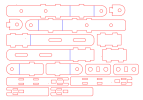
Make different Cupboards - To draw and cut.
Do high Level internal Door for both sides - Crane track from Bridge.
Sort how to do pit and cut parts
Make more trestles and Stillages
North Light wood covers to remove and remake.
Re position lighting in North Light LED Lights from boxes to frame
Fit Tiles to all roof sections
Draw and arrange cutting of clear acrylic windows.
Sort window in North Lights and Boiler shop roof.
Sort windows over main door and surrounds
Run Pipe work down sides
Draw, print and fix gutters.
Down Pipes from bottom of North Lights
All other external pipework including gas pipe (Check photos to establish approx. date fitted)

Wheel Shop
Finalise design of front section of Building
Cut parts from MDF for front.
Do drawings for window frames and door panel
Assemble front of building
Sort glazing for side window - poss. clear from JS Models
Tile front section.
Sort corrugated roof panels - decide what to use.
Design how to male set up table for checking quartering.
Make gas Rings for tyre heating.
Fit pipework to gas rings
Design Wheel press for printing
Paint all wheel sets
Position wheel sets in shop and fix
See if there is a way to fit some lights
Fit crane rails to structure
Build Dummy crane - Might move on long travel.
Fit other pipework

Yard Building Build Structure
Fit rebates to detail panels and fix panels.
See if windows can be printed open.
Finish 3d Printing window frames
Trial fit all window frames
Finish Drawings for down pipes.
Etch drawings for pipe cover near toilets, Boiler shop Door and runner, Beams inside garage, Bridge Power House front, Bridge support structure. Panels for cable protectors and down pipe protector.
Detail paint all brickwork
Sort Glazing on Toilet Roof - poss. black acrylic.
Draw and cut all roof panels.
Tile roof section and corrugate middle section.
Make ducts from centre section of building
Do drawings for cables going into power house and print
Finish Design for boiler shop wall above building and false boiler shop roof and cut parts
Build glazing panels for boiler shop wall and top of false roof.
Tile roof section
Design roof walkways - cut parts and install.
Warning signs for when locos are on test.
Yard Infill Test track with filler.
Trial methods for painting sets
Finish Drawing to engrave sets - engrave and fit
Draw all concrete sections and packers - Cut and fit
Drawings for grates and other items in floor.
Draw cover for point tie bar - to be removable
Add weeds to were walls meet yard .

Extra jobs if time
Build second 28hp kit
Do drawings and have etched Esso Loco x 2
Look at option to improve fiddle yard board and mount for slide show screen.

I have this on a spread sheet and will delete and update as we move forward.


Andy
 

Allen M

Western Thunderer
Hi Andy
That should keep you going till the Summer :rolleyes: :) :D ;)
Please keep us updated with the progress. For me, being on into my 80s the forum is where I see most of my modelling now as travelling to shows, except very local, is too difficult.
Regards
Allen
 

Andy Ross

Western Thunderer
I have now glued all the panels onto the structure.

500

All the return brickwork has been glued in place along with the chimneys.

IMG_4378.jpeg.7a0e4137c06f72de9ffbb5b7aa892e25.jpg

What always amazes me is even when some of the parts are laser cut and some 3d printed they all line up as they should.

I know how it works but they are two completely different processes and the accuracy level is so good for machines that cost so little.

The 3D printed stairs match up perfectly with laser cut sides.

IMG_4372.jpeg.afc23fdc4cd4279b9e8168b272d3d364.jpg

IMG_4374.jpeg.d609f0db05fbee4c6eadff9b8fb08664.jpg

IMG_4376.jpeg.3ab03a4d31db71b8bc55e9cc6a24fbe4.jpg

The stairs come out of the back of the building to help painting.

The other door way has a door set back which will be printed.

There is a mother stairway to do further down the yard.


Andy
 

Andy Ross

Western Thunderer
There has been a major development this week. Three nights in hotels room on business gave me the opportunity to get the roof panels for the yard building drawn and to finalise the design for the Boiler shop wall and roof section.

IMG_4454.jpeg.c2f8313caa307c73d218b743a37ef6ae.jpg

The roof has the tile pattern scored on it to help with the fitting of self adhesive tiles.

IMG_4453.jpeg.5ff4ded35402534e7ac11ce4b60ad7f4.jpg

The pitched toilet roof is glaring panels. the pitch of the panels is scored on. 2mm Tee section will be fitted to the roof panel and black acrylic panels will be fitted between the tee's.

The big job for the weekend was the cutting of the boiler shop wall and roof parts and the assembling today.

I initially tried setting the parts out on the base board.

IMG_4455.jpeg.b8f6b880b97e65fee6c56c91ffb4d256.jpg

However, with the track underneath it was not practical. So I agreed with Jill to clear the breakfast counter in the kitchen and we laid it out on there.

IMG_4457.jpeg.2bd309ced86f1869f6e2677623a7dbe2.jpg

We built all the parts up and weighted it down. But how to glue it? You can get a special glue for laser cut kits. this is very thin and works quite quickly. You can also run it into the corners and it will run into the joints. we each started from either end and worked to the middle adding more weights as went.

IMG_4460.jpeg.8917d9ad0345c3d6c0e2972fe13a99cc.jpg

Once this had dried we added the wall panels, and then the lower tiles area panels. Again it will be glazing panels on the wall and at the top of the roof.

We let it all dry for a while and then it was time to try it in place.

IMG_4462.jpeg.4caf99c0354fdfe1a3e76978f9df195e.jpg

This assembly slides int a slot at the back of the yard building and rest on the top of the baseboard back panel.
IMG_4466.jpeg.66caedb7d9a5823112ce8ae84b411ffc.jpg

I was very pleased when it dropped in place.

IMG_4464.jpeg.b54f3fe588ab77404161a65451e0be4e.jpg

It completely changes the appearance of the layout.

IMG_4463.jpeg.441a70350fbe64f1932cd99494b15a6f.jpg

It also lines up with tower and the roof on the main board.

IMG_4469.jpeg.20a65737ff9336ada49bba05bd6791de.jpg

There is still a lot more to do. To prevent the roof from sagging I need to design some fold out supports that will go in the back board of the baseboard. There are all the roofing bars, glazing panels, Gutters and fall pipes to fit and paint plus all the tiles.

But I will say it again, I am really pleased how this has come out.

Andy
 

Andy Ross

Western Thunderer
Apologise all - I thought I uploaded this on the 5th July. There is a second post to follow.

It's been a little while since I had my last post due to holidays and other comitments.

However the last couple of weeks has seen some progress.

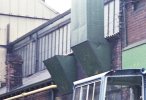
I needed to works out the best way to recreate the glazing along the boiler shop dummy wall. You can see it in the photos below.

Standard0-4-0a.jpg.88867b405d28417e899490e35b3eff81.jpg Standard0-4-0a.jpg.9dc60f8179e3d980f934df8a29fa81f8.jpg

I have worked out the width of the glazing panels and from the photos there is no visible join from top to bottom. I have scored the centre lines on the wall and roof section based on using 2mm Tee section but thought I should do a trial run.

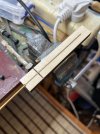
The first thing to do was to make a jig for cutting the Tee section to ensure they are all the same length.

IMG_4763.jpeg.71894f00b6edc9557c536bd6e08455e1.jpeg

IMG_4765.jpeg.57e7db55377ae6718fc80694ba35724d.jpeg IMG_4766.jpeg.ce09a73fb8df667e4cf9925689fdfd7e.jpeg

I cut a test piece from the structure drawing and glued the Tee section to the panel and fitted some strips of 1mm black acrylic.

I took the acrylic panels off the panel and etched primed the Tee section, I then fitted a length of 3d printed gutter. The whole thing was then sprayed with green primer. The acrylic was re fitted and it was then sprayed with some Army painter wash to weather it.

IMG_4767.jpeg.5f81ef09789b445213c63396de67b27a.jpeg

To be fair I a m not 100% happy with it but its a good starting point and further trials will be done.

I have also been working on supports for the extended boiler shop roof. As stated before the structure rests on top of the baseboard back board. But it is only sat in a slot so it does sag.

To stop it sagging I have designed some extendable supports.

IMG_4769.jpeg.2586f2b59544905fef40a75cc358cac0.jpeg

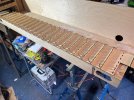
The roof is designed with a mounting lugs along its length. The support picks up off these. The bottom brackets will be doweled into the back panel so it can be taken off for transporting. There is a short amount of adjustment in the length of the bracket. The drawing shows all the parts needed to make one.

Image.png.792ac9f96214659d2734b47fbe330ab4.png
In order to get the bottom brackets in the right position I made a jig the picked up from the bottom of the baseboard.

IMG_4771.jpeg.8ad04f5f1f375265fb8de83f43f5ed0d.jpeg

The centre line was marked on in line with the top brackets while the roof was in place.

IMG_4774.jpeg.d3e7a0a90fffedf383520db7e670b85b.jpeg

The Steel dowels are fitted to the brackets. The bracket then locates in the holes in the back board of the baseboard.

IMG_4776.jpeg.f1aec48257e0c0e4a481b20ca3de9412.jpeg

I settled on using five support along the length of the roof. When these were put in place the the whole structure was far more rigged and lined up level with the roof on the main board.

IMG_4778.jpeg.aa9e0664d17fd052d7a05fdb9bb26f38.jpeg

The structure is taking shape but there is a lot of detail still to add.

IMG_4777.jpeg.923fee1ba74708fc0f628e0190457e1b.jpeg

The next job is the yard and filling in all the track - I still have to fit a point motor to the point as well.


Andy
 

Andy Ross

Western Thunderer
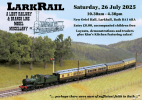
This coming weekend is Lark Rail and I am demonstrating along with Peter Kirmond.

image.png.aa7763251749e16392c604520d00cbd5.png

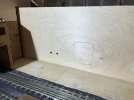
I am also taking the opportunity to take the narrow baseboard down to Peters to have some cut-out put into the back board.

IMG_4849.jpeg.cf094d28cdbd8c901b7072eeef399e19.jpeg IMG_4850.jpeg.69aa1f4de5f892a5a65d8e845ed710df.jpeg

These cutouts are to give access into the back of the building to allow me to bolt it down.

As I will have this with me I have asked the organisers at Lark Rail if they would have room for the board, buildings etc. This has been agreed.

I have also been doing the drawings for the laser to engrave all the cobbles around the point work. This take a long time to set up for cutting as you have to merge the picture bitmap file of the cobbles with the profile shapes.

They also take a long time to cut.

IMG_4854.jpeg.2d0dfd88e204c9a0cd6ed7fdae38d46d.jpeg

When I had done the drawings of each section I printed them out on paper and cut them out to use for templates to see if they fitted - any adjustment was marked on template and the drawings altered.

IMG_4845.jpeg.8bcab6a7db93c93d1305a28f0efcf5d0.jpeg

All the cobbles panels are held in place for now with double sided tape.

I have also been fitting windows frames - the small toilet ones need re drawing as I have got confused with the build up of layers.

IMG_4852.jpeg.f196f1e9f3516113184a415ad41b62ce.jpeg

I have also redrawn the main yard windows to include some with the top section open.

IMG_4853.jpeg.37c9d140571dac6e1d43372152f955d9.jpeg

As long as there is space at Lark Rail all this will be on mine and Peters Demonstration area.

Hope to see you there.


Andy
 

JimG

Western Thunderer
View attachment 244075 View attachment 244076

I have worked out the width of the glazing panels and from the photos there is no visible join from top to bottom. I have scored the centre lines on the wall and roof section based on using 2mm Tee section but thought I should do a trial run.
I think you might find that the glazing is several sheets of glass held vertically between the glazing bars with the lower sheets supporting the upper sheets with metal clips which hooked over the lower sheet's top edge and under the upper sheet's lower edge. I think you can see the horizontal ridges of the joins.

I glazed a greenhouse in a similar manner many years ago.

Jim.
 

Andy Ross

Western Thunderer
I think you might find that the glazing is several sheets of glass held vertically between the glazing bars with the lower sheets supporting the upper sheets with metal clips which hooked over the lower sheet's top edge and under the upper sheet's lower edge. I think you can see the horizontal ridges of the joins.

I glazed a greenhouse in a similar manner many years ago.

Jim.
You may be correct but in this scale you will not see the joins - what you can see on the photos running in front of the glazing panels are cables, which at first glance I thought were joins in the glass.
 

Andy Ross

Western Thunderer
Although I am not doing any exhibitions with the layout until October next year, as mentioned in the previous post I took the small board down to Gloucestershire so it could be modified by Peter Kirmond, so at the same time we took it along to Larkrail as part of out 3d and 2d Cad demonstration.

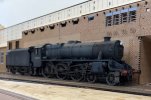
I also took my Ellis Clark Black 5

IMG_4866.jpeg.4eb48f9018cc19b5c21d28853d9dc93e.jpg

I placed this on the board as near as possible to the same location as when the real loco was photographed in the yard.

img069.jpg.3e4ee68201d38419c8ff75f039970def.jpg

I also provided a copy of this photo to Ellis Clark and Neil Armitage weathered the locomotive and it looks superb.

I had a lot of interest in the progress on the layout and this board was well received, the Black 5 also added to the interest.

It is a long way to go for a one day show, but Larkrail is more of a gathering of modellers rather than an exhibition and is always a good day.


Andy
 
Last edited:

Andy Ross

Western Thunderer
If you have been following activities on the layout, you will recall I had discovered that the position of the garage on the yard building meant I could not leave the manual point lever for operating the point. This meant I would have to fit a point motor. I could not fit a Tortoise as they are two deep for the baseboard. The position of the cross braces are also a problem relative to the position of the tie bar.

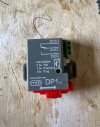
I looked at several option and it was also suggested on the RM Blog that I look at MTB Models DP1 DCC unit. This has a chip built in and controls the frog polarity as well.

IMG_4942.jpeg.21286ef17f6e3f6c69e1512349db28b7.jpg

These are very easy to set up - I used a spare power supply and just connected it to the track power, pressed the white button on the side and the digitrax unit set it to "switch one", and as you will see in the video below It worked.

It was then fitted to the point on the layout and the same power supply used to test it.

https://youtube.com/shorts/_-I157i1F8E

There is a piece of piano wire supplied with the motor that I passed through a slot in the board in front of the copper clad tie bar.

A piece of brass wire controls the amount of throw. The unit comes set with 6mm throw - you can reduce this to 3mm if required.

https://youtube.com/shorts/rUntlkVfLQ4

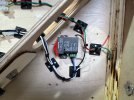
Once I was happy that it all worked I removed the temporary powered supply and wired the unit into the layout wiring - This was simple as I used the wires that had previously gone to the microswitch for the manual lever.

IMG_4902.jpeg.9648b1f87be11d408b784bc438412acc.jpg

This was all done over a week ago and the next thing to do was to test it using the hand held remote controller.

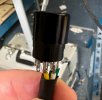
This is where it all went a bit wrong. You may also recall I had removed all the original temporary plugs and rewired some of the track feeds. I just needed to cut an old plastic plug off and fit a proper one and make up the last six way jumper cable. These were done and it was all plugged in. I got a test loco and tried it on the multigauge section and that worked, problem was that this was all that worked. By this time it was late in the day to start to try and find were I had gone wrong. I was also going off to Ireland with work so it would have to wait until the following weekend.

I started by doing various continuity tests. There is a separate track feed that goes to all the track that is not part of the multigauge test track. I checked these all the way back to the plugs from the panel. This took several hours and I could not find anything wrong. The only other thing I had disturbed was the original track feed cable that I had changed the plug on. I removed the cover from the end I had changed and found the issue, somehow I had got the white and yellow wire crossed.

IMG_4936.jpeg.6cc0de6870877c3c6966ff197b89488d.jpg

Once I had put this right everything worked.

I now tested the point motor using the dcc hand controller and that also worked.

https://youtube.com/shorts/IEBozr7xGfA

The only other question was if the point frog was the right polarity. It wasn't but this was easily fixed by swapping the wires over that supplied the DCC power to the point motor.

The loco then ran over the frog with no issues.

https://youtu.be/QL5QveemzXY

Now this is done and I am happy with all the track power, I can now finally cross something of the list, I can also finish all the cobbles and the filling in of the rest of the yard.


Andy
 

Attachments

  • 1755375361498.gif
    1755375361498.gif
    43 bytes · Views: 5
  • 1755375361491.gif
    1755375361491.gif
    43 bytes · Views: 4
  • 1755375361513.gif
    1755375361513.gif
    43 bytes · Views: 5
  • 1755375361505.gif
    1755375361505.gif
    43 bytes · Views: 8

Andy Ross

Western Thunderer
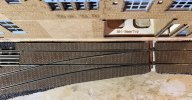
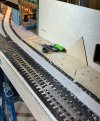
Following on from the previous posts, I started looking at the rest of the cobbles and the concrete in the yard. But it dawned on me, before I did this I really need to do the infill in the test track between the rails and strips. I had decided to do this using DAS clay as I had done on the Headingley Tram shed layout many years ago.

PA280215.JPG.b7b5a0f86fd43d1034d8ec5458a2f031.jpg

I started by doing a small section and just pushed the clay into the gaps that needed it and flushed it off with the top of the rail. But this did not work very well. As it dried it sunk in far too much and was realy obvious. Instead, I went for doing it all by rolling it out, pushing it in, and then going over it with a small roller leaving it over the rail heads.

IMG_0202.jpeg.9da04f99ff030d9a39c3b262b0bb8579.jpg

To do this, you will also note I have taken both bridges section off the layout. This is one of the reasons I am not going to show, as this is very intrusive into parts that have been fixed in place for a long time. Both building section will be finished and painted before they are fixed back on the layout so will be off for quite a while.

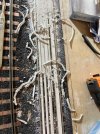
I let the DAS dry for around 48hrs and then looked at the best way to take it back down to rail level. It was still not totally dried so I did a little bit by carving it with a scalpel but it dragged a bit and left some rough bits. I have some foam sanding blocks and I had ago with one of these. I was surprised how well it worked. It sanded really well and although it took some time the rails were soon exposed.

IMG_4974.jpeg.a1126c86b3a17816d6fa0b1475d940fd.jpg

Once I got down to the rails, I then used a scalpel to clear the rail sections. As I said the DAS was not 100% dry and I think I had just timed it right for clearing the rails as it was still soft enough to come out of the gaps with no issues.

IMG_4975.jpeg.6b4ee7ac5d26f507312385df43570bcb.jpg

Once it was all cleaned up I was very pleased with the results.

IMG_4976.jpeg.a7a792e87786541cb4ce0e522000fd02.jpg

I was also pleased that I managed to do the section in the shop without messing up the block flooring, or covering all the fitted section with dust.

IMG_4982.jpeg

IMG_4981.jpeg

I am also please to say that I have tested the 2'6" and the standard gauge and both work.

The clicking you can hear in the video's is the throttle on the hand controller.

https://youtu.be/bI-7bWw2CB4

https://youtu.be/bI-7bWw2CB4

When the outer concrete section are added, I will be using some of the washes I use to just tone it down - the joints in the concrete will also be scratched in.

Now this is done, this is another item I can cross off the list. I can now finish and fit all the cobbles and the rest of the yard surfaces.

All in all, some good progress.


Andy
 
Last edited:
Top