Heljan BR class 02, conversion to S7

RichardG

Western Thunderer
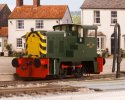
DSC_2954.jpeg
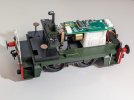
I managed to acquire £20 in discount vouchers from Heljan when I bought the class 45/0, and so I have bought this as something more suitable for any S7 layout I might build for myself. Yes, £130 for an 0 gauge loco - but there will be work here.
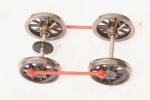
DSC_2952.jpeg
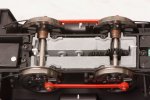
The model has a split chassis within an outer chassis.

The wheels are of plastic with metal hubs, the hubs being insulated from the axles. These hubs run in plain bearings machined into the inner chassis. There are strips of metal across the backs of the wheels (not visible here), to connect the hubs to the tyres.
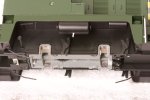
DSC_2950.jpeg
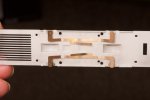
The keeper plate provides additional electrical connections from the hubs to the inner chassis.

I have never seen so much engineering achieve so little!

My first thoughts turn to making a new chassis and buying a set of Slater's wheels for it. Slater's do wheels for the 02, from the days of the DJH kit. Keep the Heljan side rods but not much else. This would be my first scratchbuilt chassis in 7mm.

Maybe there is a better way?
 

Rob R

Western Thunderer
Richard.
If you are half expecting to scratchbuild a chassis then you have nothing to lose in trying to modify what is already there.
Can't offer any advice as to how because I have not seen one in the flesh.
Rob
 

RichardG

Western Thunderer
If you are half expecting to scratchbuild a chassis then you have nothing to lose in trying to modify what is already there.

Well, I reckon the conversion can go one of two ways. Either re-profile the HJ wheels and pop them back onto their axles a bit further out; or buy Slater's wheels and put them into a completely new chassis.

If I begin with the Slater's option, I would have a chance of selling the original chassis as a going concern. This is I think all I would lose if I try to convert the factory wheelset and mess it up.

I could ponder the longevity of the factory wheels and indeed their bearings, but this isn't really dreadfully important given the kind of layouts the loco is likely to run on.
 

RichardG

Western Thunderer
2026-06-24 11.19.33.jpg
The model has been created around a large central casting which incorporates the running boards and hanging bars, and gives the model most of its weight. There is no clear-cut division between a "superstructure" and a "chassis".

2026-06-24 11.16.49.jpg
I have a feeling I could take this to pieces to let me make space to put in a completely new "under-chassis", but the process would be destructive and decidedly one-way.

I can see three approaches:

1) Reprofile the HJ wheels but leave them at their original widths.

2) Reprofile the HJ wheels, including reducing the tyre width to scale. This is a bit risky because I don't (yet) know how much spare metal there is to play with on the front and back of the tyre.

3) Strip the chassis to pieces, possibly mill out some of the large casting, and install something completely new using Slater's wheels and a commercial motor/gearbox in scratchbuilt frames. This would use the original side rods. It would let me have a rocking axle or even CSBs; and better wheels. This could triple the cost of the build if I try hard enough!

2026-06-24 11.32.39.jpg
4) If I really went to town with new underpinnings and installed battery-powered r/c, the existing access cover on the bonnet could hide a power switch and a charging socket. Battery power would need a very compact motor/gearbox if I was to shoehorn a PP3 battery in as well.

Fairly clearly, I could start with 1 or 2, and I could still try 3 if I wasn't completely satisfied. 4 would probably need a stack of phone or camera batteries to fit them inside the bonnet. Whatever I do, the conversion cannot be reversible.

I do feel, buying a RTR model with a view to altering it does sort out the parts of modelling I don't enjoy very much and am not very good at - like painting and putting on little transfers.
 

RichardG

Western Thunderer
There is an option 5.
Put it back together and move it on.

Well, the scale width of a loco driving wheel is 3.2 mm and the HJ ones measure 3.8 mm. If there isn't enough meat to slim down the HJ tyres, it is very difficult to justify the amount of work in option 3 to lose that 0.6 mm. I could still create a model which is S7 compatible if not quite compliant.

I risk feeling weary if I "move on", because this is my fourth attempt. There was a kit, for which I entrusted the wheel turning to a person who decided they couldn't be bothered. Kit and wheels sold. A Heljan 48DS, which seemed too simplistic to try and was returned for refund. A Bachmann Brassworks class 04, which seems too beautifully original to alter. And now this.

So move on to where? Perhaps a kit. The right wheels from Slater's and some broader frame spacers would make building a kit look more predictable. This takes me back to where I was a year ago.

The 02 is back together and running, but I need to sort out the rear buffer which fell off and the front step which was crooked and I pulled off. As evidenced in the photos in my last post.
 

Yorkshire Dave

Western Thunderer
Could you not look at reworking the chassis to accept Slaters axles and wheels using top hat bearings. It looks possible from the photo but I don't know what the dimensions are nor the clearance available for this. It would mean losing the split frame pickup and fabricating new wiper pick-ups.

It is also possible to make Slaters axles for use in split frames (these are links to a website I was part of).
Split axle pick-up in 0-gauge, Page 1
Split axle pick-up in 0-gauge, Page 2
Split axle pick-up in 0-gauge, Page 3
 

simond

Western Thunderer
I have used Steph’s radical solution (page 3) several times. It’s pretty easy if you have a lathe.

Do use glass fibre rod, not carbon fibre, which is conductive…. I think I got a few feet of the stuff (postage is expensive, so I asked them to cut it into lengths that fit an envelope - the lady on the phone said “but don’t you want it x feet long?” “No ta, 25mm is plenty…”

If you want a bit, let me know and I’ll see what I’ve got.
Simon
 

RichardG

Western Thunderer
DSC_2978.jpeg
The slots in the inner chassis accept the wheel bushes, and are 4.5 mm wide. This rules out putting Slater's axles directly into the factory chassis.

DSC_2979.jpeg
The wheels are of a design I have not seen before. The axles are a nominal 3mm diameter. They are serving only to hold the wheels to gauge and hold the final drive gear; they do not touch anything inside the chassis. The wheels have noticeable run-out (perhaps 2 thou concentrically and laterally) and looking at how they are made I can understand why.

DSC_2974.jpeg
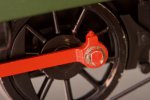
The side rod nearer to the camera in the previous photo was obviously bent.

I have straightened the side rod and the model runs better than ever. In fact it runs pretty well, and the run-out doesn't show on the track.
Unfortunately, the side rods seem to be made of a really soft metal. Certainly not steel. I think it would be stupid to build a new chassis which relied on these rods.

DSC_2980.jpeg
If the inner chassis is removed, there is enough space in the cosmetic frames to install Slater's wheels with their usual 3/16 inch axles.

So I am thinking, if I really want this loco to be ScaleSeven then I ought to be on the lookout for a workshop-grade DJH 02. These were marketed as a starter kit, so there ought to be a few out there which didn't work out. Salvage this for parts before proceeding.

I do like the look of a split chassis, especially for new builds. Thanks @Yorkshire Dave for posting the links :thumbs:
 

Bob Essex

Western Thunderer
Thank you for posting all these shots and info on the 02 Richard, it's very interesting.

Would the rods be mazak perhaps? That can be soft when in smaller section as it's not a hard material. The wheel/pick-up design seems to be a variation on the way Bachmann/Farish produced for a while their split-axle steam loco wheels although they were mazak castings then Nickel plated with a stub in which a bush exists to insulate the wheel from the axle. As you say a long way round to do so little. Beats me why they didn't just use back-scrapers as you would with Slaters etc. Split-axle/split chassis collection is useful so long as there is enough weight to ensure the axles maintain constant rolling contact in the bearings. If this isn't so then it can be less reliable than scrapers etc. This scenario in 2mm has led to the development of 'Simpson' springs (named after the originator) where fine wire bears down on the split axles to provide that constant current path. I feel it's at it's best when used for carry/tender wheels as additional collection rather than as the sole means.

Although I am quite happy with the O fine wheel profile originated by Slaters/Gibson ( it was much coarser before then) I do feel for those trying to convert such wheels to S7. I encounter much the same angst when trying to machine 4mm & N wheels for P4 and 2FS use.

Bob
 

Tim Humphreys ex Mudhen

Western Thunderer
Thank you for posting all these shots and info on the 02 Richard, it's very interesting.

Would the rods be mazak perhaps? That can be soft when in smaller section as it's not a hard material. The wheel/pick-up design seems to be a variation on the way Bachmann/Farish produced for a while their split-axle steam loco wheels although they were mazak castings then Nickel plated with a stub in which a bush exists to insulate the wheel from the axle. As you say a long way round to do so little. Beats me why they didn't just use back-scrapers as you would with Slaters etc. Split-axle/split chassis collection is useful so long as there is enough weight to ensure the axles maintain constant rolling contact in the bearings. If this isn't so then it can be less reliable than scrapers etc. This scenario in 2mm has led to the development of 'Simpson' springs (named after the originator) where fine wire bears down on the split axles to provide that constant current path. I feel it's at it's best when used for carry/tender wheels as additional collection rather than as the sole means.

Although I am quite happy with the O fine wheel profile originated by Slaters/Gibson ( it was much coarser before then) I do feel for those trying to convert such wheels to S7. I encounter much the same angst when trying to machine 4mm & N wheels for P4 and 2FS use.

Bob
Hi Bob,

On a positive note Slaters will now supply their driving wheels turned to S7 profile and with an S7 axle. There is, of course, a charge for this work on top of the price of wheels/axle. I have purchased a couple of set from them, very good quality and prompt service.

Tim
S7 626
 

richard carr

Western Thunderer
Richard

I know what my starting point would be, I'd take the wheels off the axles, take 0.25mm off the back of each of them, then reprofile the flange.
I would then put them back on the axles at the correct back to back for S7 and fit everything back together. It should work and probably looks pretty reasonable. If you don't like the result, then you won't have wasted too much time before you try an alternative that probably means making ither a new chassis or machining this one.
I don't think you can take anything off the front of the wheel as this will change the look too much.

Richard
 

RichardG

Western Thunderer
Would the rods be mazak perhaps? That can be soft when in smaller section as it's not a hard material.

DSC_2984.jpeg
I am sure the rods have been cast from something so Mazak looks likely.

I do wonder if the quest for realism has gone so far that basic engineering principles are dismissed in favour of extra detail. My Tri-ang Hornby steam loco (R659!) had steel side rods and so does the Hornby Terrier I turned into an E1 for H0. Still, I suppose longevity is hardly a concern on a shunting plank. The marks on the paint are from me taking the rod off and putting it back.

Richard,

Probably not what you want, as it's not a basket case but if all else fails you can still buy the 02 Diesel Shunter starter kit, new from The Tower Collection Blackpool
To be honest Rob, I think the Heljan is a better model on the basis of its general proportions and some particularly good detailing like the cab glazing. And parts of the paint job like the wasp stripes are far better than I could manage. The Tower model would seem like a step backwards, even if it has better underpinnings.

I know what my starting point would be, I'd take the wheels off the axles, take 0.25mm off the back of each of them, then reprofile the flange.
Yes Richard this sounds like a sensible approach.

Since I flattened out the curvy side rod, the loco really is running very well (apart from shaking about 1 mm side to side at the cab end). I want to take it to NEEGOG (0-F) next month so I do at least share it with others before starting work.

It does occur to me that, while a rocking axle would assure better electrical pickup, a DCC installation with a stay-alive will work nearly as well. Now, I am not a fan of DCC but the ScaleSeven community seems to have adopted this as a de facto standard. When the time comes, the model needs to be DCC to run on these layouts. This gives me an argument in favour of keeping the rigid chassis on the 02.
 

Dog Star

Western Thunderer
Richard,

There is always an imagined need for colliery locos when Scrufts goes out to play so your 02 is sure of a welcome... as will you.
 

Eastsidepilot

Western Thunderer
Mayzak or some similar alloy :shit:is used a lot on these Chinese models even the bodies are. But that's what you pay for !
Sow's ears and silk purses come to mind.
 

RichardG

Western Thunderer
Mayzak or some similar alloy :shit:is used a lot on these Chinese models even the bodies are. But that's what you pay for !
Sow's ears and silk purses come to mind.

I think we are really very lucky. We can make out own side rods if we need to; and if one of these Heljan ones should fail then the other one will give me a drilling template. We can build a scale chassis and combine it with excellent body mouldings. We can choose the granularity as it were of the parts we use to make our models. We can share first-hand knowledge here, and make informed decisions.

And we don't get what we don't pay for. I volunteer in a charity shop and one thought always comes to mind when a customer tries to complain about the £3 top they could buy in M&S for £30. No-one is holding a gun against their head forcing them to buy it. I nearly actually said this to a persistent non-customer a few weeks ago, but hastily remembered they were already demonstrating a sincere lack of logical reasoning and it wasn't going to help :))
 

Ian@StEnochs

Western Thunderer
View attachment 267016

It does occur to me that, while a rocking axle would assure better electrical pickup, a DCC installation with a stay-alive will work nearly as well. Now, I am not a fan of DCC but the ScaleSeven community seems to have adopted this as a de facto standard. When the time comes, the model needs to be DCC to run on these layouts. This gives me an argument in favour of keeping the rigid chassis on the 02.

All my S7 stuff still runs DC and I have no plans to downgrade!
 

Bob Essex

Western Thunderer
Hi Bob,

On a positive note Slaters will now supply their driving wheels turned to S7 profile and with an S7 axle. There is, of course, a charge for this work on top of the price of wheels/axle. I have purchased a couple of set from them, very good quality and prompt service.

Tim
S7 626

Thanks Tim that's good to know, but I decided way back when you and the late Nigel Read started down the S7 route that I would stick with finescale and for the little amount of 7mm modelling I do these days it suits me fine. However I do admire all the nice S7 stuff that gets made and if I had ever had the space I'm sure I would have gone down that route eventually.
It does occur to me that, while a rocking axle would assure better electrical pickup, a DCC installation with a stay-alive will work nearly as well. Now, I am not a fan of DCC but the ScaleSeven community seems to have adopted this as a de facto standard. When the time comes, the model needs to be DCC to run on these layouts. This gives me an argument in favour of keeping the rigid chassis on the 02.

In my experience adding stay-alive can often seem like night and day in the difference it makes to many locos with regard to reliable running quality. Do I spot that the PCB is 21pin with a 470uf capacitor already in place for when a decoder is added? Again I find Zimo is best in this respect for the way they can be programmed with one in circuit quite besides the motor control which is way better than all other current decoder makes.

Bob
 
Top